Basilica of Santa Maria del Mar
The People's Cathedral, raised stone by stone by dockworkers
Understand sacred places, explore living traditions, and learn how to engage respectfully with Pilgrim Map.
Access has not been verified. Check current local guidance before planning a visit.
Barcelona, Barcelona, Spain
Read the sources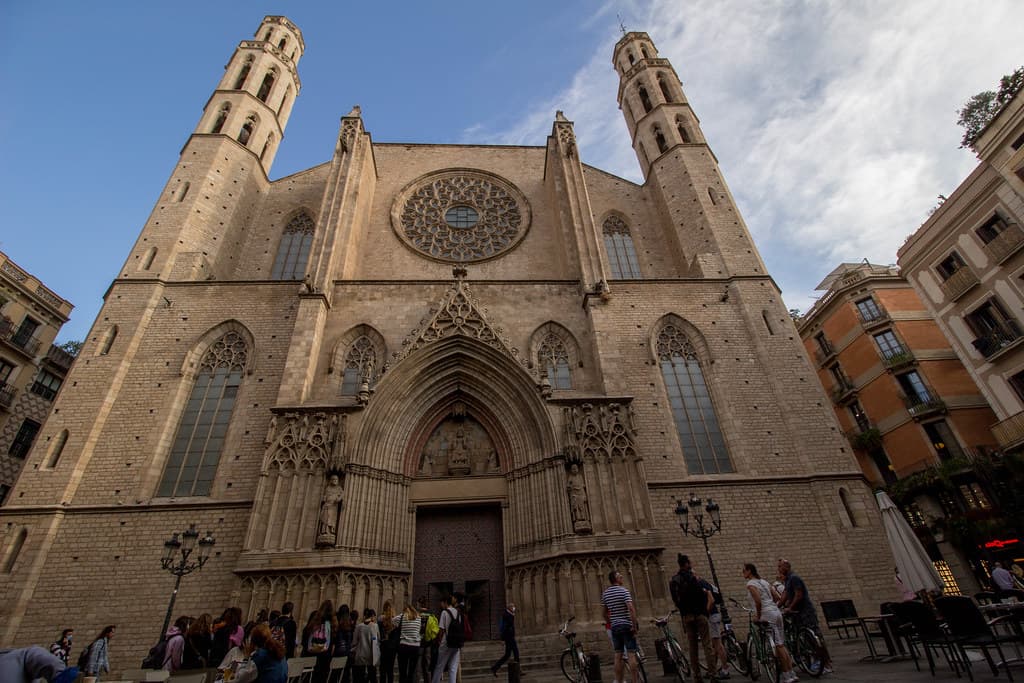
Image of Basilica of Santa Maria del Mar. Image source
Visit essentials
A quick read before you go
- Duration
- A basic visit to the nave and interior can be done in 30-45 minutes; a thorough visit including…
- Access
- The basilica stands in the Born/Ribera district of central Barcelona, on Plaça de Santa Maria, a…
Overview
Santa Maria del Mar brings plain grandeur to Barcelona's old maritime quarter. Unlike ornament layered across generations in major French or English Gothic churches, it rose in one unbroken fifty-four-year campaign, financed and physically built by Ribera merchants, fishermen, and dockworkers. The bastaixos—porters unloading ships and hauling goods—are remembered for volunteering to carry foundation stones from Montjuïc quarry on their backs, a devotion commemorated in reliefs on the doors.
That origin gives Santa Maria its popular name, the People's Cathedral, and its wide-set columns, tall clerestory windows, and uncluttered nave filled with Mediterranean light. Dedicated to the Virgin Mary as protector of sailors and fishermen from the sea's dangers, it has served as parish church for nearly seven centuries. It survived an earthquake, the catastrophic 1936 fire, and pressure as one of Barcelona's most visited monuments while continuing Mass, confession, and the Born's devotional life.
Why this place is sacred
What draws people into Santa Maria del Mar and holds them there is not a miracle story but a spatial one. The nave's columns stand nearly thirteen meters apart — an unusually wide span for Gothic construction — which does away with the forest-of-pillars effect common to French and English cathedrals and instead opens the interior into a single unified volume.
Tall clerestory windows admit daylight directly into that volume, and the 1936 fire, for all its destruction, stripped away centuries of Baroque additions and left the stone largely bare, restoring something closer to the fourteenth-century builders' original austerity.
Visitors and architectural historians alike describe the resulting sense of scale and luminosity as almost maritime — some liken standing inside the nave to being inside the hull of an overturned ship, an image that resonates given the building's dedication to sailors and its construction by the guild of the sea.
Where other sacred sites derive their charge from a site of apparition or an relic's presence, this basilica's thinness is bound up with labor and light: a building whose sanctity was earned communally, stone by carried stone, and whose interior geometry seems designed to make that communal devotion visible in the play of daylight across unornamented surfaces.
The basilica was conceived from its foundation as a parish church for the Ribera district's maritime trades — a place where sailors, fishermen, and merchants could seek Mary's protection before voyages and give thanks for safe return, distinct from the seat of the bishop at Barcelona Cathedral a few streets away.
Structurally complete by 1383 and formally consecrated in 1384, the church required no further major building campaigns, which is itself unusual for Gothic architecture; later centuries added Baroque furnishings and altarpieces that softened its original austerity, until the 1936 Spanish Civil War fire destroyed most of that later ornamentation, leaving the stone shell exposed in a form scholars now regard as closer to the founders' original vision than what stood immediately before the fire.
Experience and orientation
The approach runs through the narrow streets of El Born, past tapas bars and boutiques, until the plaça opens and the basilica's western façade appears — comparatively plain, its details concentrated around the main portal where the bastaixos are carved bearing their stones. Inside, the shift is immediate: the crowd noise of the Born falls away, and the eye adjusts to a nave that reads as taller and wider than its footprint suggests, thanks to the column spacing described elsewhere.
Visitors consistently note how different this feels from the Barcelona Cathedral a few minutes' walk away — where that building layers gilt chapels and dim side-aisles, Santa Maria del Mar offers a single legible volume lit by its clerestory windows and, on clear days, colored by light through the rebuilt rose window.
Many report a contemplative or emotional response disproportionate to the building's relative plainness, and readers of Ildefonso Falcones' novel about the basilica's construction often describe visiting with a heightened awareness of the bastaixos underfoot, so to speak, in the stones themselves.
For those with time and a ticket, the rooftop terrace tour extends the experience outward: a close vantage on the flying buttresses that carry the nave's load, and a view across the tiled roofs of the Born and Ribera that makes the church's relationship to its old maritime neighborhood legible in a way the ground-level nave cannot.
Most visitors move from the main west portal down the nave toward the apse, pause near the choir to take in the column spacing and rose window, then loop toward the side chapels for candles or quiet prayer before descending to the crypt or ascending to the roof terrace if ticketed for those areas.
Context and lineage
King Alfonso IV of Aragon laid the foundation stone on 25 March 1329, but the construction that followed was overwhelmingly a project of the Ribera district's working population rather than crown or clergy.
Popular tradition holds that the bastaixos — the guild of dockworkers who unloaded ships and portered goods through Barcelona's streets — volunteered to carry the quarried stone blocks from Montjuïc to the building site on their own backs, unpaid, as an act of piety toward the Virgin Mary they credited with protecting them and their livelihoods at sea.
That labor is commemorated in relief carvings on the church's doors and became the emotional center of Ildefonso Falcones' 2006 novel "La catedral del mar," which follows a serf-turned-guildsman, Arnau Estanyol, through the decades of construction, and which was adapted into a 2018 television series.
Historians note that the precise ratio of true volunteer labor to ordinary paid guild work is difficult to verify against the more romanticized popular version of the story, but the broader fact of grassroots, guild-financed construction — funded by merchants, sailors, and fishermen rather than a noble patron — is well documented and is what earned the building its lasting nickname, the People's Cathedral.
The basilica sits within the Archdiocese of Barcelona as an active parish church, and its devotional lineage runs through the maritime guilds of the medieval Ribera district — sailors, fishermen, and merchants who financed and used the building — down to today's parish community.
Several canonized saints associated with Barcelona's religious life, including Ignatius of Loyola, Francis Borgia, Vincent Ferrer, Joseph Oriol, and Anthony Mary Claret, are recorded by the parish as having worshipped within its walls, though the basilica functions as a devotional and civic landmark rather than a stop on any named historic pilgrimage route.
Berenguer de Montagut
Master builder / original architect
The master builder credited with the basilica's initial design and construction from 1329, establishing the wide column spacing and horizontal emphasis that architectural historians regard as the signature of mature Catalan Gothic.
Ramon Despuig
Master builder / continuing architect
Continued Montagut's design through to structural completion in 1383, maintaining stylistic coherence across a fifty-four-year build — unusual for a period when large churches typically evolved across successive, stylistically distinct campaigns.
King Alfonso IV of Aragon
Royal founder
Laid the foundation stone on 25 March 1329, giving the project royal sanction even as its financing and labor came overwhelmingly from the parish and its guilds rather than the crown.
The Bastaixos
Dockworkers' guild; traditional builders
The guild of Barcelona porters and dockworkers remembered for volunteering unpaid labor to haul foundation stone from the Montjuïc quarry, commemorated in door reliefs and central to the basilica's identity as a church built by common people rather than nobility or clergy.
Ildefonso Falcones
Novelist
Author of the 2006 novel "La catedral del mar" (Cathedral of the Sea), which dramatized the basilica's construction through the fictional guildsman Arnau Estanyol and brought international attention to the bastaixos legend, later adapted into a 2018 television series.
Traditions and practice
Historically, sailors, fishermen, and merchant families of the Ribera came to the basilica to seek the Virgin Mary's protection before setting out to sea and to give thanks on safe return — a devotion reflected directly in the dedication "del Mar." Guild processions and feast-day observances tied to the maritime trades marked the liturgical calendar, and the volunteer labor of the bastaixos during construction is itself remembered as a devotional act rather than mere physical work.
Today the basilica functions as a full parish, holding regular Catholic Mass and administering sacraments to a resident congregation alongside its heavy visitor traffic. It plays a ceremonial role in La Mercè, Barcelona's largest annual festival (23-27 September), as the departure point for the processional giant figures of King Solomon and the Queen of Sheba, linking the church to the city's broader civic and folkloric calendar.
Each spring, an early-music concert series organized with Barcelona's Auditori makes use of the nave's celebrated acoustics for organ, choral, and period-instrument performance, drawing the building's medieval devotional purpose into ongoing musical life.
Visitors are welcome to attend a public Mass to experience the space as it is used rather than only viewed, or to light a votive candle at one of the designated side chapels as a simple act of quiet reflection.
Arriving on a weekday morning, before tour groups build, allows the nave's light and silence to register more fully; those with time can pair a visit with the rooftop terrace tour to see the flying buttresses that carry the load of the wide-span nave from the outside.
Roman Catholic Marian devotion (Our Lady of the Sea)
ActiveThe basilica is dedicated to the Virgin Mary as protector of the sea, reflecting the medieval Ribera district's economic and spiritual dependence on maritime trade, fishing, and shipbuilding; the "del Mar" designation marks Mary's role as patroness of sailors and fishermen against the perils of Mediterranean voyages.
Regular Mass and sacraments as an active parish; Marian prayer and devotion; historical veneration by sailors, fishermen, and merchants seeking protection before voyages.
Guild and community-built sacred architecture (bastaixos devotion)
HistoricalUnlike most great Gothic churches funded by nobility or clergy, Santa Maria del Mar was built and financed largely by the common people of the Ribera district, especially the bastaixos dockworkers who volunteered to haul stone from the Montjuïc quarry as an act of piety — a grassroots origin central to its identity as the People's Cathedral.
Historically, unpaid guild labor offered as devotion, alongside community fundraising and construction sponsorship by merchant and artisan guilds.
Civic and cultural festival participation (La Mercè)
ActiveThe basilica plays a ceremonial role in Barcelona's largest annual festival, La Mercè (late September), with the traditional giant processional figures of King Solomon and the Queen of Sheba departing from the church, linking it to the city's wider civic and folkloric identity.
Serving as the departure point for the Gegants processional figures during La Mercè; participation in the wider festival atmosphere of correfoc, human towers, and cavalcade.
Sacred music and early-music performance
ActiveThe basilica's exceptional acoustics and Gothic architecture make it a venue for an annual early-music concert series held jointly with Santa Maria del Pi and organized by Barcelona's Auditori, connecting the space's medieval devotional purpose to ongoing musical and cultural life.
Annual spring early-music concerts featuring organ, choral, and period-instrument performance.
Perspectives and open questions
Santa Maria del Mar is read differently depending on the lens brought to it: as a textbook case of architectural purity by historians, as a monument to collective working-class piety in Catalan popular memory, and as a backdrop for historical romance in its more recent literary afterlife. None of these readings requires displacing the others.
Scholarly perspective
Architectural historians regard the basilica as the paradigmatic example of mature Catalan Gothic, distinguished from French and other European Gothic traditions by its horizontal emphasis, unusually wide column spacing, minimal ornamentation, and — rare for a large medieval church — a single, stylistically coherent construction campaign carried out under two successive master builders, Berenguer de Montagut and Ramon Despuig, between 1329 and 1383/84.
Living and traditional perspectives
In Catalan popular memory, the relevant tradition is not a pre-Christian or indigenous one but the enduring civic narrative of a cathedral built "by the people, for the people" — centered on the bastaixos legend of unpaid stone-hauling and enshrined in local identity, civic pride, and the door reliefs that still depict the dockworkers at their labor.
Alternative interpretations
No significant esoteric, occult, or alternative-spirituality tradition is documented for this site. Its broader cultural resonance beyond Catholic devotion comes primarily from historical-fiction romanticization, chiefly through Ildefonso Falcones' novel and its television adaptation, rather than from any esoteric lineage or alternative spiritual framework.
Open questions
The exact original imagery of the basilica's first rose window, destroyed in the 1428 earthquake, and the precise design intentions behind its 1459 Flamboyant-Gothic replacement are not fully documented in available sources. Historians also continue to debate the true proportion of volunteer bastaixos labor versus ordinary paid guild work in the historical construction record, as distinct from the more romanticized version that has become popular tradition.
Plan your visit
Access and arrival
The basilica stands in the Born/Ribera district of central Barcelona, on Plaça de Santa Maria, a short walk from Barcelona Cathedral, the Picasso Museum, and El Born Centre de Cultura i Memòria. It is reachable via the Jaume I metro station (L4, yellow line) and is wheelchair accessible at ground level, though the crypt and tower access involve stairs.
Opening hours for paid visiting (crypt, towers, roof terraces) run approximately 9:00-13:00 and 17:00-20:30 on weekdays with narrower Sunday hours around 10:00-14:00 and 17:00-20:00; these fluctuate by source and season, and the official parish website should be checked before visiting. Admission pricing also varies between sources, with some third-party guides citing tiered €5/€10 pricing and the official site citing a flat rate around €8 covering interior, crypt, and towers — treat exact figures as approximate.
No accommodations information was available at time of writing; the Born/Ribera and Gothic Quarter neighborhoods surrounding the basilica offer dense, walkable lodging options, and visitors should check current listings for options near Jaume I metro station.
Respectful visit
Modest dress is requested: shoulders and knees should be covered, and beachwear or swimwear is not permitted, in line with etiquette at other active churches across Barcelona.
Photography without flash is generally permitted for personal use within the nave, but visitors are asked to avoid photography that disrupts services or fellow worshippers; tripods and commercial photography typically require prior permission from the parish.
Votive candles can be lit at designated side altars and chapels, and monetary donations are welcomed to support the parish's ongoing work and the building's conservation.
Silence and respectful conduct are expected at all times, with heightened attention during Mass and liturgical activity; some chapels, the crypt, and the roof terraces are accessible only during ticketed hours, and visitors present during active services should avoid entering the presbytery or any roped-off worship areas.
The basilica is a working church, not a museum, and liturgical hours take precedence over sightseeing; visitors should expect certain chapels, the crypt, and the roof terraces to be closed or restricted during Mass and other services, and should avoid treating the building purely as a backdrop for the historical-fiction romance attached to it via Falcones' novel — the bastaixos legend is popular memory as much as documented fact, and historians caution against overstating the precise share of volunteer versus paid labor in the historical record.
Location
Map loads as you approach this section.
Pilgrim reflections
A portrait of encounter, not a score
Pilgrims describe what they felt, how present they could become, and whether the place would shape a journey. There are no stars and no ranking of traditions.
No reviewed reflections yet
The first pilgrims can help describe the character of being here.
Share a reflection
Available after an account-backed “Been there.” Every reflection is reviewed before publication.
Nearby sacred places
Explore other sacred places in the region. Proximity does not establish access or travel time; check each place’s guidance.


References
Sources consulted for this page. Source categories describe the publication, not a guarantee that every claim is verified. Traditional accounts and outside interpretations may differ.
- 01Santa Maria del Mar, Barcelona — Wikipedia — Wikipedia contributorsSource contextCore historical and architectural facts: construction 1329-1384, architects Berenguer de Montagut and Ramon Despuig, 1428 earthquake damage to rose window, 1936 Civil War fire, FC Barcelona stained-glass donation.
- 02Opening Hours and Admission Fees — Basílica de Santa Maria del Mar — Basílica de Santa Maria del Mar (parish)officialOfficial parish site; current hours and ticket pricing, request for respectful visitor conduct during liturgical activity.
- 03The Church — Basílica de Santa Maria del Mar — Basílica de Santa Maria del Mar (parish)officialOfficial parish framing of the basilica as an active place of worship welcoming visitors as pilgrims; references saints who worshipped there (Ignatius of Loyola, Francis Borgia, Vincent Ferrer, Joseph Oriol, Anthony Mary Claret).
- 04Basílica de Santa Maria del Mar — Barcelona Turisme (Barcelona City Tourism Board)officialMunicipal tourism authority overview of the basilica's history and civic status.
- 05Music in churches — Barcelona TurismeofficialConfirms annual early-music concert series (spring, organized with Auditori de Barcelona) held inside Santa Maria del Mar and Santa Maria del Pi.
- 06La Mercè 2025 / Festes de la Mercè — Barcelona City CouncilofficialConfirms La Mercè festival dates (23-27 September) and that the Solomon and Queen of Sheba giants processional figures depart from Santa Maria del Mar.
- 07Tours of Santa Maria del Mar — Barcelona City Council (Guia Barcelona)officialMunicipal listing describing guided visits, rooftop terrace access.
- 08The Basilica of Santa María del Mar, the "Cathedral of the People" — BCN MàgicaSource contextDetail on grassroots/guild financing, bastaixos labor, and Marian dedication as protector of the sea.
- 09Cathedral of the Sea — Wikipedia (entry on Ildefonso Falcones' novel) — Wikipedia contributorsSource contextConfirms the 2006 novel "La catedral del mar" by Ildefonso Falcones dramatizes the basilica's construction (1329-1384) through the story of Arnau Estanyol; adapted into a 2018 Antena 3/Netflix TV series.
- 10Bare Bones: Santa Maria del Mar — Barcelona MetropolitanSource contextEnglish-language expat magazine feature on architectural history and the 1936 fire.
Share a photo
Help visitors recognize Basilica of Santa Maria del Mar. Every submission is reviewed before publication.