Basilica of Saint Michael the Archangel, Marijampole
Lithuania's shrine of endurance, where a city named for Mary guards the tomb of its blessed son
Understand sacred places, explore living traditions, and learn how to engage respectfully with Pilgrim Map.
Access has not been verified. Check current local guidance before planning a visit.
Marijampolė, Marijampolė, Lithuania
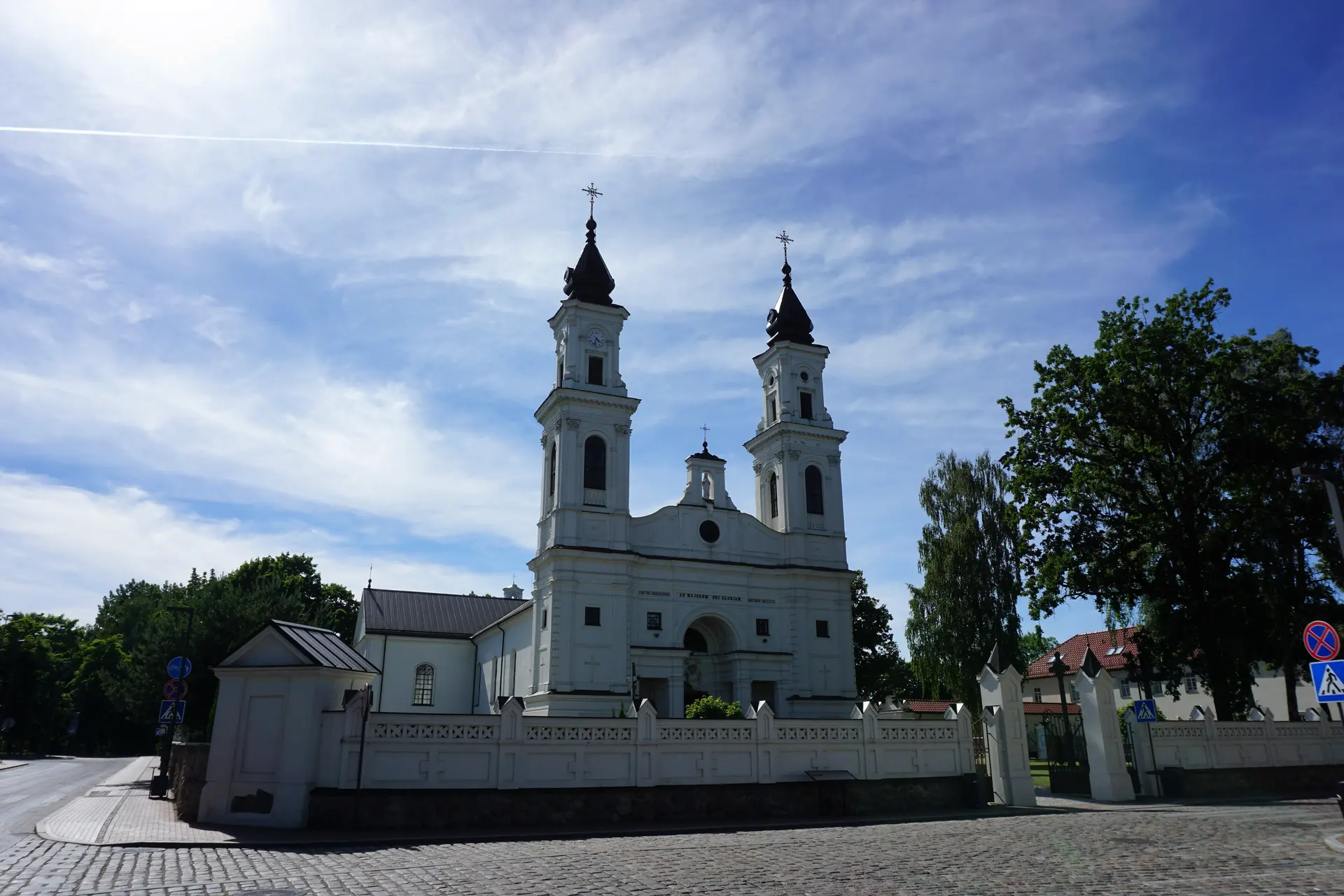
Image of Basilica of Saint Michael the Archangel, Marijampole. Image source · CC-BY-SA-4.0
Visit essentials
A quick read before you go
- Duration
- 1-2 hours for the basilica, chapel, and monastery grounds.
- Access
- Located in the centre of Marijampolė, the largest city in southern Lithuania.
Overview
In 1750 Countess Franciszka Buttlerowa invited the Marian Fathers to her lands and built them a wooden monastery and church. The surrounding town became Marijampolė, `Mary's City`, with the monastery shaping its identity for generations.
When Russian Imperial authorities closed Marian monasteries across their territories, this house alone survived as the order's last stronghold. After Lithuanian independence in 1918, it grew to more than one hundred monks and a library of about fifty thousand volumes.
Its deepest significance centers on Jurgis Matulaitis, born nearby in 1871, later Archbishop of Vilnius and renovator of the Marian Fathers. He navigated Polish-Lithuanian politics with diplomatic skill and mystic detachment. Orphaned young and physically frail, his diary records an unwavering belief that goodness could overcome evil. He died of appendicitis in 1927, aged fifty-five.
His remains came to the basilica in 1934. Pope John Paul II beatified him in 1987, the only modern Lithuanian raised to the altars. The straightforward Chapel of Blessed Jurgis Matulaitis invites reflection on endurance and engagement rather than ecstasy or escape. His motto remains: `Vince malum in bono`.
Why this place is sacred
Some sacred places derive their power from beauty or antiquity. This one draws from something harder to name: the accumulated weight of perseverance. The Marian Fathers survived here when every other house of their order was closed. Lithuanian Catholics worshipped here when the state demanded otherwise. Blessed Jurgis endured orphanhood, illness, political hostility, and ecclesiastical suspicion, transforming each trial into deeper service.
The Chapel of Blessed Jurgis Matulaitis communicates this quality without ornament. Visitors describe a space that encourages honesty rather than consolation — a place where one's own struggles find company in the story of a man who refused to let suffering diminish his capacity for good. The relics beneath the altar are not abstract symbols; they are the physical remains of someone who walked these grounds and chose, repeatedly, to respond to hatred with love.
The churchyard adds another layer. Among the graves of Marian monks lie participants in the 1831 uprising against Russian rule. Sacred and national resistance intertwine here as they do throughout Lithuanian history, making the distinction between spiritual and political endurance difficult to draw — and perhaps unnecessary.
Outside, the town itself bears the monastery's imprint. Every street radiates from this center, and the name on every map — Mary's City — keeps that founding act of devotion present nearly three centuries on.
Wooden chapel built c. 1717 by Morkus Antanas Butleris; Marian Fathers monastery founded 1750 to serve the local Catholic community
From wooden chapel (1717) through monastery foundation (1750) to stone church (consecrated 1824). Expanded 1863, towers added 1882, chapels added 1914. Designated pro-cathedral 1989, elevated to minor basilica 1992. Transfer of Blessed Jurgis's remains in 1934 transformed the church into a pilgrimage destination.
Experience and orientation
The basilica stands at the center of Marijampolė, its twin towers visible from the approach roads into the city. The neo-baroque facade, with its Latin Cross ground plan, projects institutional confidence — this was a monastery church built to anchor a community.
Inside, the scale shifts. The nave leads toward the main altar, but most pilgrims are drawn to the Chapel of Blessed Jurgis Matulaitis, later adapted to house his tomb. The chapel's straightforward design is deliberate: no overwhelming ornamentation, no theatrical lighting effects. Instead, the space offers something closer to a conversation — between the visitor and the man whose remains rest beneath the altar, between present difficulty and the possibility of responding with goodness.
Spend time reading the inscriptions. Blessed Jurgis's motto, Vince malum in bono, appears in multiple places, and the words continue to resonate with visitors facing their own adversities.
The monastery complex adjacent to the basilica repays exploration. The courtyard preserves the scale of monastic life, and the sense that this was once a self-contained world of prayer, study, and service remains palpable. The churchyard, with its graves of monks and uprising participants, offers a different kind of contemplation — the quieter communion with those who came before.
For those with additional time, the Museum of Blessed Jurgis Matulaitis, housed in a separate building, provides context through personal artifacts and documents. The chapel at his birthplace in Lūginė, a short drive from the city, holds Friday Mass and offers a more intimate encounter with his origins.
Come with whatever weighs on you. This is a place that understands difficulty and offers not escape but the companionship of someone who faced worse with grace.
Context and lineage
In 1750, Countess Franciszka Buttlerowa invited the Marian Fathers to her lands and built them a wooden monastery and church. The settlement that grew around this foundation was named Marijampolė — Mary's City. The original wooden chapel was replaced by a stone church consecrated in 1824, which was subsequently expanded in 1863 with towers added in 1882 and chapels in 1914.
The basilica continues the tradition of the Congregation of Marian Fathers of the Immaculate Conception, founded in 1673. During Russian Imperial suppression, the Marijampolė monastery was the order's only surviving house, making it the living root from which the entire congregation was later restored.
Countess Franciszka Buttlerowa
Founder who invited the Marian Fathers and donated land for the monastery in 1750
Mykolas Pietaris
Marian Father who oversaw the construction of the stone church (1763-1850)
Blessed Jurgis Matulaitis (1871-1927)
Archbishop of Vilnius, renovator of the Marian Fathers, beatified 1987. His remains rest in the basilica.
Pope John Paul II
Beatified Jurgis Matulaitis in 1987 and established the Pilgrim Way that includes this basilica
Traditions and practice
Monthly commemorative Mass on the 12th of each month at midday in the Chapel of Blessed Jurgis Matulaitis. Novena prayers for the sick through the intercession of Blessed Jurgis. Annual solemn celebrations commemorating his beatification in late June or July.
Regular parish Masses, pilgrimage devotions at the tomb, participation in the John Paul II Pilgrim Way. A chapel at Blessed Jurgis's native village of Lūginė holds Friday Mass, offering a supplementary pilgrimage station.
Attend the monthly 12th-day Mass if your visit coincides. Otherwise, spend unhurried time in the Chapel of Blessed Jurgis Matulaitis. Read his motto inscribed there and consider what 'overcoming evil with good' means in your own circumstances. Walk the monastery grounds and visit the churchyard where monks and freedom fighters share the same soil.
Roman Catholicism — Marian Fathers
ActiveThe basilica was built by the Congregation of Marian Fathers of the Immaculate Conception, who were invited to the area in 1750 by Countess Franciszka Buttlerowa. The Marian Fathers gave the town its name — Marijampolė (Mary's City). During Russian Imperial rule, this was the only Marian monastery not closed by tsarist authorities, making it the order's last stronghold. After Lithuanian independence in 1918, the monastery housed over 100 monks and one of the country's largest libraries with approximately 50,000 books.
Regular parish Masses, monthly commemorative Mass on the 12th of each month, annual beatification celebrations in July, novena prayers for the sick invoking Blessed Jurgis's intercession, pilgrimage to his tomb.
Veneration of Blessed Jurgis Matulaitis
ActiveBlessed Jurgis Matulaitis (1871-1927), Archbishop of Vilnius and renovator of the Marian Fathers, was beatified by Pope John Paul II on June 28, 1987 — the only modern Lithuanian raised to the altars. His remains were transferred to the basilica in 1934 and rest in a specially constructed altar in the Chapel of Blessed Jurgis Matulaitis. His motto 'Overcome evil with good' has become a guiding principle for Lithuanian Catholics.
Pilgrimage to the tomb and relics, praying the novena for the sick through his intercession, reading and meditating on his spiritual diary, monthly commemorative Mass on the 12th of each month.
Perspectives and open questions
The basilica can be approached as a pilgrimage shrine, a monument to Catholic endurance through persecution, or a meditation on what it means to overcome evil with good.
Scholarly perspective
Historians regard the basilica and its monastery as central to the development of Marijampolė as a town and to the survival of the Marian Fathers during periods of suppression. The building is classified as a neo-baroque monument of regional significance. Blessed Jurgis Matulaitis is studied as a key figure in Lithuanian Catholic history, particularly for his ecumenical diplomacy as Archbishop of Vilnius during the Polish-Lithuanian tensions of the 1920s.
Living and traditional perspectives
For Lithuanian Catholics, the basilica is the national shrine of their only modern blessed. Blessed Jurgis's remains are venerated as relics, and his intercession is sought particularly by the sick and those facing adversity. His motto has become a guiding principle across Lithuanian Catholic life.
Open questions
The cause of canonization for Blessed Jurgis Matulaitis remains open. He was beatified in 1987 but has not yet been canonized. Whether and when a second miracle may be recognized for his canonization remains an open question for the faithful.
Plan your visit
Access and arrival
Located in the centre of Marijampolė, the largest city in southern Lithuania. Accessible by bus from Kaunas (approximately 60 km, 1 hour) and Vilnius (approximately 170 km, 2.5 hours). The city has good road connections. Mobile phone signal is reliable in the city center. No specific opening hours were confirmed in available sources — the basilica is likely open during standard church hours.
Marijampolė offers a range of accommodation as the largest city in southern Lithuania. Hotels and guesthouses available in the city center within walking distance of the basilica.
Respectful visit
Modest dress appropriate for a Catholic basilica — shoulders and knees covered.
Photography is generally permitted outside of services. Respectful photography around the tomb chapel is expected. Avoid flash.
Candle lighting and donations are customary.
Respectful behavior during services. Quiet in the Chapel of Blessed Jurgis Matulaitis.
The basilica is an active parish church. Services occur throughout the day, and the chapel may be in liturgical use during your visit. The Museum of Blessed Jurgis Matulaitis is in a separate building with its own hours — confirm availability before planning your visit.
Current practical details
Address
Bažnyčios g. 3, 68309 Marijampolė, Lithuania
Phone
Hours
Hours, fees, and access can change — verify on the official source before you travel. Practical details last checked Jun 2026.
Location
Map loads as you approach this section.
Pilgrim reflections
A portrait of encounter, not a score
Pilgrims describe what they felt, how present they could become, and whether the place would shape a journey. There are no stars and no ranking of traditions.
No reviewed reflections yet
The first pilgrims can help describe the character of being here.
Share a reflection
Available after an account-backed “Been there.” Every reflection is reviewed before publication.
Nearby sacred places
Explore other sacred places in the region. Proximity does not establish access or travel time; check each place’s guidance.

Chapel of Blessed Jurgis Matulaitis, Lūginė
Lūginė, Lūginė, Marijampolė Municipality, Lithuania
5.7 km away

Church of the Assumption of the Virgin Mary, Alksnenai
Stirnėnai, Vilkaviškis, Lithuania
23.3 km away

Church of St Anne, Lazdijai
Lazdijai, Lazdijai, Lazdijai District Municipality, Lithuania
37.2 km away

Church of the Transfiguration of Jesus Christ, Meteliai
Meteliai, Meteliai, Lazdijai District Municipality, Lithuania
38.2 km away
Photo gallery
3 curated photos
Share a photo
Help visitors recognize Basilica of Saint Michael the Archangel, Marijampole. Every submission is reviewed before publication.