Basilica of Our Lady of San Juan del Valle, San Juan, Texas
Where a statue survived flames and a million pilgrims come seeking healing
Understand sacred places, explore living traditions, and learn how to engage respectfully with Pilgrim Map.
Access has not been verified. Check current local guidance before planning a visit.
San Juan, Texas, United States
Read the sources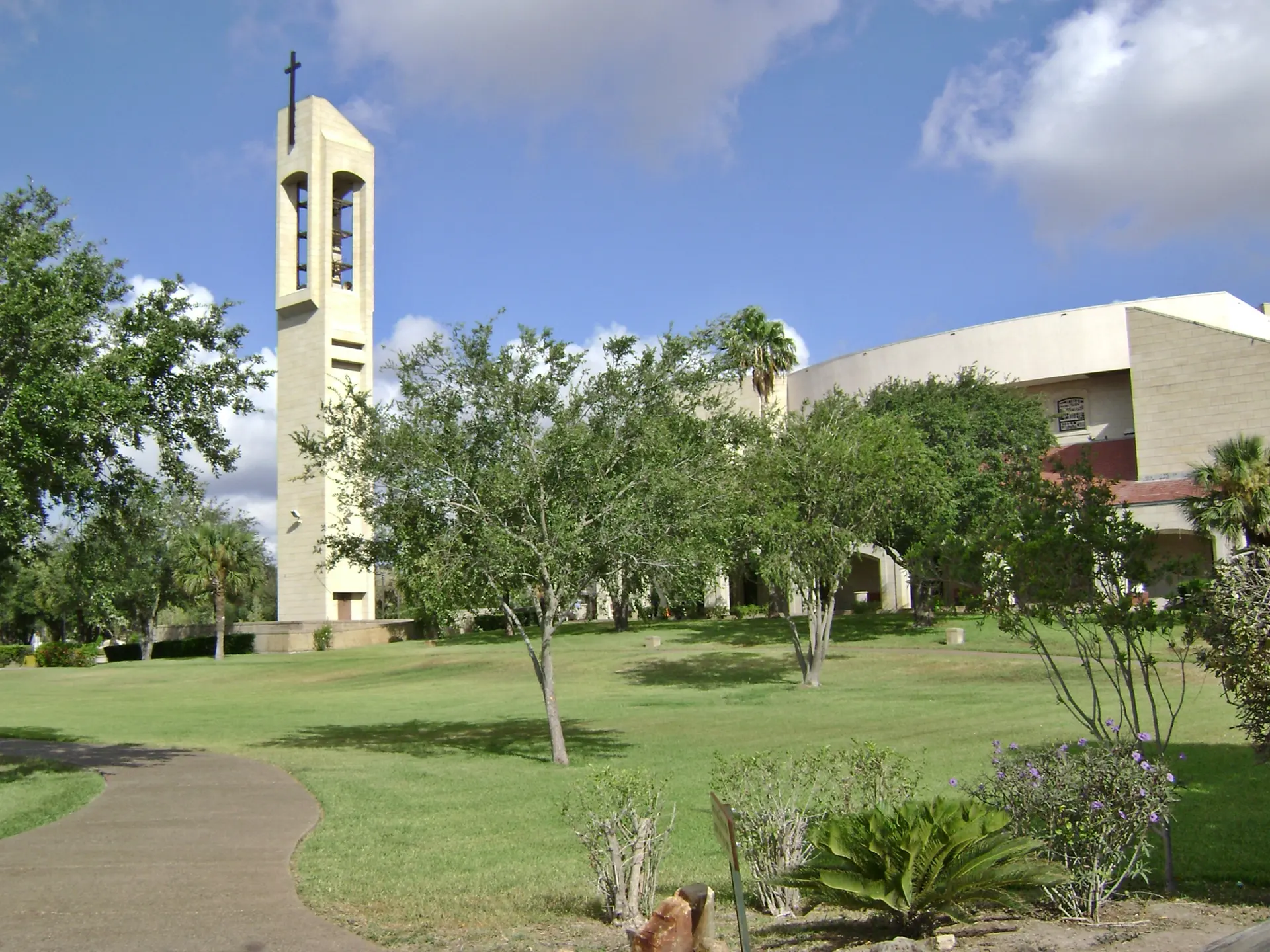
Image of Basilica of Our Lady of San Juan del Valle, San Juan, Texas. Image source · Public Domain
Visit essentials
A quick read before you go
- Duration
- 3-4 hours permits attendance at Mass, walking the full Stations of the Cross, time in the Room…
- Etiquette
- Modest attire is required—men should wear long pants, women should avoid shorts, spaghetti…
Overview
In San Juan's subtropical Rio Grande Valley farmland near Mexico stands the region's largest Catholic church and one of the United States' most visited pilgrimage sites. Over one million people yearly seek intercession, healing, comfort, and a devotion reaching four centuries to a Mexican town where a child reportedly rose from death.
The venerated statue is a replica commissioned in 1949. When a plane hit and burned the old shrine in 1970, it was rescued and everyone escaped unharmed—a survival believers received as confirmation of Mary's protection. The current basilica, completed in 1980 for growing pilgrim numbers, embodies faith sustained through catastrophe.
For borderlands Mexican-American Catholics, it is spiritual home, cultural anchor, and a living reminder that devotion crosses political, linguistic, and generational boundaries.
Why this place is sacred
There are places where the veil between petition and answer feels thin. The Basilica of Our Lady of San Juan del Valle has accumulated more than a century of continuous prayer, and visitors often describe a quality of attention in the space—as though their intentions might actually be heard.
The 1970 plane crash forms a watershed in the site's sacred geography. On October 23 of that year, sixty priests were gathered in the shrine with two hundred children nearby when a Cessna airplane plowed into the building and exploded. The structure was destroyed. The pilot, Francis B. Alexander, died. Everyone else—every single person—escaped without serious injury. Father Patricio Dominguez and a sacristan ran back into the burning building to rescue the statue of Our Lady.
Father Ron Anderson retrieved the Blessed Sacrament from the flames.
For believers, this was not coincidence but intervention. The devotion to Our Lady of San Juan de los Lagos had always carried stories of miraculous protection, reaching back to the founding miracle in 1623 Mexico. The crash confirmed that this protection extended across borders and centuries.
The monthly healing services concentrate this expectation. Pilgrims travel from across Texas and northern Mexico, some in wheelchairs, others bearing diagnoses they hope might change. Whether the recoveries they testify to admit of medical explanation or represent something harder to categorize, the weight of accumulated hope is undeniable.
The Room of Candles burns constantly with the intentions of thousands. The Room of Miracles displays ex-votos and offerings left by those who believe their prayers were answered. The 30 life-size bronze sculptures of the Stations of the Cross trace a three-quarter-mile outdoor path, inviting pilgrims into embodied contemplation of suffering transformed. Each element reinforces the sense that this is a place where the ordinary rules might bend.
The shrine originated as a mission chapel in 1920 to serve the agricultural workers of the Rio Grande Valley. It gained its current identity in 1949-1954 when Father Jose Maria Azpiazu introduced the devotion to Our Lady of San Juan de los Lagos and commissioned a replica statue from Guadalajara, Mexico.
From a small wooden chapel serving migrant farmworkers, the site evolved into a regional pilgrimage center after the installation of the replica statue in the 1950s. The devastating 1970 plane crash paradoxically accelerated its growth, as the miraculous survival of all occupants became central to the site's sacred narrative. The current basilica, completed in 1980, was designed to accommodate massive crowds.
Recognition as a National Shrine in 1998 and designation as a Minor Basilica by Pope John Paul II in 1999 formalized its status as one of America's most significant Marian pilgrimage sites.
Experience and orientation
Approach along Virgen de San Juan Boulevard and the basilica rises from the flat Valley landscape, its white walls and copper roof visible across the fields. The scale announces itself: this is a building designed for multitudes.
Inside, the nave draws the eye forward to the focal point—the small statue of Our Lady of San Juan del Valle, elevated in its ornate setting behind the altar. The statue is modest in size, no more than a foot tall, yet everything in the architectural space orients toward it. Pilgrims form quiet lines to pass near, to pray, to present their petitions.
The atmosphere shifts depending on when you arrive. Weekday mornings offer relative solitude, the air still and expectant. Sunday Masses transform the space entirely—hundreds of voices united in Spanish and English, families spanning generations, the particular intensity of communal worship in a congregation where many have traveled hours to attend.
The Room of Candles offers a different register of experience. Rows upon rows of flickering lights, each representing a human hope. The smoke is thick, the heat palpable. People move slowly between the flames, adding their own, whispering their own prayers. The cumulative effect is overwhelming—so much need, so much faith, concentrated in one small space.
Outside, the Stations of the Cross follow a winding path through gardens and along a small creek. The life-size bronze figures depict Christ's passion with unflinching physicality. Walking this path—especially in the relative cool of morning or evening—offers embodied meditation, each station an invitation to pause and contemplate suffering, compassion, and the mystery of transformation through apparent defeat.
For Mexican-American pilgrims, the experience often carries an additional layer. This is a place where their heritage and faith converge, where the border becomes spiritually irrelevant, where a devotion born in their ancestors' homeland continues unbroken. Cultural identity and religious identity interweave here in ways that can be profoundly moving.
Enter through the main doors and allow your eyes to adjust to the interior light. The statue of Our Lady is visible above the main altar. After spending time in the nave, consider visiting the Room of Candles to the side, where candles may be purchased and lit for intentions. The Room of Miracles contains ex-votos and statues of saints.
The outdoor Stations of the Cross begin near the south side of the property and take 30-45 minutes to walk contemplatively. The gift shop offers religious articles, and free holy water is available (bring a container). A modest dress code is enforced—see etiquette section.
Context and lineage
In 1623, in the small town of San Juan de los Lagos in Jalisco, Mexico, an itinerant acrobat family was performing when their young daughter fell and died during the act. An indigenous woman who cared for the local church urged the grieving parents to place a small neglected statue of the Virgin Mary upon their daughter's body while she prayed. According to tradition, the child returned to life.
News of the miracle spread rapidly. The statue—an image of the Immaculate Conception—became a focus of veneration. Over the following centuries, San Juan de los Lagos developed into one of Mexico's most important pilgrimage sites, second only to the Basilica of Our Lady of Guadalupe in Mexico City.
The Texas continuation of this devotion began more humbly. In 1920, Father Alfonso Jalbert of the Oblates of Mary Immaculate built a small wooden chapel in San Juan, Texas, to serve the agricultural workers of the Rio Grande Valley. It functioned as a mission of St. Margaret Mary Church in nearby Pharr.
The transformation came in 1949 when Father Jose Maria Azpiazu became pastor. A Spaniard by birth who had ministered in Mexico, he recognized the deep devotion to Our Lady of San Juan de los Lagos among his parishioners. He commissioned a replica statue from Guadalajara and began actively promoting the devotion. A new shrine was built and dedicated in 1954 with the blessing of Bishop Mariano Garriaga of Corpus Christi.
The shrine's reputation grew steadily through the 1950s and 1960s. Then came October 23, 1970, and everything changed.
The Oblates of Mary Immaculate, a Catholic missionary congregation founded in France in 1816, have staffed and maintained the shrine since its founding. The devotion itself belongs to a broader tradition of Marian veneration within Roman Catholicism, specifically connecting to the Mexican devotion to Our Lady of San Juan de los Lagos that began with the 1623 miracle.
The shrine represents the northward extension of this devotion across the border, adapting to serve the Mexican-American Catholic community of Texas while maintaining connection to its Mexican origins.
Father Alfonso Jalbert, O.M.I.
Founded the original chapel in 1920 as a mission to serve Rio Grande Valley farmworkers
Father Jose Maria Azpiazu, O.M.I.
Pastor who introduced the devotion to Our Lady of San Juan de los Lagos and commissioned the replica statue in 1949, transforming a simple mission into a regional pilgrimage center
Father Patricio Dominguez, O.M.I.
Priest who ran into the burning building during the 1970 crash to rescue the statue of Our Lady
Pedro Rodriguez
Sacristan who assisted Father Dominguez in rescuing the statue from the flames
Father Ron Anderson
Priest who retrieved the Blessed Sacrament from the burning church during the 1970 crash
Robert Moore
Architect who designed the current basilica, completed in 1980
Edmund Rabanser
Italian sculptor who created the 30 life-size bronze Stations of the Cross dedicated in 1993
Traditions and practice
The central practice is veneration of the statue of Our Lady of San Juan del Valle—approaching the image in prayer, presenting petitions, and expressing gratitude for favors received. This Marian devotion follows patterns established over centuries in Catholic tradition.
The lighting of candles for special intentions is ubiquitous. The Room of Candles allows pilgrims to add their own flame to the thousands already burning, a physical representation of their prayers rising to heaven.
Walking the Stations of the Cross is an embodied meditation on Christ's passion and death. The outdoor stations at the basilica, featuring life-size bronze sculptures, transform this traditional devotion into a full pilgrimage experience.
The sacraments form the foundation: Mass, celebrated multiple times daily, and Confession, available during extended hours to accommodate pilgrims who have traveled from afar.
The monthly healing services, held on the last Saturday of each month, represent the most distinctive contemporary practice. These services draw hundreds of pilgrims seeking healing from illness, addiction, grief, or spiritual distress. Testimonies are shared of apparent healings—some medically documented, others known only to those who experienced them. The services combine traditional sacramental elements with the laying on of hands and prayers specifically focused on healing.
The Feast Day celebration on September 8th has grown into a major annual gathering, with special Masses, processions, and cultural celebrations that can draw tens of thousands of pilgrims.
Retreats and group pilgrimages are accommodated through the on-site hotel and retreat facilities, allowing for multi-day immersion in the spiritual life of the shrine.
Begin with quiet time before the statue, simply sitting and allowing the atmosphere of accumulated devotion to settle around you. Attend Mass if timing permits—the communal experience adds dimensions that solitary visiting cannot replicate. Light a candle in the Room of Candles for someone you carry in your heart. Walk the Stations of the Cross slowly, allowing at least 45 minutes; early morning or late afternoon offers the most comfortable temperatures and lighting.
If your visit coincides with a monthly healing service (last Saturday), consider attending even if you come seeking nothing specific for yourself. Witnessing the faith of others can be its own form of encounter.
The Sacrament of Reconciliation is available during generous hours. For Catholics, this can be a meaningful opportunity to unburden in the context of pilgrimage.
Roman Catholicism
ActiveThe basilica holds dual distinctions as a National Shrine (designated 1998) and Minor Basilica (designated 1999 by Pope John Paul II), making it one of the most significant Catholic sites in the United States. It is the most-visited Catholic pilgrimage destination in Texas, receiving over one million visitors annually. The shrine continues a devotion to Our Lady of San Juan de los Lagos that originated with a 1623 miracle in Mexico and serves as a spiritual home for the large Mexican-American Catholic population of Texas and beyond.
Daily Masses in English and Spanish form the liturgical core, with extensive confession hours and Eucharistic Adoration. Monthly healing services on the last Saturday draw crowds seeking physical and spiritual healing. Pilgrims venerate the statue of Our Lady, light candles in the Room of Candles, walk the outdoor Stations of the Cross, and visit the Room of Miracles. The annual Feast Day on September 8th is the most important celebration of the liturgical year at the shrine.
Perspectives and open questions
The Basilica of Our Lady of San Juan del Valle admits of multiple readings. For Catholic believers, particularly those of Mexican heritage, it is a site of genuine Marian intercession where prayers are answered and healings occur. For historians and scholars, it represents a significant example of transnational religious devotion. For residents of the Rio Grande Valley, regardless of faith, it stands as a cultural landmark and source of regional identity.
Scholarly perspective
The Texas State Historical Association and other academic sources document the shrine as an important case study in the transmission of Mexican Catholic devotion across the US-Mexico border. The shrine represents continuity with colonial-era Marian apparition traditions while adapting to serve a diaspora community. Scholars of American religion note the basilica's significance as one of the most-visited Catholic shrines in the United States, illustrating the demographic shift of American Catholicism toward Hispanic communities.
The 1970 plane crash and its aftermath have been studied as examples of how traumatic events can intensify and focus religious devotion.
Living and traditional perspectives
From the Catholic theological perspective, the basilica is sacred because of Mary's continued intercession here. The devotion to Our Lady of San Juan de los Lagos began with a resurrection miracle and continues through healings and answered prayers that believers attribute to the Virgin's maternal care. The miraculous survival of everyone in the church during the 1970 crash is understood as dramatic divine protection.
The statue, though a replica, is venerated as an icon through which Mary makes herself present to those who approach with faith. The site's designation as both a National Shrine and Minor Basilica recognizes its significance within the Church's formal structures.
Open questions
The motive behind Francis B. Alexander's 1970 plane crash has never been definitively established. He warned of a 'serious plot' before takeoff but provided no specifics. One local, unverified account suggests the crash was an act of personal revenge related to his wife's suicide following rejection by members of the church community, but this has never been confirmed in official investigations.
Why he chose to destroy a church filled with priests and children, and whether he intended his own death, remains officially unknown fifty years later.
Plan your visit
Access and arrival
The Basilica Hotel, located on the shrine grounds, provides convenient lodging specifically for pilgrims. McAllen, 8 miles east, offers numerous hotels in all price ranges. Pharr and Edinburg, neighboring cities, also have accommodations. The retreat house accommodates organized groups making extended retreats.
Respectful visit
Required: Modest clothing covering shoulders and knees for all visitors. Men should wear long pants (no shorts). Women should avoid shorts, spaghetti straps, low necklines, and revealing attire. Casual footwear like Crocs is discouraged.
Restricted. No photography during Mass or liturgical services. At other times, quiet photography without flash may be permitted. Check posted signs and ask staff if uncertain.
Candles may be purchased in the Room of Candles to light for special intentions. Monetary donations support the shrine's ministry and maintenance.
{"No shorts on men; no revealing clothing","No photography during services","No chewing gum inside the basilica","No disruptive behavior","Maintain silence inside the main church"}
The monthly healing services involve emotional intensity and physical crowding. Those uncomfortable with charismatic expressions of faith or large crowds may find weekday visits more congenial.
South Texas heat during summer months can be severe. The outdoor Stations of the Cross are best walked in early morning or evening. Bring water and sun protection.
Major celebrations, particularly the September 8th Feast Day and Easter services, draw enormous crowds. Parking becomes difficult and the basilica may be standing-room only. Plan accordingly if seeking a more contemplative experience.
Current practical details
Address
400 Virgen de San Juan Blvd, San Juan, TX 78589, USA
Phone
Hours
Hours, fees, and access can change — verify on the official source before you travel. Practical details last checked Jun 2026.
Location
Map loads as you approach this section.
Pilgrim reflections
A portrait of encounter, not a score
Pilgrims describe what they felt, how present they could become, and whether the place would shape a journey. There are no stars and no ranking of traditions.
No reviewed reflections yet
The first pilgrims can help describe the character of being here.
Share a reflection
Available after an account-backed “Been there.” Every reflection is reviewed before publication.
Nearby sacred places
Explore other sacred places in the region. Proximity does not establish access or travel time; check each place’s guidance.

References
Sources consulted for this page. Source categories describe the publication, not a guarantee that every claim is verified. Traditional accounts and outside interpretations may differ.
- 01Our History - Basilica de San Juan — Basilica of Our Lady of San Juan del ValleSource contextOfficial basilica website with authoritative history
- 02Virgen de San Juan del Valle Shrine - Texas State Historical Association — Texas State Historical AssociationacademicAuthoritative Texas historical source
- 03Basilica of San Juan del Valle - Diocese of Brownsville — Diocese of BrownsvilleSource contextOfficial diocesan information
- 04Virgen de San Juan del Valle Shrine - SAH ARCHIPEDIA — Society of Architectural HistoriansSource contextAuthoritative architectural documentation
- 05Basilica of Our Lady of San Juan del Valle National Shrine - Texas Time Travel — Texas Historical CommissionSource contextTexas Historical Commission heritage tourism site
- 06Basilica of the National Shrine of Our Lady of San Juan del Valle - Wikipedia — Wikipedia contributorsencyclopediaWell-sourced Wikipedia article with extensive references
- 07Basilica of Our Lady of San Juan del Valle, San Juan - Texas Monthly — Texas MonthlyguideReputable Texas publication
- 08Motive for San Juan church plane crash still unknown 50 years later — Border ReportnewsRegional news coverage of 1970 crash anniversary
- 09San Juan basilica of Our Lady of San Juan del Valle - Pilgrim-info.com — Pilgrim-info.comguideCatholic pilgrimage resource
- 10San Juan, Texas: Basilica of Our Lady of San Juan del Valle National Shrine — The Catholic Travel GuideguideCatholic travel resource
Photo gallery
3 curated photos
Share a photo
Help visitors recognize Basilica of Our Lady of San Juan del Valle, San Juan, Texas. Every submission is reviewed before publication.