Antioch of Pisidia
Where Paul declared the Gentile church into existence — the high plateau city that changed the direction of Christianity
Understand sacred places, explore living traditions, and learn how to engage respectfully with Pilgrim Map.
Access has not been verified. Check current local guidance before planning a visit.
Isparta, Turkey
Read the sources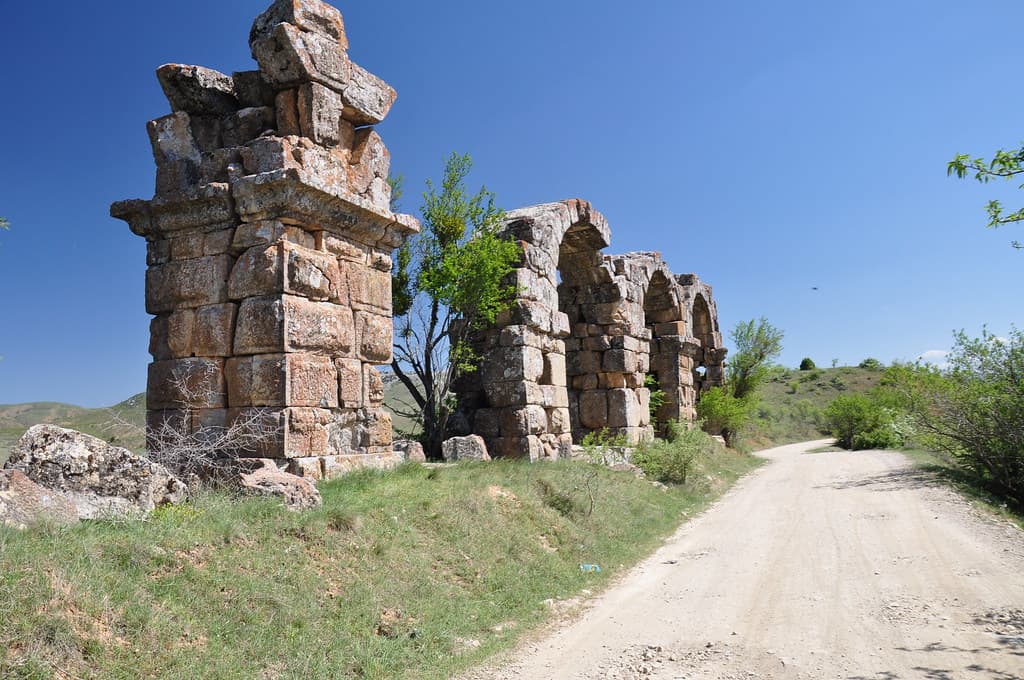
Image of Antioch of Pisidia. Image source
Station 7 of 7
St Paul TrailVisit essentials
A quick read before you go
- Duration
- Two to three hours at the ruins; add one hour for the Yalvaç Museum.
- Access
- Located approximately 1 km northeast of Yalvaç, Isparta Province.
Overview
Antioch of Pisidia occupies the exposed, clear-aired edge of the high Anatolian plateau. Antiochus I Soter founded this commanding site by the third century BCE as a Seleucid military settlement populated from Magnesia on the Maeander. Augustus refounded it in 25 BCE as the Roman military colony Colonia Caesareia Antiocheia, which became the Galatian province's most important Roman administrative center.
Paul and Barnabas arrived on their first missionary journey, probably around 45-48 CE. Invited to speak in the synagogue on the Sabbath, Paul delivered Acts 13:14-52, one of the most carefully constructed speeches in the New Testament, moving from Israel's history to Jesus as Messiah for Jewish and 'God-fearing' Gentile listeners. 'Almost the whole city' returned the next Sabbath before Jewish leaders objected.
Paul's reply—'Since you thrust it aside and judge yourselves unworthy of eternal life, behold, we are turning to the Gentiles' (Acts 13:46)—made his mission's direction a principle and became one of the New Testament's most consequential sentences.
Substantial, partly excavated remains include the rock-carved Temple of Augustus at the city's highest point, colonnaded street, theater, and Roman civic structures. Yalvaç Museum, one kilometer away, holds the finest recovered artifacts.
Why this place is sacred
Acts presents Paul's Antioch sermon not as failure but as overwhelming initial success followed by opposition that forced clarification. Jewish leaders' hostility became the occasion for stating what may have been implicit: the gospel was for Gentiles as well as Jews, and refusal by the community with prior claim opened the universal mission.
A specific spoken act, preserved however imperfectly in a historical text, is anchored here: Paul spoke in a synagogue of a Roman colonial city on this high Anatolian plateau. Above a thousand meters, exposure and clarity mark a palpable threshold between the lowland Mediterranean and continental interior. That setting suited a mission moving from established Jewish centers toward the Greco-Roman world's edges and interiors.
Seleucid military settlement, later Roman military colony (Colonia Caesareia Antiocheia) under Augustus — strategically positioned to control the plateau road network of the Galatian province.
Neolithic and Bronze Age settlement evidence on the same plateau → Seleucid foundation (c. 280 BCE) → Roman military colony (25 BCE) → flourishing provincial capital with full civic infrastructure → Paul's visit and early Christian community (c. 45-48 CE) → Byzantine period → Arab destruction (713 CE) → abandonment → ruins near modern Yalvaç → active archaeological excavation
Experience and orientation
From Yalvaç the road climbs into the broad, high, harsh, and grand Anatolian plateau. The partly excavated hillside site's main monuments follow a walking route. At its architectural center, the bedrock-carved Temple of Augustus crowns the city amid remains of a two-story colonnaded stoa. Fragments of the Res Gestae Divi Augusti—Augustus's account of his achievements—were found here, a major Roman provincial epigraphic discovery reflecting the colony's central place in Augustan ideology.
The Tiberia Platea, or main colonnaded street, conveys the lower city's scale. Its theater, nymphaeum, and baths belonged to the Galatian province's most Romanized colony. Early church remains traditionally associated with Paul's community are not always clearly signed.
One kilometer away, Yalvaç Museum's architectural elements, inscriptions, and everyday objects restore the ruins' human dimension and are essential to understanding the city.
The site is approximately one kilometer northeast of Yalvaç town. Enter from the main road; signage is present but limited — reading Acts 13 and researching the site layout in advance significantly improves the visit. Allow two to three hours at the ruins and one additional hour for the Yalvaç Museum. No audio guide is available; consider downloading a podcast or written guide to play during the visit.
Comfortable walking shoes are essential — the terrain is rocky and uneven at altitude.
Context and lineage
Antiochus I Soter of the Seleucid Empire founded the city around 280 BCE, bringing colonists from Magnesia on the Maeander to establish a settlement on the strategically important plateau. The city bore his dynastic name — Antioch — and occupied a position commanding the road network of the region.
In 25 BCE, Augustus incorporated the city into his new system of Roman military colonies, refounding it as Colonia Caesareia Antiocheia and settling Roman veterans there to secure the province of Galatia. Under this second founding, the city acquired the monumental infrastructure of a Roman colonial capital: the Temple of Augustus on the high rock, the colonnaded streets, the civic buildings. Paul and Barnabas arrived here on their first missionary journey, recorded in Acts 13, around 45-48 CE.
The sermon Paul delivered in the synagogue — and the subsequent expulsion — became one of the most theologically formative episodes in the expansion of Christianity beyond its Jewish origins.
Neolithic-Bronze Age settlement on the plateau → Seleucid foundation (c. 280 BCE) → Roman military colony (25 BCE) → thriving Galatian provincial capital → Pauline Christian community (c. 45-48 CE) → Byzantine period → Arab destruction (713 CE) → abandonment → modern archaeological site near Yalvaç
Antiochus I Soter
Seleucid founder
Augustus
Roman refoundation
Saint Paul
Apostle; preacher of the pivotal Gentile mission declaration
Barnabas
Paul's companion on the first missionary journey
W. Ramsay and D.M. Robinson
First excavators
Stephen Mitchell and Marc Waelkens
Major documenters
Traditions and practice
Paul's synagogue sermon in Acts 13 was delivered within the framework of the Sabbath service: he was invited to speak in the established manner of a visiting rabbi or teacher. The early Christian community that formed here after his expulsion from the synagogue gathered separately, in homes or other spaces — the pattern of Acts throughout Paul's missionary journeys.
Later, under Byzantine rule, the city's Christian identity was formalized in church buildings, including the one whose remains are visible at the site and are traditionally associated with Paul's community.
No active religious ceremonies take place at the archaeological site. Christian pilgrimage groups — both Turkish and international — visit regularly, making this one of the more frequented Pauline sites in central Turkey. Groups typically gather at the site of the synagogue or the early church remains, read Acts 13 in full, and hold informal prayer. The Yalvaç Museum is usually included in these pilgrimage visits.
Read Acts 13:13-52 carefully before arriving — not just for the narrative but for the specific rhetoric of the speech, which begins with Abraham and moves through the entire arc of Israel's history before arriving at its announcement. The sermon is a masterpiece of persuasion addressed to an audience that knew the story already; understanding its structure helps you understand what made it both immediately compelling and ultimately dangerous to Paul's standing in the city.
At the site itself, locate yourself on the highest point — where the Temple of Augustus stands — and look out at the plateau. The altitude and the openness are part of what this place is. Then descend to the street level and find the area of the early church.
The contrast between the monumental imperial cult architecture at the top and the modest domestic-scale church remains lower down encodes the entire drama of Paul's relationship to Roman power: working within its infrastructure, transforming it toward different ends.
Early Christianity — Pauline Mission
HistoricalAntioch of Pisidia holds the sermon (Acts 13:14-52) in which Paul made the theologically foundational declaration of the Gentile mission. The transition from Jewish synagogue audience to explicit Gentile outreach — articulated here in response to the Jewish leaders' opposition — is considered by many scholars one of the most significant single moments in the formation of Christianity as a universal rather than ethnic religion.
Synagogue preaching and early Christian community gathering; later Byzantine church worship on the same site
Roman Imperial Cult and Greco-Roman Polytheism
HistoricalAs Augustus's flagship military colony in the Galatian province, Antioch had a monumental Temple of Augustus — carved into the bedrock at the highest point of the city — surrounded by a two-story stoa. The Res Gestae Divi Augusti fragments found here confirm the colony's ideological centrality to Augustan provincial religion. The Temple of the moon god Men Askaenos ran alongside this imperial cult, reflecting the deep Anatolian religious substrate.
Imperial cult worship at the Temple of Augustus; festival observances; Men Askaenos cult worship with its own distinct ritual calendar
Archaeological Scholarship
ActiveFirst excavated by W. Ramsay and D.M. Robinson (1913-14, 1924), with major documentation by Mitchell and Waelkens (1982-83). The discovery of Res Gestae fragments was a significant epigraphic find. Ongoing research continues to refine understanding of the city's layout and the relationship between its multiple religious spaces.
Archaeological excavation and survey; Yalvaç Museum collection management; international academic collaboration on Pauline sites
Perspectives and open questions
Antioch of Pisidia is read differently depending on whether one approaches from Christian pilgrimage, classical archaeology, or the history of Anatolian religious traditions — but all three perspectives converge on the same observation: this was a place of exceptional consequence, where multiple religious streams ran together and diverged.
Scholarly perspective
For archaeologists and New Testament scholars, Antioch of Pisidia is significant on multiple levels simultaneously. As a Roman military colony it was uniquely important — the oldest, largest, and most Romanized of Augustus's Galatian foundations, whose epigraphic record includes fragments of the Res Gestae Divi Augusti. For Pauline studies, it is the site of one of the most carefully reconstructed speeches in Acts, and the location where the theological principle of the Gentile mission was first explicitly articulated.
The fact that Paul chose the most important Roman colonial city in Galatia as his first major base reflects the strategic targeting of centers of Roman administrative power that characterizes his entire missionary geography.
Living and traditional perspectives
Beneath the Hellenistic and Roman religious layers, the cult of the Anatolian moon god Men Askaenos at Antioch of Pisidia represents one of the clearest examples of indigenous Anatolian religious continuity. Men — often depicted with a crescent moon — had deep roots in the Pisidia and Phrygia regions long before Greek colonization, and his temple at Antioch continued operating alongside the Temple of Augustus.
This co-existence of imported Roman imperial cult and ancient local deity worship within the same city was characteristic of Roman religious pluralism but carried particular meaning in a region where Anatolian religious identity was especially strong.
Alternative interpretations
The high-altitude setting of Antioch of Pisidia carries a quality that several spiritual traditions associate with clarity and divine encounter: the exposed plateau, the long horizon, the air that is physically different from the lowland world below. The multiple religious traditions that inhabited this city — Anatolian moon-cult, Greek civic religion, Roman imperial theology, and then the emerging early Christian community — each found the same plateau compelling for different reasons.
The site asks whether geography itself contributes something to the religious imagination that occupies it.
Open questions
The location and character of Paul's actual early Christian community at Antioch — the congregation that formed after his expulsion from the synagogue — is archaeologically unresolved. The excavated church remains have been associated with Paul's community by tradition but this connection is difficult to establish definitively for the first century. The full extent of the pre-Hellenistic cult of Men Askaenos and its relationship to the city's Seleucid and Roman layers is also incompletely understood.
Plan your visit
Access and arrival
Located approximately 1 km northeast of Yalvaç, Isparta Province. Yalvaç is connected to Isparta (approximately 100 km) by road; Konya is approximately 200 km. The site is open daily 8:00-19:00 (summer) / 8:00-17:00 (winter); free or minimal admission — verify locally. No audio guide available; research Acts 13 and the site plan before visiting. Mobile signal is generally available in Yalvaç; more remote parts of the site may be less reliable. Emergency services are accessible from Yalvaç town.
Yalvaç town offers modest guesthouses and hotels suitable for overnight stays. Isparta (approximately 100 km) has a wider range of options. No accommodation exists at the site itself.
Respectful visit
No specific requirements. Comfortable walking shoes with ankle support are essential due to rocky, uneven terrain at altitude. Light layers recommended — the plateau can be cool even in summer, particularly in the morning and evening.
Freely permitted throughout the outdoor site. The Yalvaç Museum may have photography restrictions on specific artifacts; verify on entry.
None traditionally offered at the archaeological site.
Do not climb on or touch ancient structures. Do not remove any artifacts or stones. The site is at over 1,000 m altitude — bring adequate water and sun protection. Verify current opening hours locally as they may vary seasonally.
The site is above a thousand meters altitude — weather can change quickly, and sun protection is essential in summer. Bring water; no services are available at the ruins. The rocky terrain requires careful footwear. The Yalvaç Museum has limited opening hours — verify locally before planning your visit to ensure both site and museum can be combined in a single day.
Location
Map loads as you approach this section.
Pilgrim reflections
A portrait of encounter, not a score
Pilgrims describe what they felt, how present they could become, and whether the place would shape a journey. There are no stars and no ranking of traditions.
No reviewed reflections yet
The first pilgrims can help describe the character of being here.
Share a reflection
Available after an account-backed “Been there.” Every reflection is reviewed before publication.
Nearby sacred places
Explore other sacred places in the region. Proximity does not establish access or travel time; check each place’s guidance.




References
Sources consulted for this page. Source categories describe the publication, not a guarantee that every claim is verified. Traditional accounts and outside interpretations may differ.
- 01Paul's First Missionary Journey through Perga and Pisidian Antioch - Biblical Archaeology Society — Biblical Archaeology SocietyacademicScholarly treatment of Acts 13 events at Pisidian Antioch
- 02Antioch of Pisidia - Wikipedia — Wikipedia contributorsencyclopediaComprehensive overview of history, archaeology, and biblical significance
- 03Antioch of Pisidia | Turkish Archaeological News — Turkish Archaeological NewsacademicAggregated archaeological coverage
- 04Pisidian Antioch Turkey - Ancient City Guide - Turkey Travel Planner — Turkey Travel PlannerguideVisitor guide with detailed site description
- 05Antioch of Pisidia - Madain Project — Madain ProjectacademicDetailed architectural and historical documentation
- 06Pisidian Antioch | All About Turkey — All About TurkeyguideOverview of site and Yalvaç museum
- 07Cities Of The Bible: Antioch (Pisidia) - Modern And Biblical | Athens Bible Church — Athens Bible ChurchspiritualBiblical and theological perspective on Paul's ministry at Antioch
- 08Pisidian Antioch (Antiochia in Pisidia) | The Art of Wayfaring — Art of WayfaringguideVisitor experience report with site photos
Share a photo
Help visitors recognize Antioch of Pisidia. Every submission is reviewed before publication.