Yeperenye / Emily and Jessie Gaps Nature Park
Where three caterpillar songlines converge at the gateway to Alice Springs
Understand sacred places, explore living traditions, and learn how to engage respectfully with Pilgrim Map.
Access has not been verified. Check current local guidance before planning a visit.
Alice Springs, Northern Territory, Northern Territory, Australia
Read the sources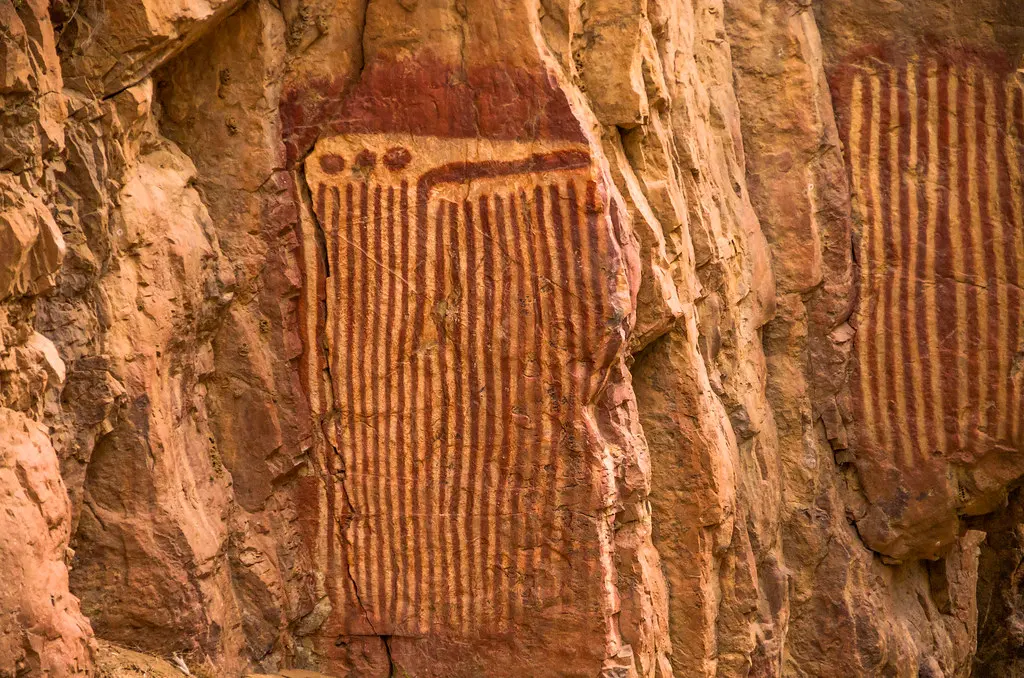
Image of Yeperenye / Emily and Jessie Gaps Nature Park. Image source
Visit essentials
A quick read before you go
- Duration
- A visit to Emily Gap alone — walking in to the waterhole and rock art viewing area — takes well…
- Access
- Emily Gap is reached via the Ross Highway east of Alice Springs and is the first of the two gaps…
Overview
Anthwerrke (Emily Gap) and Akepelye (Jessie Gap) sit within a nature park roughly ten kilometres east of Alice Springs, in a stretch of the MacDonnell Ranges cut through with quartzite gorges and permanent waterholes. In Arrernte cosmology, this is the place where the Dreaming tracks of three caterpillar ancestors — Yeperenye, Ntyarlke, and Utnerrengatye — converge, having travelled from the four cardinal points of the surrounding country.
Their meeting here is understood as foundational to the creation of Mparntwe, the Arrernte name for Alice Springs itself. Many Arrernte families of the region trace their descent to these ancestors. The site carries rock art of major anthropological significance, and it is registered as a sacred site under Northern Territory law, its custodianship active and unbroken.
What is written of it here reflects only what Arrernte people themselves have chosen to make public — the fuller ceremonial dimension of the caterpillar Dreaming remains, by design, theirs alone to hold.
Why this place is sacred
The gap itself is a narrow slot through red quartzite, opening onto a waterhole that holds water for much of the year. Walls rise close on either side, the light narrows, and any sound carries differently than it does in open country. But its thinness, in Arrernte terms, is not chiefly about this physical drama. It is about convergence.
Three caterpillar ancestors — Yeperenye, Ntyarlke, and Utnerrengatye — are understood to have travelled toward this place from separate directions across the surrounding desert, and their meeting here is treated as one of the events that brought Mparntwe into being. A site where three songlines cross carries a different order of significance than a site touched by one; custodians and land councils describe this area as among the most spiritually concentrated points in the region's cosmology for exactly that reason.
Rock art at the gap, visible from the designated path, connects to this narrative, though which panels correspond to which ancestor's track is not pursued here. Older ethnographic sources recorded ceremonial content tied to the site during a period, in the 1890s, when Aboriginal ceremonies were arranged and staged for outside observers — a method now recognised as incompatible with genuine consent.
That record exists as a documented historical fact, but its content is not reproduced here, in keeping with the wishes of Arrernte custodians and Central Land Council guidance that some knowledge belonging to Aboriginal law is not for public disclosure, regardless of how it was previously recorded.
The site's standing predates any concept of tourism or heritage listing; it is understood within Arrernte tradition as a place established during the creative period by the caterpillar ancestors themselves, marking a real point of convergence in the Dreaming geography that underlies Mparntwe.
Colonial pastoral settlement reached the area in 1872 with the establishment of Undoolya Station, bringing the site within a leasehold landscape for the first time. Ethnographers Walter Baldwin Spencer and Francis Gillen conducted fieldwork in the district in 1896–97, publishing The Native Tribes of Central Australia in 1899; this record is now understood, including by the digital humanities project devoted to their work, as having been obtained through arranged ceremonial performance that would not satisfy contemporary standards of consent.
In the twentieth century the site was formally registered as sacred under NT law and drawn into a jointly managed nature park. In 2021, Arrernte traditional owners — using park rental income under their own direction — built the 7.2-kilometre Yeperenye Trail connecting Emily and Jessie Gaps, supervised throughout by cultural authority, and released the custodian-narrated Anthwerrke Interactive Experience as an alternative to conventional signage.
Experience and orientation
The approach is short and unassuming — a car park, a signed track, then the ranges closing in. The rock at Emily Gap runs deep red, quartzite laid down some three hundred million years ago and folded upright by later movements of the earth, so the walls of the gap stand almost vertical on either side of the path.
A waterhole sits at the base, holding water through most of the year even in a country where water is otherwise scarce. Ochre rock art marks sections of the rock face, visible from the designated viewing area without need to leave the path.
Many visitors describe the Anthwerrke Interactive Experience — a free app-based tour narrated by traditional owners — as changing the register of the visit, less like reading an interpretive sign and more like being walked through the place by someone who belongs to it. Jessie Gap, a further seven kilometres along the same road, offers a quieter counterpart: fewer visitors, a similar waterhole and gap formation, picnic tables, and fire pits.
The two are connected by the Yeperenye Trail, a wheelchair-accessible path with rest stops that traditional owners built and continue to maintain. Heat governs timing here more than anything else; by late morning in the warmer months, the gap's shade becomes a relief rather than a feature.
Arrive early. The gap rewards a slow approach — walking rather than driving to the final viewpoint, and pausing at the waterhole before reading any interpretive material. Download the Anthwerrke app before arriving, since mobile signal in the park itself can be inconsistent.
Context and lineage
In publicly shared Arrernte accounts, the caterpillar ancestors Yeperenye, Ntyarlke, and Utnerrengatye travelled toward this place from four directions — from Central Mount Stuart to the north, Finke to the south, Atula to the east, and Mt Zeil to the west — and their convergence at Mparntwe is remembered as an event that shaped the surrounding MacDonnell Ranges.
Many Arrernte people born in the Alice Springs area understand themselves as descendants of these ancestors, and the site is treated as a living point of connection to that ancestry rather than a closed historical episode. The fuller ceremonial content associated with this narrative — including ritual and gender-restricted dimensions understood from ethnographic and land council sources to be substantially men's business — belongs to Arrernte law and is not detailed in this account.
Custodianship runs through Central and Eastern Arrernte families of the Alice Springs region, represented in the native title context by the Lhere Artepe Aboriginal Corporation, the Prescribed Body Corporate for native title holders over the Mparntwe, Antulye, and Irlpme estates.
In May 2000 the Arrernte people were recognised by the Federal Court as native title holders over Alice Springs — the first successful urban native title claim in Australia — formalising a custodial relationship to this country that traditional owners describe as unbroken since the creative period.
Yeperenye
Ancestral caterpillar being
One of three caterpillar ancestors whose Dreaming track converges at Anthwerrke; the park and trail take their name from this ancestor.
Ntyarlke
Ancestral caterpillar being
One of the three caterpillar ancestors whose meeting at this site is understood as foundational to the creation of Mparntwe (Alice Springs).
Utnerrengatye
Ancestral caterpillar being
The third of the caterpillar ancestors whose songline crosses this site, completing the convergence central to Arrernte creation narrative.
Lynette Ellis
Traditional owner and custodian
Named traditional owner who has led public-facing custodianship of the site, including the launch of the Anthwerrke Interactive Experience app tour.
Grant Wallace
Traditional owner and custodian
Named traditional owner involved in directing park rental income toward the construction of the Yeperenye Trail, completed under cultural supervision in 2021.
Traditions and practice
Ethnographic sources from the 1896–97 fieldwork of Walter Baldwin Spencer and Francis Gillen record that ceremonies connected to the caterpillar Dreaming were performed in this district, gathered through a method — arranging ceremonies specifically for outside documentation — now recognised as ethically compromised and non-consensual by contemporary standards. Central Land Council guidance describes Aboriginal ceremonial life in this cultural context as typically organised into separate men's and women's domains, each kept confidential from the other and from outsiders.
This account does not identify which ceremonial content applies specifically to Anthwerrke, in keeping with that guidance.
Any ceremonial practice maintained today by living custodians is not publicly documented, and Central Land Council protocol holds that it would not be appropriate to seek out or disclose such practice even where it might be discoverable.
What is documented and actively practiced in public view is custodial stewardship: traditional owners directing park rental income into infrastructure, supervising construction work on culturally sensitive ground, and personally narrating the site's public story through the Anthwerrke Interactive Experience rather than relying on static signage written by others.
Visitors are not invited to any ceremonial participation. The available practice for a visitor is attentive, unhurried walking — following the Yeperenye Trail at a pace that allows the shift from open country into the gap itself to register, and using the custodian-narrated app tour as the primary interpretive companion rather than seeking outside explanation of what is not shared.
Arrernte (Central/Eastern Arrernte) Aboriginal tradition
ActiveAnthwerrke and Akepelye mark the convergence of three ancestral caterpillar songlines — Yeperenye, Ntyarlke, and Utnerrengatye — foundational to the Dreaming narrative that establishes Mparntwe (Alice Springs). Many Arrernte people of the region identify as descendants of these ancestors, and the site anchors both spiritual identity and, since May 2000, formal native title recognition over Alice Springs.
Historical ceremonial practice connected to the caterpillar Dreaming was recorded by ethnographers in 1896–97 under conditions no longer considered ethically valid; current ceremonial practice, if any, is not publicly documented. Publicly visible practice today consists of custodian-led stewardship: construction and maintenance of the Yeperenye Trail, and the custodian-narrated Anthwerrke Interactive Experience app tour, both funded and directed by traditional owners themselves.
Perspectives and open questions
Anthwerrke draws together three distinct vantage points — academic heritage scholarship, the traditional authority of Arrernte custodians, and a deliberate silence that belongs to neither camp but to Aboriginal law itself.
Scholarly perspective
Heritage and anthropological scholarship, building on the 1899 publication of Spencer and Gillen's fieldwork, treats Anthwerrke as one of the most significant and thoroughly documented Aboriginal sacred sites in Central Australia, valued both for its rock art and for its role in the Arrernte creation narrative underlying Mparntwe.
Contemporary scholars increasingly qualify this legacy, however, acknowledging that the ethnographic record was produced through staged ceremonial performance arranged for outside observers, a method incompatible with genuine consent, and that a substantial portion of what was recorded concerns restricted, gender-specific ceremonial knowledge that Arrernte communities have never treated as public.
Living and traditional perspectives
Eastern and Central Arrernte traditional owners, represented through the Lhere Artepe Aboriginal Corporation and consulted via the Central Land Council, affirm the site's centrality to the caterpillar Dreaming and to Arrernte identity in the Alice Springs region.
They have taken active, self-directed steps — the Yeperenye Trail, the Anthwerrke Interactive Experience — to share an appropriate measure of that significance publicly, on terms they set themselves, while maintaining that the fuller ceremonial knowledge remains governed by Aboriginal law and is not for public release.
Open questions
The full ceremonial and ritual content of the caterpillar Dreaming at this site is not publicly known outside appropriate Arrernte cultural authority, and this absence reflects an ongoing, deliberate act of protection rather than an unresolved historical question. It is not a gap awaiting discovery; it is a boundary that belongs to the custodians who hold it, and it is appropriate to leave it there.
Plan your visit
Access and arrival
Emily Gap is reached via the Ross Highway east of Alice Springs and is the first of the two gaps encountered; Jessie Gap lies a further seven kilometres along the same road. The park has picnic areas, fire pits at Jessie Gap, and public toilets; camping is not permitted. Mobile phone signal in the park is inconsistent, so the free Sites and Trails NT app and its Anthwerrke Interactive Experience tour should be downloaded before arrival.
Alice Springs, roughly ten kilometres away, offers the nearest range of accommodation; no on-site or immediately adjacent lodging exists within the nature park itself.
Respectful visit
No specific dress code is required. Sun protection is the practical concern — a hat and sunscreen for the open sections of trail, since shade is limited outside the gaps themselves.
General landscape photography is accepted; the site is an active tourism destination developed in cooperation with its custodians. Visitors should not photograph rock art up close in a way that could be construed as documenting ceremonial content, and should never publish images alongside speculation about restricted meaning.
No tradition of visitor offerings is associated with this site.
Stay on designated tracks and do not touch or deface rock art. The site is registered under the Northern Territory Aboriginal Sacred Sites Act, and any land use or development nearby requires an Authority Certificate from the Aboriginal Areas Protection Authority following consultation with custodians. The restricted, ceremonial dimension of the site's significance is not open to visitor inquiry; it is not withheld as a courtesy but held as a matter of Arrernte law.
Do not seek out or attempt to research the restricted ceremonial content historically associated with this site. Central Land Council guidance states plainly that identifying or discussing certain sacred material can itself constitute a violation of Aboriginal law; the appropriate response to encountering older ethnographic writing about this area is to treat it as a closed door, not a resource to draw on.
Location
Map loads as you approach this section.
Pilgrim reflections
A portrait of encounter, not a score
Pilgrims describe what they felt, how present they could become, and whether the place would shape a journey. There are no stars and no ranking of traditions.
No reviewed reflections yet
The first pilgrims can help describe the character of being here.
Share a reflection
Available after an account-backed “Been there.” Every reflection is reviewed before publication.
Nearby sacred places
Explore other sacred places in the region. Proximity does not establish access or travel time; check each place’s guidance.

N'Dhala Gorge Nature Park
Ross River / Alice Springs region, Northern Territory, Northern Territory, Australia
14.1 km away

Napwerte / Ewaninga Rock Carvings Conservation Reserve
Hale / Alice Springs region, Northern Territory, Northern Territory, Australia
24.2 km away

Simpsons Gap
Alice Springs / Tjoritja, Northern Territory, Northern Territory, Australia
25.5 km away

Chambers Pillar Historical Reserve
Hugh / Alice Springs region, Northern Territory, Northern Territory, Australia
132.0 km away
References
Sources consulted for this page. Source categories describe the publication, not a guarantee that every claim is verified. Traditional accounts and outside interpretations may differ.
- 01Emily Gap custodians launch Anthwerrke interactive tour for visitors — Central Land CouncilofficialNames traditional owner/custodian Lynette Ellis; describes the app-based interactive visitor experience developed and controlled by custodians; confirms three caterpillar songlines intersect at the site.
- 02Traditional owners to launch new Yeperenye trail — Central Land CouncilofficialDetails trail construction, cultural supervision during works, traditional owner-led investment of park rental income, names custodians Lynette Ellis and Grant Wallace.
- 03Sacred sites and objects — Central Land CouncilofficialGeneral CLC statement on Aboriginal sacred site/object protocols: restricted, gender-specific (predominantly men's) material must not be displayed or published; identifying/discussing a site can itself be a violation. Used to inform sensitivity classification, not to describe Emily Gap specifics.
- 04Yeperenye / Emily and Jessie Gaps Nature Park Joint Management Plan — Northern Territory Department of Environment, Parks and Water Security / Traditional OwnersofficialOfficial joint management plan document for the park; exists and is referenced by multiple official sources but could not be parsed as readable text in this research pass (binary/PDF extraction failure).
- 05Yeperenye / Emily and Jessie Gaps Nature Park visitor information — Northern Territory GovernmentofficialOfficial NT Government park information document identified via search; describes the gaps as the first landscape features encountered and confirms park identity.
- 06Lhere Artepe Aboriginal Corporation — Lhere Artepe Aboriginal CorporationofficialPrescribed Body Corporate for the native title holders of Alice Springs (Mparntwe, Antulye, Irlpme estates); the Arrernte people were recognised as native title holders in May 2000, the first successful urban native title claim in Australia.
- 07Sacred sites — Aboriginal Areas Protection Authority (Northern Territory)officialStatutory authority under the NT Aboriginal Sacred Sites Act responsible for sacred site protection across the NT; issues Authority Certificates and consults custodians before works/land use near registered sacred sites such as Emily Gap.
- 08Emily Gap — Wikipedia contributorsacademicGeneral encyclopedic overview: location, geology (300-350 million year old MacDonnell Ranges formation), registered sacred site status, rock art, colonial pastoral history from 1872 (Undoolya Station lease).
- 09A guide to Yeperenye / Emily and Jessie Gap — Tourism Central Australia (Discover Central Australia)Source contextVisitor-facing practical guide: access via Ross Highway, best visiting months (April-September), facilities, the Yeperenye Trail (7.2km, opened June 2021, hand-built with cultural supervision), explicit no-touching-rock-art rule.
- 10About Spencer and Gillen — Spencer & Gillen digital humanities project (spencerandgillen.net)academicDocuments Walter Baldwin Spencer and Francis James Gillen's 1896-97 ethnographic fieldwork in Alice Springs, during which Gillen 'arranged' the performance of complex Aboriginal ceremonies for recording, resulting in The Native Tribes of Central Australia (1899). Cited here only to establish that historical ethnographic material exists and to flag its contested, non-consensual character by contemporary standards — ceremonial content itself is not reproduced.
Share a photo
Help visitors recognize Yeperenye / Emily and Jessie Gaps Nature Park. Every submission is reviewed before publication.