Xiluo Fuxing Temple
The only Mazu pilgrimage that asks permission each year
Understand sacred places, explore living traditions, and learn how to engage respectfully with Pilgrim Map.
Access has not been verified. Check current local guidance before planning a visit.
Xiluo, Yunlin County, Yunlin County, Taiwan
Read the sources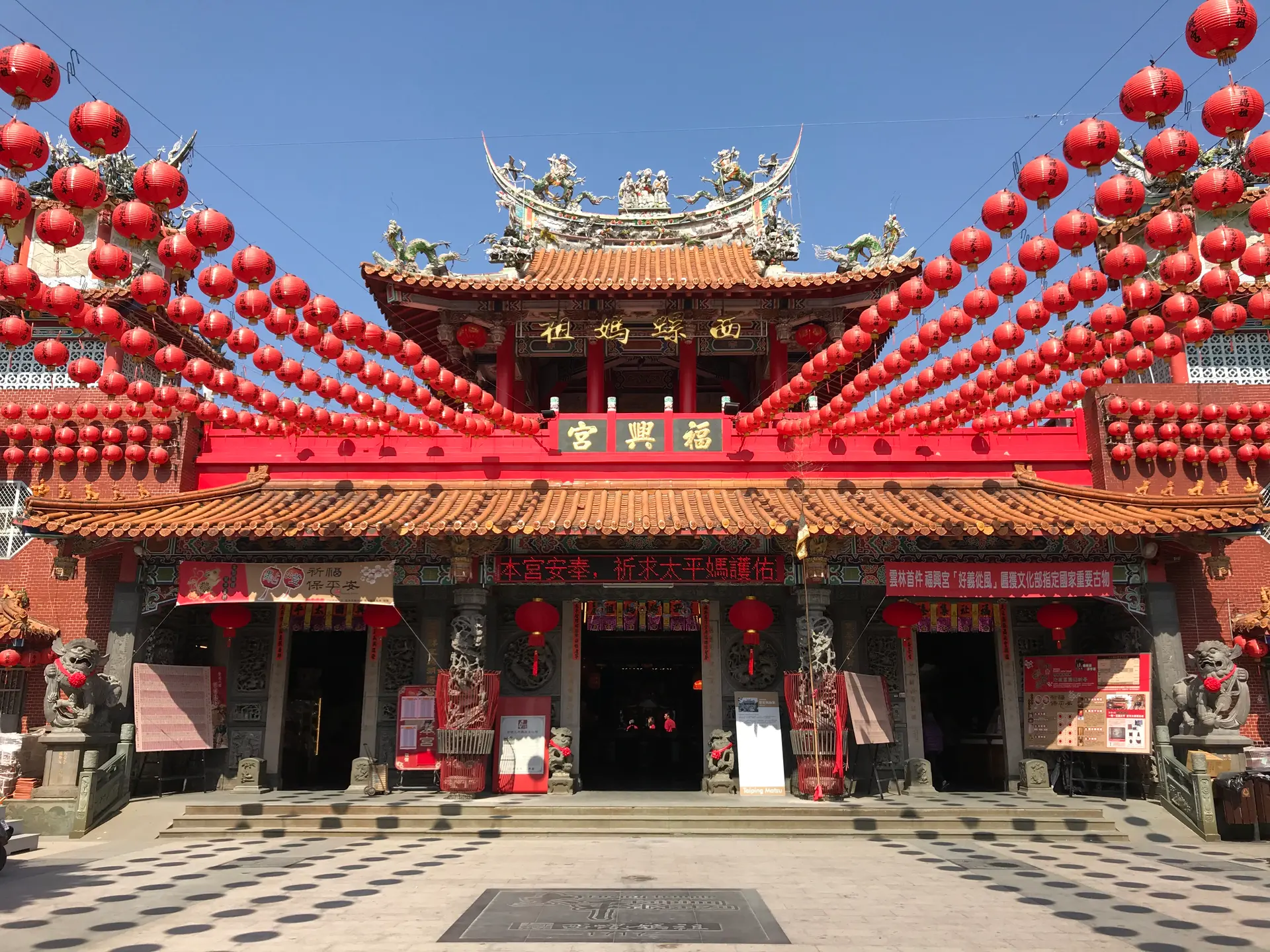
Visit essentials
A quick read before you go
- Duration
- A basic temple visit takes well under an hour; during the festival period, spectators typically…
- Access
- No.
Overview
Most of the year, Fuxing Temple is a Yanping Old Street community hub where believers bring petitions and consult Mazu through poe divination blocks. Taiping Mazu, its black-faced image believed carried from Meizhou by the monk Minghai in 1717, has a procession unlike any other in Taiwan's Mazu-worship calendar. It occurs in the ninth lunar month rather than spring, follows a radial route through Yunlin and Changhua townships rather than a linear one, and requires the goddess's divinatory approval.
The event is not fixed annually. It paused for three pandemic-era years before resuming in 2023, and sources disagree on each year's duration and township count. The temple seems to treat this variation as part of Mazu's active relationship with her community rather than a scheduling inconsistency.
Local tradition credits Taiping Mazu with helping repel rebel forces near Douliu during the 1786 Lin Shuangwen Rebellion. Sources also disagree whether her black face signifies water-element cosmology, a pirate-darkened face, or borrowed Buddhist guardian iconography.
Why this place is sacred
What distinguishes Fuxing Temple's felt sanctity from many other Mazu shrines is not primarily its statue's age, though that matters, but the degree to which its central ritual event depends on an active, current negotiation with the deity rather than a fixed calendar obligation.
The Taiping Mazu Cultural Festival — the only autumn Mazu pilgrimage in Taiwan, following a radial route through townships in Yunlin and Changhua rather than the linear routes typical of other Mazu processions — requires poe-block divination each year to confirm the goddess's willingness to proceed.
This is treated within local tradition not as a formality but as a genuinely open question: the pilgrimage was suspended for three years around the COVID-19 pandemic and only resumed after divination approval in 2023.
The temple's black-faced Mazu statue, brought (per temple tradition) from Meizhou by the monk Minghai in 1717, carries its own layer of contested meaning — sources offer at least three explanations for the statue's dark face, tied respectively to Five Elements cosmology, a legend of the goddess's face darkening while repelling pirates, and a general Buddhist-guardian convention of intensified power — none of which is treated as more authoritative than the others in available material.
A further layer of local memory attaches to the 1786 Lin Shuangwen Rebellion, during which tradition holds Taiping Mazu helped defend the area near Douliu against rebel forces.
The temple exists to house and venerate the black-faced Kaishan Mazu statue believed carried from Meizhou by the monk Minghai in 1717, giving Xiluo's early Zhangzhou and Quanzhou settler communities a shared devotional center.
From informal worship at a creek-side site called Anmao, through a 1723 formal establishment and a 1770 relocation 'by the Lady of Heaven's own decree' to the present Yanping Old Street site, the temple's identity gradually attached itself to a distinctive autumn pilgrimage tradition — suspended under Japanese colonial rule and only revived, after decades of dormancy, in 2004 following renewed divinatory approval.
Experience and orientation
Visitors and worshippers commonly describe coming to Fuxing Temple to make specific wishes or petitions to Mazu and to seek guidance through poe-block divination, a practice woven into the temple's daily rhythm rather than reserved for special occasions.
Travel sources describe the temple as a lively community hub especially during the Lunar New Year period, when neighboring villages traditionally seek blessings, and — when the pilgrimage is held — during the Taiping Mazu Cultural Festival itself, when Xiluo becomes, in local description, 'more lively than the Lunar New Year,' filled with parades, traditional performing arts troupes, and folk opera.
Recent editions of the festival have added notably contemporary programming alongside the traditional procession: newborn-infant ritual experiences, three-on-three basketball tournaments, and a 'Taiping Mazu Blessing Marathon,' suggesting a deliberately inclusive, community-wide event format rather than a closed ritual observance.
The temple sits on Yanping Old Street in central Xiluo Township; a basic visit takes well under an hour, while festival-period visitors typically watch a portion of the multi-day procession rather than its full route.
Context and lineage
According to temple tradition, the monk Minghai of Yongquan Temple, Fujian, brought the black-faced Mazu statue from Meizhou to Taiwan in 1717.
It was first worshipped informally on the north bank of the Xiluo creek at a site called Anmao, then moved to the south bank after flooding, before a formal temple was built in 1723 through community donations from Zhangzhou and Quanzhou believers, and relocated to its present site on Xiluo Street in 1770 by what tradition describes as the goddess's own decree, determined through divination.
Fuxing Temple's Taiping Mazu is understood within Yunlin's devotional geography as one of the 'Four Great Temples' of old Xiluo Street, its authority resting on the statue's Meizhou origin and its distinctive, divinely-gated pilgrimage tradition rather than a formal branch-temple network.
Minghai
Founding monk
Credited with carrying the black-faced Mazu statue from Meizhou to Taiwan in 1717.
Traditions and practice
Daily incense and prayer offerings before the Mazu statue have long been paired with poe divination, used both for individual petitioners and, historically, to request the goddess's permission and blessing for the annual pilgrimage. Village delegations from Sitong and surrounding areas historically visited around Lunar January 5 to request blessings.
The Taiping Mazu Cultural Festival, revived in 2004 after suspension during Japanese colonial rule, proceeds on a non-fixed schedule pending annual divination approval; when held, the Mazu palanquin processes radially through townships across Yunlin and Changhua counties, accompanied by traditional performing arts troupes, fireworks, and folk opera, with accounts varying year to year between roughly 13 and 15 townships and 9 to 16 days.
The general public is welcome to attend the temple for worship and to observe or join the pilgrimage procession as it passes through towns; recent editions have added public-facing programming such as newborn ritual experiences and community sporting events.
Chinese folk religion / Mazu (Taoist-Buddhist syncretic) worship
ActiveFuxing Temple is a major regional center of Mazu worship in Yunlin County, housing a black-faced Mazu statue believed brought from Meizhou in 1717. It serves as a key faith center for Xiluo, Erlun, Lunbei, and Citong townships and is one of the 'Four Great Temples' of old Xiluo Street.
Daily incense offerings and prayer; wish-making and fortune-seeking before the Mazu statue; divination to seek the goddess's approval for the annual pilgrimage; the multi-day Taiping Mazu Cultural Festival procession during the ninth lunar month; Lunar New Year period blessing rituals for surrounding villages.
Perspectives and open questions
Fuxing Temple's Taiping Mazu tradition invites reading as both a documented case of localized ritual continuity and a living, still-negotiated relationship between community and deity.
Scholarly perspective
Academic and government cultural-heritage sources treat Fuxing Temple and its Taiping Mazu Cultural Festival as a documented example of localized Mazu cult development and Qing-era-to-present ritual continuity, notable specifically for its atypical autumn timing and radial procession pattern relative to Taiwan's more famous linear Mazu pilgrimages, such as the Dajia Mazu Pilgrimage.
Living and traditional perspectives
Within local folk tradition, Taiping Mazu is regarded as a living, responsive protector deity of the historic Xiluo Fort area, credited with military protection during the 1786 Lin Shuangwen Rebellion and with granting wishes and accurate guidance to petitioners. The necessity of seeking her permission via divination before holding the pilgrimage each year reflects an active, ongoing relationship between the community and the deity rather than a purely commemorative festival.
Alternative interpretations
No distinct alternative or esoteric interpretive tradition specific to this temple was identified in sources researched, beyond the general folk explanations offered for the symbolism of the statue's black face.
Open questions
The precise original manufacture date, materials, and provenance of the 1717 Mazu statue itself, beyond the Meizhou/Minghai transmission story, were not documented in available sources; nor did any source give a definitive account of exactly how long the pilgrimage tradition was actively suspended under Japanese rule versus dormant for other reasons before its 2004 revival.
Plan your visit
Access and arrival
No. 180 Yanping Road, Xiluo Township, Yunlin County, Taiwan, on the historic Yanping Old Street in the town center; reachable by road from Douliu or via routes crossing the Zhuoshui River at Xiluo Bridge. No admission fee.
Not documented in available sources; visitors typically base themselves in nearby Douliu, the larger Yunlin County seat.
Respectful visit
No temple-specific dress code was documented in sources found; the general Taiwanese folk-temple convention of modest, respectful dress applies, as is typical for Mazu temples nationwide.
No explicit photography restriction was found for this temple; Taiwanese temples of this type are typically open and photography-friendly for worship halls, though flash near the main altar is often discouraged as a matter of general etiquette rather than a documented rule specific to Fuxing Temple.
Sources reference standard Mazu-temple offering practices, including incense, but no temple-specific offering list (such as particular fruits or foods) was documented in the higher-reliability sources used.
None documented; the temple and festival are openly promoted by Taiwan's own Ministry of the Interior as a public cultural-religious attraction.
Because the pilgrimage is not an annual fixture, travelers hoping to witness it should confirm current-year status before planning a visit around it; it has been paused for extended periods before, including a three-year pandemic-related hiatus.
Location
Map loads as you approach this section.
Pilgrim reflections
A portrait of encounter, not a score
Pilgrims describe what they felt, how present they could become, and whether the place would shape a journey. There are no stars and no ranking of traditions.
No reviewed reflections yet
The first pilgrims can help describe the character of being here.
Share a reflection
Available after an account-backed “Been there.” Every reflection is reviewed before publication.
Nearby sacred places
Explore other sacred places in the region. Proximity does not establish access or travel time; check each place’s guidance.

Zhushan Zinan Temple
Zhushan, Nantou County, Nantou County, Taiwan
21.7 km away

Shuntian Temple, Tuku
Tuku, Yunlin County, Yunlin County, Taiwan
22.0 km away

Mailiao Gongfan Temple
Mailiao, Yunlin County, Yunlin County, Taiwan
25.4 km away

Lantian Academy
Nantou City, Nantou County, Nantou County, Taiwan
25.4 km away
References
Sources consulted for this page. Source categories describe the publication, not a guarantee that every claim is verified. Traditional accounts and outside interpretations may differ.
- 01西螺福興宮 - 維基百科,自由的百科全書 — Wikipedia contributorsacademicChinese Wikipedia article giving founding history (1717 statue arrival, 1723 temple establishment, 1770 relocation, 1862 earthquake/Dai Chaochun Incident damage, 1874 renovation, 1961/1968 postwar reconstruction and board formation, 2004/2019 Taiping Mazu pilgrimage details).
- 02Xiluo Fuxing Temple - Wikidata — Wikidata contributorsacademicConfirms coordinates, administrative location (Xiluo Township, Yunlin), classification as Chinese temple, and links to Chinese Wikipedia article.
- 03Taiping Mazu Cultural Festival, Xiluo - Taiwan Religious Culture Map / Taiwan Religious 100 Sights — Ministry of the Interior, Taiwan (內政部)officialOfficial Taiwan government religious-culture site (moi.gov.tw). Confirms 1723 temple establishment enshrining a 1717-arrived Mazu statue, describes the festival as the only autumn Mazu pilgrimage in Taiwan, radial (not linear) route pattern across Yunlin/Changhua, 15-day/14-township procession, suspension under Japanese colonial rule and revival in 2004 following divination approval, and temple contact details.
- 04西螺太平媽祖文化祭-臺灣宗教文化地圖-臺灣宗教百景 — Ministry of the Interior, Taiwan (內政部)officialChinese-language counterpart of the official government festival page.
- 05財團法人雲林縣西螺福興宮|西螺媽祖太平媽 (Official Fuxing Temple Foundation site) — Fuxing Temple Foundation (財團法人西螺福興宮)officialTemple's own official site. Confirms 1717 statue arrival, 1723 formal establishment following reported miracles, secondary deities (Guanyin, Shen Nong), reference to the 1786 Lin Shuangwen Rebellion and local belief that Mazu helped repel rebels near Douliu, temple address (No. 180 Yanping Road) and contact number.
- 06西螺太平媽祖文化祭 — 文化資源地理資訊系統 (Cultural Resources GIS) — Academia Sinica, Research Center for Humanities and Social Sciences (中央研究院)academicAcademic religious-studies GIS database entry on the Taiping Mazu Cultural Festival, cataloguing the pilgrimage as a scholarly-documented religious-geography topic. Note: a related CRGIS temple-specific URL could not be successfully fetched during this research and may contain further verified detail.
- 07平原社區大學 - 福興宮 (Fuxing Temple, English page) — Pingyuan Community College (雲林縣平原社區大學)officialCommunity-college-hosted English summary of temple history: 1717 arrival of black-faced Mazu statue via monk Minghai from Yongquan Temple, Fujian; 1723 formal establishment by Zhangzhou/Quanzhou believers; 1770 relocation to present site; description of annual pilgrimage drawing over ten thousand worshippers.
- 08睽違3年!西螺太平媽遶境復辦 9天8夜進香路線曝光 — United Daily News (聯合新聞網)Source contextTaiwanese news coverage of the 2023 resumption of the Taiping Mazu procession after a 3-year pandemic-related pause; describes a 9-day/8-night itinerary for that particular year, illustrating the festival's non-fixed annual scale.
- 09西螺福興宮由來詳細介紹、起源故事與拜拜該準備什麼? — HaveFunDay (嗨放)Source contextTaiwanese travel/lifestyle blog covering temple origin story and visitor worship-preparation advice (offerings etc.); used only to corroborate general visitor practice claims already found in higher-reliability sources, not as a standalone fact source.
Share a photo
Help visitors recognize Xiluo Fuxing Temple. Every submission is reviewed before publication.