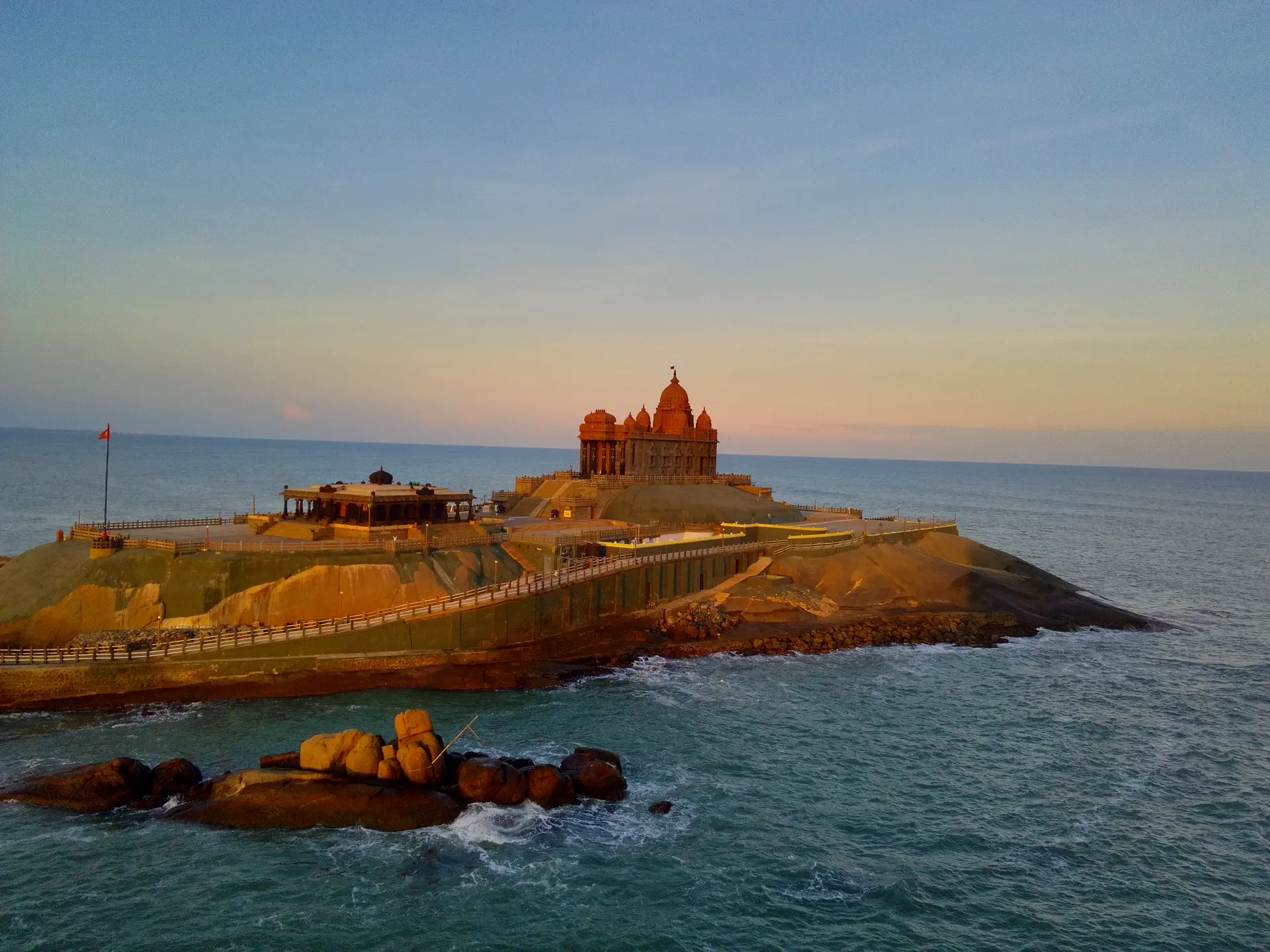
Vivekananda Rock Memorial, Kanyakumari
Where three seas meet and the virgin goddess waits at India's southernmost edge
Understand sacred places, explore living traditions, and learn how to engage respectfully with Pilgrim Map.
Access has not been verified. Check current local guidance before planning a visit.
Kanyakumari, Tamil Nadu, India
Visit essentials
A quick read before you go
- Duration
- Temple darshan requires 1-2 hours including queue time, longer during festivals.
- Access
- Thiruvananthapuram International Airport is 90 km away, with taxi and bus connections.
Overview
There is a geography of endings that becomes a geography of transformation. At Kanyakumari, the land runs out. Three great bodies of water meet in a constant mingling of currents. And on this shore stands a temple where a goddess has been waiting for a wedding that will never come.
The Kumari Amman Temple marks one of India's most sacred confluences—not only of waters, but of traditions, intentions, and time itself. Ancient texts speak of pilgrims coming here to consecrate themselves for lives of celibacy. The first-century Periplus of the Erythraean Sea records Greeks who observed devotees bathing in these waters nearly two thousand years ago. The pattern continues today, with thousands descending to the shore at dawn, cupping the sacred waters where three seas become one.
According to Shakta teaching, this is where a part of Goddess Sati's body fell when Lord Vishnu dismembered her corpse to end Shiva's grief-stricken destruction. The goddess here embodies concentrated divine feminine power—Kundalini Shakti coiled and potent. She is worshipped as Kumari, the virgin whose marriage to Shiva was thwarted by cosmic necessity. Her purity was not an accident but a purpose: only an unmarried goddess could destroy the demon Banasura.
Pilgrims come for many reasons. Some seek purification, believing that bathing in the Triveni Sangam absolves all sins. Some pray for the removal of obstacles to marriage. Some, like Swami Vivekananda in 1892, come seeking clarity about their life's purpose. All find themselves at an edge—geographical, spiritual, existential—where the ordinary categories seem less certain.
The eastern door of the temple remains perpetually closed, except during certain festivals. Legend holds that the goddess's diamond nose ring shines so brilliantly that ancient mariners once mistook it for a lighthouse, running their ships aground. Whether true or not, the story captures something essential: this is a place where light emanates, where something sacred cannot be contained, where even pragmatic precautions cannot quite manage the radiance.
Why this place is sacred
The thinness of this place begins with geography. Kanyakumari is where land becomes sea, where India ends and ocean begins. The Triveni Sangam—the meeting of Bay of Bengal, Arabian Sea, and Indian Ocean—creates a perpetual mingling of waters that pilgrims understand as cosmically significant. In Hindu tradition, confluences are inherently sacred, places where boundaries dissolve and purification becomes possible. This is perhaps the greatest confluence in India: three seas, not three rivers.
Beneath the geography lies the mythology that makes this a Shakti Peetha. According to tradition, when Sati immolated herself and Shiva carried her corpse in grief across the cosmos, Lord Vishnu used his Sudarshana Chakra to dismember the body and end Shiva's destruction. The 51 places where parts of Sati fell became seats of divine feminine power. At Kanyakumari, according to most accounts, her back or spine fell—the channel of Kundalini energy.
This makes the site not merely sacred but potent, charged with the ascending force that practitioners of yoga seek to awaken.
The goddess herself adds another dimension. Kumari is not a consort goddess, not wife or mother, but eternal virgin—her power untransferred, undiluted, self-contained. She performed penance to win Shiva as husband, but the marriage was prevented by cosmic necessity. She waits eternally, and her waiting is not passivity but power held in reserve. Seekers who come at moments of transition—between marriages, between careers, between selves—often report feeling this quality of suspension, as though the goddess understands the liminal state.
Then there is the accumulated weight of time. The Periplus confirms that pilgrims were bathing here in the first century CE. The Ramayana and Mahabharata reference this place. The great Tamil Sangam literature speaks of it. For at least two millennia—probably much longer—humans have recognized something here worth traveling toward. Such sustained attention creates its own field, whether understood psychologically as collective memory or spiritually as accumulated shakti.
And there is Vivekananda. In December 1892, a young monk swam to the rock offshore and sat in meditation for three days. What arose in that meditation would reshape global understanding of Hinduism and birth the Vedanta movement in the West. He came to Kumari for clarity, and he found it. The goddess he sought blessing from is the goddess of sanyasa, renunciation, the spiritual life.
That he received what he sought adds to the site's reputation as a place where life direction becomes clear.
The temple's original purpose, traceable through ancient texts if not archaeology, was to provide a place for consecration—particularly for those choosing lives of celibacy and spiritual practice. The first-century Periplus describes people coming here to 'consecrate themselves for the rest of their lives, and bathe and dwell in celibacy.' The goddess as eternal virgin is not incidental but central: she embodies the spiritual power possible when vital energy is not dispersed but conserved and transmuted.
Pilgrims came—and still come—seeking the goddess's blessing for their own paths of renunciation, or simply for the purification her waters provide.
The temple has been rebuilt and renovated by successive dynasties—Pandya, Chola, Vijayanagara, and Travancore—each adding to its structure while maintaining the core worship. The transfer of Kanyakumari from Kerala to Tamil Nadu in 1956 brought the site into a different administrative framework, but the temple retains Kerala-style worship traditions and the Tanthrasamuchayam rituals of its Travancore heritage.
The twentieth century added new layers of significance. Vivekananda's meditation in 1892 transformed the offshore rock into a pilgrimage destination in its own right. The memorial built there in 1970 draws seekers who might never visit a Hindu temple, adding a layer of Neo-Vedantic meaning to the site. The Thiruvalluvar Statue, unveiled in 2000, adds a Tamil cultural monument celebrating the poet-saint.
What was once a temple at land's end has become a complex of sacred sites, each with its own tradition of seekers.
Experience and orientation
The most common experience is completion. Pilgrims who have traveled across India, visiting temple after temple, often describe arriving at Kanyakumari with a sense of having reached the end of something. The land literally runs out here. The journey south can go no further. And in that geographical completion, something internal often resolves.
Darshan at the temple—standing before the goddess's idol, receiving her gaze—produces reports of unusual emotional intensity. Devotees speak of tears arising without conscious cause, as though the goddess is 'removing rigidity of the mind,' breaking through defenses that ordinary experience cannot penetrate. The idol's diamond nose ring is said to shine with such brilliance that it cannot be looked at directly—and whether this is literally true or mythologically true, the experience of being in the goddess's presence carries unusual weight.
Bathing in the Triveni Sangam is its own practice. Pilgrims descend to the waters at dawn, often before temple darshan, to immerse themselves where three seas meet. The belief is that this water absolves all sins—not through theological mechanism, but through the inherent purifying power of the confluence itself. What people report is a sense of being washed clean that goes beyond physical bathing, as though the mingling currents carry away what no longer serves.
The sunrise and sunset here produce their own contemplative effects. Because the cape juts into the ocean, both events involve the sun rising from or setting into water—an unusual sight that occurs here with particular drama. Full moon nights, when the sun sets and moon rises simultaneously over the sea, draw crowds who understand this astronomical convergence as spiritually significant.
Those who make the ferry journey to Vivekananda Rock Memorial report a different quality of experience: the sense of sitting where a great soul received vision. The Dhyana Mandapam offers space for silent meditation. Visitors often describe feeling connected to something larger—whether understood as Vivekananda's legacy, the goddess's blessing, or something less nameable.
Kumari Amman Temple rewards those who approach it as pilgrims rather than tourists. The site can be rushed through in an hour—temple darshan, quick photo of the sea, check the box. But those who report transformative experiences almost always describe arriving early, before the crowds, and staying long enough for something to shift.
Consider arriving the night before and staying in Kanyakumari town. Wake before dawn and walk to the shore for the sunrise over the waters. Then bathe in the Triveni Sangam if this resonates—the purification ritual works best before temple darshan. Enter the temple with whatever intention brought you here. Stand in the darshan line with patience, recognizing that waiting is itself a practice.
After the temple, take the ferry to Vivekananda Rock Memorial. Sit in the Dhyana Mandapam. Do not rush. The question Vivekananda brought here—what is my life's purpose, my work, my calling—is a question worth holding in silence.
If you have come at a life transition, name that transition to yourself before entering the temple. The goddess of renunciation understands crossings. She stands perpetually at the threshold between what was and what might be.
Context and lineage
Multiple origin narratives converge at this site, each adding layers of meaning. The Shakti Peetha legend holds that when Sati immolated herself and Shiva carried her corpse in destructive grief, Lord Vishnu dismembered the body to end the cosmos-threatening mourning. Where parts of Sati fell, seats of divine feminine power arose. At Kanyakumari, most traditions say her back or spine fell—the channel of Kundalini Shakti, making this a site of particularly concentrated power.
The legend of the virgin goddess tells a different story that interweaves with the first. The demon Banasura had received a boon that only a virgin girl could kill him. When he captured the devas, Goddess Parasakthi incarnated as Kumari to destroy him. Lord Shiva fell in love with the beautiful goddess, and their wedding was arranged.
But Sage Narada, knowing that Banasura could only be killed if the goddess remained unmarried, caused a rooster to crow before the auspicious wedding hour. Shiva, believing dawn had come and the moment passed, returned home. Kumari waited in vain, then scattered the prepared wedding food in her grief—explaining, the legend says, the colorful sands of Kanyakumari's beaches. When Banasura later attempted to force her to marry him, she killed him with her discus.
As he died, he repented, and the goddess granted that anyone bathing in these waters would be absolved of sins.
These narratives are not alternatives but layers. The goddess here is simultaneously the concentrated power of Sati's spine, the eternal virgin whose wedding never came, and the warrior who destroyed a demon. Each aspect speaks to seekers in different situations—those awakening kundalini, those navigating questions of partnership and independence, those facing demons of their own.
The temple's history traces through the rise and fall of South Indian empires. The Pandyas, who ruled much of Tamil Nadu from perhaps the third century BCE, are among the earliest documented patrons. The Cholas, at their height in the eleventh and twelfth centuries, likely added to the structure. The Nayaks of Madurai and the Vijayanagara Empire continued the temple's development.
Most recently, the kings of Travancore—the Malayalam-speaking kingdom that ruled this region until Indian independence—shaped the temple into its current form.
The 1956 reorganization of Indian states transferred Kanyakumari from Kerala to Tamil Nadu, placing a temple with Kerala-style worship traditions within a Tamil administrative framework. The temple continues to follow Tanthrasamuchayam, the ritual manual governing Kerala temples, maintaining continuity with its Travancore heritage even as it serves pilgrims from across India and beyond.
Devi Kanyakumari
deity
The virgin goddess, an aspect of Parasakthi, who awaits eternally for a wedding that will never occur. Her power is concentrated rather than dispersed, making her the goddess of sanyasa and spiritual renunciation. She destroyed the demon Banasura through the very purity that prevented her marriage.
Swami Vivekananda
historical
The monk who swam to the rock offshore and meditated for three days in December 1892, receiving the vision that shaped his mission to represent Hinduism at the Parliament of World Religions and spread Vedanta globally. His experience here transformed both his life and the site's significance.
Lord Shiva
deity
The god whose love for Kumari nearly resulted in marriage—a marriage prevented by cosmic necessity. In the Shakti Peetha narrative, it is Shiva's grief over Sati that led to the dismemberment that created this sacred site. The Kalabhairava of this peetha, named Nimish, is a form of Shiva.
Sage Parashurama
legendary
According to tradition, the sage who consecrated the original temple at this site. Parashurama is credited with creating Kerala itself by throwing his axe into the sea, and temples throughout the region claim his foundational blessing.
Traditions and practice
The temple follows a rigorous daily schedule of worship. Abhishekam—the sacred bathing of the deity—begins at 4:30 AM, using water from the sacred well called Patal Ganga Teerth. This is followed by Alankaram, the adorning of the goddess with ornaments and flowers. Throughout the day, multiple pujas maintain the continuous worship that has occurred here for centuries. The evening Deeparadhana at 6 PM, the ceremonial lighting of lamps, marks the day's transition with particular beauty.
Circumambulation of the temple—walking the outer and inner corridors, passing shrines including that of Kala Bhairava—is a traditional practice for pilgrims. The physical movement around the sacred center mirrors the devotional turning of attention toward the goddess.
Bathing in the Triveni Sangam is perhaps the practice most visitors engage in. The confluence of three seas is believed to carry exceptional purifying power. Pilgrims immerse themselves in the waters, often at dawn before temple darshan, understanding this as cleansing not merely of body but of accumulated karma.
Modern pilgrims continue the ancient practices while adding newer dimensions. The ferry journey to Vivekananda Rock Memorial has become a pilgrimage in its own right—many visitors spend time in the Dhyana Mandapam, sitting in meditation in the place where Vivekananda received his vision. This practice appeals particularly to those drawn to Vedanta and Neo-Vedantic traditions.
Special darshan arrangements allow devotees to have closer access to the goddess for a small fee. Special Abhishekam, where a devotee sponsors the ritual bathing of the deity, can be arranged for those seeking a more direct connection.
Watching sunrise and sunset from the cape has become a contemporary practice that blends tourism and contemplation. The astronomical significance of this location—where both events occur over water, where full moon nights show sun and moon simultaneously—creates opportunities for reflection on cosmic rhythms.
If you come seeking transformation, consider structuring your visit with intention. Arrive the evening before and watch the sunset over the meeting waters. Spend the night in Kanyakumari town.
Wake before dawn and go to the shore. Watch the sunrise in silence. If bathing in the Triveni Sangam resonates with you, do so now—the purification works best before temple darshan.
Enter the temple when it opens at 4:30 AM if you wish to witness the morning Abhishekam. Otherwise, arrive early enough to avoid the midday crowds. In the darshan line, use the waiting as practice—this is not an obstacle to worship but part of it.
After temple darshan, take the ferry to Vivekananda Rock Memorial. Sit in the Dhyana Mandapam with whatever question brought you here. Vivekananda came seeking clarity about his life's purpose. Let yourself hold a genuine question.
Before leaving Kanyakumari, return to the shore. What has shifted? What are you taking with you? What are you leaving in the three seas?
Hindu Shaktism
ActiveThe Kumari Amman Temple is one of the most sacred Shakti Peethas—counted variously as among 51, 52, or 108 such sites across South Asia. According to Shakta tradition, this is where the back or spine of Goddess Sati fell during Lord Vishnu's dismemberment of her corpse, creating a concentrated presence of Kundalini Shakti. The goddess is worshipped here as the eternal virgin whose power remains undiluted by marriage, making her a deity of penance, renunciation, and spiritual transformation.
Daily worship follows the Kerala Tanthrasamuchayam tradition, with Abhishekam at 4:30 AM, multiple pujas throughout the day, and Deeparadhana at 6:00 PM. Pilgrims practice circumambulation of the temple, offer prayers for the removal of obstacles, and bathe in the Triveni Sangam for purification. Navaratri is the major festival, with nine nights of intensive worship when the eastern door is opened. Pilgrimage to this site is understood as particularly powerful for those seeking spiritual awakening or life transitions.
Tamil Hindu Tradition
ActiveFor Tamil Hindus, Kanyakumari represents the southern boundary of sacred India and a site deeply connected to Tamil cultural identity. The goddess Devi Kanya Kumari is both a manifestation of the Great Goddess and a regional guardian deity. The site's connection to the Kumari Kandam legend—the mythical lost Tamil continent—while not historically verified, expresses deep cultural attachment to this place as a point of origins and endings. The meeting of three seas symbolizes completeness and the return to source.
The Vaisakha Festival (ten days in May-June) is the temple's most important annual celebration, featuring processions and culminating in the Thoni Ezhunellathu boat procession. Chitra Purnima and Mandaikadu Festival also draw significant participation. Musical offerings in the Navarathri Mandapam connect temple worship to Tamil artistic traditions. Pilgrimage to Kanyakumari often marks significant life transitions or completes journeys through the sacred sites of Tamil Nadu.
Vedanta and Neo-Vedanta
ActiveSince Swami Vivekananda's transformative three-day meditation on the offshore rock in December 1892, Kanyakumari has held special significance for followers of Vedanta and Neo-Vedantic traditions. Vivekananda came seeking the blessing of the goddess of sanyasa for his spiritual mission. What he received—the vision that led to his address at the Parliament of World Religions and his subsequent teaching—transformed global understanding of Hinduism. The site is now understood as a place where clarity about life purpose can arise.
Seekers in this tradition visit the Vivekananda Rock Memorial, completed in 1970 on the rock where the monk meditated. The Dhyana Mandapam provides space for silent meditation. Many approach the temple visit as pilgrimage in Vivekananda's footsteps, seeking the goddess's blessing for their own paths of service and renunciation. The rock memorial is managed by Vivekananda Kendra, which maintains programs and accommodations for spiritual seekers.
Perspectives and open questions
Kumari Amman Temple invites multiple frameworks of understanding, and honest engagement holds them together without forcing resolution. The Shakta devotee, the Tamil cultural preservationist, the Vedantic seeker, and the academic historian each offer genuine insight. The site is large enough—geographically and spiritually—to contain them all.
Scholarly perspective
Academic consensus confirms the antiquity of worship at this site, with the first-century Periplus providing the earliest written reference. Archaeological and textual evidence establishes the temple's renovation by successive dynasties—Pandya, Chola, Nayak, and Travancore—though the precise date of original construction remains uncertain. Scholars understand the site as occupying a liminal position between Tamil and Kerala cultural spheres, reflected in its retention of Kerala worship traditions despite its location in Tamil Nadu since 1956.
The Shakti Peetha identification, while central to devotional understanding, is not archaeologically verifiable—these designations emerged from religious tradition rather than historical documentation. Academic treatments note the considerable variation in different sources regarding the number of Shakti Peethas (51, 52, or 108) and which body part of Sati fell at specific locations. This variation suggests the tradition developed over time rather than reflecting a single original narrative.
Living and traditional perspectives
Within Shakta tradition, the temple is a seat of concentrated divine feminine power, one of the most sacred Shakti Peethas. The goddess here embodies Kundalini Shakti—the coiled serpent energy at the base of the spine that yogic practice seeks to awaken. Pilgrims understand the site as energetically potent, capable of accelerating spiritual development for those who approach with proper devotion.
The Tamil tradition adds dimensions of cultural identity and regional significance. Kanyakumari represents the southern boundary of the sacred land of Bharat, the edge where Tamil civilization meets the sea. The connection to legends of Kumari Kandam—the mythical lost Tamil continent—while not historically supported, expresses deep cultural attachment to this site as a place of origins and endings.
The Vedantic perspective, influenced by Vivekananda's experience, frames the site as a place of spiritual clarification. The goddess of sanyasa blesses those seeking paths of renunciation and service. Vivekananda came with a question about his life's purpose; he left with a mission that reshaped global understanding of Hinduism.
Alternative interpretations
Some contemporary spiritual seekers describe Kanyakumari as an energy vortex or earth chakra, a node on planetary energy lines. The confluence of three seas is understood as creating unique energetic properties that facilitate spiritual practice and transformation. The site is sometimes connected to theories about ancient advanced civilizations, particularly through the Kumari Kandam legend's suggestion of a lost Tamil continent.
These interpretations lack scholarly support but often emerge from genuine experiences visitors have at this site. The language of 'energy' and 'vortex' may be attempts to describe something real that resists conventional vocabulary. Academic skepticism about explanatory frameworks need not dismiss the experiences that generate them.
Open questions
Genuine mysteries remain about this site. The exact date of the original temple's construction is unknown—estimates range from three thousand years ago to the Sangam period, but no definitive archaeological dating exists. The origin of the diamond nose ring legend and its connection to the perpetually closed eastern door is unclear—is this an ancient tradition or a more recent elaboration?
The Kumari Kandam legend remains an open question. While mainstream geology finds no support for a lost continent in the Indian Ocean, the persistence of this narrative in Tamil culture raises questions about what collective memory, however transformed, it might preserve. The tradition's emotional power for many Tamil people deserves respect even as its historical claims require skepticism.
Perhaps most fundamentally: why do visitors so consistently report transformative experiences here? Is this the accumulated power of millennia of worship, the psychological impact of standing at land's end, the geological effects of the three-seas confluence, or something that defies conventional categories entirely? The question remains open.
Plan your visit
Access and arrival
Thiruvananthapuram International Airport is 90 km away, with taxi and bus connections. Kanyakumari Railway Station is just 1 km from the temple, with direct trains from Chennai, Bangalore, and other major cities. The bus station is similarly close. The temple sits in the heart of Kanyakumari town, walking distance from the seafront, hotels, and all local amenities.
Kanyakumari town offers accommodation at all price points, from basic dharamshalas to heritage hotels. Staying in town allows for dawn temple visits and evening contemplation at the shore. The government-run TTDC Hotel Tamil Nadu offers comfortable mid-range options. For spiritual context, the Vivekananda Kendra operates accommodation with a contemplative atmosphere near the rock memorial.
Respectful visit
For men: Remove shirt and vest before entering darshan line. Jeans not permitted. Dhoti preferred but not required if you wear other modest lower garments. For women: Saree, salwar suit, or long skirt required. No shorts, short skirts, or revealing clothing. Both: Remove all leather items including shoes, belts, and bags.
Photography is restricted or prohibited in the inner temple areas, as is typical of Hindu temples. The explicit rule is that mobile phones are prohibited inside the temple entirely—leave them at the shoe deposit or in your accommodation. Photographing the exterior and surroundings is generally acceptable.
Flowers, sandalwood paste, and traditional puja items are appropriate offerings. These can be purchased near the temple. Special Abhishekam can be arranged through official temple channels for approximately Rs. 250. Do not bring offerings that are not traditional to Hindu worship.
The eastern gate remains closed except during specific festivals—new moon in Edavam and Karkkidakam, during Navaratri, and in the month of Vrischikam. Do not attempt to access areas that are closed or restricted. Certain inner areas may have limited access depending on the time and ongoing ceremonies. Follow the directions of temple staff.
The temple enforces dress codes and entry requirements strictly. Prepare accordingly or you will not enter the darshan line. Mobile phones must be left outside—the temple enforces this absolutely. Plan for where you will secure your phone before arriving.
The eastern door of the temple is closed except during specific festivals. If witnessing the goddess's brilliance through this door is important to you, time your visit for Navaratri or the new moon in the months of Edavam or Karkkidakam.
Be cautious of unofficial guides or touts offering special access or rituals. The temple has official arrangements for special darshan and abhishekam; use these rather than informal offers.
Current practical details
Address
Kanniyakumari, Tamil Nadu, India
Phone
Hours
Hours, fees, and access can change — verify on the official source before you travel. Practical details last checked Jun 2026.
Location
Map loads as you approach this section.
Pilgrim reflections
A portrait of encounter, not a score
Pilgrims describe what they felt, how present they could become, and whether the place would shape a journey. There are no stars and no ranking of traditions.
No reviewed reflections yet
The first pilgrims can help describe the character of being here.
Share a reflection
Available after an account-backed “Been there.” Every reflection is reviewed before publication.
Nearby sacred places
Explore other sacred places in the region. Proximity does not establish access or travel time; check each place’s guidance.
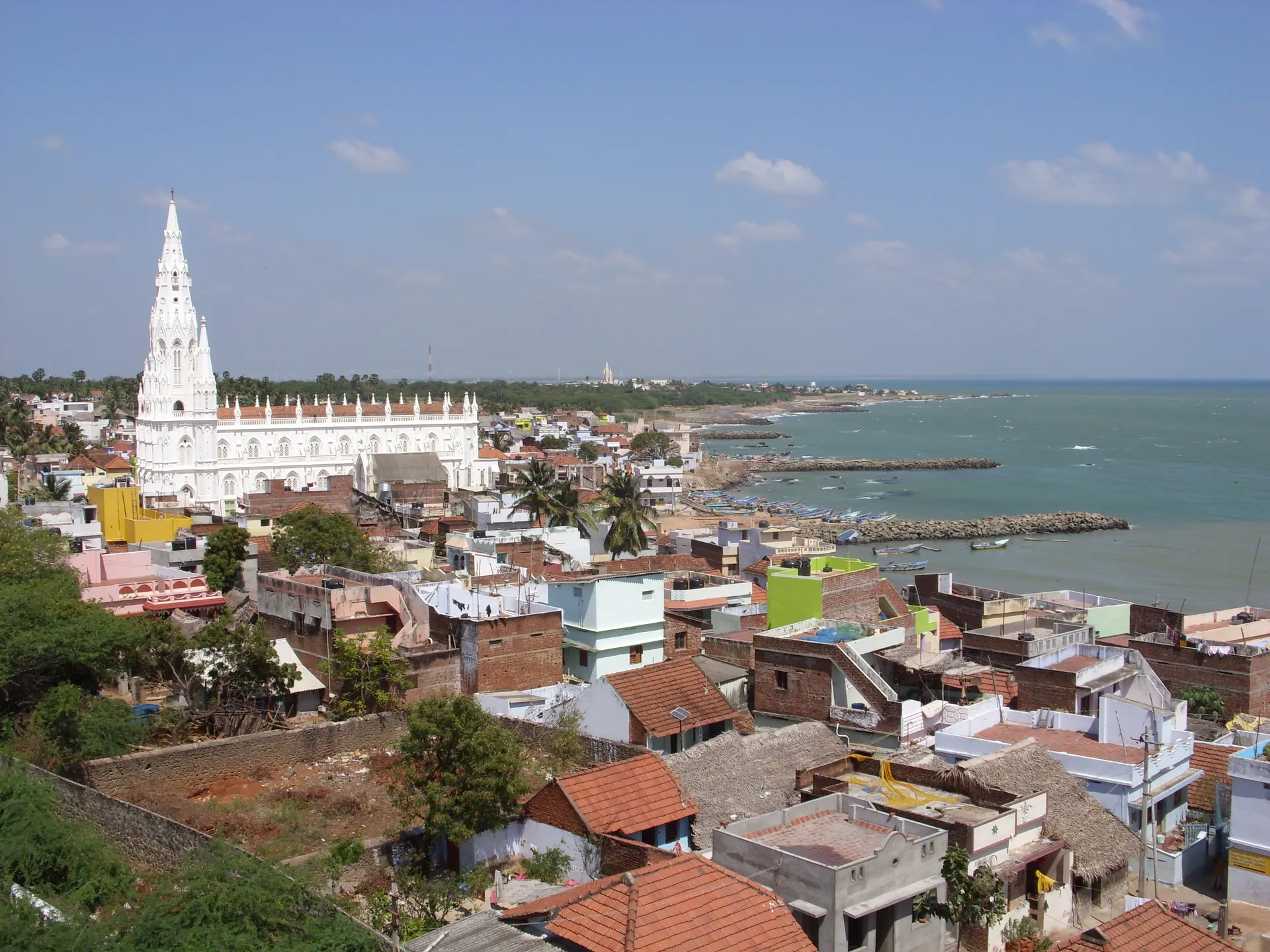
Our Lady of Ransom Church, Kanyakumari
Kanyakumari, Tamil Nadu, India
0.7 km away

Agasthiyar Falls (Papanasam)
Tamil Nadu, India
72.4 km away

Arulmigu Nellaiappar Temple, Tirunelveli, Tamil Nadu
Tirunelveli, Tamil Nadu, India
73.8 km away

Attukal Bhagavathy Temple, Thiruvananthapuram, Kerala
Thiruvananthapuram, Kerala, India
78.6 km away
Photo gallery
3 curated photos
Share a photo
Help visitors recognize Vivekananda Rock Memorial, Kanyakumari. Every submission is reviewed before publication.