Sherborne Abbey
Where Saxon saints and medieval craftsmen created a sanctuary that still draws pilgrims after thirteen centuries
Understand sacred places, explore living traditions, and learn how to engage respectfully with Pilgrim Map.
Access has not been verified. Check current local guidance before planning a visit.
Sherborne, England, United Kingdom
Read the sources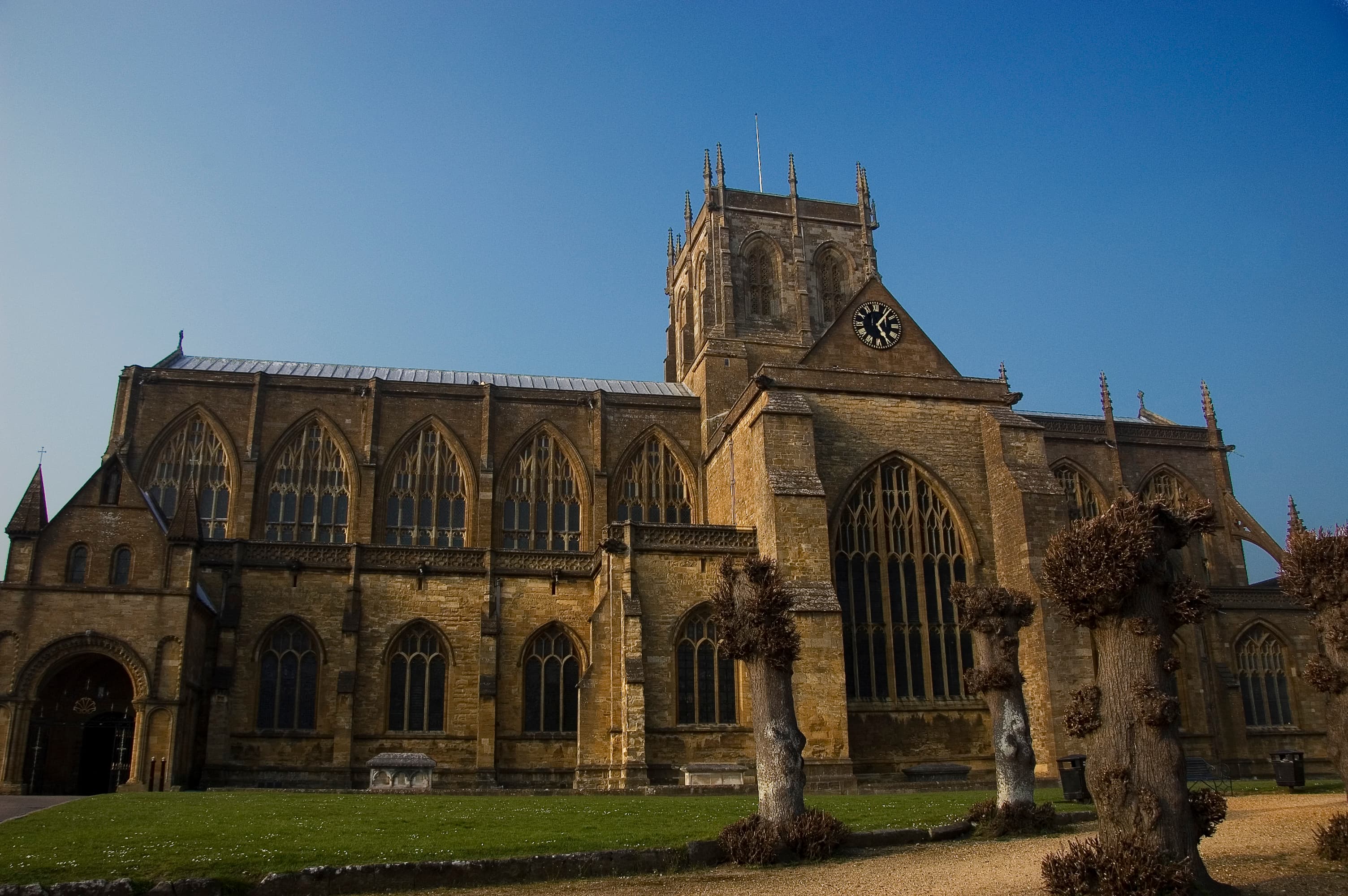
Visit essentials
A quick read before you go
- Duration
- 1-2 hours to follow the Pilgrim's Tour and engage contemplatively
- Access
- The abbey stands in the center of Sherborne, a market town on the Dorset/Somerset border.
Overview
Fifteenth-century masons worked Sherborne Abbey's fan vaulting into precise stone geometry. They did so without computers or power tools, creating geometry that still challenges explanation. Simon Jenkins compared it favorably to any work of the Italian Renaissance.
The vaulting crowns a much older place. St Aldhelm founded his cathedral here in 705. The Roman Empire was then a fading memory and England had not yet become England. For centuries its bishops governed a vast diocese from Dorset to Devon, and Benedictine monks prayed the daily offices for another five hundred years. Two sons of a Wessex king, elder brothers of Alfred the Great, chose this place for their burial.
Since the Dissolution, Sherborne's people have maintained the abbey as a parish church rather than letting it become a ruin. Morning communion follows the Book of Common Prayer, and Evensong sounds beneath the fan vaults. The abbey explicitly welcomes pilgrims in the hope that each visitor might leave transformed. Thirteen centuries of accumulated prayer remain joined to living worship.
Why this place is sacred
What makes a place sacred? At Sherborne Abbey, the answer unfolds in layers.
First, continuity. This ground has known Christian worship since 705 CE—over thirteen hundred years of prayer, praise, and petition. The original Saxon cathedral has been replaced and rebuilt, but the practice persists. Morning and evening, voices still rise. This unbroken thread of intention saturates the stones.
Second, sanctity. St Aldhelm, the founding bishop, was no ordinary administrator. A scholar who wrote elegant Latin verse, a musician who sang vernacular songs to gather crowds, a pastor who traveled his vast diocese until death took him on the road—he embodied a holiness that medieval people recognized. His presence shaped this place from its beginning.
Third, royal burial. Two Saxon kings rest here: Æthelbald and Ethelbert, elder brothers of Alfred the Great. Their tombs in the North Choir Aisle mark this as ground worthy of kings, a place where power sought to align itself with eternity.
Fourth, the architecture itself. The fan vaulting creates an experience that words struggle to capture. Looking up, you lose your bearings. The stone seems to defy gravity, to aspire toward something beyond stone. Medieval masons encoded their faith in geometry, and that geometry still speaks.
Finally, the active intention. The abbey does not merely preserve its heritage—it extends the invitation. Pilgrim's Tour leaflets guide visitors toward spiritual engagement. The stated hope is that guests will 'leave renewed, as a pilgrim.' This explicit welcome matters. The abbey remains not a museum but a living sacred space.
King Ine of Wessex founded Sherborne as a cathedral in 705 CE to serve the vast diocese of Western Wessex—territory covering Dorset, Somerset, Devon, and parts of Wiltshire. The pressure on Winchester had grown too great for a single bishop to manage. St Aldhelm, already Abbot of Malmesbury and kinsman to the king, became the first bishop. His mission included bringing Celtic Christians of the southwest into conformity with Roman practice, essentially completing the Christianization of Wessex.
The abbey's role has transformed repeatedly across thirteen centuries. Initially a cathedral (705-1075), it served as the seat of bishops governing a vast diocese. When Herman unified Sherborne with Ramsbury and moved the see to Old Sarum in 1075, Sherborne lost cathedral status but retained religious significance. In 998, St Wulfsige had already established a Benedictine monastery, and this community continued until the Dissolution in 1539.
The townspeople then purchased the church, preserving it as their parish church—a role it maintains today as part of the Church of England. What might have become another romantic ruin instead became a place of continuous living worship.
Experience and orientation
You enter through doors that have welcomed seekers for centuries. The nave opens before you, but almost immediately your gaze rises. The fan vaulting commands attention with its impossible precision—stone ribs spreading like frozen fountains, catching light, creating rhythm. For several minutes, you may simply stand and look up.
When your eyes descend, other details emerge. The reddish tint on some masonry recalls the fire of 1437, when conflict between monks and townspeople left its mark. The Saxon doorway in the northwest corner—a survivor from c.1050—connects you to the earliest building on this site. Side chapels hold quiet spaces for prayer or reflection.
The North Choir Aisle draws those interested in history. Here lie the tombs believed to hold King Æthelbald and King Ethelbert, elder brothers of Alfred the Great. Saxon kings who ruled Wessex now rest beneath stone effigies, their power long surrendered to time. Standing before them prompts reflection on what endures and what passes.
The Lady Chapel at the east end offers particular stillness. Steps lead down to a space apart, where light filters through stained glass and the bustle of visitors fades. Here the contemplative purpose of the abbey feels most accessible.
Throughout, the abbey balances heritage and living practice. This is not a museum. Candles burn. Service times are posted. The Pilgrim's Tour leaflet invites deeper engagement. The shop offers prayer cards and icons. The message is clear: whatever brought you here, you are welcome to seek more.
Most visitors enter through the main door on the south side. Inside, the nave stretches eastward toward the altar, with the famous fan vaulting overhead. The North Choir Aisle (left as you face the altar) contains the Saxon kings' tombs. The Lady Chapel lies at the east end, down a short flight of steps. The Saxon doorway (c.1050) survives in the northwest corner of the nave. The abbey shop is located in the North Aisle near the main entrance.
Guided tours run April through October on Tuesdays and Thursdays at 10:30am.
Context and lineage
In the early eighth century, the diocese of Winchester had grown unwieldy. King Ine of Wessex, recognizing the need for better pastoral care of his western territories, created a new diocese centered on Sherborne. For its first bishop, he chose his kinsman Aldhelm—already renowned as Abbot of Malmesbury, a scholar of Latin verse, and a man of evident holiness.
Aldhelm arrived in 705 to establish a cathedral that would serve as the spiritual center of western Wessex for the next 370 years. He was the first of 27 bishops of Sherborne, and his foundation set the pattern for all that followed.
The spiritual lineage of Sherborne Abbey flows through three distinct phases. First, the cathedral era (705-1075): bishops governed Western Wessex from here, with Aldhelm's example shaping the diocese's character. Second, the monastic era (998-1539): Benedictine monks followed the Rule of St Benedict, praying the daily offices and maintaining the abbey through the medieval period. Third, the parish era (1539-present): after the townspeople purchased the church at the Dissolution, it became an Anglican parish church, maintaining continuous worship to this day.
Each phase built upon its predecessors, creating the layered sacred identity the abbey holds today.
St Aldhelm
King Ine of Wessex
St Wulfsige III
King Æthelbald of Wessex
King Ethelbert of Wessex
Traditions and practice
The Benedictine monks who occupied Sherborne from 998 to 1539 followed the Rule of St Benedict. Their day was structured around the Opus Dei—the work of God—with eight daily offices: Matins, Lauds, Prime, Terce, Sext, None, Vespers, and Compline. Mass was celebrated daily. This rhythm of prayer shaped the building and saturated its stones with intention.
Today's abbey maintains a modified rhythm of daily prayer. Book of Common Prayer Communion is offered at 8am. The Parish Eucharist on Sundays at 9:30am gathers the community for shared worship. Choral Evensong at 6pm continues the abbey's strong musical tradition. The annual Sherborne Abbey Festival brings special concerts and events. Throughout, the abbey functions as both heritage site and working church.
For pilgrims and spiritual seekers, the abbey offers several paths of engagement. Pick up the Pilgrim's Tour leaflet near the entrance for guided contemplation of the abbey's spiritual highlights. Spend time before the Saxon kings' tombs, contemplating mortality and continuity. Sit in the Lady Chapel for quiet prayer. Light a candle as an offering. If timing permits, attend a service—the experience of worship under the fan vaulting is qualitatively different from mere visiting.
Allow at least an hour; rushing diminishes the encounter.
Church of England/Anglican
ActiveSince the Reformation, Sherborne Abbey has served as a Church of England parish church. The townspeople's decision to purchase and maintain the church in 1539 preserved it as a living place of worship rather than allowing it to fall into ruin.
Daily worship includes Book of Common Prayer Communion (8am), Parish Eucharist (Sundays 9:30am), and Choral Evensong (6pm). The abbey maintains a strong choral tradition and hosts regular concerts. It functions as the parish church of Sherborne, serving the local community while welcoming visitors from around the world.
Christian Pilgrimage
ActiveThe British Pilgrimage Trust recognizes Sherborne Abbey as a significant pilgrimage destination. The abbey itself explicitly welcomes pilgrims, hoping visitors will 'leave renewed, as a pilgrim.' The site connects to St Aldhelm's Way pilgrimage route.
The abbey offers a Pilgrim's Tour leaflet guiding visitors through spiritual highlights. Pilgrims may light candles, sit in prayer, attend services, and engage contemplatively with the sacred space. The approach differs from tourism in its intention: seeking transformation rather than information.
Benedictine Monasticism
HistoricalFrom 998 to 1539, Sherborne was a Benedictine abbey. The monks followed the Rule of St Benedict, shaping daily life around the Opus Dei—the liturgical offices that punctuated each day with prayer. This heritage profoundly influenced the building and its atmosphere.
The Benedictines prayed the eight daily offices, celebrated Mass, engaged in sacred reading (lectio divina), and balanced prayer with work. Their rhythm consecrated time itself, and echoes of this structure persist in the abbey's contemporary worship schedule.
Saxon Cathedral Christianity
HistoricalFrom 705 to 1075, Sherborne served as cathedral of Western Wessex—a vast diocese covering Dorset, Somerset, Devon, and parts of Wiltshire. St Aldhelm's establishment here marked the Christianization of the region and the assertion of Roman over Celtic practice.
Saxon bishops combined pastoral care with political influence. Aldhelm was known for his preaching, his scholarly writings, and his use of vernacular song to attract listeners. The 27 bishops of Sherborne shaped Christianity across southwestern England for nearly four centuries.
Perspectives and open questions
Sherborne Abbey invites interpretation through multiple lenses. Historians see one of England's most significant ecclesiastical sites. Architects encounter medieval craftsmanship of the highest order. Pilgrims find a place saturated with centuries of prayer. Each perspective reveals truth; none exhausts the abbey's meaning.
Scholarly perspective
Historians recognize Sherborne Abbey as exceptional in several dimensions. The documented history stretches from 705 CE—over thirteen centuries. The cathedral era (705-1075) produced 27 bishops and shaped Christianity across southwestern England. The Benedictine era (998-1539) maintained monastic practice through the medieval period. The fan vaulting (c.1490) represents the pinnacle of late Gothic engineering. The royal burials—brothers of Alfred the Great—connect the site to the most consequential dynasty in early English history. Few parish churches can claim such significance.
Living and traditional perspectives
From a traditional Christian perspective, Sherborne Abbey represents the establishment and continuity of faith in England. St Aldhelm's mission completed the Christianization of Wessex. The Benedictine centuries maintained the rhythm of prayer that medieval Christians understood as essential to cosmic order. The post-Reformation persistence of worship demonstrates the deep roots Christianity has put down in this soil. The abbey remains what it has always been: a place where humans reach toward the divine.
Alternative interpretations
Some seekers approach Sherborne Abbey through esoteric lenses. The geometric precision of the fan vaulting appeals to those interested in sacred geometry—mathematical relationships believed to encode spiritual truths. The 1,300-year accumulation of prayer is understood as creating perceptible energy. Aldhelm's reputation for healing and mystical experience suggests dimensions beyond ordinary history. These interpretations, while not verifiable, represent genuine engagement with the abbey's numinous quality.
Open questions
Much about Sherborne Abbey remains uncertain. Whether a Celtic Christian community preceded the Saxon foundation cannot be confirmed. The full extent of earlier buildings beneath the current structure is unknown. The identities of the masons who created the fan vaulting are lost. What other burials might lie undiscovered? The abbey keeps its secrets while continuing to welcome those who seek.
Plan your visit
Access and arrival
The abbey stands in the center of Sherborne, a market town on the Dorset/Somerset border. Sherborne railway station is a 10-minute walk, with regular services from London Waterloo and the West Country. By car, the town is accessible from the A30. Parking is available at Culverhayes Car Park, a 5-minute walk from the abbey. No parking within abbey grounds.
Sherborne offers various accommodation options: historic inns, B&Bs, and hotels. The Eastbury Hotel and The Grange are well-regarded options. The town itself is charming, with independent shops and good restaurants.
Respectful visit
No strict dress code applies, but modest attire appropriate for a place of worship is appreciated. Visitors attending services may wish to dress somewhat formally, though this is not required.
Photography is permitted throughout the abbey. Use discretion around those at prayer. Flash photography should be avoided if others are present. Consider the architecture deserves more than a quick snap—take time to truly see before reaching for the camera.
Candles are available for lighting as prayer offerings. Donations are welcomed to support the abbey's ongoing ministry and maintenance. The shop offers religious items including icons and prayer cards.
Access may be restricted during services, weddings, and funerals. The Lady Chapel requires descending steps. Guide dogs and assistance dogs are welcome. The abbey is wheelchair accessible for most areas.
Respect the abbey as a working church. During services, visitor access may be limited; check the website for times. Be mindful of others at prayer. Photography is permitted but should be exercised thoughtfully. The Lady Chapel requires descending steps and may not be accessible to all visitors.
Current practical details
Address
Abbey Cl, Sherborne DT9 3LQ, UK
Phone
Hours
Hours, fees, and access can change — verify on the official source before you travel. Practical details last checked Jun 2026.
Location
Map loads as you approach this section.
Pilgrim reflections
A portrait of encounter, not a score
Pilgrims describe what they felt, how present they could become, and whether the place would shape a journey. There are no stars and no ranking of traditions.
No reviewed reflections yet
The first pilgrims can help describe the character of being here.
Share a reflection
Available after an account-backed “Been there.” Every reflection is reviewed before publication.
Nearby sacred places
Explore other sacred places in the region. Proximity does not establish access or travel time; check each place’s guidance.


References
Sources consulted for this page. Source categories describe the publication, not a guarantee that every claim is verified. Traditional accounts and outside interpretations may differ.
- 01Sherborne Abbey — Sherborne AbbeySource contextOfficial abbey website
- 02Sherborne Abbey, Sherborne — British Pilgrimage TrustSource contextPilgrimage perspective
- 03Sherborne: Abbey Church of St Mary The Virgin — A Church Near YouSource contextChurch of England official directory
- 04Sherborne Abbey Educational Images — Historic EnglandofficialHeritage body educational resources
- 05Sherborne Abbey — WikipediaencyclopediaWell-referenced article
- 06Aldhelm — WikipediaencyclopediaDetailed biography of founding saint
Photo gallery
3 curated photos
Share a photo
Help visitors recognize Sherborne Abbey. Every submission is reviewed before publication.