Cerne Abas Giant
Ancient chalk figure where fertility seekers encounter masculine earth energy carved into Dorset's hillside
Understand sacred places, explore living traditions, and learn how to engage respectfully with Pilgrim Map.
Access has not been verified. Check current local guidance before planning a visit.
Cerne Abbas, England, United Kingdom
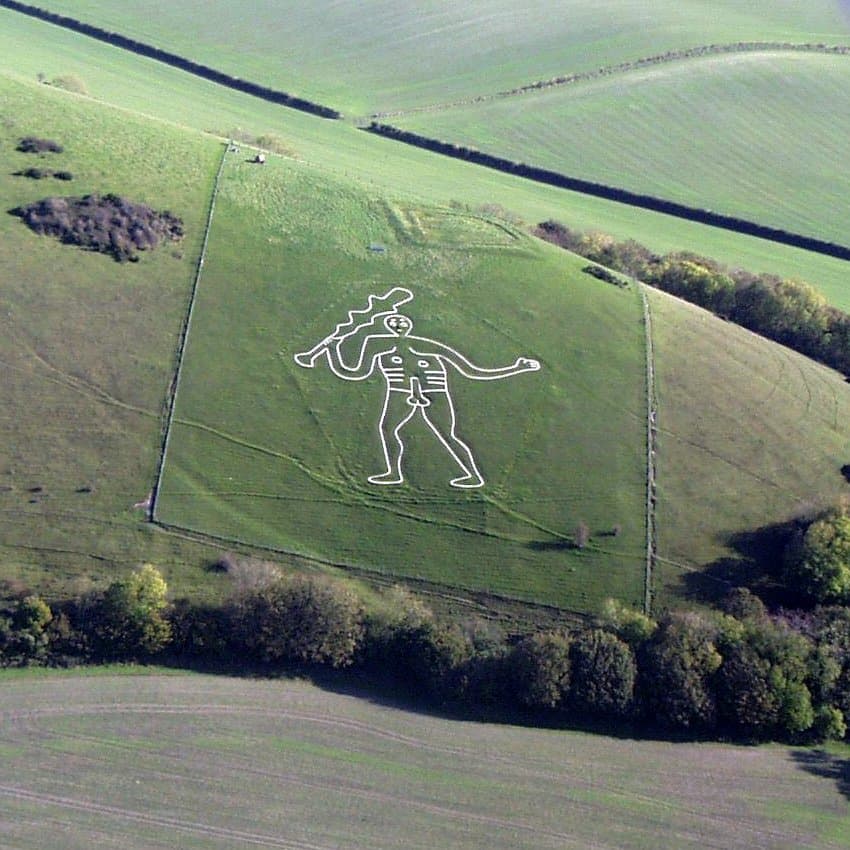
Image of Cerne Abas Giant. Image source · CC-BY-SA-3.0
Visit essentials
A quick read before you go
- Duration
- 1.5-2 hours including walk to Trendle and village exploration
- Etiquette
- The primary rule is simple: do not walk on the Giant.
Overview
On a steep hillside above Cerne Abbas, a naked chalk giant stands one hundred and eighty feet tall, raising a knotted club in his right hand while his erect phallus confronts visitors with power, fertility, and attachment to the land. Scientific dating places its creation in 700–1100 AD; recent Oxford research suggests Hercules and a possible Saxon warrior muster point, though the original meaning remains debated.
The Giant's explicit sexuality sustains a centuries-old fertility pilgrimage under National Trust stewardship. Above his head, the Trendle hosts May Day celebrations, while St Augustine's Well and abbey ruins in the village form a wider landscape where Christian and pre-Christian sacred streams meet.
Why this place is sacred
What creates the sense of presence here? The Giant offers no comfortable spiritual ambiguity. His sexuality is unambiguous, almost confrontational to modern sensibilities accustomed to sanitized sacred spaces. This very directness may be his power. The figure cuts through abstraction to something fundamental about human existence. Visitors report not transcendence in the usual sense but grounding: a connection to earth, body, and the cycles of generation that link us to all who came before.
The mystery of his origins intensifies this effect. We do not know who carved him or why, only that they chose to make this statement across an entire hillside. Whether he represents Hercules invoked by Saxon warriors, a Celtic fertility god, or something else entirely, he forces engagement with questions about power, sexuality, mortality, and continuity. The Trendle earthwork above his head suggests this hillside held significance long before the Giant was cut, layering meanings across millennia.
Current scholarly consensus, following 2024 Oxford research, suggests the Giant represents Hercules and may have served as a military muster point where Saxon warriors gathered before expeditions. The cult of Hercules persisted in Britain through the early medieval period. However, the original purpose remains debated, and fertility associations may be equally ancient.
The Giant has been maintained through regular re-chalking across centuries. Early modern antiquarians documented him but disagreed on his age and meaning. Victorian-era theories proposed prehistoric origins. A discredited 20th-century theory suggested he was a 17th-century satire of Oliver Cromwell. The 2021 OSL dating revolutionized understanding by confirming Saxon origins. Throughout this scholarly evolution, folk fertility traditions continued unbroken.
Experience and orientation
You see him first from the car park viewpoint across the valley. Even at this distance, the figure commands attention. The white lines of his body stand stark against the green hillside, his proportions surprisingly graceful despite the crude medium. The raised club suggests action, while his phallus makes an unmistakable statement.
Most visitors experience a moment of surprised laughter followed by something deeper: wonder at the scale, curiosity about origins, perhaps recognition of something primal that modern life tends to suppress. Walking closer changes the perspective without diminishing the power. From the hillside itself, the figure fragments into trenches and grass, legible only in parts. But the sense of presence remains. You are walking on ancient ground, maintained by countless hands across more than a thousand years.
The Trendle above offers wider views of the Dorset landscape while adding another layer of sacred geography. In the valley below, Cerne Abbas village clusters around its medieval church, its holy well and abbey ruins completing a complex sacred landscape where meanings accumulate rather than cancel each other out.
The National Trust viewpoint car park on the A352 provides the best complete view of the Giant. A panel explains the figure and recent dating research. From here, paths lead up the hillside for closer encounters, though walking on the figure itself is prohibited. The village of Cerne Abbas lies in the valley below, accessible by footpath or road.
Context and lineage
For centuries the Giant's origins remained mysterious. Local legend claimed villagers traced the outline of an actual giant who terrorized the area, killing him as he slept on the hillside. Antiquarians proposed various theories from prehistoric to Roman to medieval origins. The 2021 optically stimulated luminescence study, analyzing soil from the figure's trenches, finally provided scientific dating: 700-1100 AD, the Late Saxon period.
This overturned both prehistoric theories and the popular suggestion that the Giant was a 17th-century satire of Oliver Cromwell. In 2024, Oxford scholar Helen Gittos published research identifying the figure as likely Hercules, noting the club, nudity, and pose match classical depictions. The cult of Hercules persisted in Britain through the early medieval period. Gittos suggests the site may have served as a muster point where warriors gathered before military expeditions, invoking the hero's strength.
The Giant represents a tradition of British hill figures that includes the Uffington White Horse and Long Man of Wilmington. These chalk-cut images required regular maintenance and community commitment across centuries. The Giant's survival reflects the value successive generations placed on preserving him, whether for religious, cultural, or practical reasons.
Hercules (attributed identity)
Helen Gittos
Traditions and practice
The Giant's most persistent tradition connects to fertility. For centuries, couples unable to conceive have visited the figure, with some sleeping on or near the phallus in hopes of promoting conception. Written records of this practice extend back to at least the 18th century, though the tradition is likely much older. The Trendle earthwork above the Giant's head has been a site of May Day celebrations with maypole dancing, connecting to widespread British Beltane traditions honoring spring fertility.
Fertility pilgrimage continues today, with couples visiting from around the world. The National Trust accommodates this tradition while protecting the figure from erosion. May Day gatherings at the Trendle remain active, drawing participants interested in folk traditions and earth-based spirituality. The Giant is included in pilgrimage routes connecting Dorset's sacred sites, often combined with visits to St Augustine's Well in the village and the nearby abbey ruins.
Approach the Giant with openness to whatever arises. The viewpoint car park offers contemplative space for meditation on themes of fertility, mortality, power, and continuity. Walking the hillside around the figure (not on it) allows closer encounter with the scale and presence. For deeper engagement, visit the village to see St Augustine's Well and abbey ruins, then return to the viewpoint at different times of day to observe how light transforms the figure.
Fertility pilgrimage
ActiveThe Giant's prominent phallus has made him a fertility symbol for centuries, possibly since his creation. Couples unable to conceive visit seeking blessing, continuing an ancient tradition.
Visitors come to pray, meditate, or simply hope near the figure. Historically, some slept on or near the phallus. Today, the National Trust prohibits walking on the Giant, but the fertility tradition continues through visits and offerings at the viewpoint.
Earth-based spirituality
ActiveThe Giant attracts practitioners who see him as embodying masculine earth energy, the Horned God, or the vital force of nature. His explicit form is understood as sacred expression of divine creativity.
Meditation at the viewpoint, seasonal celebrations (especially May Day), offerings, and rituals honoring the sacred masculine. The Giant often appears in pilgrimage routes connecting Britain's sacred sites.
May Day celebration
ActiveThe Trendle earthwork above the Giant's head hosts traditional May Day celebrations with maypole dancing, connecting to widespread British Beltane customs.
Gatherings on May 1st include maypole dancing, music, and celebration of spring fertility. The Giant's presence below adds explicit fertility symbolism to these observances.
Saxon Hercules cult
HistoricalRecent research suggests the Giant was created as a representation of Hercules, possibly for military gatherings. The hero's cult persisted in Britain through the early medieval period.
If this interpretation is correct, the site may have hosted military musters where warriors gathered before expeditions, invoking Hercules's strength and protection.
Perspectives and open questions
The Giant's interpretation has shifted dramatically with recent scientific research, though mystery persists. Different communities approach the figure through different lenses.
Scholarly perspective
The 2021 OSL dating study established the Giant was created 700-1100 AD, during the Late Saxon period. This overturned theories of prehistoric or 17th-century origin. The 2024 Oxford research by Helen Gittos proposes the figure represents Hercules, likely serving as a military muster point. The Hercules cult remained active in Britain through this period. The club and nudity match classical depictions. However, fertility associations may be equally ancient, and the original purpose remains debated.
Archaeological investigation of the Trendle earthwork suggests pre-Giant activity on the hillside.
Living and traditional perspectives
British folk tradition has long associated the Giant with fertility, regardless of scholarly interpretation. The giant-killing origin story represents folk rationalization of a mysterious ancient figure. May Day celebrations at the Trendle connect to widespread British spring fertility customs predating Christianity. The figure's preservation across centuries reflects community valuation transcending individual belief systems.
Alternative interpretations
Practitioners of earth-based spirituality see the Giant as a powerful expression of masculine earth energy. Some identify him with the Horned God of Wiccan tradition or Celtic fertility deities. The figure's explicit sexuality is understood as sacred rather than obscene, representing divine generative power. The site appears in ley line theories connecting Britain's sacred geography. The Giant is honored as a phallic god embodying vitality and the creative force of nature.
Open questions
Fundamental questions remain unanswered. Why was this hillside chosen? What was the figure's original purpose? How has the image changed through re-chalking across centuries? What was the relationship between the Giant and the nearby Benedictine abbey, founded in 987 AD within the figure's likely creation window? Did the monks create, tolerate, or try to suppress this pagan image? The tension between the Giant's explicit sexuality and the presence of a major monastery nearby remains unexplained.
Plan your visit
Access and arrival
Cerne Abbas village offers charming B&Bs and holiday cottages within walking distance of the Giant. The Royal Oak and New Inn provide traditional pub accommodation. Dorchester (8 miles) offers wider hotel selection. The village makes an excellent base for exploring Dorset's sacred landscape.
Respectful visit
No specific requirements. Sturdy footwear recommended for hillside walking. Dress appropriately for Dorset weather, which can change quickly.
Photography is freely permitted and encouraged. The viewpoint offers optimal angles for capturing the complete figure. Dawn and dusk light create dramatic effects.
Some visitors leave small offerings near the viewpoint. Nothing should be placed on the figure itself. Any offerings should be biodegradable and removed if they become unsightly.
Do not walk on the Giant under any circumstances. This causes erosion and damages the monument. Dogs must be controlled. The site is on open access land but the figure itself is protected.
Never walk on the Giant itself. The chalk is fragile and erosion threatens the figure's survival. The National Trust asks visitors to respect this boundary. The hillside can be slippery when wet. Dogs should be kept under control.
Current practical details
Address
The Giant Inn, 24 Long St, Cerne Abbas, Dorchester DT2 7AL, UK
Phone
Hours
Hours, fees, and access can change — verify on the official source before you travel. Practical details last checked Jun 2026.
Location
Map loads as you approach this section.
Pilgrim reflections
A portrait of encounter, not a score
Pilgrims describe what they felt, how present they could become, and whether the place would shape a journey. There are no stars and no ranking of traditions.
No reviewed reflections yet
The first pilgrims can help describe the character of being here.
Share a reflection
Available after an account-backed “Been there.” Every reflection is reviewed before publication.
Nearby sacred places
Explore other sacred places in the region. Proximity does not establish access or travel time; check each place’s guidance.


Share a photo
Help visitors recognize Cerne Abas Giant. Every submission is reviewed before publication.