Sanctuary of Our Lady of the Head
A Black Madonna on a remote Sierra Morena summit, and one of Spain's oldest romerías
Understand sacred places, explore living traditions, and learn how to engage respectfully with Pilgrim Map.
Access has not been verified. Check current local guidance before planning a visit.
Andújar, Jaén, Spain
Read the sources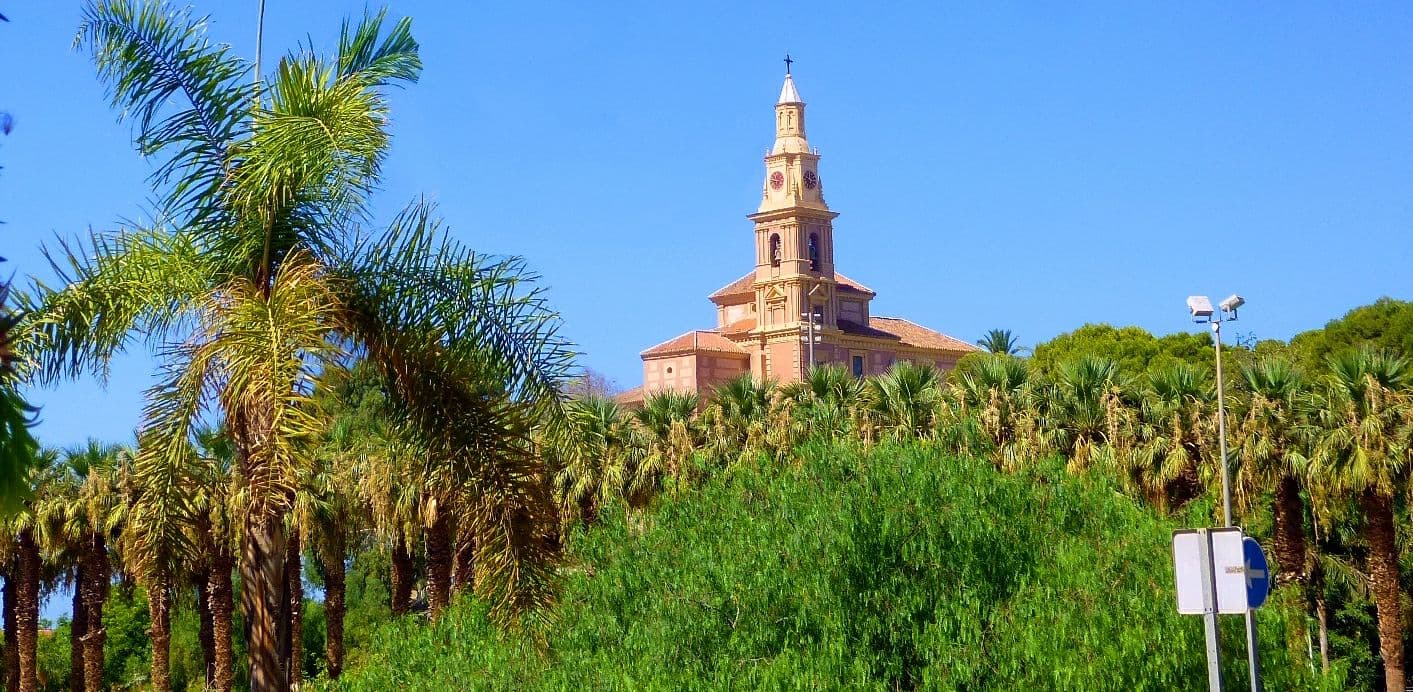
Image of Sanctuary of Our Lady of the Head. Image source
Visit essentials
A quick read before you go
- Duration
- A basilica-only visit can be completed in one to two hours.
- Access
- Located about 32 km north of the city of Andújar via the A-6177 road, within the Sierra de…
Overview
Nuestra Señora de la Cabeza sits on the Cerro del Cabezo, a granite summit deep in the Sierra Morena, reached today through a nature reserve better known internationally for the Iberian lynx than for its shrine. The remoteness is not incidental.
According to tradition, a shepherd named Juan Alonso de Rivas found the small image lodged between two rocks on the night of August 11–12, 1227, after mysterious lights and bells drew him up the hill — and was healed of a paralyzed arm in the encounter.
Whether or not the date holds up to scrutiny, the basic shape of the story — image hidden, image found, hill made holy — recurs across Iberian Marian devotion, and it is the shape this sanctuary tells about itself.
What is much better documented is one of the oldest continuously observed pilgrimages in Spain.
The shrine's history is not only devotional. For nine months in 1936–37, the sanctuary was besieged during the Spanish Civil War, held by Nationalist loyalists against Republican forces until it fell on May 1, 1937, in ruins. The building was rebuilt after the war. Both stories — the shepherd's healing and the siege — belong to this hilltop, and neither erases the other.
Why this place is sacred
Tradition places the founding miracle on the night of August 11–12, 1227: the shepherd Juan Alonso de Rivas, suffering paralysis in his arm, followed strange lights and the sound of bells to the Cerro del Cabezo, where he found a small image of the Virgin between two granite blocks. The Virgin asked him to build a temple on the spot and healed his arm.
A separate and older devotional strand traces the image's presence in the region even earlier, to a legend involving St. Euphrasius, a disciple of the apostle James and reputed first bishop of Andújar, with the image said to have been hidden on the hill during the eighth-century Moorish occupation before its rediscovery.
These are legends, not documented history, and the research behind this content did not find independent corroboration for either — but their persistence across centuries of retelling is itself part of what makes the hill significant to those who visit it.
What elevates this beyond a single origin story is the physical setting: a remote, granite-crowned summit roughly 619 to 686 meters up in the Sierra Morena, difficult to reach even now and considerably more so before roads existed.
That difficulty was not incidental to the site's sanctity — it was, by tradition, the reason the image could be hidden safely during Moorish rule, and centuries later the same isolation made the sanctuary defensible enough to be fought over for nine months during the Civil War. A place set apart by distance and stone has repeatedly become a place set apart by history as well.
The romería itself is a third register of thinness: not a single miraculous event but nearly seven centuries of accumulated, repeated ascent. Pilgrims have been documented making this climb since at least 1485, with confraternity statutes formalized in 1505 — making the observance one of the oldest continuously running pilgrimages in Spain, predating the more famous version of many other Iberian romerías by generations.
The site's original and enduring purpose is Marian veneration centered on the image discovered, by tradition, in 1227 — understood by the faithful as a site of ongoing intercession rather than a historical monument. Construction of the first sanctuary church on the site began between 1287 and 1304, formalizing what had likely already become a place of pilgrimage.
The sanctuary was substantially rebuilt in the late sixteenth and early seventeenth centuries under the Renaissance architect Andrés de Vandelvira — the chancel begun in 1534, the main facade balcony completed in 1607 — transforming what had likely been a modest medieval structure into a more imposing basilica.
Papal recognition followed in the twentieth century: patroness of Andújar in 1909, patroness of the Diocese of Jaén in 1959, and in 2009 the rare honor of the Golden Rose from Pope Benedict XVI, making this the first Marian image in Spain to receive it.
Between these honors sits the 1936–37 siege, which left the building in ruins; restoration from 1945 was directed by Francisco Prieto Moreno, also curator of the Alhambra, and the basilica was elevated to minor basilica status in 2010.
Experience and orientation
Outside the romería, the sanctuary is a quieter destination: a basilica reached by a scenic but real drive into a nature reserve, with the building itself emerging on a rugged hilltop rather than announcing itself from a distance.
Visitors who come for the wildlife — the surrounding Sierra de Andújar Natural Park is one of Europe's best chances to see the endangered Iberian lynx, alongside imperial eagles and black vultures — often encounter the shrine almost incidentally, which gives the visit a different character than a purpose-built pilgrimage stop.
During the last weekend of April, that changes completely. Pilgrims arrive by the tens of thousands, on foot, horseback, and tractor-drawn carriage, along the roughly 32-kilometer route from Andújar, stopping to sing Salves and dance and share meals at waypoints like Lugar Nuevo.
Confraternities from across Andalusia, Castile, Madrid, Catalonia, and parts of Latin America arrive in distinctive costume, and the weekend culminates in the Sunday procession of La Morenita carried on pilgrims' shoulders around the basilica grounds — a moment visitors describe as combining intense devotion with an almost carnival-like communal joy, two registers that don't usually sit this close together elsewhere.
If visiting outside the romería, treat it as a natural-park destination as much as a shrine visit — the basilica alone can be seen in an hour or two, but the surrounding sierra rewards a half or full day. If visiting during the romería, come prepared for crowds, heat, and heavy traffic on rural roads, and expect the experience to be as much about the collective, festive pilgrimage culture as about individual contemplation before the image.
Context and lineage
By tradition, on the night of August 11–12, 1227, the shepherd Juan Alonso de Rivas — suffering paralysis in his arm — was drawn by mysterious lights and bell sounds to the Cerro del Cabezo, where he found a small image of the Virgin lodged between two granite blocks. The Virgin asked him to build a temple on the spot and healed his arm. A separate, older devotional strand attributes the image's presence in the region to St.
Euphrasius, a disciple of the apostle James and reputed first bishop of Andújar, with the image hidden on the hill during the eighth-century Moorish occupation and rediscovered centuries later. Construction of the original sanctuary church began between 1287 and 1304; the building was substantially rebuilt in the Renaissance style under architect Andrés de Vandelvira, with the chancel begun in 1534 and the main facade balcony completed in 1607.
Organized pilgrimage to the site is documented from at least 1485, with confraternity statutes confirmed in 1505, giving it a continuous devotional lineage of more than five centuries independent of the founding legend's own, less verifiable, 1227 date. The romería was declared a Festivity of National Tourist Interest in 1980 and inscribed as a Cultural Heritage Asset of Andalusia in 2013.
The sanctuary itself endured near-total destruction in the 1936–37 siege and was rebuilt from 1945 onward, receiving minor basilica status in 2010 — a twentieth century that added both grave rupture and its highest papal honor to a much older devotional line.
Juan Alonso de Rivas
historical
Shepherd from Colomera credited by tradition with discovering the image in 1227 and being healed of a paralyzed arm.
Andrés de Vandelvira
historical
Renaissance architect who directed the major sixteenth- and seventeenth-century rebuilding of the sanctuary.
Captain Santiago Cortés
historical
Nationalist commander who led the defense of the sanctuary during the 1936–37 siege and died of wounds after the final assault.
Francisco Prieto Moreno
historical
Architect and curator of the Alhambra who directed the sanctuary's postwar restoration from 1945.
Nuestra Señora de la Cabeza
deity
The Black Madonna image at the center of the sanctuary's devotion; patroness of Andújar (1909) and the Diocese of Jaén (1959), awarded the Golden Rose by Pope Benedict XVI in 2009.
Traditions and practice
The romería's core ritual is the ascent to the sanctuary followed by veneration of the image, culminating in a Sunday procession in which La Morenita is carried on the shoulders of the faithful around the basilica grounds. The pilgrimage was originally held in September before shifting to its current late-April date sometime in the late Middle Ages.
Pilgrims travel the roughly 32-kilometer route from Andújar by foot, horseback, or tractor-drawn carriage over the last Saturday and Sunday of April, stopping en route — notably at a waypoint called Lugar Nuevo — to sing Salves, dance, and share meals. Confraternities from across Andalusia, Castile-La Mancha, Castile y León, Madrid, Valencia, Catalonia, and parts of Latin America participate, each in distinctive costume with decorated harnesses for their animals.
Visitors who cannot attend the romería but want a comparable register of engagement might attend a regular Mass at the basilica, or spend time at the museum's collection of seventeenth-century paintings depicting the historic pilgrimage — a way to sense the weight of five centuries of repeated ascent even outside the pilgrimage weekend itself.
Roman Catholic Marian devotion
ActiveThe Virgen de la Cabeza is patroness of Andújar (declared by Pope Pius X in 1909) and of the Diocese of Jaén (declared by Pope John XXIII in 1959). She is one of Spain's most venerated Black Madonnas, known affectionately as 'La Morenita.' In 2009 Pope Benedict XVI awarded her the Golden Rose, making her the first Marian image in Spain to receive this honor.
Regular Mass, individual veneration and prayer, votive offerings, and the annual romería culminating in the procession of the image around the sanctuary carried on pilgrims' shoulders.
Romería de la Virgen de la Cabeza
ActiveConsidered one of the oldest romerías in Spain, with documented celebration since at least 1485 and confraternity statutes confirmed in 1505. Declared a Festivity of National Tourist Interest in 1980 and inscribed as a Cultural Heritage Asset of ethnological character in Andalusia's General Catalog of Historical Heritage in 2013. It draws up to 250,000 pilgrims annually.
Pilgrims travel on foot, horseback, or in tractor-drawn carriages along the roughly 32 km route from Andújar, stopping to sing Salves and dance, often sharing meals at a waypoint called Lugar Nuevo. The event runs Saturday through Sunday of the last weekend of April, ending in the descent and procession of La Morenita through the sanctuary grounds.
Legend of the shepherd Juan Alonso de Rivas
HistoricalThe foundational miracle narrative of the sanctuary: a shepherd from Colomera, suffering paralysis in his arm, followed strange lights and bell sounds to the Cerro del Cabezo, where he found the small image of the Virgin between granite blocks and was healed after she asked him to build a temple there.
Retold in devotional literature and local tradition; commemorated symbolically each year through the pilgrimage's ritual ascent of the same hill.
Civil War siege memory (1936–1937)
HistoricalFor nine months (September 14, 1936 – May 1, 1937), roughly 1,200 civil guards, falangists, and civilians loyal to the Nationalist uprising held the sanctuary against Republican forces, resupplied partly by air drops and carrier pigeons, before being overrun on May 1, 1937. The siege left the building in ruins; it was rebuilt after the war under architect Francisco Prieto Moreno, curator of the Alhambra. The episode remains a landmark of Civil War history in Andalusia and, for some, a politically charged memory site.
No devotional ritual specifically re-enacts the siege, but it is commemorated in local historical memory, museum displays, and published histories such as Antonio Marín Muñoz's account of the siege.
Perspectives and open questions
The sanctuary asks visitors to hold three distinct registers together: a medieval apparition legend, a well-documented five-century pilgrimage tradition, and a twentieth-century military siege that is, for some in Spain, still a politically charged memory rather than settled history.
Scholarly perspective
Historians treat the 1227 apparition account as a foundational devotional legend typical of medieval Iberian Marian cults, with the documented, verifiable history of organized pilgrimage beginning by at least the late fifteenth century — a 1485 celebration and 1505 confraternity statutes are independently attested, regardless of how the earlier apparition date holds up.
The 1936–37 siege is treated as a well-documented episode of the Spanish Civil War, notable both for its nine-month length and for the propaganda and symbolic weight it carried for the Nationalist cause during and after the war.
Living and traditional perspectives
Within Catholic devotional tradition, the site is understood as the authentic location of a Marian apparition and an ongoing site of miraculous intercession, with the Virgin's patronage of Andújar and the Diocese of Jaén treated as an established spiritual reality, reaffirmed by successive papal honors including the 2009 Golden Rose.
Alternative interpretations
As with many Black Madonna shrines across Europe, some writers outside mainstream Catholic or academic historiography have linked such images to pre-Christian or syncretic devotional continuities at mountain and hilltop sites. No site-specific scholarship substantiating such a claim for this particular shrine was found during research, so this remains a broader pattern applied to the site rather than a documented feature of it.
Open questions
The precise origins and dating of the devotional image itself, prior to 1227, are not independently documented beyond legend; the St. Euphrasius origin story belongs to devotional tradition rather than verified history. The exact scale of destruction and rebuilding across the medieval, Vandelvira-era, and post-1937 structures is not fully disentangled across the sources reviewed.
The 1936–37 siege's meaning also remains genuinely contested in Spanish public memory — some remember it as a Nationalist symbol of resistance, others read it within the broader, still-debated politics of the Civil War — and this content presents it as documented history rather than adopting either partisan framing.
Plan your visit
Access and arrival
Located about 32 km north of the city of Andújar via the A-6177 road, within the Sierra de Andújar Natural Park in the Sierra Morena mountains. A private vehicle is the most practical way to visit outside the romería.
Mobile phone signal should be assumed unreliable once inside the natural park's mountainous terrain; no site-specific signal information was confirmed in the sources reviewed, so visitors relying on connectivity should plan accordingly, and the nearest reliable signal and settlement is Andújar, roughly 32 km away.
No specific accommodation information for the sanctuary itself was available at time of writing; check the Sierra de Andújar Natural Park visitor centers (Cercado del Ciprés, Viñas de Peñallana) or the town of Andújar, about 32 km away, for current lodging options.
Respectful visit
General photography of the exterior, grounds, and pilgrimage is common and widely documented in tourism and press coverage. Photography during active Mass or of the image itself may be restricted, as is customary at Spanish shrines, though no official policy document was located.
Votive candles and personal petitions are customary, consistent with broader Spanish Marian shrine practice; no site-specific offering ritual beyond general veneration was documented.
No unusual access restrictions apply beyond standard visiting hours. Because the sanctuary sits within the Sierra de Andújar Natural Park, visitors should follow park rules regarding wildlife (this is Iberian lynx habitat) and road access, particularly during the high-traffic romería weekend.
The romería is a genuine devotional and civic occasion for tens of thousands of participants, not a staged event for visitors; those attending as observers should be mindful of confraternity processions and avoid treating the Sunday procession primarily as a photo opportunity.
Location
Map loads as you approach this section.
Pilgrim reflections
A portrait of encounter, not a score
Pilgrims describe what they felt, how present they could become, and whether the place would shape a journey. There are no stars and no ranking of traditions.
No reviewed reflections yet
The first pilgrims can help describe the character of being here.
Share a reflection
Available after an account-backed “Been there.” Every reflection is reviewed before publication.
Nearby sacred places
Explore other sacred places in the region. Proximity does not establish access or travel time; check each place’s guidance.


References
Sources consulted for this page. Source categories describe the publication, not a guarantee that every claim is verified. Traditional accounts and outside interpretations may differ.
- 01Romería de la Virgen de la Cabeza — Patrimonio Cultural Inmaterial de España — Ministerio de Cultura, Gobierno de EspañaofficialOfficial Spanish Ministry of Culture intangible heritage record; medieval origins, original September date shifted to late April, national heritage recognitions
- 02Romería de la Virgen de la Cabeza — Turismo de Andújar — Ayuntamiento de Andújar (Turismo de Andújar)officialMunicipal tourism office information on the sanctuary, pilgrimage route, and visitor logistics
- 03Pilgrimage of Nuestra Señora de la Cabeza — spain.info — Turespaña (Spain's national tourism board)officialOfficial national tourism board confirmation of the last-Sunday-of-April pilgrimage date and its status as one of Spain's oldest romerías
- 04Santuario de la Virgen de la Cabeza — Andalucía.org — Junta de Andalucía (official tourism board)officialRegional tourism board listing with visitor/location details, second most visited Andalusian sanctuary
- 05Sierra de Andújar Natural Park — spain.info — TurespañaofficialNatural park context: Iberian lynx, imperial eagle, black vulture habitat surrounding the sanctuary; visitor centers (Cercado del Ciprés, Viñas de Peñallana)
- 06Our Lady of Cabeza — Wikipedia — Wikipedia contributorsencyclopediaApparition legend, coronation dates (1909, 1959, 2009 Golden Rose), Black Madonna classification, patronage of traditional Spanish hunts
- 07Siege of Santuario de Nuestra Señora de la Cabeza — Wikipedia — Wikipedia contributorsencyclopediaCivil War siege dates (14 Sept 1936 - 1 May 1937), defenders/besiegers, casualties, aerial resupply, outcome
- 08Basílica de Nuestra Señora de la Cabeza — Wikipedia (Spanish) — Wikipedia contributorsencyclopediaArchitectural history, Vandelvira rebuilding 1534-1607, 1945 post-war restoration by Prieto Moreno, 2010 minor basilica designation
- 09History — Cofradía Matriz de la Virgen de la Cabeza — Cofradía Matriz de AndújarspiritualOfficial confraternity account of the romería's history and devotional practice
- 10Virgen de la Cabeza Pilgrimage — iHeritage — iHeritage.euguidePilgrimage since at least 1485, brotherhood statutes confirmed 1505, declared Festivity of National Tourist Interest 1980, pilgrim numbers up to 250,000
- 11History and miracles of the Pilgrimage of the Virgen de la Cabeza de Andújar — idealista/newsnewsApparition legend detail (shepherd Juan Alonso de Rivas from Colomera, healed arm), 8th-century hiding of the image during Moorish occupation, St. Euphrasius origin tradition
Share a photo
Help visitors recognize Sanctuary of Our Lady of the Head. Every submission is reviewed before publication.