Sanctuary of Our Lady of Lapa
A Marian image still housed inside the living granite that hid it
Understand sacred places, explore living traditions, and learn how to engage respectfully with Pilgrim Map.
Access has not been verified. Check current local guidance before planning a visit.
Sernancelhe, Viseu, Portugal
Read the sources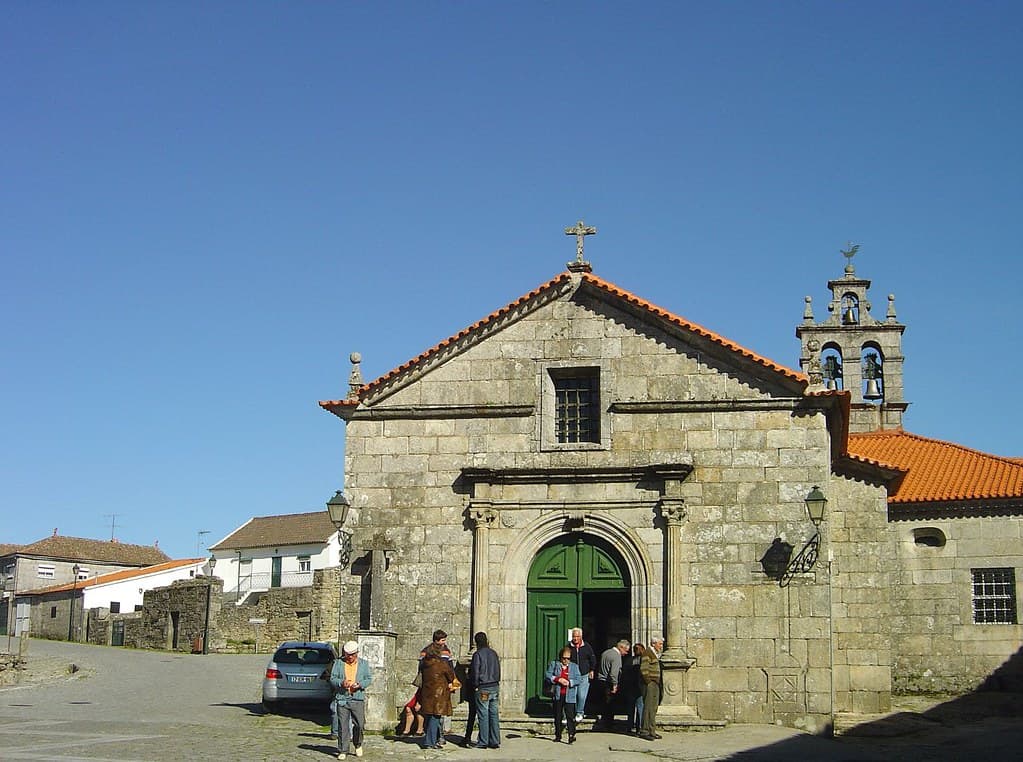
Image of Sanctuary of Our Lady of Lapa. Image source
Visit essentials
A quick read before you go
- Access
- Located in the parish of Quintela, municipality of Sernancelhe, Viseu district, Diocese of…
- Etiquette
- As an active parish church, Lapa expects the general modest dress and quiet conduct customary at…
Overview
Before the church stood a boulder—a lapa, or natural granite shelter. The sanctuary raised around it in the early 17th century kept the rock visible, including the niche where tradition says a devotional image was found.
Local tradition holds that nuns fleeing a late-10th-century raid hid a small Virgin image inside the rock. Around 1498—a minority of sources say 1493—a shepherdess named Joana, reportedly mute from birth, found it while tending her flock. When her disbelieving mother tried to burn it, tradition says the image did not burn, the mother's arm became paralyzed, and Joana cried out, restored to speech.
The Society of Jesus assumed the site in the 1550s and built the surviving Baroque church around the boulder. Pilgrims still attempt the Quelha da Lapa, a narrow rock fissure traditionally understood as passable only by the sinless: less an attraction than a private reckoning.
Why this place is sacred
What sets Lapa apart from many Marian shrines is architectural rather than purely narrative: the granite boulder is not a relic displayed inside a church, it is part of the church, structurally present in a way a statue in a niche cannot be. The original opening where the image was reportedly found is preserved and visible, so the founding story and the physical fabric of the building remain the same object rather than separated by a display case.
The Quelha da Lapa, a narrow fissure through the rock, extends this quality into ritual: tradition holds that only those free of serious sin can pass through it, turning a piece of geology into a recurring, personal test rather than a monument to be observed. Sources describe pilgrims still attempting the passage today as a moment of self-examination rather than spectacle.
According to local legend, a large lizard effigy suspended inside the sanctuary has two competing explanations circulating locally: one involving a woman who killed a giant lizard by invoking Our Lady of Lapa, another tying it to a vow fulfilled after a peril suffered in India. Perhaps because neither account traces to an independent source, both are treated here as folklore layered onto the site's Marian cult rather than settled history.
The site's original purpose, as far as any source documents, was devotional from its earliest recorded moment: a natural rock shelter used to conceal a sacred image, later marked by a chapel once the image was rediscovered.
A traditional chapel is said to have been erected in 1498; the present Baroque sanctuary was built mainly between 1610 and 1635 under Jesuit administration, with construction and expansion continuing to 1714. The Jesuits used Lapa as a base to spread Marian devotion into Portugal's colonial territories, including India and Brazil — a separate Bom Jesus da Lapa shrine in Bahia shares the name but has a distinct history.
The Society's administration ended with the Jesuit suppression in the mid-18th century; although it holds no UNESCO designation, the sanctuary received Portuguese national heritage protection (Imóvel de Interesse Público) in 1951.
Experience and orientation
Visitors and pilgrims commonly describe attempting to pass through the narrow Quelha da Lapa fissure as a test of conscience, viewing the granite boulder integrated directly into the church interior, and observing the suspended giant lizard effigy alongside its competing local explanations. Pilgrims report the site as a place for fulfilling vows made during hardship or illness.
Context and lineage
According to tradition, nuns fleeing forces associated with the Caliphate-era raider Almançor hid a small image of the Virgin Mary beneath a boulder near Quintela in the late 10th century, sealing it inside a natural grotto — sources vary on whether this should be dated to the 9th or late 10th century, and the event rests entirely on oral tradition rather than documentary record.
According to legend, in 1498 (a minority of sources say 1493) a young shepherdess named Joana, mute since birth, discovered the hidden image while tending her flock near the rock. When her mother, disbelieving the discovery, tried to cast the image into a fire, tradition holds that the image remained unburned, the mother's arm became paralyzed, and Joana miraculously regained her speech.
A local legend also explains a giant lizard effigy hanging inside the sanctuary, with two competing, unverified versions: in one, a woman carrying weaving thread killed an enormous lizard on a mountain path by invoking Our Lady of Lapa and throwing her thread to choke it; in another, the effigy fulfills a vow made by someone who survived a peril in India.
For roughly two centuries, the Society of Jesus administered the sanctuary and its adjoining Colégio da Lapa (1685-1759), teaching Latin, logic, and moral philosophy while using the site as a base to promote Marian devotion into Portugal's colonial territories. The Jesuit suppression ended that administration in the mid-18th century; a further disruption came with an 1910 Republican-era confiscation of church property.
The sanctuary today functions as an active parish shrine within the Diocese of Lamego, overseen by a local confraternity (Irmandade da Lapa).
Joana
traditional
The shepherdess, said in tradition to have been mute since birth, credited with discovering the hidden Marian image around 1498 and being restored to speech in the Virgin's presence.
King Sebastian
historical
The Portuguese king who granted the Society of Jesus administration of the sanctuary in the 1550s, formalizing Jesuit oversight of the site.
Pope Gregory XIII
ecclesiastical
Confirmed the Jesuit administration of Lapa in 1575.
Traditions and practice
Novena prayer cycles preceded the June and August feasts historically, and ex-voto offerings, including royal treasures, were left at the shrine in thanksgiving. The image was processed on a platform to a small 18th-century chapel during the main romaria.
Three annual romarias continue — 10 June, 15 August, and the first Sunday of September — organized with the local Irmandade da Lapa, alongside scheduled parish Masses and guided visits highlighting the rock, the narrow passage, and a permanent nativity scene.
Visitors curious about the Quelha da Lapa ritual can approach it as tradition frames it — a moment of private self-examination rather than a curiosity to be photographed from inside. Visiting outside the three romaria dates offers a quieter encounter with the rock chapel itself.
Roman Catholic Marian devotion (Our Lady of Lapa / Nossa Senhora da Lapa)
ActiveCentral devotional cult of the sanctuary; the image of Nossa Senhora da Lapa is venerated as miraculous, associated by tradition with the restoration of speech to a mute shepherdess and with healings and vow-fulfillments reported by pilgrims over five centuries.
Mass and liturgical veneration of the image housed within the granite grotto; ex-voto offerings and treasures left by pilgrims and royalty; passage through the narrow rock fissure (Quelha da Lapa); novenas preceding the June and August feast days.
Jesuit missionary promotion of the cult
HistoricalFrom the mid-16th to mid-18th century, the Society of Jesus administered the sanctuary, built the current Baroque church and adjoining college, and used Lapa as a base to spread Marian devotion to Portuguese colonial territories including India and Brazil.
Construction and expansion of the sanctuary complex (1610-1714); educational instruction at the Colégio da Lapa (Latin, logic, moral philosophy).
Perspectives and open questions
Lapa asks visitors to separate two layers that sources keep distinct: a well-documented architectural and administrative history under the Jesuits, and a founding discovery legend that the same sources treat as tradition rather than verified event.
Scholarly perspective
Documented architectural and administrative history — Jesuit administration from the 1550s-1570s, construction 1610-1714, royal donations, the 1910 Republican-era confiscation — is well attested in municipal and encyclopedic sources.
The founding apparition/discovery narrative itself is treated by these same sources as legend or tradition rather than verified historical event, and no current visitor-count data was found to confirm the commonly repeated claim that Lapa ranks as the second most-visited Marian shrine in Portugal after Fátima; available sources assert only a historical importance said to rival Santiago de Compostela, not a current visitor ranking, so that broader claim is not asserted here.
Living and traditional perspectives
Local Catholic tradition holds the discovery of the image by the shepherdess Joana and her restored speech as a genuine miracle, and continues to mark the site as one of Portugal's most important Marian shrines through the annual romarias and novenas.
Alternative interpretations
According to local folklore, the giant lizard effigy is explained by two competing legends — a monster-slaying miracle in one version, a vow fulfilled after peril in India in another — that circulate as a distinct legend layered onto the site's Marian cult, echoing older regional dragon- and serpent-slaying folk motifs merged with Catholic devotion. Perhaps because neither version traces to a documented source, both are treated as folklore rather than historical fact by the sources that record them.
Open questions
Sources disagree on the exact year of the image's discovery (1493 versus 1498) and on the century in which the founding nuns are said to have hidden it (variously the 9th or late 10th century); the precise origin of the giant lizard relic and its legend remains uncertain, resting on at least two competing local explanations.
Plan your visit
Access and arrival
Located in the parish of Quintela, municipality of Sernancelhe, Viseu district, Diocese of Lamego — approximately 11 km from Sernancelhe town and roughly 50 km from the city of Viseu. There is no rail access; a car or regional bus/tour is the practical way to reach the site.
Respectful visit
Ex-voto offerings and donations are a long-established part of the site's tradition, including historic treasures donated by royalty and pilgrims; no specific current-day rules on offerings were found in available sources.
No documented formal access restrictions were found; as an active parish church, general Catholic church etiquette — quiet, modest dress during services — would be expected but was not explicitly specified by any source consulted.
Location
Map loads as you approach this section.
Pilgrim reflections
A portrait of encounter, not a score
Pilgrims describe what they felt, how present they could become, and whether the place would shape a journey. There are no stars and no ranking of traditions.
No reviewed reflections yet
The first pilgrims can help describe the character of being here.
Share a reflection
Available after an account-backed “Been there.” Every reflection is reviewed before publication.
Nearby sacred places
Explore other sacred places in the region. Proximity does not establish access or travel time; check each place’s guidance.


References
Sources consulted for this page. Source categories describe the publication, not a guarantee that every claim is verified. Traditional accounts and outside interpretations may differ.
- 01A montanha, a fé e um Santuário com 520 anos de história (municipal brochure)officialSernancelhe municipal council tourism brochure, dating the sanctuary's founding narrative to 1498 (520 years by publication)
- 02Santuários - Câmara Municipal de SernancelheofficialMunicipal tourism/heritage page listing the sanctuary among Sernancelhe's religious patrimony
- 03Santuário da Lapa - official siteofficialSanctuary's own website (indexed via search; direct fetch not attempted due to encoding issues in search result)
- 04Santuário da Senhora da Lapa | www.visitportugal.comSource contextOfficial Portuguese national tourism board page; gives address, phone, architectural notes, and the alternate 1493 discovery date
- 05Sanctuary of Our Lady of Lapa - WikipediaSource contextEnglish Wikipedia article; detailed construction chronology 1555-1910, architectural dimensions, but discovery date given as 1493 here vs 1498 elsewhere
- 06Santuário de Nossa Senhora da Lapa – Wikipédia, a enciclopédia livreSource contextPortuguese Wikipedia; states 1951 heritage classification, coordinates, and repeats the claim that Lapa once ranked among the two most important Iberian sanctuaries alongside Santiago de Compostela
- 07Milagres, lendas e lagartos: o mistério da Senhora da LapaSource contextPortuguese weather/lifestyle outlet (Tempo.pt) feature article on the miracle legend, the paralyzed-arm detail, and the Quelha da Lapa narrow-passage tradition
- 08Romaria de Nossa Senhora da Lapa - Sernancelhe - Folclore.PTSource contextPortuguese folklore/tradition site describing the romaria as one of the most important pilgrimages in the Beira Alta region, with celebrations on 10 June, 15 August, and first Sunday of September
- 09Santuário de Nossa Senhora da Lapa / Museu da Lapa - Sernancelhe | All About PortugalSource contextEnglish-language Portugal travel guide; opening hours (summer 9am-8pm, winter 9am-6pm), Quintela/Sernancelhe/Lamego diocese location details
- 10Lapa - Aldeias de PortugalSource contextPortuguese villages tourism network; access/distance details (11 km from Sernancelhe town, ~50 km from Viseu)
- 11A fabulosa história do lagarto da LapaSource contextLocal culture blog; source for the two competing folk-legend explanations of the giant lizard relic (weaver-woman-and-thread story vs. India-vow story)
Share a photo
Help visitors recognize Sanctuary of Our Lady of Lapa. Every submission is reviewed before publication.