Salvador, Igreja Matriz de Santana
Where a grandmother saint and an ocean mother share the same coastline
Understand sacred places, explore living traditions, and learn how to engage respectfully with Pilgrim Map.
Access has not been verified. Check current local guidance before planning a visit.
Salvador, Bahia, Brazil
Read the sources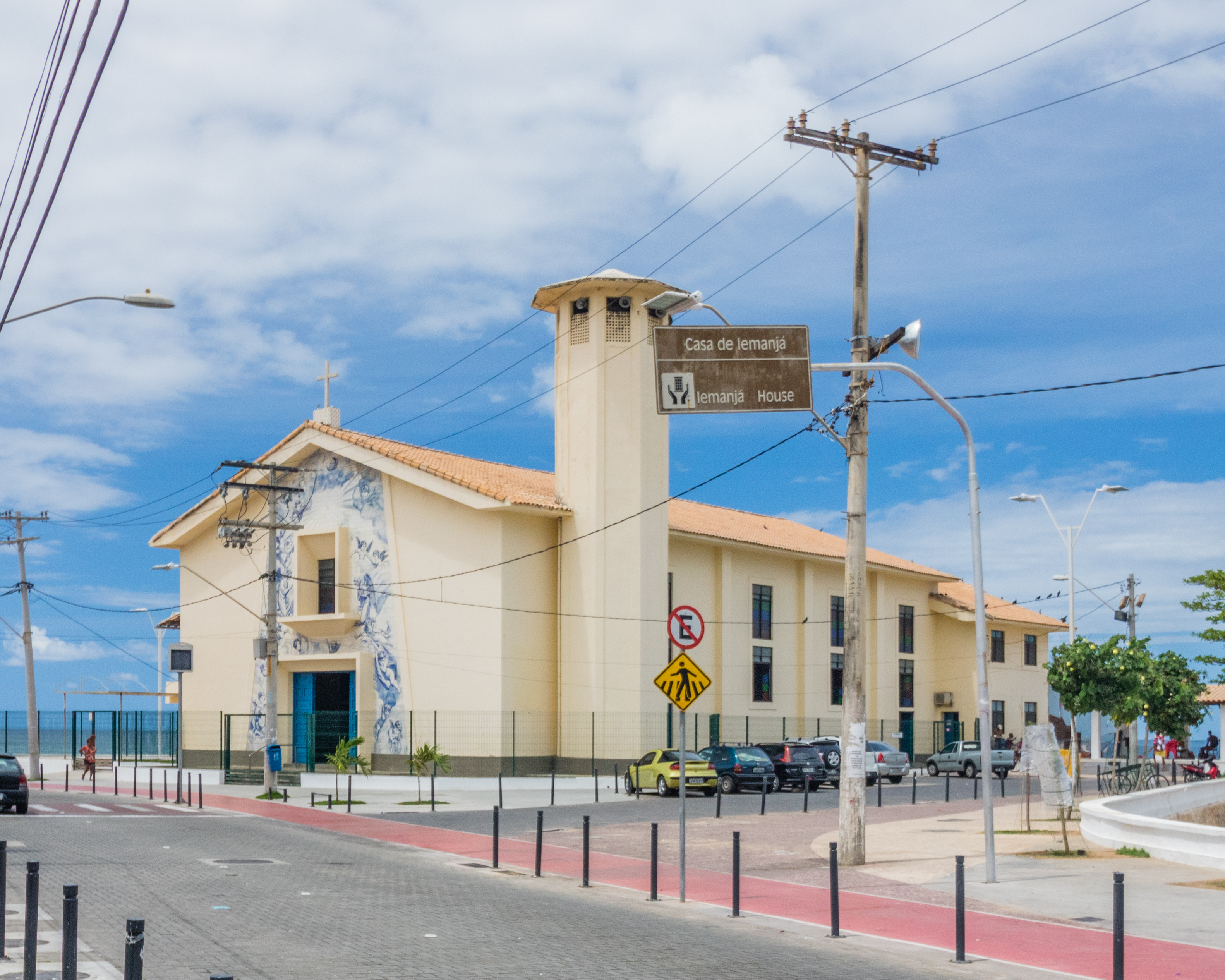
Image of Salvador, Igreja Matriz de Santana. Image source · CC-BY-SA-4.0
Visit essentials
A quick read before you go
- Duration
- A focused church visit takes thirty minutes to an hour.
- Access
- Rua Guedes Cabral, 143, Rio Vermelho, CEP 40950-620, Salvador, Bahia, Brazil.
Overview
Two forms of feminine reverence meet on this Bahian coast. Inside the Igreja Matriz de Sant'Ana, candles burn before Jesus's grandmother, evoking family continuity, patient nurture, and the quiet authority of women holding households together across generations. At Largo de Santana's edge, the Atlantic-facing Casa de Iemanja honors the ocean mother with flowers, mirrors, and perfume from hundreds of thousands of devotees each year.
Neither tradition fully explains the other. The Catholic sisterhood that formalized Sant'Ana devotion in 1882 drew on European piety. Candomble ceremonies growing among Rio Vermelho's fishermen drew on Yoruba cosmology carried across the Middle Passage. Their centers within a few hundred coastal meters speak to a place of meeting and threshold, where land yields to sea and one prayer to another.
The church has been rebuilt twice since Jesuits raised a palm-thatch chapel around 1580 to catechize the Tupinamba. The gathering impulse, not one structure, persists in setting this ground apart. Rio Vermelho means Red River, from the Tupi word for small crimson flowers once lining its banks. Their color has faded from the waterways, not from devotion.
Why this place is sacred
What makes a place thin is rarely a single factor. At the Igreja Matriz de Sant'Ana, the thinness is cumulative — layer upon layer of human attention directed toward the sacred, deposited in the same ground over centuries.
The Jesuits chose this inlet around 1580 for practical reasons: indigenous Tupinamba settlements nearby, a protected cove, access from the sea. But something in the location proved adhesive. When the palm-thatch chapel was replaced by a masonry church in the early nineteenth century, the builders kept the same ground.
When the parish outgrew that church and raised a new one in 1967, they built it on the ruins of the Fort of Sao Goncalo — adjacent, still within the same sacred perimeter. The old chapel was not demolished but repurposed as a social center. Nothing here is discarded; everything accumulates.
The coastal setting amplifies this layering. In Catholic devotional geography, churches built facing the sea carry associations of protection, of intercession for those who go out on the water and may not return. In Candomble understanding, the ocean is Iemanja's domain — not a symbol of her but her body. The fishermen of Rio Vermelho lived inside both frameworks simultaneously, attending mass at Sant'Ana and leaving offerings at the waterline. For decades, these practices coexisted without formal separation.
The rupture came in 1930, when a parish priest refused to celebrate the fishermen's mass and publicly condemned their Candomble offerings. The fishermen responded not by abandoning either tradition but by separating them — moving the Festa de Iemanja to its own date. The wound healed into a boundary, and the boundary became its own kind of sacred architecture: two traditions, distinct but proximate, each inhabiting the same ground on different days.
There is something in the feminine character of both devotions that deepens the resonance. Sant'Ana is the grandmother — the one who nurtures the nurturer, who holds the mother of God. Iemanja is the ocean mother — vast, receiving, the origin to which all rivers return. Neither tradition borrowed from the other, yet visitors standing in the Largo de Santana often sense an underlying coherence, as though both devotions were responses to the same quality in the place itself.
The original Jesuit chapel served as a site for the catechesis of Tupinamba indigenous people — a fraught purpose, inseparable from the colonial project. The chapel's front faced the sea, oriented toward the arriving world rather than the land being transformed.
As the settlement grew, the chapel became a parish church: a center for sacramental life, community gathering, and the rhythms of the liturgical year in a neighborhood of fishermen, summer residents, and eventually the bohemian culture for which Rio Vermelho is now known.
From Jesuit mission chapel to colonial parish church to mid-twentieth-century mother church, the site has been continuously rebuilt without ever being abandoned. The current church, inaugurated on the feast of Sant'Ana in 1967, seats five hundred — a significant expansion from the seventy-two-person capacity of the old chapel.
The parish was formally created in 1913 by Archbishop Dom Jeronymo Thome da Silva, but organized devotion to Sant'Ana in Rio Vermelho predates the parish by decades, initiated by summer residents who established the feast in 1870.
The surrounding sacred landscape has evolved in parallel. The Casa de Iemanja was established adjacent to the church area in 1972, formalizing a devotional presence that had existed informally for much longer. Today, the Largo de Santana serves as the ceremonial heart for both the July Festa de Sant'Ana and the February Festa de Iemanja — a rare instance of shared sacred space between traditions that maintain their distinctness.
Experience and orientation
Rio Vermelho is not a quiet neighborhood. Restaurants and bars line the streets. Music spills from doorways. The coast draws surfers, swimmers, and vendors. Against this backdrop, the Igreja Matriz de Sant'Ana offers something the neighborhood otherwise withholds: a pocket of stillness.
Step inside during an ordinary weekday and the contrast is immediate. The noise of Rua Guedes Cabral drops away. The church is modern — consecrated in 1967 — without the ornamental density of Salvador's colonial churches. This sparseness works in its favor. The space breathes. Light enters cleanly. There is room for the kind of attention that older, more cluttered churches sometimes overwhelm.
Walk outside again, cross the Largo de Santana, and you encounter the Casa de Iemanja — a small shrine housing offerings and images of the ocean goddess. The juxtaposition is not jarring but generative, as though the two sites create a conversation across the square. Visitors who spend time with both often describe a sense of something larger than either tradition alone, a feminine sacred geography that the neighborhood holds without resolving into a single narrative.
The deepest encounters happen during the festivals. The Festa de Sant'Ana, culminating on July 26, fills the church and surrounding streets with procession, music, food, and communal prayer. The novena preceding it — nine evenings of devotion from July 17 to 25 — carries a cumulative quality, each night deepening the sense of preparation. Those who attend multiple evenings report that the final feast day mass lands differently than it would in isolation.
The Festa de Iemanja on February 2 transforms the entire neighborhood. Hundreds of thousands of people gather. Flowers and offerings pile along the beach. Fishing boats carry gifts into the open water. The air is thick with incense, salt, and the sound of drums. The church stands at the periphery of this celebration, not participating but present — a witness to a devotion it once tried to suppress and now simply neighbors.
Come to the church first. Sit inside for at least twenty minutes before exploring the surroundings. Let the interior silence establish itself before you step into the sensory richness of the Largo and the coastline. After the church, walk to the Casa de Iemanja. Then stand at the waterline where offerings are sent to sea each February. Notice the triangle these three points form — church, shrine, ocean — and how each faces the others.
If you are visiting during the Festa de Sant'Ana, attend at least one evening of the novena before the feast day itself. The repetition matters. If you arrive for the Festa de Iemanja, come early in the morning, before the crowds peak, and watch the fishermen prepare their boats. The ceremony builds slowly, and the early hours carry a quieter devotion that the afternoon spectacle sometimes obscures.
For an ordinary visit outside festival season, the parish office is open Tuesday through Saturday mornings. A weekday mass offers the most intimate encounter with the living parish — a handful of regulars, the priest's voice in Portuguese, the rituals of a faith that has occupied this ground for four centuries.
Context and lineage
The story begins before the chapel, with the Tupinamba. They called the area camarajibe — river of the camaras, a small red flower that colored the waterways. The Portuguese rendered this as Rio Vermelho, Red River. Around 1510, the navigator Diogo Alvares Correia, later known as Caramuru, was shipwrecked nearby and lived among the Tupinamba for years, becoming a figure of cultural crossing whose legend still shapes how Salvador understands itself.
Seventy years later, around 1580, Jesuit priests erected a chapel of wattle and palm thatch in the Santana inlet, its front facing the sea. The purpose was catechesis — the conversion of indigenous people to Christianity. Whatever the Tupinamba understood this chapel to mean, the Jesuits understood it as a beachhead for souls.
The chapel's dedication to Sant'Ana — grandmother of Jesus — may have been chosen for the figure's associations with family, teaching, and the transmission of faith across generations.
In the first half of the nineteenth century, the chapel was rebuilt in masonry and reoriented to face the Largo de Santana as it exists today. It was a small church, seating seventy-two, adequate for a neighborhood that was then primarily a summer retreat for wealthier Salvadorans. The devotion to Sant'Ana was formalized by these summer residents, who established the annual feast in 1870 and the Sisterhood of the Glorious Senhora Sant'Ana in 1882.
The lineage here is not a single thread but a braid. The Jesuit mission tradition, which founded the chapel, gave way to diocesan parish life after the Jesuits' expulsion from Brazil in 1759. The summer residents who revived the Sant'Ana devotion in the 1870s brought a different flavor of piety — festive, communal, tied to the rhythms of leisure rather than mission.
The fishermen who worked the Rio Vermelho coast added their own strand, carrying both Catholic devotion and Candomble practice until the 1930 rupture forced a separation.
Today the parish operates within the Archdiocese of Sao Salvador da Bahia, one of the oldest dioceses in the Americas. The Centro Social Monsenhor Amilcar Marques, housed in the preserved old chapel, maintains a tradition of community service that grounds the parish in the neighborhood's daily needs. Meanwhile, the Candomble presence in Rio Vermelho has only grown — the terreiros, the Casa de Iemanja, the February festival — creating a parallel lineage that the church neither claims nor can ignore.
Saint Anne (Sant'Ana)
patroness
Grandmother of Jesus, mother of the Virgin Mary, wife of Saint Joachim. In Catholic devotion she embodies maternal wisdom, the nurturing of faith across generations, and the welcoming hospitality that the parish describes as its defining character — 'the grandmother who welcomes everyone.'
Diogo Alvares Correia (Caramuru)
historical
Portuguese navigator shipwrecked near Rio Vermelho around 1510 who lived among the Tupinamba. His story of cultural crossing between European and indigenous worlds prefigures the neighborhood's later role as a site where Catholic and Afro-Brazilian traditions converge.
Archbishop Dom Jeronymo Thome da Silva
historical
Archbishop of Sao Salvador da Bahia who formally created the Parish of Sant'Ana do Rio Vermelho on April 5, 1913, elevating the chapel to mother church status and establishing the institutional structure the parish maintains today.
Father Antonio Vieira
historical
The vicar under whose leadership the current Igreja Matriz was constructed between 1959 and 1967, replacing the small colonial-era chapel with a church capable of seating five hundred on the site of the former Fort of Sao Goncalo.
Iemanja
deity
Ocean mother deity honored in the Festa de Iemanja centered on the Largo de Santana each February 2. Though not venerated within the church itself, her presence in the adjacent Casa de Iemanja and along the Rio Vermelho shoreline shapes the site's sacred geography.
Traditions and practice
The devotional calendar of the parish is anchored by the novena to Sant'Ana, nine evenings of prayer running from July 17 to 25, building toward the solemn feast day mass and procession on July 26. The novena tradition carries a cumulative weight — each evening's prayers layered on the last, the community's attention gathering like the tide.
The procession through Rio Vermelho's streets on the feast day transforms the neighborhood into sacred space, the image of Sant'Ana carried through the same streets that host Carnival and nightlife the rest of the year.
The Sisterhood of the Glorious Senhora Sant'Ana, founded in 1882, maintained devotional practices that shaped the parish's character: organized prayer, charitable works, and the stewardship of the patroness's feast. The fishermen's mass, historically celebrated on June 29 for the feast of Sao Pedro, patron of fishermen, connected the parish to the working life of the coast — a connection that ruptured in 1930 when the parish priest condemned the fishermen's dual allegiance to Catholic sacraments and Candomble offerings.
Regular masses continue throughout the week, with the parish office open Tuesday through Saturday from 7am to noon. The sacraments of baptism, confession, marriage, and Eucharist are administered. The Centro Social Monsenhor Amilcar Marques, operating from the preserved old chapel, provides community social services that express the parish's understanding of faith as inseparable from practical care.
The annual Festa de Sant'Ana remains the high point of parish life, drawing parishioners and visitors into a celebration that blends liturgical solemnity with the quermesse — a church fair of food, music, and neighborly gathering. The festival has retained its character as a community event, more intimate than Salvador's larger religious festivals, rooted in the neighborhood rather than the city at large.
Attend a weekday mass to encounter the parish at its most ordinary and perhaps its most genuine. The small congregation, the familiar rhythms of the liturgy, the priest's voice filling a church built to hold five hundred — these carry a quality of intimacy that festival days cannot replicate.
If you visit during the novena, commit to more than one evening. The practice of returning, of adding your presence to the accumulating prayer, shifts something. By the third or fourth evening, the prayers feel less like observation and more like participation.
Outside the church, walk to the waterline where offerings to Iemanja are released each February. Even outside the festival, the shore holds the residue of that devotion. Stand where the water meets the sand and consider what it means that two traditions, each with its own integrity, have chosen the same threshold between land and sea.
Roman Catholicism
ActiveThe Igreja Matriz de Sant'Ana is the mother church of the Parish of Sant'Ana do Rio Vermelho, one of the historic parishes of the Archdiocese of Sao Salvador da Bahia. Dedicated to Saint Anne, the grandmother of Jesus, the parish has maintained continuous worship since at least the early nineteenth century, with roots reaching to the Jesuit mission chapel of 1580. The devotion to Sant'Ana in Rio Vermelho, formalized by the Sisterhood founded in 1882, emphasizes hospitality, family continuity, and the nurturing of faith across generations.
Daily masses, a nine-day novena to Sant'Ana from July 17 to 25, a solemn feast day mass and neighborhood procession on July 26, administration of sacraments including baptism, confession, and marriage, and community social services through the Centro Social Monsenhor Amilcar Marques housed in the preserved old chapel.
Candomble and Afro-Brazilian Religion
ActiveWhile Candomble is not practiced within the church itself, the Igreja de Sant'Ana and the Largo de Santana form the spatial center of the Festa de Iemanja, the largest public manifestation of Candomble in Bahia. The Casa de Iemanja, established in 1972 adjacent to the church, formalizes an Afro-Brazilian devotional presence that existed in Rio Vermelho long before. The neighborhood's fishermen carried both Catholic and Candomble practice until the traditions were formally separated following the 1930 confrontation with the parish priest.
The Festa de Iemanja on February 2 draws hundreds of thousands of devotees who bring offerings of flowers, perfume, mirrors, and food to the Rio Vermelho shoreline. Offerings are placed in boats and sent to sea by fishermen. Candomble terreiros hold ceremonies throughout the day. The celebration blends prayer, drumming, dance, and communal gathering in a devotional expression that honors Iemanja as ocean mother and protector.
Perspectives and open questions
The Igreja Matriz de Sant'Ana sits at an intersection where Catholic devotional theology, Afro-Brazilian religious practice, colonial history, and contemporary cultural identity all claim stake. No single perspective captures what this place means. The most honest approach holds them together, noting where they converge and where they remain distinct.
Scholarly perspective
Historical scholarship documents the church's origins in the Jesuit catechesis mission of the late sixteenth century, tracing its evolution through colonial reconstruction, formal parish creation in 1913, and the inauguration of the current church in 1967.
The site's significance for scholars of Brazilian religion lies less in the church itself than in its position within the religious ecology of Rio Vermelho — a neighborhood that has become a primary case study for understanding the relationship between Catholicism and Candomble in Bahia.
The 1930 incident, in which a parish priest condemned the fishermen's Candomble offerings and refused to celebrate their mass, is widely cited in studies of Bahian syncretism as a pivotal moment. Rather than eliminating the Afro-Brazilian presence, the priest's intervention catalyzed its independent growth, leading to the establishment of the Festa de Iemanja as a freestanding celebration that now dwarfs the Catholic festival in scale.
Scholars debate whether the coexistence of these traditions represents genuine syncretism — a blending of theological content — or a strategic parallelism, in which distinct traditions share space without merging.
Living and traditional perspectives
In Catholic understanding, the dedication to Saint Anne carries particular resonance. As the grandmother of Jesus and mother of Mary, Sant'Ana embodies the transmission of faith through family, the patience of nurturing across generations, and the often-invisible labor of women in sustaining spiritual life. The parish describes its patroness as 'the grandmother who welcomes everyone' — a framing that positions the church as a place of hospitality rather than exclusion.
From within Candomble, the Rio Vermelho coastline is Iemanja's territory. The ocean is not a metaphor for the goddess but her living presence. Offerings sent to sea are received by her directly. The Festa de Iemanja is not a cultural festival with religious elements but a religious ceremony that has become culturally significant — the distinction matters to practitioners.
The relationship between Iemanja and Sant'Ana is one of neighborhood coexistence, not theological equivalence, though some practitioners recognize resonances between the two figures' maternal qualities.
Alternative interpretations
Some interpreters read the convergence of Sant'Ana and Iemanja devotion in Rio Vermelho as evidence of a deep archetypal pattern — the grandmother and the ocean mother as two expressions of a universal feminine sacred principle. This reading finds support in the spatial proximity and the thematic echoes between the two figures, though it risks collapsing real theological differences into a narrative of underlying unity that practitioners of neither tradition may recognize as their own.
The neighborhood's bohemian reputation adds another layer of interpretation. Artists, writers, and musicians have long been drawn to Rio Vermelho, and some frame the neighborhood's religious diversity as an expression of creative spiritual freedom — a place where orthodoxies of all kinds soften in the coastal air.
Open questions
Genuine uncertainties remain. The exact location of the original 1580 Jesuit chapel is undocumented — whether it stood on precisely the same ground as the current church or nearby in the Santana inlet is unclear. Whether the Tupinamba held the site as spiritually significant before the Jesuits arrived is unknown; the colonial sources that survive were not interested in documenting what they sought to replace.
The history of the Fort of Sao Goncalo do Rio Vermelho, on whose foundations the current church was built, is incompletely documented. What the fort's military past contributes to the layering of the site — if anything — is a question that archaeology might eventually address but has not yet explored. The formal heritage listing status of the church through IPHAN or municipal authorities was not confirmed at the time of writing.
Plan your visit
Access and arrival
Rua Guedes Cabral, 143, Rio Vermelho, CEP 40950-620, Salvador, Bahia, Brazil. Rio Vermelho is well-connected to central Salvador by bus, taxi, and ride-sharing services. The neighborhood is walkable, with the church, Largo de Santana, and Casa de Iemanja all within a few minutes' walk of each other. Mobile phone signal is reliable throughout the neighborhood. No special access arrangements are required for the church during regular hours.
Rio Vermelho is one of Salvador's most popular neighborhoods for visitors, offering hotels, pousadas, and rental apartments at a range of price points. The neighborhood's concentration of restaurants, bars, and cultural venues means that accommodation here places you within walking distance of both the church and the broader nightlife and dining scene. During the Festa de Iemanja in February, book well in advance — the neighborhood fills completely.
Respectful visit
Shoulders and knees should be covered when entering the church. Beachwear is not appropriate inside, despite the neighborhood's coastal character. For the Festa de Iemanja, many devotees wear white — you are welcome to do the same as a gesture of respect, though it is not required. Comfortable shoes are advisable for the cobblestone streets around the Largo.
Photography is generally permitted inside the church when services are not in progress. During mass, put your camera away. At the Casa de Iemanja and during the Festa de Iemanja, photograph the offerings, the decorations, and the general scene freely, but always ask before photographing individuals engaged in prayer or ritual. A respectful approach is to observe first and photograph later — if at all.
Candles may be lit inside the church. During the Festa de Sant'Ana, purchasing food and crafts at the quermesse supports the parish directly. If you wish to participate in offerings to Iemanja during the February festival, flowers — particularly white ones — are the most common and appropriate. Do not leave offerings inside the Catholic church that belong to another tradition; this is a shared neighborhood, not a blended practice.
Standard Catholic church etiquette applies: remove hats upon entering, silence mobile phones during services, do not eat or drink inside, maintain a quiet voice. The parish office hours are Tuesday through Saturday, 7am to 12pm. Outside these hours, the church may be locked.
The Festa de Iemanja on February 2 draws enormous crowds — hundreds of thousands. If you attend, be prepared for a celebratory atmosphere that can feel overwhelming. Pickpocketing is a concern in dense crowds. Stay aware of your surroundings while remaining open to the experience.
Do not conflate the Catholic and Candomble traditions. They coexist in Rio Vermelho but are not the same practice, and practitioners of each may take offense at casual syncretism that flattens their distinct theologies. Approach both with the respect you would give any living faith tradition in its own house.
Current practical details
Address
R. Guedes Cabral, 143 - Rio Vermelho, Salvador - BA, 41950-620, Brazil
Phone
Hours
Hours, fees, and access can change — verify on the official source before you travel. Practical details last checked Jun 2026.
Location
Map loads as you approach this section.
Pilgrim reflections
A portrait of encounter, not a score
Pilgrims describe what they felt, how present they could become, and whether the place would shape a journey. There are no stars and no ranking of traditions.
No reviewed reflections yet
The first pilgrims can help describe the character of being here.
Share a reflection
Available after an account-backed “Been there.” Every reflection is reviewed before publication.
Nearby sacred places
Explore other sacred places in the region. Proximity does not establish access or travel time; check each place’s guidance.


References
Sources consulted for this page. Source categories describe the publication, not a guarantee that every claim is verified. Traditional accounts and outside interpretations may differ.
- 01Paroquia Sant'Ana - Arquidiocese de Sao Salvador da Bahia — Archdiocese of Sao Salvador da BahiaofficialOfficial archdiocesan page for the parish
- 02Sant'Ana / Rio Vermelho - Arquidiocese de Sao Salvador da Bahia — Archdiocese of Sao Salvador da BahiaofficialArchdiocesan page with neighborhood religious context
- 03Paroquia de Sant'Ana do Rio Vermelho - A Padroeira — Paroquia de Sant'Ana do Rio VermelhoofficialOfficial parish website with patroness history
- 04Avo de Jesus, Senhora Sant'Ana sera homenageada por fieis no Rio Vermelho — Arquidiocese de Sao Salvador da BahianewsArchdiocesan news about the feast of Sant'Ana
- 05Igreja Santana do Rio Vermelho — Paroquia de Santana do Rio VermelhoofficialAlternative parish website
- 06Salvador - Igreja Matriz de Santana — iPatrimonioofficialBrazilian heritage database entry with architectural and historical details
- 07Igreja de Sant'Ana do Rio Vermelho - Turismo em Salvador — Salvador TurismoofficialTourism guide with historical and practical information
- 08100 Anos da Paroquia do Rio Vermelho — Ubaldo Marques Porto FilhoacademicDetailed local history of the parish's centenary
- 09Rio Vermelho (neighborhood) - Wikipedia — Wikipedia contributorsencyclopediaOverview of the neighborhood's history including Jesuit and indigenous origins
- 10Iemanja Festival: Meaning and Celebrations — Bahia.wsofficialContext on the Iemanja festival centered on Rio Vermelho
Share a photo
Help visitors recognize Salvador, Igreja Matriz de Santana. Every submission is reviewed before publication.