Casa de Yemanjá
Where the sea receives what the faithful bring, and sometimes gives back what was lost
Understand sacred places, explore living traditions, and learn how to engage respectfully with Pilgrim Map.
Access has not been verified. Check current local guidance before planning a visit.
Salvador, Bahia, Brazil
Read the sources
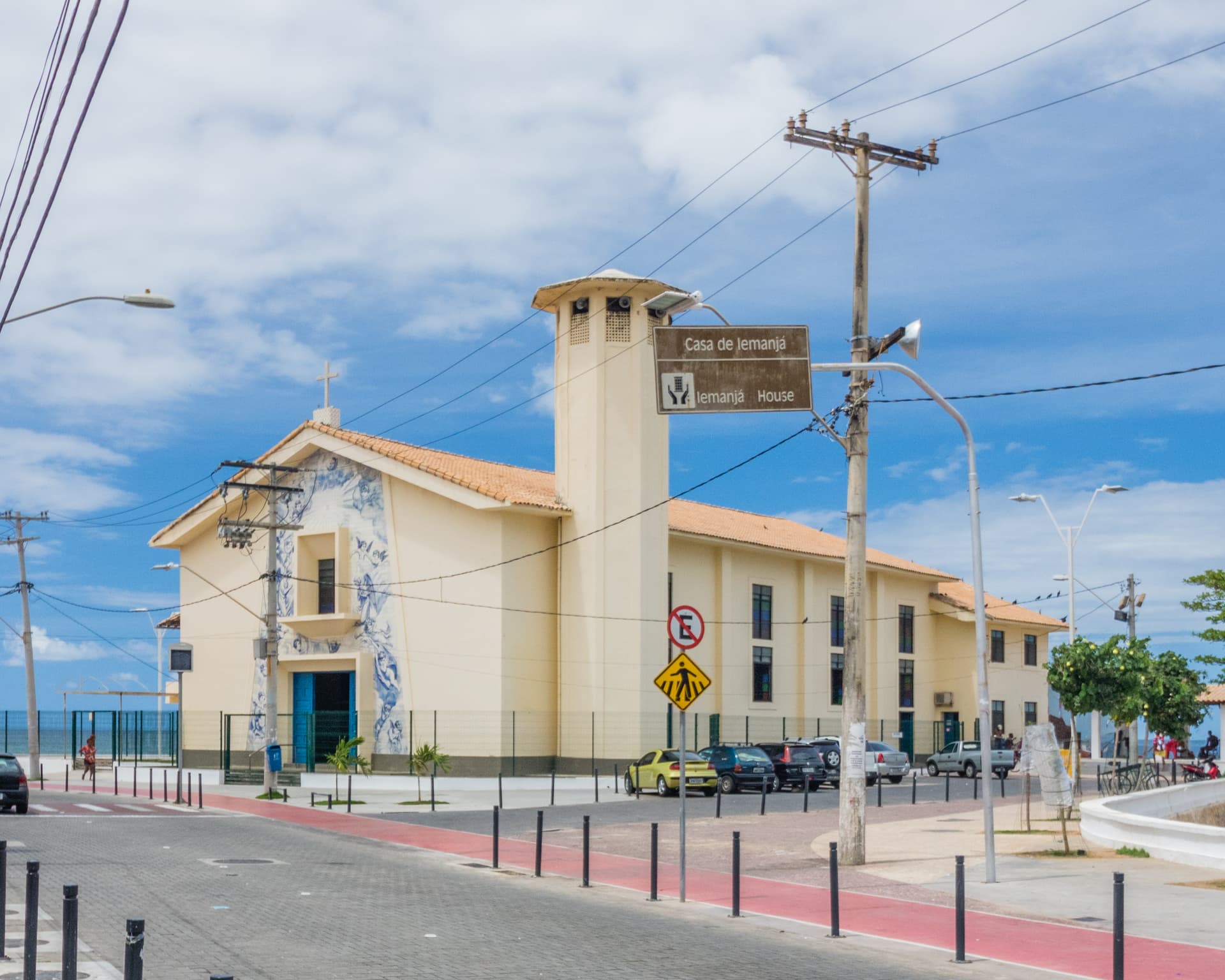
Image of Casa de Yemanjá. Image source · CC-BY-SA-4.0
Visit essentials
A quick read before you go
- Duration
- A visit to the Casa itself takes 30 to 60 minutes — enough to view the altars, the mosaic…
- Access
- Located in Rio Vermelho on Largo de Santana, near Praia de Santana.
Overview
Casa de Yemanjá is humble: blue windows, mosaics of waves and a woman rising from the sea, and a patio where fish are still weighed and sold. Inside, statues stand among perfume, flowers, mirrors, and combs—objects of care and vanity offered to the Mother of the Waters so she may look kindly on devotees' lives.
At Praia de Santana, where Rio Vermelho meets the Atlantic, the building began as a weighing house for the local fishermen's colony. In the early 1920s, when fish stopped coming, the fishermen consulted the orixás through cowrie-shell divination and were told Yemanjá required offerings. They gave, the fish returned, and the giving continues.
Every February 2, hundreds of thousands dressed in white bring flowers, perfume, letters, and wishes. At four in the afternoon, fishermen carry the offerings by boat to sea. For Candomblé and Umbanda practitioners, gifts that sink are accepted by Yemanjá; those washing back must be improved. The wider Salvador community also turns toward the ocean that day and asks to be held.
Even non-practitioners encounter the convergence of devotion, salt air, drumming, and a city oriented beyond itself.
Why this place is sacred
In Candomblé cosmology, the shoreline is not simply a geographic feature. It is a border between realities. The land belongs to the living. The sea belongs to Yemanjá. Where waves meet sand, the two worlds touch. Casa de Yemanjá sits precisely at this border, and for over a century, people have gathered here to negotiate the crossing.
The thinness of this place accumulates through repetition. Every offering placed at the water's edge, every chant sung in Yoruba over the crash of waves, every tearful petition written on paper and tucked into a basket of flowers — these acts layer upon one another. The fishermen who first offered gifts to Yemanjá in the 1920s could not have imagined that their desperate appeal would become the largest public Candomblé celebration in Brazil.
But the logic of the tradition explains it: when you honor the forces of nature, abundance follows. When you neglect them, scarcity returns.
The building itself embodies this layering. A fish market that is also an altar. A commercial space that is also a shrine. In many traditions, sacred sites are set apart from daily life — elevated, enclosed, separated. Here the sacred insists on cohabiting with the ordinary. Fish scales and prayer occupy the same square meters. This refusal to separate the spiritual from the material reflects something fundamental about Candomblé: the orixás do not live in a distant heaven.
They live in the waters, the wind, the forest, the iron. They are here.
Rio Vermelho — Red River — adds another dimension. The meeting of fresh and salt water is a liminal zone in Candomblé understanding, a place of particular spiritual potency. The neighborhood's name carries this charge even in Portuguese, pointing to a quality of the place that predates any building constructed upon it.
The original structure served as the Casa do Peso — the Weighing House — for the Colônia de Pescadores Z1, the fishermen's colony of Rio Vermelho. Its purpose was entirely practical: a place to weigh, price, and sell the day's catch. The transformation into a devotional space arose from need. When the fish disappeared in the early 1920s, the fishermen turned to the spiritual technology they trusted — divination through the orixás — and received instruction to honor Yemanjá.
The building's sacred function grew from its practical one, not replacing it but absorbing it.
The Casa do Peso was officially transformed into Casa de Yemanjá in 1972, formalizing a devotional use that had been growing for decades. In 2008, artist Ed Ribeiro added the mosaic facade that now defines the building's exterior — images of Yemanjá and marine life rendered in tile, marking the structure as sacred space visible from the street.
The annual festival has grown from a small gathering of fishermen to an event that draws hundreds of thousands. The 2026 celebration marked the 103rd anniversary of the tradition. The Festa de Iemanjá is now recognized as Intangible Cultural Heritage of Salvador, a designation that reflects both its cultural significance and the long struggle of Afro-Brazilian religious traditions for public recognition.
What began as a local act of desperation has become one of the most powerful public expressions of African-descended spirituality in the Americas.
Experience and orientation
On an ordinary weekday morning, the Casa de Yemanjá is small and still. The altars inside hold statues of the orisha surrounded by offerings — flowers beginning to dry, perfume bottles, hand mirrors. The air carries the salt of the nearby ocean mixed with something sweeter. Outside, fishermen work the patio.
The coexistence of devotion and daily labor creates a feeling visitors often describe as authentic — a word that means, in this context, that nothing here is performed for an audience.
During the Festa de Iemanjá on February 2, the scale transforms entirely. The neighborhood fills before dawn. Fireworks mark the beginning at 4:45 AM. Throughout the day, devotees arrive carrying offerings in wicker baskets — white and blue flowers, bottles of perfume, mirrors, jewelry, letters. Many are dressed entirely in white, the color sacred to both Yemanjá and Oxalá. Yoruba chants rise from circles of practitioners, their rhythms answered by drums.
The air thickens with incense, salt spray, and the collective intensity of several hundred thousand people oriented toward a single purpose.
At four in the afternoon, the fishermen of the Colônia de Pescadores Z1 load the offerings into boats and carry them out beyond the breakers. The crowd watches. If the baskets sink, the year will be blessed. If they return to shore, the gifts were insufficient. Visitors consistently describe this moment — the boats departing, the crowd holding its breath, the ocean deciding — as one of overwhelming communal emotion. People weep. Strangers embrace.
The boundary between participant and observer dissolves.
Those who visit outside the festival find something different but no less genuine. The Casa is small enough to feel intimate. Sitting quietly before the altars, watching the light through blue windows, hearing the ocean a few steps away — this smaller encounter strips away spectacle and leaves the essential relationship: a person, an offering, the sea.
If you come during the festival, surrender any expectation of controlling your experience. The crowds are immense, the energy overwhelming, the schedule governed by tradition rather than convenience. Arrive before dawn if you want to witness the full arc from first fireworks to the boat departure. Wear white or light blue — not as costume but as participation. Bring an offering if you wish: flowers, perfume, something given with sincerity rather than expense.
If you come on a quiet morning, enter the Casa slowly. Let your eyes adjust. Notice what people have left on the altars — the accumulation of petition and gratitude. Step outside to the patio where fish are sold and feel the two worlds occupying the same ground. Walk to the waterline. In Candomblé understanding, you are now standing at the edge of Yemanjá's domain.
Whatever you brought with you — a question, a grief, a hope — this is the place to set it down.
Context and lineage
The story begins in West Africa, along the Ogun River in present-day Nigeria, where the Yoruba people honored Yemọja as a powerful river deity. Her name derives from Yoruba: Yeyé omo ejá — Mother whose children are the fish. She governed fertility, protected women, and ensured the abundance of the waters.
The Atlantic slave trade carried Yoruba people — and Yemọja — to Brazil. In the crossing, her domain shifted. No longer a river goddess, she became the Mother of the Ocean, the deity of the very waters that had carried her people into bondage. This transformation is not incidental. It reflects the profound capacity of African spiritual traditions to adapt to new geographies while maintaining their essential relationships with the divine.
In Salvador da Bahia, which received more enslaved Africans than any other city in the Americas, Yoruba religion took root and evolved into Candomblé. Under centuries of persecution — first by the colonial Portuguese, then by Brazilian authorities who criminalized Afro-Brazilian religious practice well into the 20th century — Candomblé survived partly through syncretism. Yemanjá became associated with Nossa Senhora da Conceição, the Virgin of the Immaculate Conception.
The association allowed practitioners to honor their orisha under the guise of Catholic devotion.
In the early 1920s, the fishermen of Rio Vermelho — many of them descendants of enslaved Africans — faced a crisis. The fish had vanished. They consulted the orixás through the jogo de búzios, the cowrie-shell divination central to Candomblé practice. The answer was clear: Yemanjá required offerings. The fishermen obliged, presenting gifts to the sea from their weighing house. The fish returned. The tradition took hold.
The lineage runs from the banks of the Ogun River in Yorubaland, across the Atlantic in the holds of slave ships, into the terreiros of Salvador where Candomblé took form, and finally to this stretch of beach in Rio Vermelho where a weighing house became a shrine. Each generation added to the tradition without breaking it. The fishermen of the 1920s honored an orisha their ancestors had honored in Africa.
The practitioners who come today sing songs in Yoruba that have crossed centuries and an ocean. The Festa de Iemanjá, now in its second century, is both ancient and continuously renewed — the same gesture of offering, repeated until it wears a groove in the world deep enough to hold the sacred.
Yemanjá
deity
Queen of the Ocean, Mother of All Heads (Iyá Ori), protector of fishermen and women. In Candomblé cosmology, she governs emotional and spiritual balance and is responsible for the harmony necessary for life on Earth. Her domain is the sea — every wave an expression of her presence.
The Fishermen of Colônia Z1
founders
The fishing community of Rio Vermelho whose desperate consultation with the orixás in the 1920s initiated the tradition of offerings to Yemanjá. Their colony continues to organize the annual Festa de Iemanjá, carrying the offerings by boat to the open sea.
Ed Ribeiro
artist
The artist who created the mosaic facade of Casa de Yemanjá in 2008, rendering Yemanjá and marine imagery in tile and transforming the building's exterior into a visible declaration of its sacred purpose.
Mães de Santo
spiritual leaders
The priestesses who lead Candomblé terreiros and maintain the tradition's knowledge and practice. Candomblé has historically been sustained by women, and Yemanjá's centrality reflects the matriarchal dimension of the tradition. These women preserve the songs, rituals, and cosmological understanding that give the Casa its meaning.
Traditions and practice
The core practice is offering. Devotees bring objects associated with feminine beauty and care — flowers (especially white and blue), perfume, mirrors, combs, jewelry, soaps — and present them to Yemanjá at the shoreline or on the altars inside the Casa. These are not symbolic gestures but acts of reciprocity within a living cosmological framework. Yemanjá provides — fish, fertility, emotional balance, protection — and in return, her children honor her with gifts she values.
The Festa de Iemanjá on February 2 follows a structure developed over a century. The day begins before dawn with fireworks. Throughout the morning and afternoon, devotees bring offerings in large wicker baskets to the Casa and the surrounding beach. Cantigas de Iemanjá — traditional songs in Yoruba — are sung in circles. Practitioners dance in white, the color sacred to Yemanjá and to Oxalá.
Some enter trance states and experience incorporação — possession by the spirit of Yemanjá herself, understood not as loss of self but as direct communion with the divine.
At four in the afternoon, the climactic moment arrives. Fishermen of the Colônia de Pescadores Z1 load the accumulated offerings into boats and carry them beyond the breakers. The ocean receives or rejects. Acceptance — the offerings sink — promises a blessed year. Rejection — they wash ashore — demands the community return with better gifts. This exchange is the living heart of the tradition: a conversation between the human and the divine, mediated by the sea.
Year-round, devotees visit the Casa to light white and blue candles, leave offerings at the altars, and pray. The fish market continues to operate from the patio, maintaining the original connection between the site and the fishing community that gave it birth. Consultation of the orixás through búzios (cowrie-shell divination) remains a central practice in the broader Candomblé tradition and informs how practitioners relate to Yemanjá throughout the year.
New Year's Eve brings its own wave of devotion. Along Salvador's beaches on December 31, thousands place candles and flowers at the water's edge for Yemanjá, asking for blessings in the coming year. While not centered on the Casa itself, these practices extend the devotional relationship into everyday time.
The festival has also become an expression of cultural identity and resistance. In a country where Afro-Brazilian religions faced criminalization within living memory, the public celebration of Candomblé on this scale carries political weight alongside spiritual significance.
If you wish to participate rather than observe, the tradition is generous with outsiders who approach with sincerity. Bring an offering — flowers are simplest and most welcome. White or blue blooms are traditional. Avoid plastic or non-biodegradable materials; Yemanjá is the ocean, and she should not be honored with what harms her.
At the shoreline, hold your offering and speak to Yemanjá directly. Practitioners address her as Odoyá — a Yoruba salutation meaning 'Hail, Mother of the Waters.' Tell her what you carry. Ask for what you need. Then release the offering to the waves. Whether you understand this as prayer, ritual, or something without a name, the act of standing at the edge of the Atlantic and releasing something into the water carries its own weight.
Inside the Casa, you may light a candle. Sit quietly. The space is small enough that sincerity is the only currency that matters.
Candomblé
ActiveCasa de Yemanjá is one of the most publicly visible and accessible Candomblé sacred sites in Brazil. The site is dedicated to the orisha Yemanjá, Queen of the Ocean and Mother of All Heads, who governs emotional and spiritual balance. In Candomblé cosmology, the orixás are not distant deities but living forces present in the natural world — and Yemanjá lives in the sea itself. The Casa bridges the sacred and the everyday, functioning simultaneously as a fish market and a devotional space, reflecting the Candomblé understanding that the divine does not inhabit a separate realm but permeates daily life.
Offerings of flowers, perfume, mirrors, combs, and objects of feminine beauty placed at the altars or carried to the sea. Singing of cantigas in Yoruba. Dancing in white. Spirit possession by the orisha. Divination through búzios (cowrie shells). The annual Festa de Iemanjá on February 2, centered on the boat procession carrying offerings to the open ocean.
Umbanda
ActiveUmbanda, a syncretic Brazilian spiritual tradition that blends elements of Candomblé, Catholicism, Kardecist spiritism, and indigenous practice, also honors Yemanjá as a central figure. Many Umbanda practitioners participate in the Festa de Iemanjá and visit the Casa for devotional purposes. Yemanjá's role in Umbanda overlaps with but is not identical to her significance in Candomblé, reflecting the broader Brazilian religious landscape in which African-derived spirituality takes multiple forms.
Offerings to Yemanjá at the shore, candle-lighting, prayer, and participation in the February 2 festival. Umbanda ceremonies honoring Yemanjá may occur at separate terreiros throughout Salvador.
Catholic Syncretism
ActiveThe association of Yemanjá with Nossa Senhora da Conceição (Our Lady of the Immaculate Conception) dates to the colonial period, when enslaved Africans maintained their spiritual practices by aligning orixás with Catholic saints. This syncretism is not merely historical — many Bahians continue to honor both Yemanjá and Nossa Senhora simultaneously, understanding them as different faces of the same maternal divine force. The Festa de Iemanjá falls near the Catholic feast of Candlemas (February 2), deepening the overlap.
Some devotees at the Casa and during the festival invoke both Yemanjá and the Virgin Mary. Catholic prayers may be offered alongside Yoruba chants. The visual iconography of Yemanjá in Brazil often echoes Marian imagery — the blue mantle, the maternal posture, the association with the sea.
Perspectives and open questions
Casa de Yemanjá sits at the intersection of African religious continuity, Brazilian cultural identity, and the universal human impulse to bring gifts to the sea. Understanding the site requires holding multiple frames simultaneously — the scholarly, the devotional, and the experiential — without collapsing any into the others.
Scholarly perspective
Scholars of Afro-Brazilian religion recognize the Festa de Iemanjá and its anchor site as one of the most significant public expressions of Candomblé.
The tradition illustrates several processes central to the study of the African diaspora: the transformation of the Yoruba river deity Yemọja into a Brazilian sea goddess, reflecting the oceanic crossing that defined the diaspora experience; the syncretism with Catholicism, specifically the association of Yemanjá with Nossa Senhora da Conceição, which allowed practitioners to maintain their spiritual identity under persecution; and the gradual movement from secrecy to public celebration, tracking the broader arc of Afro-Brazilian cultural recognition.
The festival's growth from a small fishermen's offering in the 1920s to a gathering of hundreds of thousands reflects Salvador's evolving relationship with its African heritage. The recognition of the Festa as Intangible Cultural Heritage marks a formal acknowledgment of what practitioners always knew — that this tradition carries the weight of centuries and the resilience of a people who refused to let their gods be taken from them.
Living and traditional perspectives
For Candomblé practitioners, Yemanjá is not a cultural artifact or a symbol of African heritage — she is a living divine force. Iyá Ori, Mother of All Heads, she governs the emotional and spiritual balance without which life cannot proceed. The offerings at the Casa and at the sea are not symbolic but functional: acts of reciprocity through which humans maintain their relationship with the powers that sustain the world.
The matriarchal dimension is inseparable from Yemanjá's significance. Candomblé terreiros have historically been led by mães de santo — mothers of the saint — and the tradition as a whole centers feminine spiritual authority in ways that distinguish it from many world religions. Yemanjá embodies this: the mother whose care extends to all, whose domain is the water from which all life emerged.
Spirit possession during ceremonies — incorporação — is understood as direct communion with the orisha. When a devotee is taken by Yemanjá, it is not performance or pathology but the most intimate form of encounter between the human and the divine. The body becomes a vessel. The boundary dissolves.
Alternative interpretations
Some contemporary spiritual seekers approach Yemanjá as an archetype of the universal Mother Goddess and the feminine divine principle that appears across cultures — Isis, Kuan Yin, the Virgin Mary. The practice of offering gifts to the sea is interpreted as ritual communion with the collective unconscious, the water element, or the feminine aspect of creation. The site's location at the land-sea boundary is read as a thin place where material and spiritual realities overlap.
These interpretations, while not rooted in Candomblé theology, often emerge from genuine experiences at the site. The impulse to honor the ocean with gifts of beauty, to stand at the shoreline and ask for something, appears to tap into a layer of human experience that predates any specific tradition.
Open questions
Several questions resist resolution. The precise mechanism by which a small fishermen's offering became the largest public Candomblé event in Brazil remains only partly documented — the oral tradition carries more than the written record. The relationship between the various sites in Salvador named Casa de Yemanjá, including a Ketu-nation terreiro in Cidade Nova, and their interconnection within the broader Candomblé network, warrants further study.
The ongoing tension between the festival's commercialization — with municipal government involvement, tourism marketing, and the sheer scale of the event — and its religious authenticity is debated within the community itself. Some practitioners feel the spectacle has overtaken the devotion; others see the public visibility as a victory after centuries of suppression. Both perspectives carry weight.
Plan your visit
Access and arrival
Located in Rio Vermelho on Largo de Santana, near Praia de Santana. Address: Rua Guedes Cabral, 143, Rio Vermelho, Salvador, BA, 41950-620, Brazil. Accessible by taxi, ride-sharing apps (which operate reliably in Salvador), or local buses. Rio Vermelho is one of Salvador's best-known neighborhoods and drivers will recognize the destination. Entry is free. During the Festa de Iemanjá, vehicular access to the immediate area may be restricted; plan to walk the final stretch.
Mobile phone signal is generally available in the area. No advance booking is required for regular visits.
Rio Vermelho offers a range of accommodations from budget hostels to boutique hotels. The neighborhood is one of Salvador's liveliest, with restaurants, bars, and cultural venues. For the Festa de Iemanjá, book accommodation well in advance — the festival draws visitors from across Brazil and internationally. Staying in Rio Vermelho allows walking access to the Casa and the festival beach. The Pelourinho and Barra neighborhoods are also well-positioned, with taxi access to the site in 15 to 30 minutes.
Respectful visit
White or light blue clothing is customary and expected, particularly during the Festa de Iemanjá. These are the colors of Yemanjá and of Oxalá. Wearing them is not merely aesthetic but participatory — it signals respect and willingness to enter the space on its own terms. Avoid dark colors. Wear comfortable shoes suitable for sand and beach terrain.
Photography of the building's exterior, the mosaic artwork, and the public festival celebrations is welcomed. Inside the Casa, ask before photographing altars or devotional objects. Never photograph a practitioner in trance, at prayer, or performing ritual without their explicit consent. During the festival, the procession and the boat departure are public events and photography is expected, but maintain awareness that for many present, this is worship, not performance.
Visitors are welcome to bring offerings for Yemanjá. Traditional gifts include white or blue flowers, perfume, mirrors, combs, soaps, and jewelry. The emphasis is on beauty and care — items associated with the feminine. Sincerity matters more than expense. Choose biodegradable materials; plastic flowers and packaging should not enter the ocean. During the festival, offerings may be placed in the communal wicker baskets that the fishermen carry out to sea.
Do not touch or move items on altars. Do not interrupt practitioners in prayer, song, or trance. Some inner spaces may be reserved for initiated practitioners — honor these boundaries. During the festival, access to certain areas near the boats may be restricted to the fishermen and organizers. The Casa is open mornings and early afternoons; respect the posted hours.
Do not treat the altars or offerings as curiosities. The objects placed there represent genuine petitions and expressions of faith. Do not touch, rearrange, or remove anything from the altars. If you witness a practitioner in trance or deep prayer, maintain respectful distance — do not photograph them without permission, and do not interrupt.
During the Festa de Iemanjá, the crowds are immense and the energy intense. Stay aware of your surroundings. Pickpocketing can occur in dense crowds. Leave valuables at your accommodation. The heat of a Salvador February, combined with hours of standing and the emotional intensity of the celebration, can be physically demanding. Bring water and sun protection.
Current practical details
Address
Rio Vermelho, Salvador - State of Bahia, Brazil
Hours, fees, and access can change — verify on the official source before you travel. Practical details last checked Jun 2026.
Location
Map loads as you approach this section.
Pilgrim reflections
A portrait of encounter, not a score
Pilgrims describe what they felt, how present they could become, and whether the place would shape a journey. There are no stars and no ranking of traditions.
No reviewed reflections yet
The first pilgrims can help describe the character of being here.
Share a reflection
Available after an account-backed “Been there.” Every reflection is reviewed before publication.
Nearby sacred places
Explore other sacred places in the region. Proximity does not establish access or travel time; check each place’s guidance.
Salvador, Igreja Matriz de Santana
Salvador, Bahia, Brazil
0.1 km away

Salvador, Nossa Senhora da Conceição da Praia
Salvador, Bahia, Brazil
4.7 km away

Salvador, Nosso Senhor do Bonfim Church
Salvador, Bahia, Brazil
9.9 km away

Bom Jesus da Lapa, Santuário do Bom Jesus da Lapa
Bom Jesus da Lapa, Bahia, Brazil
534.6 km away
References
Sources consulted for this page. Source categories describe the publication, not a guarantee that every claim is verified. Traditional accounts and outside interpretations may differ.
- 01Iemanjá Festival — Salvador da Bahia Official Tourism — Salvador da Bahia Tourism BoardofficialOfficial tourism information about the festival and Casa de Iemanjá
- 02Odoyá, Queen of the Sea! — Salvador da Bahia Official Tourism — Salvador da Bahia Tourism BoardofficialDescription of Casa de Iemanjá and the Yemanjá devotion experience
- 03Festa de Iemanjá: Salvador se prepara para celebrar 103 anos — Prefeitura de Salvador — Prefeitura Municipal de SalvadornewsOfficial city government source confirming festival history and cultural heritage status
- 04In Salvador, Brazil's largest Iemanjá celebration blends faith, culture, and resistance — Brasil de Fato — Brasil de Fatonews2026 coverage of the festival highlighting cultural resistance dimensions
- 05Candomblé, Afro-Brazilian Women, and African Religiosity in Brazil — AAIHS — African American Intellectual History SocietyacademicAcademic perspective on Candomblé and gender roles
- 06Multidão lota Rio Vermelho para celebrar Iemanjá — Agência Brasil — Agência BrasilnewsBrazilian government news agency coverage of the 2026 festival
- 07Yemọja — Wikipedia — Wikipedia contributorsencyclopediaOverview of the orisha Yemanjá across the African diaspora
- 08Iemanjá Festival: Meaning and Celebrations — Bahia.ws — Bahia.wsguideDetailed account of the festival celebrations and their meaning
- 09Candomblé — Wikipedia — Wikipedia contributorsencyclopediaGeneral overview of Candomblé religion
- 10Casa de Yemanjá — Tempero Bahia — Tempero BahiaguideLocal tourism guide with details about the site
Share a photo
Help visitors recognize Casa de Yemanjá. Every submission is reviewed before publication.