Roncesvalles Collegiate Church
The first shelter after the Pyrenees, where the Camino's hardest day ends in a blessing
Understand sacred places, explore living traditions, and learn how to engage respectfully with Pilgrim Map.
Access has not been verified. Check current local guidance before planning a visit.
Roncesvalles/Orreaga, Navarre, Spain
Read the sources
Station waypoint of 11
Camino de Santiago — Selected Sacred SitesVisit essentials
A quick read before you go
- Duration
- The church and cloister can be visited in 30-60 minutes; a fuller visit including the museum and…
- Access
- Reached by road, with regular bus service from Pamplona, or on foot via the Camino Francés from…
Overview
Almost every pilgrim walking from Saint-Jean-Pied-de-Port reaches Roncesvalles spent: the Napoleon route climbs some 1,250 meters across roughly 24 kilometers and is widely called the Camino's hardest single day. That difficulty explains the institution—a fraternity founded in 1127 by Bishop Sancho de Larrosa under King Alfonso I “the Battler” specifically to receive pilgrims.
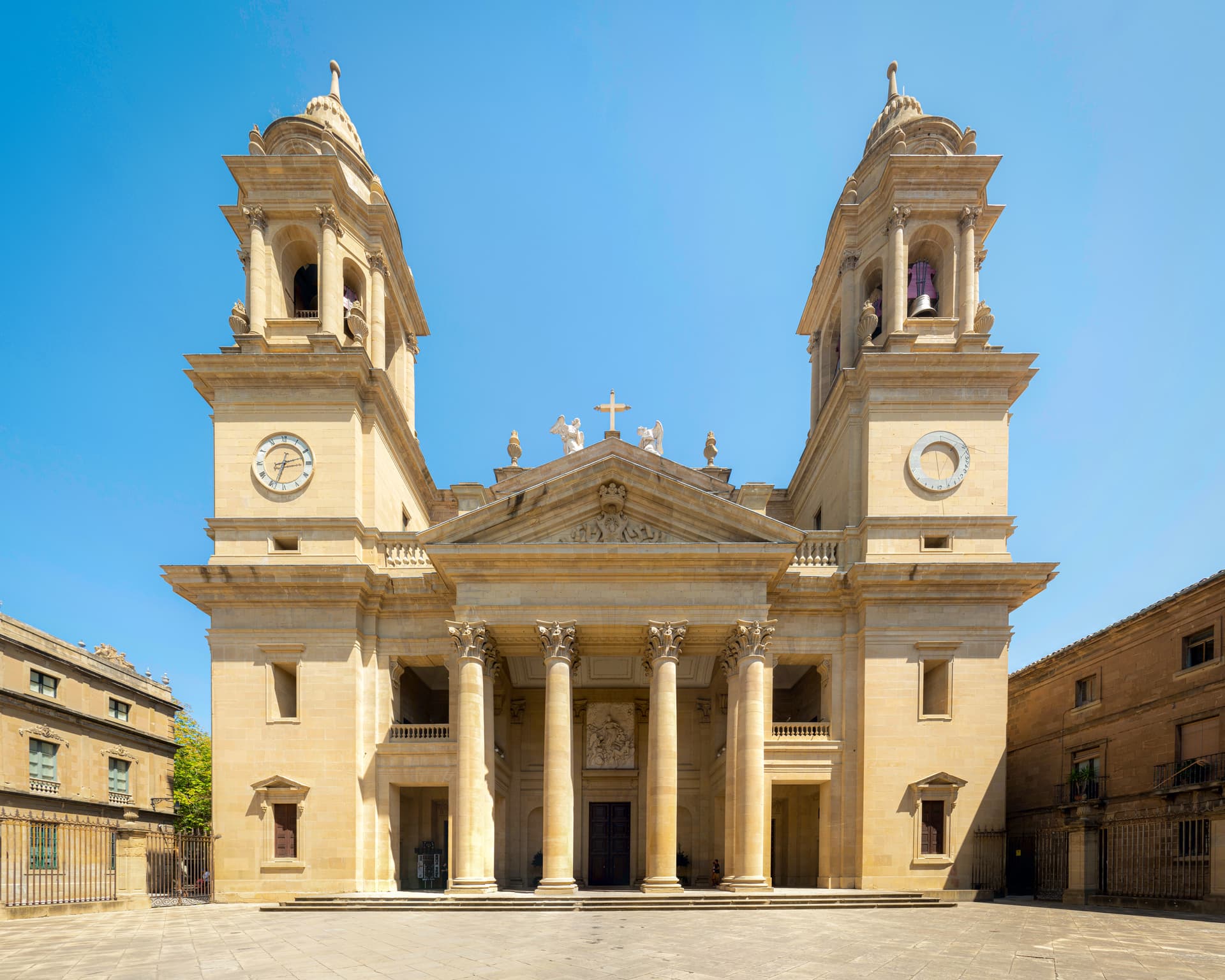
Its Gothic collegiate church, built in 1215–1221 under Sancho VII “the Strong” and modeled on Notre-Dame of Paris, houses the Virgin of Roncesvalles. This Gothic wood-and-silver Marian image, canonically crowned in 1960, is venerated as “Queen of Navarre's Pyrenees” by a fraternity exceeding 3,000 members. After the last daily Mass, pilgrims who request it receive the Pilgrim's Blessing, often described as deeply affecting because it is their first formal welcome after the mountain.
The pass also remembers 778, when a Basque force ambushed Charlemagne's retreating rearguard. Centuries later, the Song of Roland recast this as Christendom confronting a vast Saracen host. That poetic, not historical, account made Roncesvalles known across medieval Europe before most present buildings existed.
Why this place is sacred
The most immediate register is topographic and psychological rather than doctrinal: the descent from the high, often fog-bound Pyrenees pass into the shelter of the collegiate complex is repeatedly described by modern pilgrims as a powerful transition in mood as much as terrain. That the institution here has been formally receiving exhausted travelers since the 12th century — not incidentally, but as its founding purpose — gives the relief real historical depth rather than just personal feeling.
Layered onto that threshold is active Marian devotion. The Virgin of Roncesvalles has her own foundation legend, distinct from both the historical battle and the Roland epic: devotional tradition holds that her image was revealed to local shepherds after a stag was seen with two stars shining between its antlers. This is presented as legend rather than documented history, but it gives the shrine a specifically local, non-literary origin story separate from the fame Roncesvalles gained through war and poetry.
The third register is historical-literary, and it is the one most easily misread. The 778 ambush was a real, dated event — a Basque force attacking Charlemagne's retreating rearguard, recorded by the contemporary Vita Karoli Magni. The Song of Roland, composed roughly three centuries later, reimagined that same ambush as a war against 400,000 Saracens, with Roland dying a martyr's death against impossible odds.
That later, more famous version is a Crusade-era literary reworking rather than a historical account, and Basque cultural memory has explicitly pushed back against a popular narrative that some Basque commentators describe as history taken from them in favor of the French epic framing.
The institution was founded in 1127 (with the pilgrim hospital sometimes dated to 1132) explicitly to receive, shelter, and care for pilgrims crossing the Pyrenees on the Camino Francés — a purpose distinct from, and older institutionally speaking than, the site's fame from the 778 battle, which the Song of Roland later mythologized into a much larger European legend.
What began as a fraternity founded by Bishop Sancho de Larrosa under Alfonso I 'the Battler' grew into a medieval network of dependent hospitals stretching across the Pyrenees, southern France, Normandy, England (Westminster), and Valencia by the 13th century. The current Gothic church replaced earlier structures between 1215 and 1221, built under Sancho VII 'the Strong' and modeled on Notre-Dame of Paris.
The Virgin of Roncesvalles' devotion formalized much later, with canonical coronation in 1960 and the revival of her 3,000-member fraternity in 1985. The historic pilgrim hospital building itself continues in active use today as a modern albergue with nearly 200 beds, serving the same population — Camino pilgrims — that the 12th-century founders built it for.
Experience and orientation
Pilgrims frequently describe overwhelming physical relief and emotional release on arrival, particularly after the demanding Napoleon/Orisson route from Saint-Jean-Pied-de-Port. Many single out the daily Pilgrim's Blessing, given at the end of the last Mass, as one of the most moving moments of the entire Camino — not for its length or elaborateness, but because it marks the first formal, communal acknowledgment of the walk they've just begun, after a day that tested them individually.
Inside the church, visitors note the hush and scale of the Gothic interior, modeled on Notre-Dame and considered one of the purest examples of Île-de-France Gothic outside France itself.
The museum and treasury, housing relics including the Reliquary of the Holy Thorns and artifacts tied to the Roland legend — among them a chain-mail fragment and, in some accounts, 'Charlemagne's chessboard' — add a layer of tangible connection to the 778 story, though this material is displayed with separate admission and hours distinct from the church's free access for worship.
For many modern Camino pilgrims, Roncesvalles functions as a threshold experience in the fullest sense: individual effort, in surviving the mountain crossing, meeting collective ritual welcome, in the Blessing — a moment often cited as reframing the walk from a physical challenge into a shared spiritual undertaking.
If you're walking the Camino, plan your arrival to coincide with the last Mass of the day and stay for the Pilgrim's Blessing rather than treating Roncesvalles only as an overnight stop. If you're visiting without walking in, separate your visit into two parts: the free church itself, and the paid museum/treasury, which keep different hours.
Either way, take time at Ibañeta Pass just above the collegiate complex, traditionally associated with Roland's death, before or after visiting the church below — the two sites read together better than either does alone.
Context and lineage
Two origin narratives operate at different registers here and should not be conflated. Historically, in 778 AD, a Basque force ambushed the rearguard of Charlemagne's retreating army in this pass, in retaliation for the Franks' destruction of Pamplona's walls; the Frankish commander Roland, along with Eggihard and Anselmus, was killed, according to the contemporary account in Einhard's Vita Karoli Magni.
Three centuries later, the Song of Roland reimagined this same ambush as an apocalyptic clash between Christendom and 400,000 Saracens, casting Roland as a legendary knight who dies wielding the sword Durendal and blowing his oliphant horn for help that arrives too late — a poetic reworking composed to serve Crusade-era Christian identity, not a factual account.
Separately again, devotional legend holds that the statue of the Virgin of Roncesvalles was revealed to local shepherds after the sighting of a stag with two stars shining between its antlers — a foundation legend for the Marian shrine, distinct from both the battle and the epic.
The institution itself, as distinct from any of these legends, was founded in 1127 by Bishop Sancho de Larrosa of Pamplona under the patronage of King Alfonso I 'the Battler,' explicitly to receive pilgrims.
From a 1127 fraternity built to receive Pyrenees-crossing pilgrims, Roncesvalles grew by the 13th century into a hospital network with dependencies across the Pyrenees, southern France, Normandy, England, and Valencia. The Gothic church built under Sancho VII in the 1215-1221 window remains the site's core structure today.
The historic pilgrim hospital building continues in active use as a modern albergue, and the Marian devotion, formalized with the 1960 canonical coronation, sustains a fraternity of over 3,000 members revived in 1985 — continuous institutional threads running from the 12th century into the present Camino.
Bishop Sancho de Larrosa
founder
Founded the fraternity/institution at Roncesvalles in 1127 under the patronage of King Alfonso I 'the Battler,' establishing the site's purpose of receiving and caring for pilgrims.
Sancho VII 'the Strong'
patron
King of Navarre who patronized construction of the current Gothic Santa María church between 1215 and 1221, modeled on Notre-Dame Cathedral of Paris.
Roland
historical/legendary
Historical Frankish commander killed in the 778 ambush per Einhard's Vita Karoli Magni; later transformed by the 11th-century Song of Roland into a legendary Christian knight facing an army of 400,000 Saracens.
Einhard
chronicler
Author of the Vita Karoli Magni, the earliest and most reliable surviving account of the 778 battle, describing a Basque ambush rather than the vast holy war later depicted in the Song of Roland.
Traditions and practice
The collegiate's hospital order historically received and cared for sick, injured, or destitute pilgrims from the 12th century onward. Valley processions honoring the Virgin of Roncesvalles, with traditional Navarrese costume and parish crosses, took place in May and June, and the canonical coronation of the Virgin's image in 1960 formalized her devotion at a scale beyond the immediate valley.
Daily Mass is held on a seasonal schedule — winter weekdays at 6:00 PM, summer weekdays at 8:00 PM, Saturdays at 6:00 PM, Sundays and holidays at noon and 6:00 PM — followed by the Pilgrim's Blessing at the end of the last Mass of the day, given year-round on request. Confession is offered thirty minutes before Mass. The Virgin's feast day is observed September 8, and valley processions continue in May and June.
Pilgrims and visitors of any or no denomination are welcomed to attend Mass and receive the Pilgrim's Blessing; many collect their first Camino passport stamp here and stay overnight in the historic albergue. A visitor not walking the Camino can still take part meaningfully by attending an ordinary Mass and staying for the Blessing, rather than visiting only during museum hours.
Catholic Christianity (Marian devotion — Virgin of Roncesvalles)
ActiveCentral devotional focus of the site; the Virgin of Roncesvalles, a Gothic wood-and-silver Marian sculpture known as 'Queen of Navarre's Pyrenees,' was canonically crowned in 1960, and her fraternity, revived in 1985, is the largest in Navarre with more than 3,000 members.
Daily Mass, valley processions with traditional costumes and parish crosses in May-June, feast day celebrations on September 8, veneration of the Virgin's image and the Reliquary of the Holy Thorns.
Camino de Santiago pilgrimage (Way of St. James)
ActiveRoncesvalles is the first major stop in Spain on the Camino Francés after the arduous Pyrenees crossing from Saint-Jean-Pied-de-Port; it has served this function continuously since the 12th century, when the hospital was founded specifically to receive and care for these pilgrims.
Daily pilgrim Mass ending in the Pilgrim's Blessing; overnight stays in the historic albergue; collection of the pilgrim's passport stamp (sello); giving thanks for a safe mountain crossing.
Historical/legendary commemoration — Battle of Roncevaux Pass and the Roland legend
HistoricalThe 778 AD battle, in which a Basque force ambushed and destroyed Charlemagne's Frankish rearguard, gave Roncesvalles its earliest fame; this was later transformed by the 11th-century Chanson de Roland into a foundational epic of French chivalric literature, elevating Roland into a legendary Christian hero facing 400,000 Saracens — a literary embellishment not supported by the contemporary historical record.
Historically referenced in medieval memorial and literary culture; today primarily an interpretive and historical narrative for visitors rather than an active ritual practice.
Perspectives and open questions
Roncesvalles asks readers to hold three separate frames at once — documented military history, its later literary transformation, and Basque cultural memory's own account of the same events — without collapsing any of them into the others.
Scholarly perspective
Historians agree, based on Einhard's Vita Karoli Magni, that the 778 battle was a Basque ambush of Charlemagne's Frankish rearguard during his retreat from a failed campaign in Iberia, motivated by revenge for the Frankish destruction of Pamplona's walls — not a religious war against Muslims.
The Song of Roland's depiction of a vast Saracen army and a Christian-Muslim holy war is understood by scholars as an 11th-century literary and ideological reworking, composed generations later to serve Crusade-era Christian identity, not a historical record of the event.
Living and traditional perspectives
Basque cultural memory frames the 778 battle as a Basque defensive and retaliatory victory over an occupying Frankish force, a narrative some contemporary Basque commentators note has been historically overshadowed by the Frankish-derived, France-centered Roland legend; some Basque sources explicitly describe the popular narrative as history taken from the Basques in favor of the French epic framing.
Alternative interpretations
Popular and devotional tradition holds that the statue of the Virgin of Roncesvalles was miraculously revealed via a stag bearing two stars between its antlers, guiding shepherds to the lost image — a foundation legend distinct from documented church history and treated here explicitly as legend rather than verified fact.
Open questions
The precise identity of the Basque commander at the 778 battle remains historically uncertain, sometimes tentatively identified with Lupo II of Gascony, though this attribution is disputed. The exact original 12th-century extent and layout of the earliest hospital buildings before the 13th-century Gothic rebuilding is not fully documented in the sources reviewed.
Plan your visit
Access and arrival
Reached by road, with regular bus service from Pamplona, or on foot via the Camino Francés from Saint-Jean-Pied-de-Port, France — approximately 24-25 km with about 1,250 meters of ascent over the Napoleon/Orisson route, widely cited as the toughest single stage of the Camino Francés — or via the gentler, lower Valcarlos route used in bad weather.
The historic pilgrim hospital building continues in active use as a modern albergue, with roughly 180-200 beds; check-in hours are posted by the albergue directly.
Respectful visit
Standard modest dress expected for church visits, particularly during Mass — covered shoulders and knees advisable. No specific site-published dress code beyond general Catholic church norms was found.
General tourist photography is permitted in the church and grounds, but flash photography and photography during active Mass or the Pilgrim's Blessing should be avoided out of respect for worshippers. The museum/treasury housing relics and artworks may restrict photography of specific pieces; verify locally, as source data on museum-specific photography rules was limited.
Votive candle offerings are customary, as in Catholic churches generally; no site-specific offering practice beyond standard church donations and candle-lighting was documented.
None beyond respecting active worship; the museum/treasury has separate admission hours and a fee, distinct from the church's free access for prayer and Mass.
Location
Map loads as you approach this section.
Pilgrim reflections
A portrait of encounter, not a score
Pilgrims describe what they felt, how present they could become, and whether the place would shape a journey. There are no stars and no ranking of traditions.
No reviewed reflections yet
The first pilgrims can help describe the character of being here.
Share a reflection
Available after an account-backed “Been there.” Every reflection is reviewed before publication.
Nearby sacred places
Explore other sacred places in the region. Proximity does not establish access or travel time; check each place’s guidance.


References
Sources consulted for this page. Source categories describe the publication, not a guarantee that every claim is verified. Traditional accounts and outside interpretations may differ.
- 01History of Roncesvalles — Roncesvalles-Orreaga — Ayuntamiento/Colegiata de Roncesvalles (official site)officialOfficial heritage authority page; provides founding date (1127), Bishop Sancho de Larrosa, Alfonso I 'the Battler', architectural timeline through the centuries.
- 02Spirituality — Roncesvalles-Orreaga — Roncesvalles-Orreaga (official site)officialOfficial source for Virgin of Roncesvalles devotion, 1960 canonical coronation, fraternity membership (3,000+, revived 1985), mass times and Pilgrim's Blessing schedule, feast day September 8.
- 03Roncesvalles — Wikipedia — Wikipedia contributorsacademicGeneral overview: location, Chapel of Sancti Spiritus (12th-century Romanesque, oldest structure), population, 1813 Battle of Roncesvalles (Peninsular War, distinct from the 778 battle).
- 04Battle of Roncevaux Pass — Wikipedia — Wikipedia contributorsacademicDetails the historical 778 AD battle: Basque ambush of Charlemagne's Frankish rearguard, Einhard's Vita Karoli as primary source, casualties (Roland, Eggihard, Anselmus), Song of Roland's legendary transformation of events.
- 05Song of Roland — Wikipedia — Wikipedia contributorsacademicThe 11th-century chanson de geste; oldest surviving major work of French literature; recasts the historical Basque ambush as a Christian-vs-Saracen holy war, introduces Durendal sword and Oliphant horn.
- 06Routes of Santiago de Compostela: Camino Francés and Routes of Northern Spain — UNESCO World Heritage Centre — UNESCO World Heritage CentreofficialOfficial UNESCO listing (inscribed 1993, extended/renamed 2015) covering the Camino Francés and associated culturally significant structures. Direct fetch returned HTTP 403 during this research session; designation year and general scope corroborated via Wikipedia and secondary Camino heritage sources instead.
- 07Routes of Santiago de Compostela: Camino Francés and Routes of Northern Spain — Wikipedia — Wikipedia contributorsacademicConfirms 1993 original inscription, 2015 extension/rename, and that the listing includes 16 individually named culturally significant structures along the routes in addition to the trail network itself.
- 08Welcome to the Roncesvalles pilgrims hostel — Albergue de Roncesvalles (official)officialOfficial albergue site; confirms modern operation of the medieval hospital building as a pilgrim hostel (~180-200 beds), check-in hours.
- 09The French Way: Roncesvalles and its Colegiata of Santa María — Fundación JacobeaSource contextCamino-focused heritage foundation; corroborates UNESCO inclusion of the church as a monument along the Camino Francés World Heritage route, and gives the 1215-1221 construction window for the Gothic church under Sancho VII 'the Strong'.
- 10Hospitality Along the Camino — Digital Camino de Santiago (academic/research-oriented project)academicDetails the 1132 hospital founding by Bishop Sancho of Larrosa with support from Alfonso I; documents the hospital's medieval network of dependent hospitals in France, England (Westminster), and Valencia by the 13th century.
- 11Battle of Roncevaux Pass (778) — Medievalists.netacademicPopular-academic history site summarizing scholarly consensus on the 778 battle, Basque motivations (retaliation for the sacking of Pamplona), and the primary source record.
- 12Orreaga/Roncesvalles definition and meaning — Collins English DictionaryacademicUsed for cross-checking the Basque toponym Orreaga; corroborated by Wikidata and other sources for the 'juniper grove' etymology and the competing Erro-Zabal theory.
- 13Roncesvalles Spain in Spanish Pyrenees | Camino de Santiago — Camino AdventuresSource contextPilgrim-guide/travel-press source; corroborates practical details (facilities, tourist office location, absence of shops) and framing of Roncesvalles as the traditional first major stop after crossing the Pyrenees.
- 14Walking the First Stage of the Camino - St Jean Pied de Port to Roncesvalles — Raw TravelSource contextTravel/pilgrim guide corroborating the 24-25km, ~1,250m-climb difficulty of the Napoleon/Orisson route from Saint-Jean-Pied-de-Port, widely described as the toughest stage of the Camino Francés.
Share a photo
Help visitors recognize Roncesvalles Collegiate Church. Every submission is reviewed before publication.