Pumdikot Shiva Statue, Pokhara
Nepal's second-tallest Shiva rises above Pokhara with blessing hand outstretched
Understand sacred places, explore living traditions, and learn how to engage respectfully with Pilgrim Map.
Access has not been verified. Check current local guidance before planning a visit.
Pokhara, Gandaki Province, Nepal
Read the sources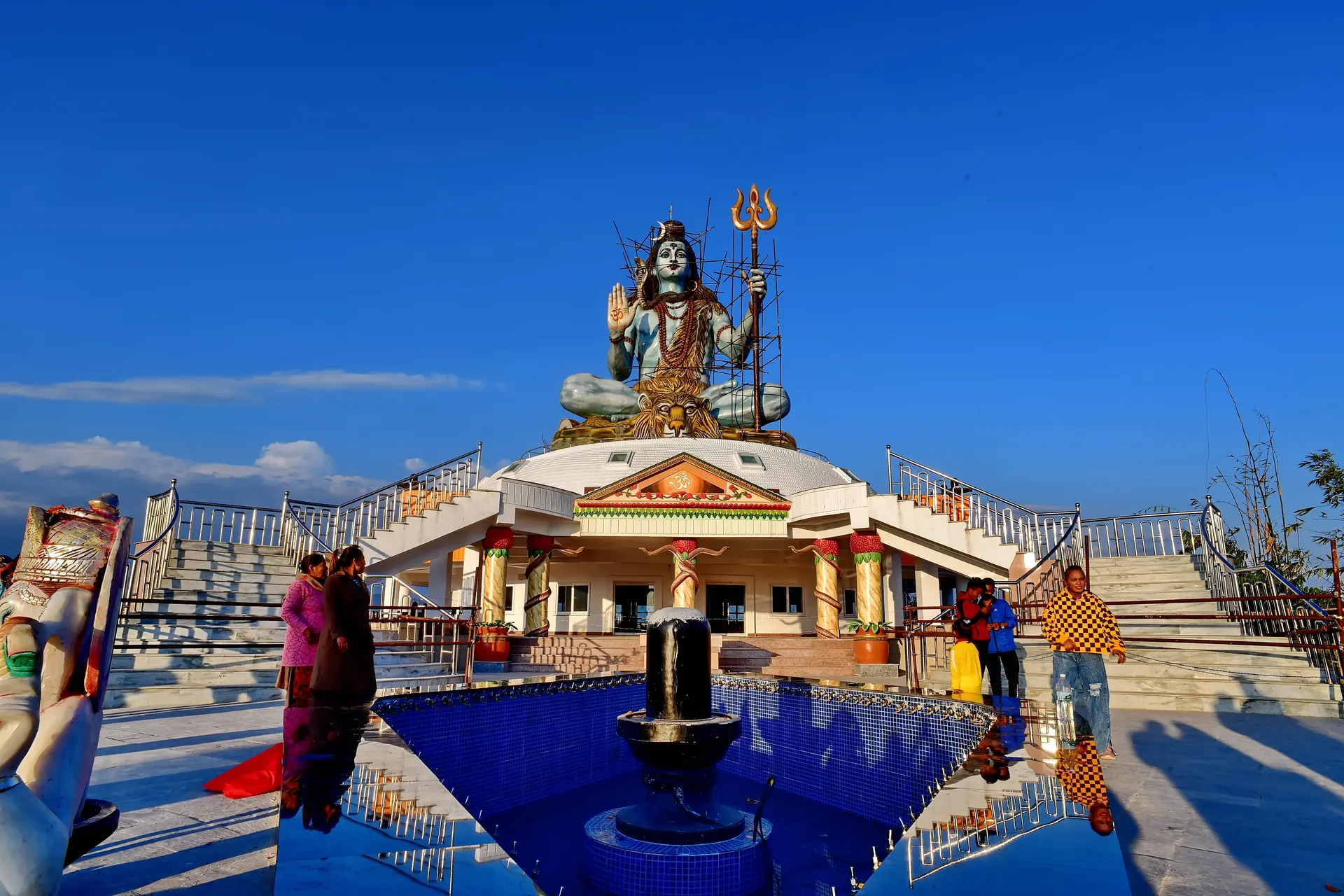
Visit essentials
A quick read before you go
- Duration
- 1-2 hours for the statue and views; half-day if combining with World Peace Pagoda.
- Access
- Approximately 10.5 km from Pokhara's Lakeside area.
Overview
Visible across the Pokhara valley, Shiva rises from Pumdikot with his right hand raised in blessing and his left gripping the trident symbolizing power over ignorance. The 51-foot statue stands atop a 57-foot white stupa, making a 108-foot whole that embodies a number sacred throughout Hindu tradition.
The World Peace Pagoda occupies an adjacent ridge, creating a corridor of contemplative spaces along the valley's southern rim. On clear days, Dhaulagiri, Machapuchare, Annapurna, Manaslu, and Himalchuli form a wall of snow and stone behind the statue.
Why this place is sacred
The site's power derives less from accumulated centuries of worship than from the elemental facts of its location. At 1,500 meters, the hilltop stands between the valley floor and the mountain summits, a middle ground where human and divine scales converge. The statue itself embodies this mediation—human-crafted yet depicting the divine, earthbound yet pointing skyward.
The incorporation of the sacred number 108 throughout the design intensifies the symbolic dimension. One hundred eight Shiva Lingas ring the base; 108 steps lead up to the platform; the statue itself stands 108 feet total. In Hindu tradition, 108 represents the wholeness of existence—the complete journey from ignorance to liberation.
Experience and orientation
The approach to Pumdikot allows time for the eyes to adjust from valley to vastness. Most visitors arrive by vehicle to a parking area from which the final ascent proceeds on foot. The 108 steps climb through landscaped grounds where the peripheral Shiva Lingas begin to appear, each one a sacred object in its own right.
The statue grows larger with each step, details emerging—the mudra of blessing, the features of the face, the damaru drum held in one hand. This particular Damaru is reportedly the largest in Asia, emphasizing Shiva's role as the cosmic dancer whose rhythm creates and destroys universes.
From the viewing platform at the statue's base, the landscape opens fully. The view encompasses Phewa Lake far below, the white sprawl of Pokhara city, and the entire Annapurna range filling the northern horizon. Visitors frequently fall silent here, the conversation between human creation and natural grandeur speaking for itself.
Pumdikot is located in the Pumdi Bhumdi village area, approximately 10.5 km from central Pokhara. The site includes parking, the 108-step approach, the statue platform, and surrounding gardens with the 108 Shiva Lingas.
Context and lineage
Unlike ancient temples that accumulate meaning over centuries, Pumdikot emerged from a specific project to create a new pilgrimage destination combining religious significance with scenic tourism. The statue was carved in Mathura—a city in Uttar Pradesh with deep connections to Hindu sacred art—before being transported to Nepal for installation.
The 2021 inauguration marked the beginning of the site's public life. Though young, the statue immediately became a recognizable landmark and draw for both devotees and visitors seeking viewpoints.
The statue embodies Shaivism—the worship of Shiva as supreme deity. While the specific site is new, it participates in a tradition of monumental Shiva images across the subcontinent, including the Kailashnath Mahadev Statue near Kathmandu (the only taller Shiva in Nepal).
Traditions and practice
Devotees make offerings to Shiva at the statue base, circumambulate the complex including the 108 Lingas, and offer prayers for blessing and protection.
The site operates as both pilgrimage destination and tourist attraction. Photography features prominently in most visits. The viewpoint draws couples, families, and tour groups alongside solo spiritual seekers.
Visit during clear weather for optimal Himalayan views—typically October through April, with morning offering the clearest conditions before afternoon clouds build. Combining Pumdikot with the nearby World Peace Pagoda creates a contemplative half-day pilgrimage.
Hinduism (Shaivism)
ActiveNepal's second-tallest Shiva statue represents the deity in blessing posture, incorporating the sacred number 108 throughout its design.
Worship, offerings, circumambulation, prayer.
Perspectives and open questions
As a newly constructed monument, Pumdikot invites reflection on how sacred sites acquire meaning—through intention, location, or accumulated devotion over time.
Living and traditional perspectives
Within Shaivite tradition, Shiva's image serves as a focal point for devotion regardless of the structure's age. The statue's consecration rituals established it as a legitimate center of worship.
Plan your visit
Access and arrival
Approximately 10.5 km from Pokhara's Lakeside area. Most visitors arrive by taxi or private vehicle. The site is also reachable by hiking from the World Peace Pagoda area.
Day trip from Pokhara accommodations. No lodging at the site.
Respectful visit
Modest dress appropriate for a religious site.
Permitted throughout the complex.
Traditional offerings to Shiva are welcomed at the statue base.
{"Respect worshippers engaged in prayer"}
Current practical details
Address
Pokhara 33700, Nepal
Phone
Hours
Hours, fees, and access can change — verify on the official source before you travel. Practical details last checked Jun 2026.
Location
Map loads as you approach this section.
Pilgrim reflections
A portrait of encounter, not a score
Pilgrims describe what they felt, how present they could become, and whether the place would shape a journey. There are no stars and no ranking of traditions.
No reviewed reflections yet
The first pilgrims can help describe the character of being here.
Share a reflection
Available after an account-backed “Been there.” Every reflection is reviewed before publication.
Nearby sacred places
Explore other sacred places in the region. Proximity does not establish access or travel time; check each place’s guidance.


References
Sources consulted for this page. Source categories describe the publication, not a guarantee that every claim is verified. Traditional accounts and outside interpretations may differ.
- 01Pumdikot Shiva Statue - Wikipediaencyclopedia
- 02Altitude Himalaya - Pumdikotguide
- 03Glorious Himalaya - Pumdikotguide
Pilgrim glossary
- Stupa
- A dome-shaped Buddhist monument that holds relics or marks a sacred place.
- Mudra
- A symbolic hand gesture used in Buddhist iconography and practice.
Share a photo
Help visitors recognize Pumdikot Shiva Statue, Pokhara. Every submission is reviewed before publication.