Murudeshwara Shiva temple, Bhatkal Taluk, Karnataka
A 37-metre Shiva and a fragment of the Atma Linga on a Karnataka coastal headland
Understand sacred places, explore living traditions, and learn how to engage respectfully with Pilgrim Map.
Access has not been verified. Check current local guidance before planning a visit.
Bailuru, Karnataka, India
Read the sources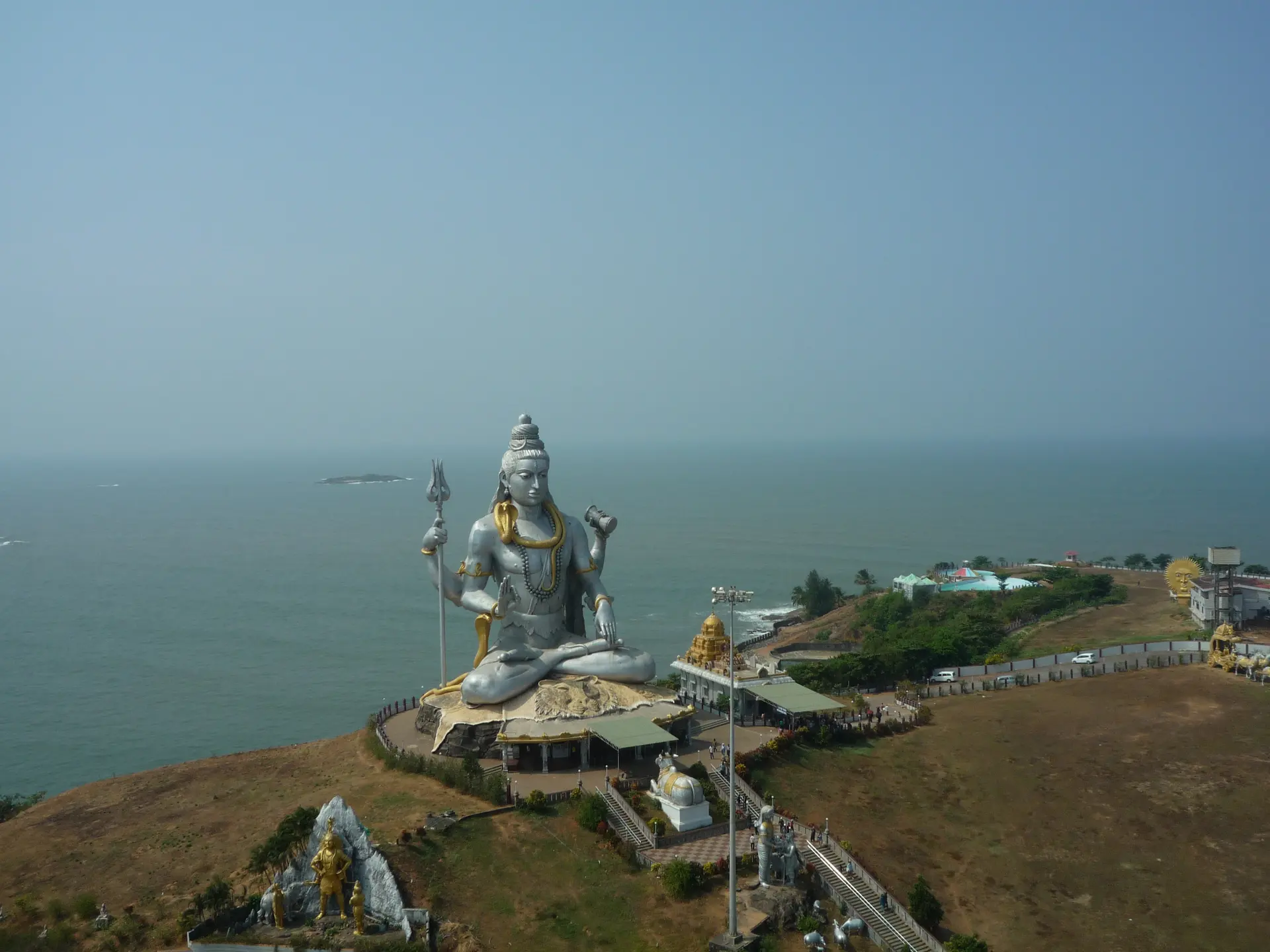
Image of Murudeshwara Shiva temple, Bhatkal Taluk, Karnataka. Image source · CC-BY-SA-3.0
Visit essentials
A quick read before you go
- Duration
- Two to three hours for the temple, statue area, and gopura ride.
- Access
- Reached by road from Mangalore (~165 km south), Udupi (~95 km), Hubballi (~165 km east), or Goa…
Overview
Murudeshwara is a Shaiva temple on Kanduka Hill in Bhatkal taluk, Uttara Kannada district, Karnataka. Nearly an island, the hill has the Arabian Sea on three sides. Industrialist R. N. Shetty commissioned its two modern monuments: a 37-metre seated Shiva completed in 2002 and a 20-storey Raja Gopura completed in 2008. The older, smaller focus of worship is the Sri Mridesa Linga, about two feet below ground in the inner sanctum.
Tradition holds that this linga is a piece of Shiva's Atma Linga, the soul-essence linga Ravana sought to carry from Mount Kailash to Lanka. Ganesha, disguised as a brahmin boy, tricked him into setting it down near Gokarna. When Ravana furiously tried to destroy the linga and its coverings, fragments scattered along the Karnataka coast. Its cloth is said to have fallen here; Kanduka Hill takes its name from kanduka, or ball, for how the cloth landed and bounced.
Murudeshwara is one of five Pancha Kshetra sites marking that scattering, with Mahabaleshwara at Gokarna, Dhareshwara, Gunavanteshwara, and Sajjeshwara. Open and welcoming, it draws Shaiva pilgrims on the circuit and coastal visitors coming for the statue and sea.
Why this place is sacred
Murudeshwara's quality of presence is unusual. The original linga is below ground, modest in scale, and accessed through a small inner sanctum — but the surrounding complex is among the most assertive temple environments in coastal India. The 37-metre Shiva statue dominates the headland and is visible from many kilometres along the shore; the 20-storey Raja Gopura allows visitors to look down on the temple roofline, the statue, and the Arabian Sea in a single panoramic frame.
Sunset, with the sun setting over the sea behind the statue, is widely regarded as the most affecting moment of the day. Layered onto this geography is the Ramayana resonance: Murudeshwara is one of five coastal points where the Atma Linga episode is said to have left physical traces, and the Pancha Kshetra circuit gives the site a place in a wider sacred geography that ties it to Gokarna a short distance south.
Pilgrims tend to register the layering; visitors who arrive expecting only a coastal landmark often report being unexpectedly moved.
A Shaiva shrine traditionally associated with the Atma Linga episode of the Ramayana, marking where the cloth covering of Shiva's Atma Linga is said to have fallen.
The original shrine is considered ancient by local tradition but is not precisely datable. The current complex is largely modern: the seated Shiva statue (sculpted by Kashinath Devali Shetty) was completed in 2002 and the 20-storey Raja Gopura in 2008, both under the patronage of industrialist R. N. Shetty. The inner sanctum and the Sri Mridesa Linga predate the modern reconstruction.
Experience and orientation
The complex is generously laid out across the headland, and a single visit easily covers the main temple, the statue, the gardens, and the gopura elevator to the upper viewing levels. Within the inner sanctum, darshan of the Sri Mridesa Linga is brief and quiet — the linga itself is small, set below ground, and approached on bare feet. Outside, the contrast is dramatic: the 37-metre statue rises against the open horizon, often with bright sun and sea wind.
From the top of the Raja Gopura the temple plan is visible all at once, with the Arabian Sea on three sides. Sunset draws the largest informal gathering of the day, and pilgrims and visitors alike tend to remain on the headland through the golden hour and into the evening aarti.
Enter via the main gate on Kanduka Hill, remove footwear, and visit the inner sanctum first if your purpose is darshan. The statue, gopura, and gardens can be explored before or after.
Context and lineage
In the Ramayana, Ravana obtained the Atma Linga from Shiva on the condition that it not be set on the ground before reaching Lanka. Ganesha, disguised as a brahmin boy, tricked Ravana into setting it down near Gokarna at the moment of evening prayer. When Ravana found the linga immovable, he attempted to destroy it and scattered its coverings; the cloth covering is said to have fallen on Kanduka Hill, where Murudeshwara now stands.
The hill's name derives from kanduka — ball — for how the cloth landed and bounced. The site name Murdeshwara derives from the Sanskrit Mridesa, the gentle lord, a name given to this manifestation of Shiva.
Shaiva, with no single sectarian affiliation; the temple participates in the broader Karnataka coastal Shaiva tradition centred at Gokarna.
Traditions and practice
Daily morning and evening abhishekam and aarti, Rudrabhishekam on Mondays and Maha Shivaratri, and Pradosham observances on the thirteenth lunar day. Coconuts, flowers, bel leaves, and ghee are the usual offerings; coastal ritual bathing in the Arabian Sea before temple entry remains common.
Maha Shivaratri (February or March) is the temple's largest festival, with all-night bhajans and continuous abhishekam. Kartika Purnima (November) celebrates Shiva's destruction of Tripura with lamps lit across the complex. Daily pilgrim flow combines with significant tourist visitation, particularly at sunset.
Time the visit around sunset, when the light on the statue and the sea is at its strongest. If on the Pancha Kshetra circuit, pair Murudeshwara with Gokarna in a single trip — the two are inseparable in the underlying mythology.
Hinduism (Shaiva)
ActiveMurudeshwara is regarded as the site where the cloth covering of Shiva's Atma Linga fell during Ravana's attempt to carry it to Lanka. The temple participates in the Pancha Kshetra cluster (with Gokarna, Dhareshwara, Gunavanteshwara, and Sajjeshwara) marking where pieces of the Atma Linga landed along the Karnataka coast.
Perspectives and open questions
Murudeshwara is read both as an ancient Shaiva site within the Pancha Kshetra mythology and as a late-twentieth-century reconstruction of religious monumental architecture.
Scholarly perspective
The mythic association with the Atma Linga is centuries old, but the present architectural complex is largely a late-twentieth-century construction. The statue (2002) and the 20-storey gopuram (2008) are modern monuments built on the site of a much older shrine and funded by industrialist R. N. Shetty.
Living and traditional perspectives
Devotees regard the Sri Mridesa Linga as a literal fragment of Shiva's Atma Linga, making the site a primary node in the Karnataka coastal Shaiva sacred geography. Pilgrimage to all five Pancha Kshetra sites is regarded as especially meritorious.
Alternative interpretations
Some interpretations read the coastal Atma Linga cluster as a yantra-like geographic figure along the shoreline, with each broken piece of the linga marking a chakra in the body of the land.
Open questions
The original date of the shrine predating modern reconstruction is undocumented. How the kanduka (ball) place-name connects historically to the cloth-falling episode is interpretive rather than evidentially fixed.
Plan your visit
Access and arrival
Reached by road from Mangalore (~165 km south), Udupi (~95 km), Hubballi (~165 km east), or Goa (~250 km north). Nearest rail station is Murdeshwar on the Konkan Railway (~2 km from the temple). Nearest airports are Mangalore (MAA, ~3.5 hours) and Goa (GOI, ~4 hours). Darshan timings approximately 06:00 to 13:00 and 15:00 to 20:30 (verify on arrival; seasonal variations).
A range of hotels and guesthouses in Murdeshwar town within walking distance of the temple. RNS Residency, operated by the same patronage family as the temple complex, is the most prominent option.
Respectful visit
Modest dress with shoulders and knees covered. Traditional dhoti or sari encouraged for puja.
Permitted throughout the outer complex, gardens, statue area, and from the gopura top. Restricted inside the inner sanctum.
Coconuts, flowers, bel leaves, and ghee are traditional. Special pujas can be booked at the temple office.
Footwear removed at the entrance | Silence in the sanctum | No food or drink within the temple precinct
The complex is open and generally welcoming, but the inner sanctum follows standard Hindu temple norms: no photography, modest dress, and footwear removed at the entrance. Monsoon visits are atmospheric but the sea is rough and rain heavy.
Current practical details
Address
3FVM+GVJ, Murudeshwar Temple Hwy, Gangavati, Murdeshwar, Karnataka 581350, India
Phone
Hours
Hours, fees, and access can change — verify on the official source before you travel. Practical details last checked Jun 2026.
Location
Map loads as you approach this section.
Pilgrim reflections
A portrait of encounter, not a score
Pilgrims describe what they felt, how present they could become, and whether the place would shape a journey. There are no stars and no ranking of traditions.
No reviewed reflections yet
The first pilgrims can help describe the character of being here.
Share a reflection
Available after an account-backed “Been there.” Every reflection is reviewed before publication.
Nearby sacred places
Explore other sacred places in the region. Proximity does not establish access or travel time; check each place’s guidance.
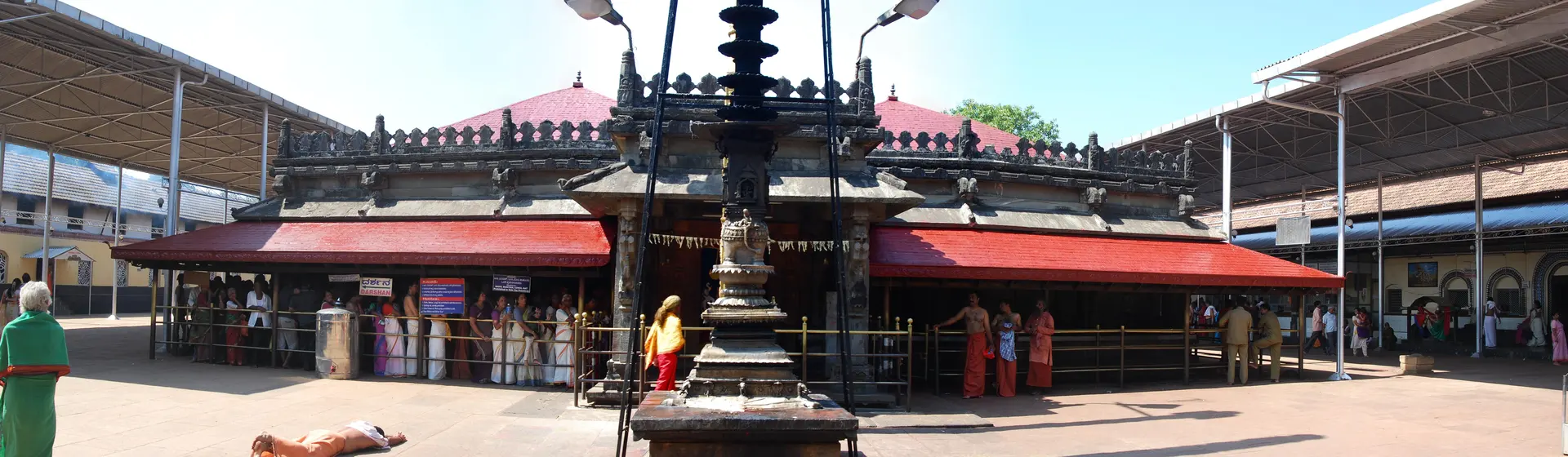
Kollur Mookambika Temple
Kolluru, Karnataka, India
43.8 km away

Belkal Theertha (Govinda Theertha)
Udupi, Karnataka, India
52.5 km away

Anegudde Shree Vinayaka Ganapathi Temple, Anegudde, Karnataka
Kumbhashi, Karnataka, India
63.0 km away
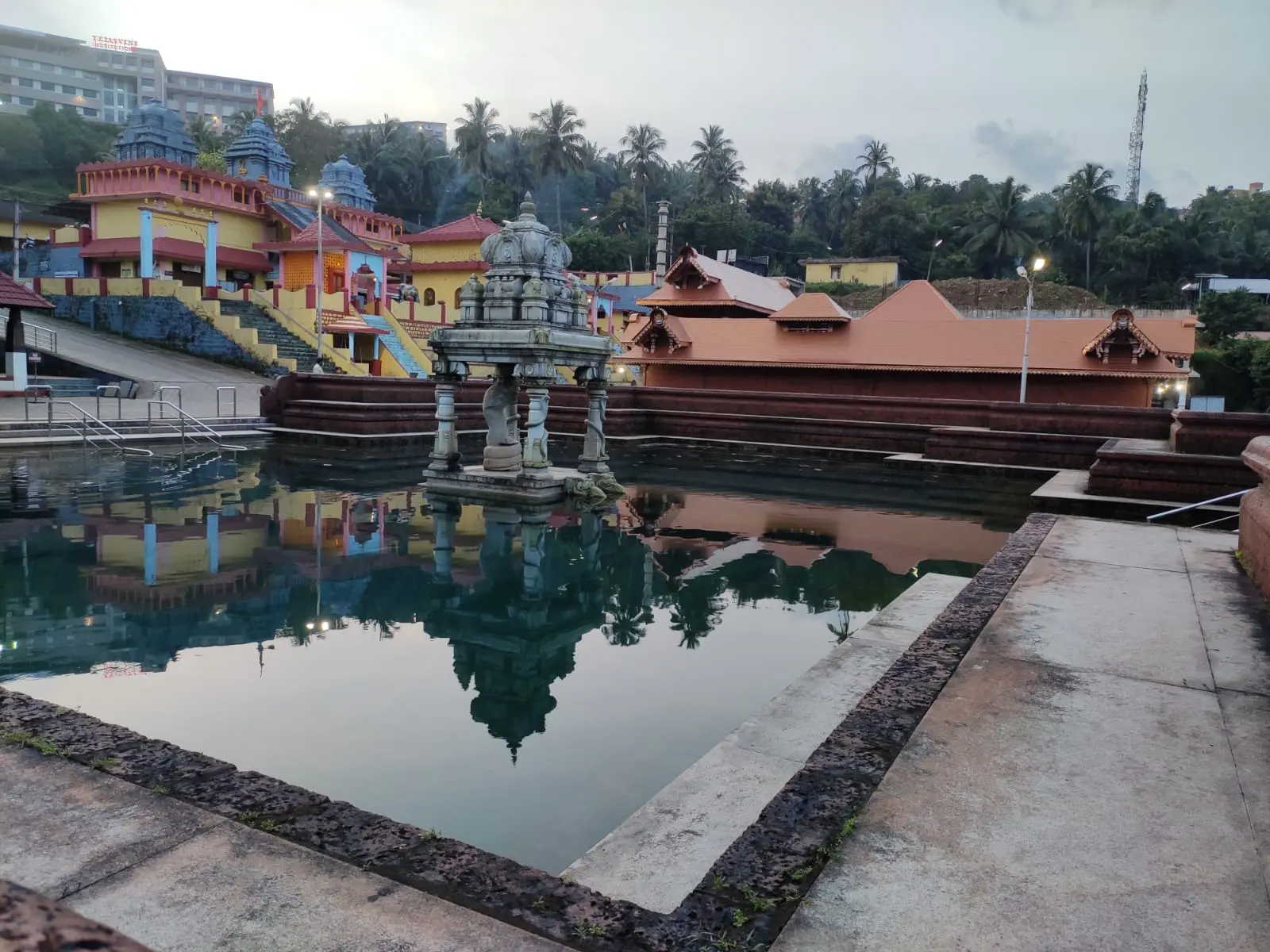
Shree Ananthapadmanabha Temple, Kudupu
Mangaluru, Karnataka, India
139.5 km away
References
Sources consulted for this page. Source categories describe the publication, not a guarantee that every claim is verified. Traditional accounts and outside interpretations may differ.
- 01Murdeshwar — Wikipedia — Wikipedia contributorsencyclopediaComprehensive overview of the Atma Linga legend, statue, and 20-storey Raja Gopura.
- 02Murdeshwara — Uttara Kannada District, Government of Karnataka — Uttara Kannada District AdministrationofficialOfficial district-government description of the temple's location, statue, and significance.
- 03Murudeshwara | Lord Shiva Statue — Karnataka Tourism — Karnataka Tourism BoardofficialState tourism authority page on Murudeshwara, including visitor information.
- 04Lord Shiva Statue, Murudeshwar — Trawell — Trawell.inguideDetailed visitor info on statue (37 m, R.N. Shetty patronage), festivals, and timings.
- 05Murudeshwar Temple — Trawell — Trawell.inguideFestival schedule, Maha Shivaratri and Kartika Purnima observances, darshan timings.
- 06Shri Murudeshwar Temple: Home to the World's Second Tallest Shiva Statue — Veena World — Veena World TravelguideMythology and physical layout description; useful on coastal setting.
- 07Murudeshwar Temple — Timings, Legend, Festivals, Architecture & Benefits — AstroVed — AstroVedspiritualDevotional perspective with detailed legend and ritual content.
- 08Murudeshwar Temple (Lord Shiva), Karnataka — TempleWalks — TempleWalksguideCross-referenced ritual and architectural details.
Photo gallery
2 curated photos
Share a photo
Help visitors recognize Murudeshwara Shiva temple, Bhatkal Taluk, Karnataka. Every submission is reviewed before publication.