Mt. Ishizuchi
The Roof of Shikoku: where sacred chains lift climbers toward the dwelling place of a primordial deity
Understand sacred places, explore living traditions, and learn how to engage respectfully with Pilgrim Map.
Access has not been verified. Check current local guidance before planning a visit.
Saijo, Ehime Prefecture, Japan
Read the sources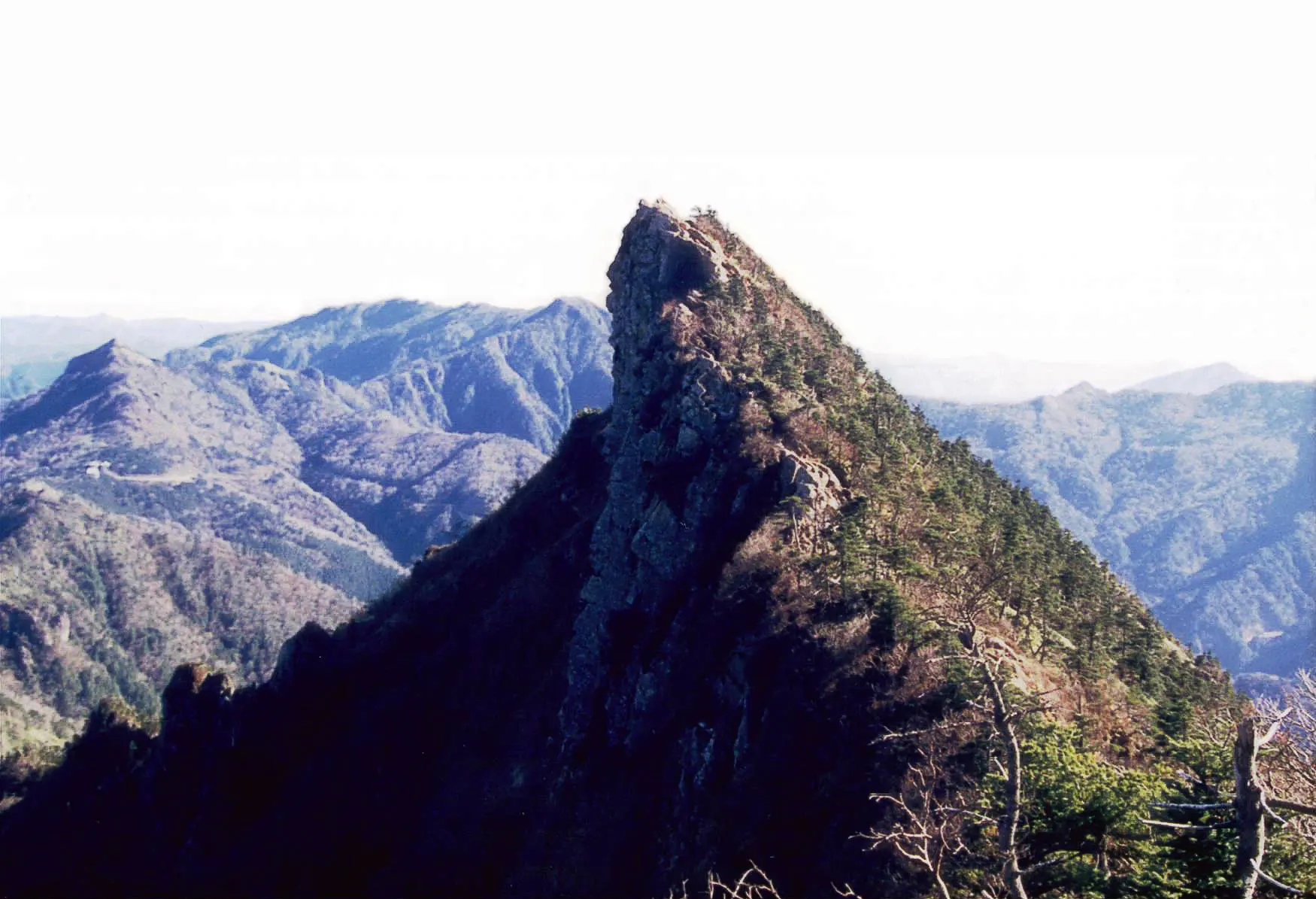
Image of Mt. Ishizuchi. Image source · CC-BY-SA-3.0
Visit essentials
A quick read before you go
- Duration
- 6-8 hours for round trip from ropeway station to summit and back; full day recommended
- Access
- Open during daylight in climbing season.
Overview
Mount Ishizuchi rises 1,982 meters above Ehime Prefecture as Shikoku's highest point, the 'Roof of Shikoku.' It is one of Japan's Seven Sacred Mountains, shaped by over 1,300 years of worship and association with En no Gyoja, Shugendo's legendary founder.
In 685 CE he climbed the summit and performed rites for the mountain deity Ishizuchi-biko no Mikoto, second son of the creator deities Izanagi and Izanami, thereby 'opening' this mountain to spiritual practice as he did Mount Fuji and other sacred peaks.
Ishizuchi-jinja Shrine forms a vertical pilgrimage of four shrines rather than one building. Climbers register at Kuchinomiya-honsha, reach the middle level at Chugu Joju-sha, and find Okumiya Chojo-sha at the summit. Between stations, three kusari chain routes cross vertical rock: the 33-meter tesuri, 33-meter ichi-no-kusari, and 68-meter ni-no-kusari. Their physical ordeal demands trust, courage, and complete presence as natural meditation.
The July 1st mountain-opening festival, Otaki Matsuri, begins the climbing season. White-robed pilgrims then stream upward as they have for over a millennium, seeking transformation through challenge.
Why this place is sacred
The thinness of Mount Ishizuchi is earned through effort. This is not a place where one simply arrives and absorbs atmosphere. The mountain demands engagement, and in that demand lies its power to transform.
The chain routes embody this dynamic. Climbing 68 meters of vertical rock on chains bolted into stone requires complete presence. There is no room for the wandering mind, no space for past regrets or future anxieties. There is only the chain, the rock, the next handhold, the breath.
This forced presence is itself a form of meditation - and at the top of each chain section, climbers often find themselves in altered states they could not have reached through sitting practice alone.
But the thinness goes deeper than psychological effect. Ishizuchi-biko no Mikoto - the deity of this mountain, child of the original creator gods - is understood to actually dwell here. The mountain is shintaizan, a body of kami. To climb is not merely to approach a symbol of divinity but to walk upon and within a divine presence.
This explains why Shugendo practitioners have been drawn here for over 1,300 years. The physical challenge of the mountain is not obstacle but means. Through the ordeal of the climb, through the fear and exhilaration of the chains, through the exhaustion and eventual arrival at the summit, something is burned away. What remains is clearer, lighter, more open to what lies beyond ordinary perception.
Mount Ishizuchi was 'opened' as a place of Shugendo practice - mountain asceticism aimed at transcending ordinary consciousness through physical ordeal and communion with the kami. The mountain's extreme challenge was its purpose: the chains, the exposure, the altitude all serve to strip away the distractions of ordinary mind.
The mountain's sacred significance has remained remarkably stable over 1,300 years. The four-shrine structure creates the same vertical pilgrimage today as in centuries past. The chains are maintained, the routes are marked, and pilgrims continue to climb. Women, historically excluded, are now welcomed - an evolution toward inclusivity that has expanded rather than diminished the tradition. The connection to the broader Shikoku pilgrimage reinforces the mountain's place in a sacred geography that encompasses the entire island.
Experience and orientation
The ascent of Mount Ishizuchi begins with a choice: the full climb from the base, or a ropeway that lifts visitors to the Joju-sha level at the seventh station. Either way, the serious climbing remains.
From the ropeway station, the path leads through forest toward the first chain section. Here, pilgrims face a decision that has been faced for centuries: the chains, or the alternative walking route that bypasses them. There is no shame in the walking route - and yet something is offered in the chains that cannot be found on easier paths.
The first chain (tesuri) is the gentlest introduction - 33 meters that teach the technique of chain climbing. The chains are thick, the holds are there, but the exposure is real. The second chain (ichi-no-kusari) maintains that length with increased difficulty. By the third chain (ni-no-kusari) - 68 meters of near-vertical ascent - climbers have either found their rhythm or returned to the walking route.
Between chain sections, the trail continues through terrain that would be considered challenging even without the chains. The forest gives way to exposed ridgelines. Views open to reveal Shikoku spread below - the sea in the distance, the mountains rolling in all directions.
The summit arrives not with a single peak but with a series of rocky outcrops. The Misen peak holds the summit shrine, Okumiya Chojo-sha. Here, having earned arrival through physical effort, pilgrims offer prayers to Ishizuchi-biko no Mikoto. On clear days, the Seto Inland Sea shimmers in the distance.
The descent can be made by the same route or alternative paths. Either way, the mountain releases climbers transformed by the ordeal.
Mount Ishizuchi lies in Ehime Prefecture, within Ishizuchi Quasi-National Park. The main approach uses the Ishizuchi ropeway from the base at Shimotani to reach Joju-sha at the seventh station. From there, approximately 3-4 hours of climbing reaches the summit. The four shrines of Ishizuchi-jinja mark the ascent: Kuchinomiya-honsha at the base, Chugu Joju-sha at the ropeway station, and Okumiya Chojo-sha at the summit.
Context and lineage
The origins of Mount Ishizuchi as a sacred site reach back to En no Gyoja - En no Ozunu - the legendary founder of Shugendo who lived from approximately 634 to 701 CE. This remarkable figure is credited with 'opening' numerous sacred mountains across Japan, including Mount Fuji and the Omine mountain range.
In 685 CE, En no Gyoja climbed Mount Ishizuchi's challenging slopes and reached the summit. There he performed rituals to honor the mountain deity, Ishizuchi-biko no Mikoto. According to Shinto mythology, this deity is the second son of Izanagi and Izanami, the original creator gods who gave birth to the Japanese islands themselves. By honoring this primordial deity, En no Gyoja opened the mountain to the practice of Shugendo.
Over a century later, Kukai (774-835) - the founder of Shingon Buddhism who would become one of Japan's most revered religious figures - also practiced on Mount Ishizuchi. This connection to Kukai reinforces the mountain's place among the holiest sites in western Japan.
Mount Ishizuchi belongs to the Shugendo tradition established by En no Gyoja across Japan's sacred peaks. The mountain also connects to Shingon Buddhism through Kukai's practice here. The Ishizuchi-jinja shrine maintains the formal Shinto worship structure. These traditions interweave, as they have throughout Japanese religious history, creating a syncretic practice that draws on multiple sources while remaining distinctively of this mountain.
En no Gyoja (En no Ozunu)
Founder who opened the mountain
Kukai
Practiced on the mountain
Ishizuchi-biko no Mikoto
Mountain deity
Traditions and practice
Traditional practice at Mount Ishizuchi centers on the climb itself as spiritual discipline. The chain routes transform hiking into ordeal - the Shugendo understanding that physical challenge can catalyze spiritual opening. Worship at each of the four shrine levels marks stages of the pilgrimage. The July 1st mountain-opening ceremony (Otaki Festival) ritually opens the climbing season with fire and prayer. Shugendo practitioners perform more intensive austerities: extended periods on the mountain, night climbing, ascetic exercises.
Contemporary practice maintains the essential structure. Pilgrims continue to climb during the open season (May-November), with the July 1st opening drawing the largest crowds. The chain sections remain optional but are understood as the deeper path. Registration at the base shrine creates formal intention. Prayers at each shrine level honor the mountain deity. The summit prayer for family safety, protection from evil, and healing continues the tradition established by En no Gyoja 1,300 years ago.
Visitors seeking spiritual experience at Mount Ishizuchi should approach the climb as pilgrimage rather than hiking. Consider registering at the base shrine to formalize intention. At each chain section, make a conscious choice - the chains offer something the walking route does not, but only if you are physically and mentally prepared. On the chains, let the experience itself become the practice: complete presence, breath, trust. At the summit, take time for genuine prayer or meditation.
The ordeal of arrival has opened something; do not rush to close it.
Shugendo
ActiveMount Ishizuchi is one of Japan's most important Shugendo centers. The mountain was 'opened' to spiritual practice by En no Gyoja in 685 CE. Ishizuchi-biko no Mikoto, second son of the creator deities, dwells here as the mountain deity. Shugendo practitioners perform rigorous mountain asceticism to honor this deity and transform themselves.
Mountain climbing as spiritual practice, chain climbing as ordeal, waterfall meditation, worship at the four shrines, prayers for family safety and healing
Shinto / Ishizuchi-jinja
ActiveIshizuchi-jinja Shrine is distributed across four locations on the mountain, creating a vertical pilgrimage from base to summit. This arrangement allows worship at different altitudes and creates a complete ritual journey.
Shrine worship, pilgrim registration, sacred chain climbing, summit prayers
Perspectives and open questions
Mount Ishizuchi is understood through interwoven Shugendo and Shinto perspectives, with scholarly analysis illuminating both.
Scholarly perspective
Scholars recognize Mount Ishizuchi as one of Japan's most significant examples of Shugendo mountain religion. The mountain's status as the highest peak in western Japan gave it natural prominence for mountain worship. The connection to En no Gyoja places it in the same foundational category as Mount Fuji and other peaks he opened. The chain routes are studied as examples of how physical challenge was structured into sacred geography.
Living and traditional perspectives
In traditional understanding, Mount Ishizuchi is the shintaizan - the living body - of Ishizuchi-biko no Mikoto. This is not metaphor but fact: the deity genuinely dwells in the mountain. To climb is to approach and commune with divinity. The physical ordeal of the chains purifies the practitioner, burning away impurities and creating openness to spiritual power. Those who complete the climb with proper attitude receive the deity's blessings of protection and healing.
Open questions
The full extent of En no Gyoja's activities on the mountain remains legendary rather than historical. The original rituals he performed at the summit are not documented. The specific relationship between the mountain deity and sea deities in local belief represents an area where knowledge has been lost or remains hidden within esoteric teaching.
Plan your visit
Access and arrival
Open during daylight in climbing season. Free mountain access; ropeway fee optional. Reach via bus from Saijo to ropeway base station. Ropeway operates to Joju-sha station, reducing but not eliminating the climb.
Mountain huts available during climbing season; lodging in Saijo city; ryokan in the Ishizuchi area
Respectful visit
Proper hiking attire including sturdy boots. Mountain conditions require preparation for rapid weather changes. Gloves useful for chain sections.
Permitted in most areas. Be mindful of other climbers on the chains.
Coins at shrine offering boxes along the route. Prayers for protection traditional.
{"Prepare adequately for the challenging climb","Register at the base shrine","Do not climb in dangerous weather","Respect other climbers on the chains","Certain inner shrine areas may be restricted"}
Mount Ishizuchi is a serious mountain requiring proper preparation. The chain sections are genuinely dangerous for those without adequate fitness or composure. Climbing season runs May-November; winter conditions are severe. Weather can change rapidly at altitude. The ropeway reduces but does not eliminate the physical challenge. Those who cannot manage the chains should use the walking alternatives without shame - the mountain offers its gifts through multiple paths.
Current practical details
Address
Mount Ishizuchi, Wakayama, Kumakogen, Kamiukena District, Ehime 791-1710, Japan
Hours, fees, and access can change — verify on the official source before you travel. Practical details last checked Jun 2026.
Location
Map loads as you approach this section.
Pilgrim reflections
A portrait of encounter, not a score
Pilgrims describe what they felt, how present they could become, and whether the place would shape a journey. There are no stars and no ranking of traditions.
No reviewed reflections yet
The first pilgrims can help describe the character of being here.
Share a reflection
Available after an account-backed “Been there.” Every reflection is reviewed before publication.
Nearby sacred places
Explore other sacred places in the region. Proximity does not establish access or travel time; check each place’s guidance.


References
Sources consulted for this page. Source categories describe the publication, not a guarantee that every claim is verified. Traditional accounts and outside interpretations may differ.
- 01Learn About the Ishizuchi Mountain Range — Ishizuchi Mountain Range Official WebsiteSource contextOfficial information
- 02Mt. Ishizuchi - Japan National Tourism Organization — JNTOSource contextOfficial tourism information
- 03Ishizuchi Journey — Ishizuchi JourneyguidePilgrimage information
- 04Sacred Mountains of Japan - Association for Asian Studies — Association for Asian StudiesacademicAcademic perspective
- 05Mount Ishizuchi - Wikipedia — Wikipedia contributorsencyclopediaComprehensive overview
Pilgrim glossary
- Shingon
- An esoteric Japanese Buddhist school emphasizing ritual, mantra, and mandala practice.
Share a photo
Help visitors recognize Mt. Ishizuchi. Every submission is reviewed before publication.