Mashhad
The only Imam buried in Iran, at the heart of Khorasan
Understand sacred places, explore living traditions, and learn how to engage respectfully with Pilgrim Map.
Access has not been verified. Check current local guidance before planning a visit.
Mashhad, Razavi Khorasan, Iran
Read the sources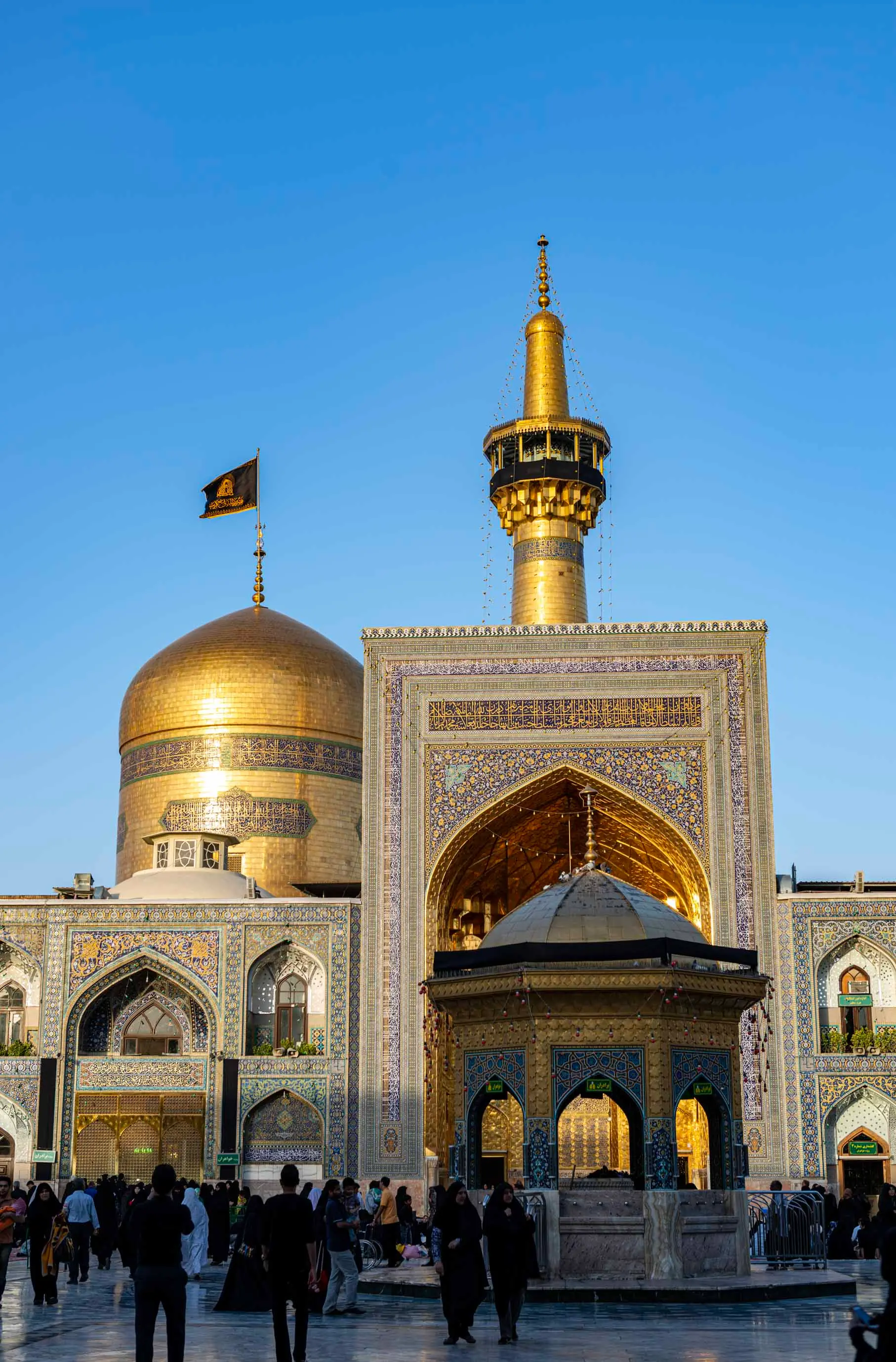
Image of Mashhad. Image source · CC-BY-SA-4.0
Visit essentials
A quick read before you go
- Duration
- Half a day minimum for outer courtyards and museums.
- Access
- Central Mashhad, Razavi Khorasan, north-eastern Iran.
Overview
The Imam Reza Holy Shrine—Haram-e Razavi—surrounds the burial place of Imam ʿAli al-Riḍā, eighth of the Twelve Imams of Twelver Shiʿa Islam, who died near Tus in 203 AH / 818 CE. The only one of the Twelve buried in Iran, he is honored within more than two dozen interconnected sahns, iwans, mosques, museums, and libraries.
The main precinct is commonly cited at around 600,000 square metres, with a substantially larger waqf estate, and widely described as the world's largest active mosque complex by area. The Timurid Goharshad Mosque, completed in 1418 CE under Empress Gowhar Shad, is a supreme work of Persian Islamic architecture. Astan Quds Razavi, among the Islamic world's oldest and largest religious endowments, administers the shrine and supports pilgrim hospitality, schools, hospitals, and a major university.
Twenty to thirty million pilgrims are reported annually, peaking on Safar's last day, the martyrdom anniversary; returning pilgrims bear the honorific Mashhadi as a permanent mark of the journey.
Why this place is sacred
Mashhad — the city's name means 'place of martyrdom' — grew up around the grave. The burial chamber lies under a great golden dome first gilded under the Safavids and re-gilded across successive dynasties. Surrounding it, generations have added courtyard upon courtyard: the ʿAtīq sahn from the Safavid period, the Jadid (new) sahn from the Qajar era, the vast Imam Khomeini sahn opened in the modern period, and the Goharshad mosque from the Timurid fifteenth century.
The complex is large enough that pilgrims wander for hours before reaching the inner rawza — and that wandering is itself part of the ziyarat. Qurʾan recitation continues in shifts day and night. Free meals, free lodging, and free transport in the Mashhadi tradition are extended by both the Astan Quds Razavi endowment and ordinary residents of the city.
What pilgrims report is rarely a single moment but a long, slow saturation in collective devotion — a city organised around one grave.
Burial chamber and pilgrimage shrine of Imam ʿAli al-Riḍā, the 8th Imam of Twelver Shiʿa Islam, who died at Sanabad near Tus in 818 CE while serving — under coercion — as heir-apparent to the Abbasid caliph al-Maʾmun.
From a small grave-chamber in the early ninth century, the shrine was rebuilt under the Saffarids, Ghaznavids, and Seljuks; Sultan Sanjar carried out significant works in the early twelfth century. The Timurid Empress Gowhar Shad commissioned the great mosque adjoining the shrine in 1418. The Safavids — Shah Tahmasp I and Shah ʿAbbas I, who in 1601 walked from Isfahan to Mashhad on pilgrimage — gilded the dome and expanded the ʿAtīq courtyard.
Nader Shah added further gilding in the eighteenth century. Qajar and Pahlavi works followed; the Islamic Republic has opened new courtyards over recent decades.
Healing traditions
Shi'a intercession and healing testimony tradition
At Imam Reza's shrine in Mashhad, pilgrims seek God's help through the Imam's intercession. Shi'a religious resources preserve accounts of miraculous healing as part of that devotion, alongside the practice of ziyara. The material reviewed for this section establishes the continuing tradition but does not provide enough detail to retell a named recovery responsibly.
Ways to participate
Muslim pilgrims can offer a du'a or recite a ziyara text in an area where they are permitted to worship. Ask shrine staff about access and assistance; non-Muslim visitors should confirm which areas and guided visits are open to them. Prayer does not require pressing against the tomb enclosure or remaining in a crowd that feels unsafe.
These accounts describe religious traditions and reported experiences. They do not promise a cure or replace medical care.
Experience and orientation
Approaching the haram, pilgrims first see the gilded dome and twin minarets above Mashhad's skyline. Beyond security, marble paving stretches across courtyards larger than European cathedrals, framed by Timurid-blue and Safavid-green tilework. The Goharshad Mosque on the southern flank holds one of Persian architecture's great vaulted spaces, where pilgrims often sit silently against the walls. Toward the rawza, the scale compresses through a gilded iwan and silver doors into the burial chamber, where a silver-and-gold zarih surrounds the grave.
The atmosphere is intensely emotional: pilgrims press toward the grille, recite ziyarat texts aloud, touch and kiss it, tie small cloth strips as vows, call “Ya Reza!”, and often weep.
Enter via one of the named gates — Bab al-Reza is the principal international entry. Women's chador is provided at the gates free of charge. Bags, cameras with detachable lenses, and most electronics are not permitted beyond security and may be checked. The Office of International Pilgrims (Bab al-Reza area) coordinates multi-language tours for non-Iranian visitors and can advise on which areas are open to non-Muslims at any given time.
Context and lineage
Al-Maʾmun, attempting to reconcile factions in the Abbasid caliphate and to co-opt the rising prestige of the Ahl al-Bayt, summoned ʿAli al-Riḍā from Medina and in 201 AH / 816 CE designated him as heir-apparent — naming him 'al-Riḍā' ('the one chosen as acceptable'). The Imam reportedly accepted only under duress. Two years later he died suddenly at Tus. Shiʿa tradition holds that al-Maʾmun, terrified of the Imam's growing influence, had him poisoned — commonly cited as grapes or pomegranate.
Some Sunni historians describe the death as illness; Shiʿa devotion holds firmly to the martyrdom narrative. Al-Maʾmun buried the Imam beside his own father, Harun al-Rashid, in a tomb-garden. Within decades the grave had become a pilgrimage destination. The first attested mausoleum dates to the ninth century; it was destroyed by the Ghaznavid governor Subuktigin and by later raids, then continuously rebuilt and expanded under successive Persian and Central Asian dynasties.
Twelver (Ithnāʿasharī) Shiʿa Islam. The shrine is administered by Astan Quds Razavi, one of the oldest and largest religious endowments (waqf) in the Islamic world.
Traditions and practice
Pilgrims approach the rawza reciting the Ziyarat-nameh of Imam Reza or the more general Ziyarat al-Jamiʿah al-Kabirah, then salute the Imam on crossing the threshold. At the zarih they touch and kiss the grille, tie small pieces of cloth as votive bonds, and offer personal supplication. Tawassul — seeking the Imam's intercession before God — is widely practised. The dawn duʿaʾ (sahar) and the supplications after the night prayer are observed by many pilgrims who stay multiple days.
The shrine's servant corps performs the ceremonial dust-sweeping (khadem-i rowze) at set times.
The last day of Safar — the anniversary of the Imam's martyrdom — is the peak pilgrimage night; millions converge on Mashhad and the haram fills with mourning processions. The first ten nights of Muharram bring nightly azadari (mourning observances) across the courtyards. Nowruz (Iranian New Year, 21 March) is the major family pilgrimage week. Ramadan brings nightly prayer and recitation programmes; many pilgrims stay through the last ten nights for the Layali al-Qadr.
Allow time to acclimatise — the scale of the precinct is difficult to absorb on a first short visit. If you are a Muslim pilgrim, enter the rawza in the early morning when the press is lightest, recite the dedicated ziyarat-nameh slowly, and stay long enough that the experience becomes interior rather than performative.
If you are non-Muslim, the Office of International Pilgrims at Bab al-Reza can arrange a guided tour of the outer sahns, the Goharshad mosque exterior, the museums, and the central library — these alone repay several hours.
Twelver Shiʿa Islam
ActiveTomb of Imam ʿAli al-Riḍā, the 8th of the Twelve Imams and the only Imam buried in Iran. Pilgrimage (ziyarat) to his shrine is among the most meritorious acts in Twelver tradition; returning pilgrims take on the honorific 'Mashhadi'. The shrine is administered by Astan Quds Razavi, one of the oldest and largest waqf institutions in the Islamic world.
Ziyarat with the recitation of the Imam Reza ziyarat-nameh and Ziyarat al-Jamiʿah al-Kabirah; tawassul (seeking intercession through the Imam); touching and kissing the zarih; congregational prayer in the Goharshad Mosque and the great sahns; mourning observances at Muharram and on the anniversary of the Imam's martyrdom (last day of Safar); dawn duʿaʾ (sahar) and night-prayer supplications.
Perspectives and open questions
The shrine holds together a contested historical death, an unbroken pilgrimage of more than twelve centuries, and a present-day waqf institution that touches millions of lives. Each frame is worth holding alongside the others.
Scholarly perspective
The shrine is the largest and most-visited religious complex in Iran and is widely described as the largest active mosque complex in the world by area — roughly 600,000 square metres for the main precinct, with further waqf estates beyond. Architectural phases span more than a millennium; the Goharshad Mosque is among the finest surviving Timurid buildings. The Astan Quds Razavi endowment is one of the great waqf institutions of Islamic history.
Living and traditional perspectives
Twelver Shiʿa tradition regards Imam Reza as a Maʿṣūm — divinely protected and the rightful spiritual leader of his age. His ziyarat is held to bring forgiveness of sins, healing, and the Imam's intercession on the Day of Judgement. Some hadiths attributed to the Imams promise paradise to one who visits him knowing his right.
Alternative interpretations
Sufi orders with strong Shiʿa sympathies — most notably the Niʿmatullahi — treat Imam Reza as a polar saint (qutb) whose presence sanctifies the whole region of Khorasan. Local devotional practice in Mashhad weaves Sufi and Shiʿa registers together more freely than formal theology.
Open questions
The exact circumstances of the Imam's death — whether poisoned by al-Maʾmun, as Shiʿa tradition holds, or illness, as some Sunni historians have argued — remain a matter of theological conviction rather than historical proof. The spiritual reality his devotees encounter at the zarih is, by their account, not reducible to historical questions.
Plan your visit
Access and arrival
Central Mashhad, Razavi Khorasan, north-eastern Iran. Mashhad International Airport (MHD) is one of Iran's busiest airports with direct flights from across the Islamic world. Direct trains and buses run from Tehran (~900 km). Multiple named gates open onto the haram precinct; the Office of International Pilgrims (Bab al-Reza area) coordinates non-Iranian visitors and can arrange multi-language guides.
Free pilgrim housing is provided through the Astan Quds Razavi endowment in dormitory accommodation around the haram. Mashhad also has the largest concentration of hotels in north-eastern Iran across all price ranges; the streets immediately around the haram are densely built with pilgrim hotels. Bookings rise sharply during the last days of Safar, Muharram, and Nowruz.
Respectful visit
Women: chador (provided free at entry gates) over modest clothing, hair fully covered. Men: long trousers and long sleeves; no shorts. Shoes removed before entering covered prayer halls and the rawza.
Generally not permitted inside the burial chamber or the Goharshad Mosque interior. Outer courtyards and the gilded iwans may be photographed without flash. Do not photograph individual pilgrims, especially women or those weeping. Cameras with detachable lenses are usually refused at security; a phone camera is acceptable in permitted areas.
Donations to the shrine's charitable trust (waqf) are welcomed. Money is sometimes thrown over the zarih grille as a vow; cloth strips are tied. Avoid edible or perfumed offerings inside the rawza.
No bags, weapons, non-religious literature, or cameras with detachable lenses past security; phones may be inspected. Maintain silence near the rawza. Withdraw walking backwards rather than turning your back to the burial chamber. Women's and men's prayer areas in the inner shrine are separated. Non-Muslims are generally not permitted in the innermost rawza or Goharshad prayer hall—verify current policy with the Office of International Pilgrims.
Maintain a tone of reverence in all parts of the precinct; laughter, loud conversation, and casual photography are out of place. Women's and men's prayer areas in the inner shrine are separated. Do not turn your back to the burial chamber when leaving — pilgrims withdraw walking backwards. Verify current non-Muslim access policy with the Office of International Pilgrims before travel.
Current practical details
Address
Mashhad, Razavi Khorasan Province, Iran
Hours, fees, and access can change — verify on the official source before you travel. Practical details last checked Jun 2026.
Location
Map loads as you approach this section.
Pilgrim reflections
A portrait of encounter, not a score
Pilgrims describe what they felt, how present they could become, and whether the place would shape a journey. There are no stars and no ranking of traditions.
No reviewed reflections yet
The first pilgrims can help describe the character of being here.
Share a reflection
Available after an account-backed “Been there.” Every reflection is reviewed before publication.
Nearby sacred places
Explore other sacred places in the region. Proximity does not establish access or travel time; check each place’s guidance.
Malik Ajdar Palwan Tomb
Kaka District, Ahal, Turkmenistan
102.4 km away

Seyit Jemaleddin Mosque Ruins
Anau, Ahal Region, Turkmenistan
202.4 km away

Old Nisa Sacred City
Bagir / Ashgabat, Ahal Region, Turkmenistan
222.9 km away

Kyz Bibi Mausoleum
Ancient Merv / Bayramaly, Mary Region, Turkmenistan
272.1 km away
References
Sources consulted for this page. Source categories describe the publication, not a guarantee that every claim is verified. Traditional accounts and outside interpretations may differ.
- 01Astan Quds Razavi — Official Custodianship Portal — Astan Quds RazaviofficialAdministrative custodian of the shrine; publishes architectural, ritual and visitor information.
- 02Imam Reza (A.S.) Shrine — Official English site — Astan Quds RazaviofficialEnglish-language portal: ziyarat texts, courtyards, sahns, congregational schedule.
- 03Imam Reza shrine — Wikipedia — Wikipedia contributorsencyclopediaComprehensive overview of sahns (courtyards), iwans, museums, library; cites area figures and pilgrim statistics.
- 04Ali al-Rida — Wikipedia — Wikipedia contributorsencyclopediaBiography of the 8th Twelver Imam (c. 765–818 CE); appointment as heir-apparent by al-Maʾmun; death at Tus.
- 05Goharshad Mosque — Wikipedia — Wikipedia contributorsencyclopediaTimurid mosque (1418 CE) commissioned by Empress Gowhar Shad, wife of Shah Rukh; now integrated into the shrine complex.
- 06Mashhad | Iran — Britannica — Encyclopædia BritannicaencyclopediaCity history; the shrine as the spiritual heart of north-eastern Iran and most-visited pilgrimage site in the country.
- 07Haram-i Imam Riza — Archnet documentation — Archnet (MIT Aga Khan Documentation Center)academicArchitectural drawings and historical phases from Saffarid origins through Safavid, Qajar and Pahlavi expansions.
- 08MAŠHAD — Encyclopædia Iranica — Encyclopædia IranicaacademicAuthoritative scholarly entry covering the shrine's history, custodianship, and place in Twelver Shiʿism.
- 09Imam Reza religious resources — Office of Ayatollah SistanispiritualSupports the attributed account or visitor practice in the healing section; not evidence of clinical efficacy.
- 10Astan Quds Razavi — shrine administrationofficialSupports the attributed account or visitor practice in the healing section; not evidence of clinical efficacy.
Photo gallery
3 curated photos
Share a photo
Help visitors recognize Mashhad. Every submission is reviewed before publication.