Kapel in 't Zand Church, Roermond, Netherlands
Where six centuries of Marian devotion flow from a miraculous spring in the Dutch sands
Understand sacred places, explore living traditions, and learn how to engage respectfully with Pilgrim Map.
Access has not been verified. Check current local guidance before planning a visit.
Roermond, Limburg, Netherlands
Read the sources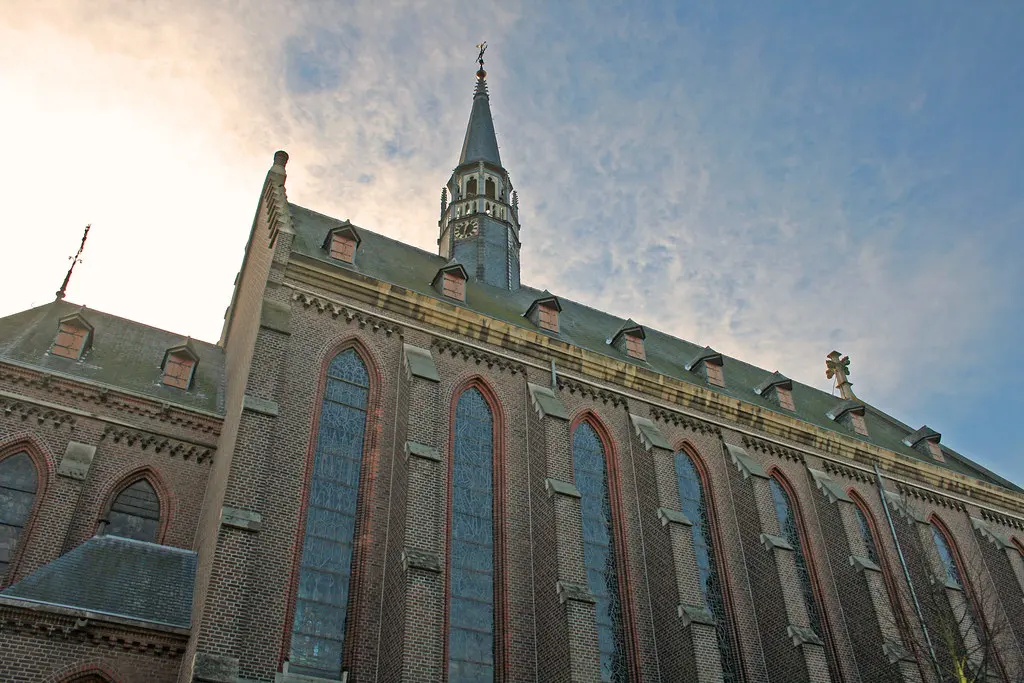
Visit essentials
A quick read before you go
- Duration
- One to two hours allows time to walk the processional pathway, explore the chapel, and walk the…
- Etiquette
- Visitors should approach the Kapel in 't Zand with the respect appropriate to an active Catholic…
Overview
Kapel in 't Zand earned holiness through accumulated need and gratitude. For more than six hundred years, pilgrims have come to sandy ground outside Roermond seeking Mary's intercession and leaving evidence of answered prayer.
Tradition says a Polish shepherd found a small Virgin Mary statue in a well in the early fifteenth century. As prayers gathered, a chapel rose, was destroyed, rose again, and grew into today's neo-Gothic structure. Devotion survived siege, occupation, and secularization.
Over seven thousand votive tiles line the processional path, compressing stories of healing, survival, births, and crises passed into terracotta. Some date to 1927, when the tradition began; others were placed last week, making generations of faith visible.
Redemptorist fathers have tended the pilgrimage for over 160 years. From May through September, processions cross the Kruiswegpark, families arrive from the Netherlands and beyond, and the Sinti community holds its annual week of prayer and celebration. The central statue remains small and unassuming; what has grown around it is vast.
Why this place is sacred
The concept of a thin place suggests locations where the boundary between ordinary experience and something greater becomes permeable. At the Kapel in 't Zand, that permeability emerges not from geology or ancient cosmology but from human need sustained across centuries.
The founding story matters less for its historical precision than for what it reveals about the site's character. A shepherd, a foreign laborer in a strange land, discovers something precious in a well. The image speaks to countless pilgrims who have come since: those who feel foreign to their own lives, who search for something precious in unexpected places, who lower their hope into dark water and find it returned transformed.
The well still exists, visible in the Lady Chapel. Pilgrims can see where the story began, though the waters no longer flow. What flows instead is the stream of those who come: the sick seeking healing, parents seeking protection for children, travelers seeking guidance, the grieving seeking comfort. The consistency of their coming, year after year for six centuries, creates its own kind of sacred geography.
The votive tiles lining the processional pathway offer the most tangible evidence of what draws people here. Each tile represents a prayer offered and, in the donor's understanding, answered. Reading them is to encounter an archive of human vulnerability: cancer survived, accidents escaped, children recovered, marriages saved. The tiles do not argue for miracles; they simply testify. Whether one attributes their existence to divine intervention, psychological comfort, or coincidence, their presence creates a powerful atmosphere.
To walk among them is to walk through accumulated gratitude.
The neo-Gothic architecture, designed to echo the Sainte-Chapelle in Paris, lifts the eye toward heaven. Light filters through stained glass by Albin Windhausen. The triumphal cross presides over the nave. But the sacred atmosphere here is not primarily architectural. It is accumulated, human, intimate. The chapel smells of candles. The silence holds centuries of whispered petition.
The original chapel, commissioned by the Roermond city council in 1418, served to shelter the miraculous statue discovered in the sandy area outside the city walls. From the beginning, its purpose was pastoral: to provide a place where the faithful could venerate Mary and seek her intercession.
The site's location outside the city gates placed it on the threshold between the urban and the wild, the settled and the uncertain, making it a natural place to entrust fears and hopes to divine care.
The chapel's history mirrors the turbulent history of the southern Netherlands. Destroyed during a Spanish siege in 1577, rebuilt in 1613, expanded in 1684 to accommodate growing pilgrim numbers, closed by French Revolutionary authorities in 1797, reopened in 1802, and finally transformed into its current neo-Gothic form in 1896. Each destruction and renewal testified to the devotion's resilience.
The arrival of the Redemptorist fathers in 1862 marks a turning point. Entrusted with the pilgrimage by Bishop Paredis, they professionalized and expanded the site: building a monastery, laying out the processional pathway, and eventually creating the Kruiswegpark for the Stations of the Cross. The votive tile tradition, begun in 1927, provided pilgrims a lasting way to express gratitude.
The site has grown into one of the Netherlands' most visited pilgrimage destinations, drawing seekers from traditions the founders never imagined, including the annual Sinti pilgrimage that has become one of Europe's most significant gatherings of that community.
Experience and orientation
The first thing many visitors notice is the quiet. The chapel sits in its own neighborhood, removed from Roermond's commercial center, and the grounds themselves create a buffer between secular traffic and sacred space. Entering the processional pathway, lined on both sides with votive tiles, visitors often fall silent without being asked. Something about the visual weight of so much gratitude demands attention.
The tiles themselves provide an unexpectedly emotional experience. Each small terracotta square tells a compressed story: a date, a few words, sometimes a symbol. Reading them, one encounters the intimate struggles of strangers across decades. A child's illness in 1934. A safe return from war in 1945. A cancer survival in 2019. The cumulative effect is not depressing but oddly hopeful. So many prayers offered. So many apparently answered, or at least so felt.
Inside the chapel, the neo-Gothic architecture creates the intended effect: the eye lifts, the ceiling soars, light filters through stained glass in colors that seem older than they are. The atmosphere combines intimacy and elevation. The space is not vast, but it points toward vastness. Visitors frequently report an unexpected stillness settling over them, a quieting of mental noise that allows something subtler to emerge.
The miraculous statue itself, small and unassuming on its altar, draws pilgrims forward. Those who come seeking Mary's intercession light candles, kneel, pray. Those who come without explicit faith often find themselves unexpectedly moved. The accumulated centuries of petition seem to have saturated the space with something that does not require belief to be felt.
Participating in a procession during pilgrimage season intensifies the experience. Walking with others through the Kruiswegpark, pausing at each station of the cross, joining voices in prayer or song, pilgrims enter a rhythm that predates them and will continue after they leave. The sense of participation in something larger than individual seeking provides its own kind of comfort.
The Kapel in 't Zand rewards those who approach it as pilgrimage rather than tourism. Consider what you bring with you. What weighs on you? What are you grateful for? What do you need? These questions are not required for entry, but they unlock something in the experience that sightseeing alone cannot.
Begin with the processional pathway. Walk slowly among the votive tiles. Let them teach you about the range of human need and the resilience of human hope. Notice which tiles draw your attention. What do they reflect back to you about your own concerns?
In the chapel, find a place to sit in silence before approaching the statue or lighting a candle. Let the space settle around you. The peace here is not emptiness but fullness: centuries of prayer have made the silence rich. If you carry an intention, offer it silently. If you carry gratitude, let it find expression. If you carry nothing but curiosity, that too is enough.
If visiting during pilgrimage season, consider attending Mass or joining a procession. These are not performances for observers but living practices that welcome participants. You need not share the faith to share the experience of communal movement toward something held sacred.
Context and lineage
According to the Chronicle of Roermond, compiled between 1562 and 1638, the story begins with a Polish shepherd working in the sandy area outside the city's Zwartbroek gate. In 1418, or perhaps 1435 depending on the source, this shepherd discovered a small statue of the Virgin Mary in a well. The statue was brought to the city, but it kept returning to its place of discovery, signaling, in the understanding of the time, that Mary wished to be venerated there.
The city council of Roermond responded by commissioning a chapel to shelter the statue. The miraculous image, likely manufactured in a Mechelen workshop around 1500, became known for answering prayers and effecting healings. Word spread. Pilgrims came. The chapel became too small and grew larger. The story of a foreign laborer finding the sacred in unexpected ground became the foundation for centuries of devotion.
The statue itself remains the focal point of veneration. Small, carved from wood, it depicts Mary holding the Christ child. Its power lies not in artistic distinction but in the accumulated faith of those who have prayed before it. The well where it was found can still be seen in the Lady Chapel, a material link to the origin story.
The spiritual care of the Kapel in 't Zand has passed through several hands over the centuries. Initially a city-sponsored shrine, it became associated with various religious communities before Bishop Paredis entrusted it to the Redemptorist fathers in 1862. The Congregation of the Most Holy Redeemer, founded by St. Alphonsus Liguori in 1732, specializes in preaching and mission work, making them well-suited to nurturing a pilgrimage site.
The Redemptorists established a monastery adjacent to the chapel in 1863-1866 and have guided the pilgrimage ever since. Their 160-year stewardship has shaped the site's current character: the expanded infrastructure, the pilgrimage season programming, the welcoming of diverse pilgrim communities including the Sinti. This continuity of care provides institutional memory and stability, ensuring that the pilgrimage tradition is maintained and renewed for each generation.
Mary, Our Lady in the Sand
deity
The Virgin Mary under this particular title is the focus of devotion at the chapel. According to Catholic teaching, Mary intercedes for those who seek her help, and the miraculous statue has been associated with answered prayers and healings for six centuries.
Bishop Paredis
historical
The Bishop of Roermond who entrusted the pilgrimage to the Redemptorist fathers in 1862 and laid the first stone of the processional pathway in 1864, initiating the modern era of the pilgrimage's development.
Pierre Cuypers
historical
The renowned Dutch architect who redesigned elements of the chapel interior in 1866 and whose final design project, the Kruiswegpark, was completed in 1919-1920, creating the contemplative setting for the Stations of the Cross.
Albin Windhausen
historical
The artist who painted the triumphal arch murals in 1904-1905, contributing to the chapel's distinctive neo-Gothic atmosphere.
Traditions and practice
The core practice at the Kapel in 't Zand is Marian devotion: prayer before the miraculous statue seeking the Virgin's intercession. Pilgrims light candles, kneel before the altar, and offer their petitions in the centuries-old Catholic tradition of asking Mary to pray on their behalf. The processional pathway, lined with the stations of the rosary and culminating at the chapel, formalizes the pilgrim's approach as a devotional act rather than mere travel.
The Kruiswegpark offers the Stations of the Cross, allowing pilgrims to walk meditatively through the final hours of Christ's passion. This practice, common throughout Catholic pilgrimage sites, takes on particular character here: the park setting designed by Pierre Cuypers creates a contemplative environment distinct from the chapel interior.
The votive tile tradition, though only begun in 1927, has become central to the site's character. Pilgrims who feel their prayers have been answered commission tiles bearing their testimony, which are then permanently placed in the processional pathway. This practice makes individual gratitude communal, creating a visible archive of faith for future pilgrims to encounter.
The pilgrimage season runs from the first weekend of May through mid-September, with regular Masses, confessions, and organized pilgrimages throughout this period. Various regional pilgrimages bring communities from across the Netherlands: Amsterdam, Rotterdam, Winssum, and Roermond itself, among others. The historic Bossche Bedevaart, a pilgrimage from 's-Hertogenbosch that has continued since 1885, maintains one of the oldest continuous pilgrim traditions.
The Sinti Pilgrimage, established in 1982, has become one of the site's most distinctive features. Each July, Sinti families from the Netherlands and abroad gather at the chapel for a week of devotion that combines traditional Catholic practice with their community's particular expressions: a prayer service around a campfire, blessing of the caravans, procession to the chapel, and a concluding outdoor Mass. This pilgrimage demonstrates the site's capacity to welcome diverse communities within its embrace.
The pilgrimage season concludes with the creation of a flower carpet, a tradition of arranging fresh flowers into elaborate patterns that beautifies the site and marks the transition from the intensive pilgrimage period to the quieter months.
If you come seeking spiritual engagement, consider these invitations.
Arrive through the processional pathway rather than entering the site from another direction. Let the approach be part of the practice. Read the votive tiles as you walk. Notice which testimonies move you and consider what they reveal about your own concerns.
In the chapel, light a candle before the miraculous statue. You need not be Catholic to offer light as a symbol of intention. As you light it, name silently what you carry: a hope, a fear, a gratitude, a question.
If time and season permit, walk the Stations of the Cross in the Kruiswegpark. The stations offer a meditation on suffering, presence, and transformation that does not require doctrinal belief to find meaningful. Walk slowly. Pause at each station. Notice what arises.
If you experience something you would call answered prayer, consider commissioning a votive tile. The tradition continues. Your gratitude, made visible, becomes part of what future pilgrims will encounter.
Roman Catholic Marian Devotion
ActiveThe Kapel in 't Zand is dedicated to Our Lady in the Sand, making Marian veneration the central and defining practice of the site. For Catholic teaching, Mary serves as intercessor, bringing the prayers of the faithful to her Son. The miraculous statue discovered in the fifteenth century has been associated with healings and answered prayers for six centuries, establishing the site as one of the most important Marian pilgrimage destinations in the Netherlands.
Pilgrims pray before the miraculous statue, light candles accompanying their petitions, participate in processions during pilgrimage season, walk the processional pathway as a devotional approach, and commission votive tiles in gratitude for answered prayers. The rosary and other Marian prayers are commonly prayed both individually and in organized groups.
Redemptorist Spirituality
ActiveSince 1862, the Congregation of the Most Holy Redeemer has served as stewards of the pilgrimage. Redemptorist spirituality, grounded in the teaching of St. Alphonsus Liguori, emphasizes the abundance of God's mercy and its accessibility to all, especially the poor and marginalized. This charism shapes how the pilgrimage is conducted: as an invitation to all who suffer to come and find comfort.
The Redemptorist fathers provide regular Mass, confession, and spiritual direction for pilgrims. They organize the pilgrimage season calendar, maintain the physical site, and ensure continuity of the pilgrimage tradition. Their preaching and pastoral presence shape the spiritual atmosphere pilgrims encounter.
Sinti Pilgrimage Tradition
ActiveSince 1982, the Sinti Pilgrimage has brought Sinti families from across Europe to the Kapel in 't Zand for a week of devotion each July. This pilgrimage has become one of the most significant annual gatherings of Sinti people on the continent, demonstrating the shrine's capacity to welcome and be claimed by communities beyond Dutch Catholicism.
The Sinti Pilgrimage combines traditional Catholic devotion with practices specific to the community: prayer around a campfire, blessing of the caravans that many families still use, procession to the chapel, walking the Way of the Cross in the Kruiswegpark, and a concluding open-air Eucharist. The week is both sacred gathering and family reunion, strengthening bonds within a community whose members are often dispersed.
Perspectives and open questions
The Kapel in 't Zand invites interpretation from multiple angles. For practicing Catholics, it is a place of genuine Marian encounter and miraculous intercession. For cultural historians, it represents an unusually well-preserved example of Dutch Catholic pilgrimage tradition. For visitors of any background, the accumulated testimonies of six centuries of pilgrims raise questions about faith, healing, and the persistence of sacred places.
Scholarly perspective
Academic study of the Kapel in 't Zand situates it within the broader context of Marian pilgrimage in the Low Countries, a tradition that survived the Reformation in the southern provinces and experienced revival in the nineteenth century. The site's Rijksmonument status confirms its architectural and cultural heritage significance.
The miraculous statue itself has been dated to circa 1500, manufactured in a Mechelen workshop. This dating creates tension with the 1418 origin story, suggesting either that the original statue was replaced or that the legendary dating is imprecise. Scholars note that such tensions are common in pilgrimage traditions, where the narrative significance of origin stories often matters more than strict historical accuracy.
The votive tile collection has attracted interest from folklorists and sociologists as an archive of popular religion, documenting the concerns and beliefs of ordinary Catholics across a century. The tiles provide evidence for continuity in certain themes, such as concern for children's health, and change in others, such as the appearance of cancer and automobile accidents as prominent concerns in later decades.
Living and traditional perspectives
For Catholic pilgrims, the Kapel in 't Zand is a place where Mary, the Mother of God, has made herself accessible. The miraculous statue is not merely a carved object but a locus of encounter with the Virgin, who hears prayers and intercedes with her Son on behalf of those who come to her. The thousands of votive tiles testify to this intercession: each one represents a prayer answered, a healing received, a crisis survived through Mary's help.
The Redemptorist tradition emphasizes the accessibility of God's mercy and the role of Mary as advocate for sinners and the suffering. The pilgrimage to the Kapel in 't Zand embodies this charism: here, the afflicted can come, present their needs, and trust that they are heard. The continuity of the pilgrimage across six centuries demonstrates, from this perspective, the faithfulness of Mary to those who seek her.
Open questions
Questions remain about the earliest history of the site. The discrepancy between the 1418 foundation date and the circa 1500 date of the surviving statue raises uncertainties about the original object of veneration. What happened to the statue the shepherd discovered, if it was not the current one? Was there an earlier sacred association with the well before the Christian story took shape?
The mechanism by which answered prayers become attributed to Marian intercession, rather than coincidence, medical treatment, or other factors, remains beyond historical investigation. Whether the site possesses some quality that facilitates healing or transformation, or whether the pilgrimage process itself, the community support, and the power of hope account for reported effects, cannot be resolved by scholarship. The consistency of the reports across centuries suggests something worth attending to, even if we lack vocabulary for it.
Plan your visit
Access and arrival
Roermond offers a range of accommodations from hotels to bed-and-breakfasts. For those making the pilgrimage a more extended spiritual retreat, the quiet neighborhood around the chapel provides a contemplative atmosphere. The Redemptorist monastery adjacent to the chapel does not offer guest accommodation.
Respectful visit
Modest dress is expected: shoulders and knees covered, no revealing clothing. This is not strictly enforced but reflects respect for the sacred character of the site and the sensibilities of practicing Catholics who come here. Comfortable walking shoes are appropriate for the Kruiswegpark and processional pathway.
Photography is generally permitted in the chapel and grounds. However, use discretion: do not photograph individuals at prayer without permission, avoid flash inside the chapel, and do not allow photography to become a distraction from the contemplative atmosphere. During services, photography should be minimal or avoided entirely.
Candles can be lit in the chapel as offerings accompanying prayer. Votive tiles can be commissioned for permanent placement in the processional pathway, a meaningful way to offer lasting testimony to answered prayers. Information about commissioning tiles is available at the site.
The chapel is open during designated hours, typically afternoon during pilgrimage season. Remove hats upon entering. No food or drink inside the chapel. Maintain silence or speak only in whispers. Mobile phones should be silenced and used only for essential purposes.
The Kapel in 't Zand is an active Catholic pilgrimage site, not a historical museum. While visitors of all backgrounds are welcome, the site exists primarily to serve Catholic pilgrims seeking Marian intercession. Approach with appropriate respect for those for whom this is a place of living faith.
During Mass and other services, visitors should remain respectfully at the back or outside rather than treating the liturgy as a spectacle. If you do not share the faith, your presence is welcome but your behavior should not interrupt those at prayer.
The Sinti Pilgrimage week is open to outside observers, but participation should be sensitive to the fact that you are witnessing another community's sacred gathering. Ask before photographing. Follow any guidance given by organizers or community members.
Current practical details
Address
Parklaan 1, 6045 BS Roermond, Netherlands
Phone
Hours
Hours, fees, and access can change — verify on the official source before you travel. Practical details last checked Jun 2026.
Location
Map loads as you approach this section.
Pilgrim reflections
A portrait of encounter, not a score
Pilgrims describe what they felt, how present they could become, and whether the place would shape a journey. There are no stars and no ranking of traditions.
No reviewed reflections yet
The first pilgrims can help describe the character of being here.
Share a reflection
Available after an account-backed “Been there.” Every reflection is reviewed before publication.
Nearby sacred places
Explore other sacred places in the region. Proximity does not establish access or travel time; check each place’s guidance.

Our Lady Presentation Church, Ommel
Ommel, Ommel, North Brabant, Netherlands
31.8 km away

Basilica of the Holy Sacrament, Meerssen
Meerssen, Meerssen, Limburg, Netherlands
37.2 km away
St Gerlachus Church and Shrine
Houthem-Sint Gerlach, Houthem-Sint Gerlach, Limburg, Netherlands
37.3 km away

Klooster Wittem Pilgrimage Centre
Wittem, Wittem, Limburg, Netherlands
41.2 km away
References
Sources consulted for this page. Source categories describe the publication, not a guarantee that every claim is verified. Traditional accounts and outside interpretations may differ.
- 01Kapel in 't Zand - Official WebsiteofficialOfficial parish and pilgrimage site
- 02Visit Zuid-Limburg - Kapel in 't ZandSource contextOfficial tourism authority
- 03VVV Hart van Limburg - Kapel in 't ZandSource contextRegional tourism office
- 04Kapel in 't Zand - Wikipedia (Dutch)encyclopediaEncyclopedic source
- 05Rijksdienst voor het Cultureel Erfgoed - Kapel in 't ZandSource contextDutch Cultural Heritage Agency
- 06Archeo Route Limburg - Miracle of RoermondSource contextArchaeological heritage route
- 07Kruiswegpark Official WebsiteSource contextStations of the Cross park
- 08Roermond Archives - Pilgrimage HotspotSource contextCity archives historical documentation
- 09MyCityHunt - Kapel in 't ZandguideTravel guide with historical details
- 10AroundUs - Kapel in 't ZandguideVisitor information
Share a photo
Help visitors recognize Kapel in 't Zand Church, Roermond, Netherlands. Every submission is reviewed before publication.