Kakatiya Rudreshwara Ramappa Temple, Telangana
Where 800 years of devotion meet engineering that defies gravity and time
Understand sacred places, explore living traditions, and learn how to engage respectfully with Pilgrim Map.
Access has not been verified. Check current local guidance before planning a visit.
Palampet, Telangana, India
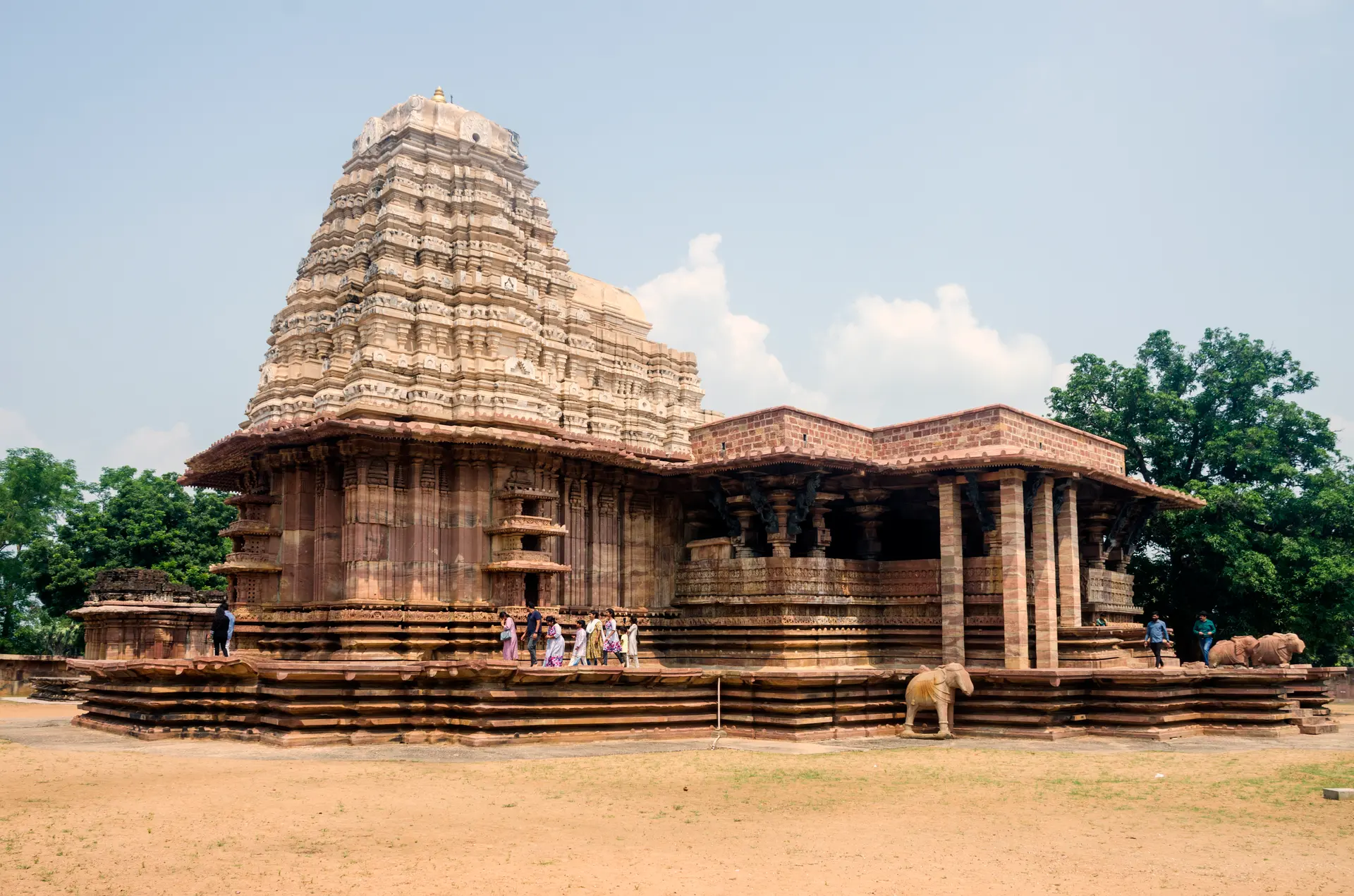
Image of Kakatiya Rudreshwara Ramappa Temple, Telangana. Image source · CC-BY-SA-4.0
Visit essentials
A quick read before you go
- Duration
- Two to three hours allows full appreciation of the temple, including time with the Madanika…
- Access
- The temple is located in Palampet village, Venkatapur mandal, Mulugu district, Telangana.
Overview
The 13th-century Kakatiya shrine to Lord Shiva joins devotion to engineering that still puzzles experts. Tower bricks float on water; a sand, lime, jaggery, and medicinal-fruit foundation absorbs earthquakes; and dancing women carved in metal-ringing basalt preserved poses from which a dance form was revived 700 years later.
Marco Polo supposedly called Ramappa the brightest star in the galaxy of temples during his reported Kakatiya visit, though whether he said it remains uncertain. The phrase suits a precision in which every stone and technical solution serves sacred purpose.
Ramappa remains a living shrine. Priests offer daily puja before a Shivalingam honored for eight centuries, and thousands gather for Maha Shivaratri's three-day celebration. Engineering and unbroken prayer remain united as the builders intended.
Why this place is sacred
The Shaiva Kakatiyas built on the conviction that excellence is worship. Ramappa's six-foot star-shaped platform echoes meditative yantras; its nine-foot-elevated Shivalingam traditionally joins Earth and Heaven at the sanctum.
Clay bricks mixed with acacia wood, chaff, myrobalan fruit, and vetiver grass have such low specific gravity that they float, lightening the tower above the sanctum. A Kakatiya sandbox foundation absorbs seismic energy: a major 17th-century earthquake damaged the floor, yet the temple stood. These were devotional acts expressed through material knowledge, not secular fixes added to sacred architecture.
About forty six-foot Madanika brackets carved from iron- and silite-rich black basalt retain a metallic luster after eight centuries. Their poses preserved Perini Shivatandavam so precisely that Dr. Nataraja Ramakrishna read its movements from them when reviving the lost dance in the 20th century—a stone library of sacred motion.
Through invasions, plunder, and natural disaster, eight hundred years of flames, bells, and worship before the same lingam have continued. Visitors consistently sense those centuries of prayer inhabiting the stone.
Recharla Rudra, a general of Kakatiya King Ganapati Deva, commissioned the temple in 1213 CE as an act of devotion to Lord Shiva. The construction took approximately forty years and was overseen by the master architect Ramappa, whose skill was so exceptional that the temple came to be known by his name rather than the deity's—the only such instance in India.
In Shaiva understanding, the temple was designed as a place where Shiva is truly present, where devotees could encounter the divine through darshan and puja.
The temple served the Kakatiya court for nearly a century before the dynasty fell to the Delhi Sultanate. Yet worship continued under various rulers and through periods of neglect. The 7th Nizam of Hyderabad funded restoration in 1914, and Dr. Ghulam Yazdani completed decorative repairs in 1931. The Archaeological Survey of India has protected the site since 1914, maintaining it as both heritage monument and active shrine.
In 2021, UNESCO inscribed Ramappa Temple as a World Heritage Site—the first from Telangana—recognizing it as a masterpiece of human creative genius. This international recognition brought new visitors, but the temple's essential character remains: a living shrine where daily puja continues the intention of the 13th-century builders.
Experience and orientation
The first encounter is often one of scale confusion. The temple appears modest from a distance—no soaring gopuram, no massive complex. Then the details begin to register. The Madanika figures, each taller than a person, display jewelry carved so finely that individual ornaments are distinguishable. Their expressions carry subtle emotion—not the serene blankness of much religious sculpture but something knowing, alive.
The basalt itself draws attention. Unlike the reddish sandstone of the main structure, the bracket figures and columns are carved from dolerite so dense with iron that it rings when struck. Over centuries, the stone has developed a polish that seems to glow from within. Visitors often find themselves touching it—cool, almost liquid-smooth—before remembering they perhaps should not.
In the sanctum, the atmosphere shifts. The Shivalingam rises high, receiving the light that filters through the mandapa. Priests perform abhishekam and puja on schedule, and even when visitors arrive between ceremonies, the scent of incense and flowers persists. The continuity is not abstract here—it is sensory. These rituals have occurred daily for eight centuries. The stones have absorbed that much intention.
The tranquility of the setting amplifies the effect. Ramappa Lake, constructed alongside the temple by the same patron, creates a landscape of water and green surrounding the shrine. Many visitors describe a sense of rightness to the placement—the temple positioned precisely where it should be, the reservoir reflecting it.
Those who visit during Maha Shivaratri encounter the temple in full devotional intensity: three days of special pujas, large gatherings, all-night worship honoring Shiva. This is when the temple's identity as a living shrine is most visible. But even on ordinary days, the combination of engineering wonder and unbroken prayer creates something that stays with visitors.
Ramappa Temple rewards attention to detail. Come prepared to look closely—at the jewelry of the Madanika figures, at the floral patterns in the basalt columns, at the way light falls differently on sandstone and dolerite. Binoculars can help with upper-level carvings.
If the Nandi mandapam is accessible, spend time with the bull facing the sanctum. In Shaiva understanding, Nandi is not merely Shiva's vehicle but his most devoted devotee, eternally watching the Lord. Something of that patience inhabits this particular statue, which has survived eight centuries while facing the same lingam.
The temple is open for darshan, and visitors of any background may observe worship. Position yourself respectfully at the back during puja. The chanting and bell-ringing are not performance—they are continuation of what has happened here since the 13th century.
Consider visiting Ramappa Lake before or after the temple. The Kakatiyas built their sacred and hydraulic engineering as unified projects, and seeing the reservoir contextualizes the vision—a civilization that understood water management and temple architecture as expressions of the same care.
Context and lineage
The Kakatiya dynasty emerged as regional rulers in the 11th century and grew to control much of the Deccan plateau. King Ganapati Deva, who reigned from 1199 to 1262, oversaw the dynasty's golden age. His general Recharla Rudra commissioned Ramappa Temple as an expression of Shaiva devotion, beginning construction in 1213 CE.
The project was entrusted to an architect named Ramappa, whose skill was such that the temple came to bear his name rather than Lord Shiva's—an honor unprecedented in Indian temple history. Construction continued for approximately forty years, with the last structures completed around 1234 CE.
Marco Polo traveled through the Kakatiya kingdom during the reign of Queen Rudramadevi, Ganapati Deva's daughter. Later accounts attribute to him the phrase that Ramappa was the brightest star in the galaxy of temples. Some sources note this attribution as supposed, suggesting it may be legendary rather than documented in Polo's writings. Whether historical or not, the description has attached itself to the temple's identity.
The Kakatiya dynasty fell to the Delhi Sultanate in 1323, but the temple continued to function as a place of worship. Various rulers and local communities maintained the shrine through centuries of political change. The 7th Nizam of Hyderabad supported restoration in the early 20th century, recognizing the temple's artistic and historical significance despite the difference in religious tradition.
Since 1914, the Archaeological Survey of India has protected Ramappa as a monument of national importance. This protection coexists with its status as an active temple—a balance between heritage preservation and living worship that the site embodies.
The 2021 UNESCO inscription brought international recognition, naming Ramappa as India's 39th World Heritage Site and Telangana's first. Criteria cited were masterpiece of human creative genius and exceptional testimony to a cultural tradition. The temple has entered the global consciousness while remaining what it has always been: a place where people come to pray.
Lord Shiva
deity
The temple is dedicated to Shiva in the form of Ramalingeswara, also called Rudreshwara. The Shivalingam in the garbhagriha has received continuous worship for eight centuries. Rudra, a fierce form of Shiva from whom the temple takes one of its names, represents both destruction and transformation.
Recharla Rudra
historical
The general who commissioned the temple as an act of devotion to Lord Shiva. His patron was Kakatiya King Ganapati Deva. Rudra's choice to dedicate decades to this single project reflects both personal devotion and the Kakatiya understanding that great temples bring merit to patron, dynasty, and kingdom.
Ramappa
historical
The master architect whose name the temple bears—uniquely in India, honoring the sculptor rather than the deity. Nothing is known of his life beyond this testament to his skill. That the temple carries his name eight centuries later speaks to the Kakatiya recognition of individual creative genius in service of the sacred.
Ganapati Deva
historical
The Kakatiya king who ruled from 1199 to 1262, overseeing the dynasty's golden age. Under his reign, the distinctive Kakatiya architectural and sculptural traditions reached their height. Ramappa Temple was built under his authority, though commissioned by his general.
Traditions and practice
Daily worship follows traditional Hindu temple practice. Abhishekam—the ritual bathing of the Shivalingam—is performed at regular intervals, along with offerings of flowers, coconuts, and prasadam. The positioning of the Nandi statue facing the sanctum maintains the eternal vigil of Shiva's devotee. The bell at the entrance, rung by devotees before entering, announces their presence to the deity.
Maha Shivaratri is the principal festival, celebrated for three consecutive days. Special pujas intensify throughout the period, culminating in all-night worship on the main night. Devotees fast, offer prayers, and maintain vigil in honor of Shiva. The festival falls on Chaturdasi of the Magha month (February-March) and draws large gatherings from across Telangana and Andhra Pradesh.
Current practice maintains continuity with historical worship while accommodating the temple's status as a heritage site. The Archaeological Survey of India manages the grounds and buildings, while priests continue religious functions. This dual identity—heritage monument and living shrine—creates a distinctive atmosphere.
The revival of Perini Shivatandavam adds another dimension to contemporary practice. Though the dance is not performed at the temple itself, the connection remains vital: practitioners and dance scholars visit to study the Madanika sculptures that preserved the tradition. The temple thus functions as a living archive of sacred movement.
Visitors seeking more than sightseeing might consider these approaches:
Time your visit to coincide with puja if possible, even if specific schedules are not advertised. The morning and evening hours typically include worship. Position yourself respectfully to observe without intruding. The sound of bells and mantras in the mandapa creates an atmosphere that contextualizes everything you see.
Spend time with individual Madanika sculptures. Each has a distinct pose, expression, and set of ornaments. Imagine a dance master 700 years later learning to move from these frozen gestures. What is preserved here goes beyond technique—something of the devotional intention of the original dancers survived in stone.
Walk to Ramappa Lake and back. The reservoir was built alongside the temple by the same patron, and the landscape was conceived as unified. The water, the trees, the temple—these were not separate projects but expressions of a single vision. Experiencing them together helps clarify what the Kakatiyas understood about sacred space.
Shaivism (Kakatiya tradition)
ActiveThe Kakatiya dynasty were devoted Shaivas, and Ramappa Temple represents the highest expression of their devotion to Lord Shiva. The temple houses Shiva in the form of Ramalingeswara (also called Rudreshwara), with the lingam placed at an elevated height of nine feet in the garbhagriha. Every element of the temple—from the star-shaped platform echoing yantra geometry to the Nandi eternally facing the sanctum—expresses Shaiva theology and devotional practice. The name Rudreshwara refers to Rudra, the fierce Vedic form of Shiva associated with both destruction and transformation.
Daily pujas continue the worship initiated eight centuries ago. Abhishekam and offerings of flowers, coconuts, and prasadam maintain the reciprocal relationship between deity and devotees. The Maha Shivaratri festival brings three days of intensive celebration, with special pujas and all-night vigils honoring Shiva. Devotees circumambulate the temple, ring the bell before entering, and receive darshan of the deity as culmination of their visit.
Perini Shivatandavam
ActivePerini Shivatandavam is an ancient Telugu dance form dedicated to Lord Shiva that flourished during the Kakatiya period. The dance was believed to invoke prerana (inspiration) and was performed both before battle and in celebration after victory. When the Kakatiya dynasty fell, the living tradition was lost—but the Madanika sculptures at Ramappa Temple preserved the dance poses in stone. In the 20th century, Dr. Nataraja Ramakrishna studied these sculptures and medieval texts like Bharataarnavam and Nrtta Ratnavali to reconstruct the dance, performing it publicly for the first time in 700 years in 1975.
The revived Perini tradition maintains its connection to Ramappa Temple, with dancers and scholars visiting to study the original Madanika sculptures. The Perini Institute in Warangal continues to train dancers. While performances do not occur at the temple itself, the site functions as a living archive and source of authority for the tradition. The connection between stone sculpture and embodied dance represents a remarkable instance of sacred knowledge preservation across centuries.
Perspectives and open questions
Ramappa Temple invites multiple readings: as engineering achievement, artistic masterpiece, living shrine, and witness to devotion's persistence across centuries. These perspectives are not competitors but lenses that reveal different aspects of what the Kakatiyas created and what continues here today.
Scholarly perspective
Art historians and archaeologists recognize Ramappa Temple as the pinnacle of Kakatiya architecture. UNESCO inscription cited criteria for masterpiece of human creative genius and exceptional testimony to a cultural tradition. The floating brick technology—with specific gravity of approximately 0.9 g/cc, allowing the bricks to float on water—and the sandbox foundation technique represent engineering achievements whose exact processes remain only partially understood.
The Madanika bracket figures are considered masterpieces of Kakatiya art. Scholars note the unusual choice of dolerite, a stone so hard it rings like metal, and the technical virtuosity required to achieve such detail in such resistant material. The metal-like finish has endured eight centuries without significant deterioration.
Scholarly attention has also focused on the temple's astronomical alignments and the possible cosmological intentions of its star-shaped platform. The Kakatiya understanding of temple architecture as integrated with celestial and terrestrial forces remains an area of ongoing study.
Living and traditional perspectives
For Shaiva devotees, Ramappa Temple is a living place of worship where Lord Shiva is present as Ramalingeswara. The temple's survival through invasions, neglect, and a major earthquake is understood not merely as engineering success but as divine protection. The continued worship—eight centuries of unbroken intention directed toward the same lingam—creates a sacred space that accumulates potency over time.
The positioning of the Shivalingam at nine feet elevation, on a raised platform shaped like a sacred yantra, reflects traditional understanding of the temple as axis mundi—the connection point between earthly and divine realms. The Nandi facing the shrine maintains eternal vigil, modeling the devotion the temple invites.
Traditional perspective does not conflict with appreciation of engineering and artistry. Rather, these achievements are understood as expressions of bhakti—devotion that seeks excellence as offering. The architects and sculptors were not merely craftsmen but worshipers whose work was a form of prayer.
Alternative interpretations
Some visitors are drawn by the mysteries that remain unsolved. How did Kakatiya engineers develop floating bricks that remain functional after 800 years? What calculations enabled them to design earthquake-resistant foundations without modern seismology? The sandbox technique in particular—a mixture of sand, lime, jaggery, and myrobalan fruit—suggests empirical knowledge whose origins and transmission remain unclear.
The precision of the Madanika sculptures, combined with their role in preserving a dance tradition across centuries, strikes some as evidence of lost understanding about how sacred knowledge can be encoded in material form. The temple becomes a kind of library whose contents we are still learning to read.
The Marco Polo attribution—whether historical or legendary—positions Ramappa within a network of medieval connections between Indian and European worlds, raising questions about what knowledge may have traveled along these routes.
Open questions
Genuine mysteries persist. What exact processes created floating bricks that have remained structurally sound for eight centuries? How did the builders calculate the sandbox foundation mixture for earthquake resistance without modern soil mechanics? What ceremonies originally accompanied the Madanika sculptures, and what relationship did they have to the Perini dance tradition?
Did Marco Polo actually visit and praise the temple, or is this attribution a later legend that attached itself to the site? The historical record is ambiguous on this point.
Most fundamentally: what did it mean to the Kakatiyas to invest forty years in a single temple? What understanding of devotion, of time, of excellence produced such sustained effort? The engineering can be analyzed; the intentions behind it remain partly beyond recovery.
Plan your visit
Access and arrival
The temple is located in Palampet village, Venkatapur mandal, Mulugu district, Telangana. From Hyderabad, the journey is approximately 200-210 km by road, taking about 4 hours. From Warangal, the distance is about 70-77 km.
Public transportation includes state transport buses and private taxis from both Warangal and Hyderabad. The nearest railway stations are Warangal and Kazipet Junction. The nearest airport is Rajiv Gandhi International Airport in Hyderabad.
The temple entrance may have a nominal fee. Separate charges may apply for parking and camera usage. Facilities near the temple include basic amenities; more extensive services are available in Warangal.
Limited accommodation exists near the temple itself; most visitors stay in Warangal, which offers options ranging from budget to mid-range. Hyderabad provides a full range of accommodation for those making a day trip or passing through. For multi-day exploration of Kakatiya heritage, Warangal serves as a practical base for visiting Ramappa, the Thousand Pillar Temple, and the fort complex.
Respectful visit
Modest traditional attire is appropriate. Shoulders and knees should be covered for both men and women. Light, comfortable clothing is recommended, particularly during the hot months from April through June. Traditional Indian dress—dhoti, saree, salwar kameez—is always appropriate. Avoid black clothing if possible, as some traditions associate it with mourning or inauspiciousness at temples.
Personal photography is generally permitted in exterior areas and the courtyard. Certain zones may be restricted for heritage protection—follow posted guidelines and any instructions from security staff. Do not use flash inside structures. Professional equipment and commercial shoots require advance permits.
Consider spending time without a camera before documenting. The temple has much to show that cannot be captured in images—the quality of light on basalt, the sound of bells, the scent of incense. Let these register before framing shots.
Traditional offerings such as flowers and coconuts are available at shops near the temple. Devotees make offerings during puja. Visitors who wish to participate may do so, though no obligation exists. Prasad received should be treated respectfully—consumed in designated areas or taken home, not discarded.
The temple is open from approximately 6:00 AM to 6:00 PM daily. A nominal entry fee may apply. Certain areas may be closed for restoration or during specific ceremonies. Outside food is not permitted in the temple area. Follow any instructions from staff regarding access.
Ramappa is an active temple, and behavior should reflect this. The Archaeological Survey of India manages the site for preservation, but respect for ongoing worship is equally important. Do not treat the temple as purely historical; people come here to pray.
Do not touch sculptures or stones beyond what is explicitly permitted. The basalt carvings have survived eight centuries; the oils from millions of hands threaten that survival. Photography is generally permitted in exterior areas but may be restricted in certain zones—follow posted guidelines.
Be aware that footwear must be removed before entering temple premises. The stone can become hot in midday sun; plan timing accordingly. During Maha Shivaratri, expect large crowds and limited access to certain areas.
Current practical details
Address
Nandi Mandapam, RAMAPPA, Mulugu, Telangana 506345, India
Hours
Hours, fees, and access can change — verify on the official source before you travel. Practical details last checked Jun 2026.
Location
Map loads as you approach this section.
Pilgrim reflections
A portrait of encounter, not a score
Pilgrims describe what they felt, how present they could become, and whether the place would shape a journey. There are no stars and no ranking of traditions.
No reviewed reflections yet
The first pilgrims can help describe the character of being here.
Share a reflection
Available after an account-backed “Been there.” Every reflection is reviewed before publication.
Nearby sacred places
Explore other sacred places in the region. Proximity does not establish access or travel time; check each place’s guidance.


Photo gallery
3 curated photos
Share a photo
Help visitors recognize Kakatiya Rudreshwara Ramappa Temple, Telangana. Every submission is reviewed before publication.