Idomenae (Isar, Marvinci)
An ancient Macedonian hilltop city where 1,300 years of Balkan civilizations left their mark on a single ridge
Understand sacred places, explore living traditions, and learn how to engage respectfully with Pilgrim Map.
Access has not been verified. Check current local guidance before planning a visit.
Valandovo, North Macedonia
Read the sources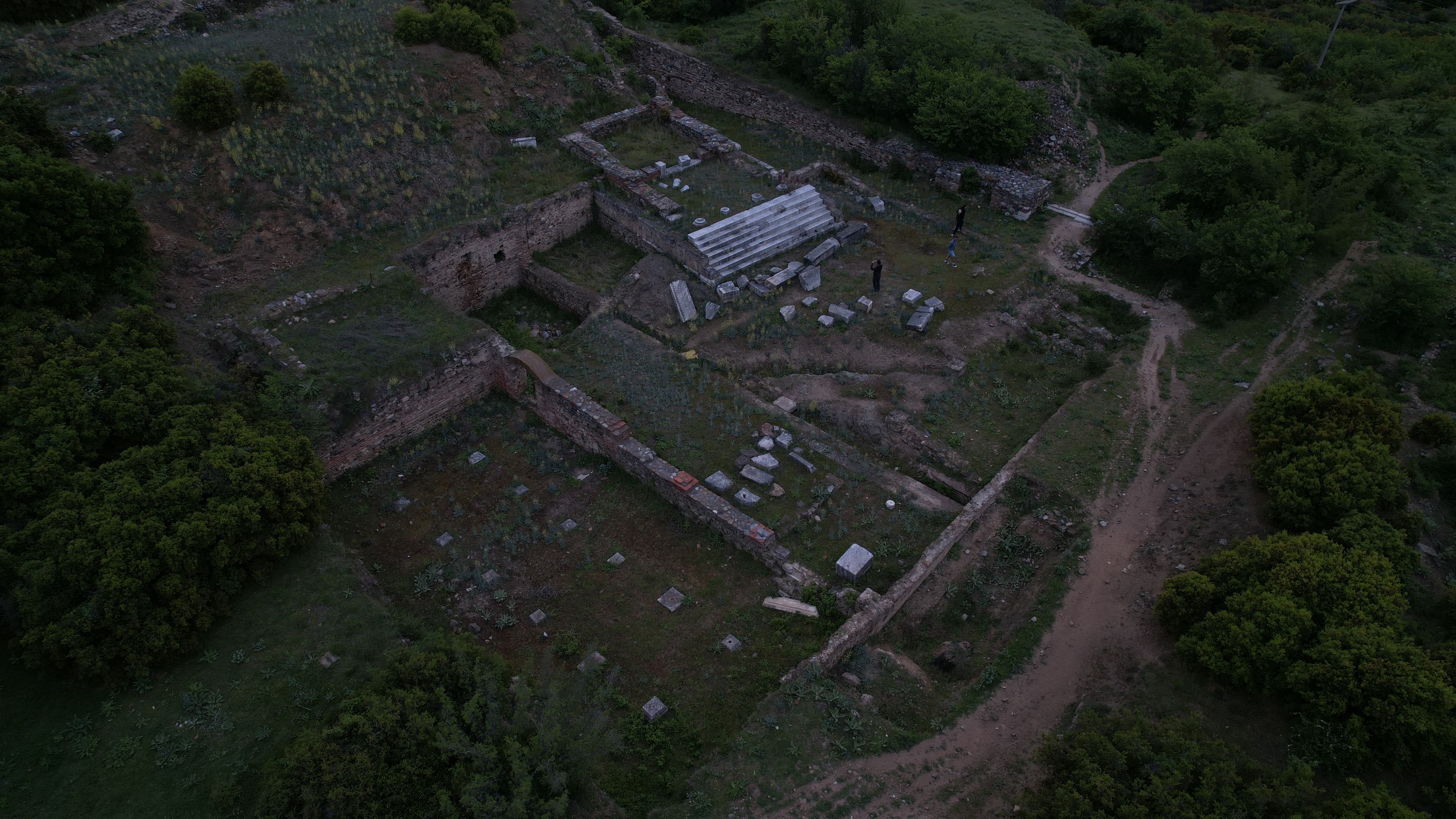
Image of Idomenae (Isar, Marvinci). Image source
Visit essentials
A quick read before you go
- Duration
- 1–2 hours, including the approach walk and exploration of the ridge.
- Access
- Located above the village of Marvinci in Valandovo municipality, southeastern North Macedonia.
Overview
On Isar above Marvinci, overlooking the Vardar River in southeastern North Macedonia's Valandovo region, Idomenae accumulated Macedonian, Hellenistic, and Roman layers until urban life waned in the 6th century CE. Thucydides first mentioned it in the 5th century BCE during the Peloponnesian War as a settlement in Bottiaea. Philip II's 4th-century BCE reorganization placed it in renamed Emathia within the Macedonian kingdom's western hinterland.
Under Rome, a temple and apparent stadium transformed the existing urban culture. Trade with Thassos, Rhodes, and Asia Minor connected this less-famous city to wider Aegean commerce and culture. Today it remains a quiet hilltop ruin above a village, only partly excavated and with its temple complex not fully understood: a record of ordinary settlement continuity on defensible ground beside a reliable river rather than individual grandeur.
Why this place is sacred
The sacred significance of Idomenae was never separable from its civic one. In the ancient world — both Macedonian and Roman — the city's temples were its public religious institutions, and their practices were inseparable from the life of the community.
The Roman-era temple at Isar Marvinci, still only partially excavated, was the physical center of that integration: a space where the community's relationship to its gods was enacted in public, where votive offerings and civic ceremonies maintained the bond between the living city and its divine patrons.
The hilltop's elevation above the Vardar valley — visible for kilometers in every direction — would have given Idomenae a natural symbolic centrality. In the ancient Balkan landscape, strategic height and sacred authority were often the same thing. The site's panoramic position made it both defensible and cosmologically oriented: a place from which the surrounding world could be seen whole.
What archaeology has recovered is suggestive but incomplete. The necropolis at the base of the hill contained imported ceramics from major Aegean trading centers — Thassos, Rhodes, Asia Minor — placed with the dead as grave goods. These objects speak of a community with wide cultural horizons, whose sacred practice was linked to a larger Mediterranean world through trade and exchange.
Fortified Macedonian city functioning as administrative center for the Parorbelia region; later Roman settlement with civic religious institutions including a temple. The hilltop's commanding position above the Vardar made it both a defensive stronghold and a center of regional political-religious authority.
Occupied from the 7th century BCE into the 6th century CE — a span of approximately 1,300 years. The transition from Macedonian civic religion to Roman imperial cult and, presumably, later Christian practice mirrors the broader trajectory of Balkan urban history. The site was not continuously excavated; only the 1977–1986 campaigns by teams from Belgrade and the Museum of North Macedonia have provided systematic archaeological data.
Experience and orientation
The drive to Marvinci from Valandovo follows the Vardar valley southeast, the river below and the hills rising on either side. The village is small; the isar rises clearly above it, the characteristic ridge form of a fortified hilltop settlement. The approach on foot through the village and up the slope takes fifteen to twenty minutes.
At the summit, the ruins are in the condition of a site that has been excavated but not extensively curated for visitors. There are foundations visible, traces of walls, the outlines of what may have been civic structures. The panorama compensates for the interpretive sparseness: the Vardar valley extends in both directions, the strategic sense of the ancient city's position is immediate, and the long view toward the Aegean world that Idomenae traded with carries a certain historical resonance.
Move slowly along the ridge. The Roman-era temple foundations, though not always clearly labeled, represent the ritual center of the ancient city — a space that once organized the community's relationship to its gods. The necropolis area at the base of the hill, where excavators found Aegean grave goods, requires imagination but rewards attention: the people buried here with Thasian and Rhodian ceramics were part of a world significantly larger than their hilltop city.
Idomenae does not offer the visitor an easy narrative. Its interest lies precisely in its incompleteness — the sense that the full story of this place has not yet been recovered, and perhaps cannot be.
Access via Marvinci village in Valandovo municipality; the site is on the hill above the village. No entrance fee; no visitor facilities on site. Bring water. Sturdy footwear recommended for the hillside path. Mobile signal may be limited.
Context and lineage
Idomenae's earliest occupation dates to the 7th century BCE, when Iron Age communities settled the defensible ridge above what is now Marvinci. The city first appears in written historical record during the Peloponnesian War period, mentioned by Thucydides. It served as the administrative center of the region of Parorbelia within the Macedonian kingdom before Philip II reorganized the area, incorporating it into the expanded territory of Emathia.
Under Roman rule, Idomenae acquired the civic infrastructure characteristic of provincial Roman urban life: a temple, what appears to have been a stadium, and connections to the wider imperial trade network evidenced by imported ceramics. Some scholars have suggested the city's name relates to the Homeric hero Idomeneus, but this connection remains speculative rather than established.
The city's life extended into the 6th century CE, when it followed the fate of most late Roman cities in the region: gradual contraction and eventual abandonment in the context of migrations and seismic events.
Idomenae's long occupation reflects the general pattern of hilltop fortified settlements in the Vardar valley: strategic position, successive cultural layers, gradual integration into larger imperial systems, and eventual abandonment. The finds from the excavations are held at the Museum of the Republic of North Macedonia in Skopje.
Traditions and practice
As a functioning Macedonian city and later Roman settlement, Idomenae would have hosted the standard religious institutions of both eras. In the Macedonian period, civic religion organized around the traditional Greek pantheon was central to communal life. The Roman-era temple that excavations have identified was the formal center of this practice — a space for public ceremony, votive offering, and the civic expressions of communal piety.
The grave goods recovered from the necropolis — imported amphorae from Thassos and Rhodes, ceramics from Asia Minor — suggest that the material culture of religious practice at Idomenae reached beyond local production into the Mediterranean trade world.
No active religious practice at the site. Idomenae functions as a heritage site for archaeological research and educational tourism.
Walk the ridge from end to end before stopping at any specific feature. The form of the hilltop isar — the way its elevation commands the valley, its natural defensibility — communicates something essential about why this site was chosen and held for thirteen centuries.
Stand at the high point and look toward the Vardar: you are seeing roughly what every generation of inhabitants saw, a view that connected them to both the local landscape and the wider world beyond it.
At the temple foundations, take a moment to consider the scale. A Roman provincial temple in a city of this size would have been the largest public building, visible from the approaches below, the center of the community's formal relationship to its gods. That center is now grass and stones. Notice what that transition evokes.
The necropolis area, even without visible remains, is worth attention as a location. The people buried here with objects imported from across the Aegean were not isolated. They were part of something wider. Standing near where they were buried invites reflection on how far ordinary lives extended even in the ancient world.
Ancient Macedonian and Roman Civic Religion
HistoricalAs a fortified Macedonian city and later Roman settlement, Idomenae hosted the public religious institutions of both cultures. The Roman-era temple was the formal center of civic piety; the necropolis with its imported grave goods attests to religious practices linking the community to wider Aegean trade networks.
Temple worship and civic ceremonies; funerary rites with imported ceramics as grave offerings; trade-linked votive practices.
Archaeological and Heritage Research
ActiveOne of the important archaeological sites in Valandovo municipality, providing evidence of continuous habitation from the Iron Age through Late Antiquity and illuminating ancient Macedonian urbanism and Vardar valley trade networks. Excavation finds are held at the Museum of the Republic of North Macedonia.
Systematic excavations conducted 1977–1986 by teams from Belgrade and the Museum of North Macedonia; ongoing heritage site management.
Perspectives and open questions
Idomenae is viewed primarily through archaeological and historical lenses; its spiritual dimensions are inferred from the civic-religious framework common to Macedonian and Roman urbanism rather than documented directly.
Scholarly perspective
The identification of Isar, Marvinci with ancient Idomenae is broadly accepted based on the convergence of historical sources and the site's geographic position along the Vardar valley. The site demonstrates the standard pattern of Macedonian hilltop urban development and subsequent Roman integration. The Princeton Encyclopedia of Classical Sites recognizes Marvinci as the location of Idomenae, and the excavations of 1977–1986 established the stratigraphic sequence.
The full extent of the Roman temple complex and its dedicatory inscriptions, if any exist, has not yet been recovered.
Living and traditional perspectives
No surviving oral or religious traditions are directly connected to Idomenae. The site represents a phase of pre-Christian and pre-Slavic Balkan history that does not connect directly to current Macedonian cultural memory through living practice.
Alternative interpretations
No documented esoteric or alternative spiritual traditions are associated with this site.
Open questions
The specific deities venerated in Idomenae's temple and the ritual practices conducted there remain unexcavated and undocumented. The relationship between the pre-Macedonian Iron Age community and the named city of Idomenae is not fully established. The circumstances of the city's final decline and abandonment in Late Antiquity are not documented in detail.
Plan your visit
Access and arrival
Located above the village of Marvinci in Valandovo municipality, southeastern North Macedonia. Accessible by car from Valandovo town (approximately 15 km). No public transport to the site. No entrance fee. No facilities on site — bring water. Mobile signal may be limited in the valley; download maps before departure. No posted opening hours; visit during daylight hours.
Valandovo town (approximately 15 km) offers basic accommodation. Gevgelija (~30 km south) and Strumica (~50 km east) have a broader range of options.
Respectful visit
No specific dress requirements. Appropriate footwear for uneven terrain.
Photography is permitted throughout the site.
None appropriate at this site.
Do not remove any artifacts or archaeological material. Do not disturb areas that may be part of ongoing or future excavation.
Do not remove any artifacts or disturb the excavated areas. The site is only partially excavated — unassuming areas of ground may contain undisturbed archaeological deposits. Check on current site conditions before visiting, as access and signage may be limited.
Location
Map loads as you approach this section.
Pilgrim reflections
A portrait of encounter, not a score
Pilgrims describe what they felt, how present they could become, and whether the place would shape a journey. There are no stars and no ranking of traditions.
No reviewed reflections yet
The first pilgrims can help describe the character of being here.
Share a reflection
Available after an account-backed “Been there.” Every reflection is reviewed before publication.
Nearby sacred places
Explore other sacred places in the region. Proximity does not establish access or travel time; check each place’s guidance.


References
Sources consulted for this page. Source categories describe the publication, not a guarantee that every claim is verified. Traditional accounts and outside interpretations may differ.
- 01Idomenae - Wikipedia — Wikipedia contributorsencyclopediaPrimary reference for historical identification and location
- 02Isar, Marvinci - Wikipedia — Wikipedia contributorsencyclopediaSite-specific article with archaeological details
- 03The Princeton Encyclopedia of Classical Sites: MARVINCI (Idomenae) — Perseus Digital Library / PrincetonacademicAcademic classical reference source
- 04Idomenai (Marvinci) - Trismegistos — TrismegistosacademicAcademic database entry for the ancient site
- 05Isar Archaeological Site - Marvinci village - North Macedonia Timeless — North Macedonia TourismofficialOfficial tourism description
- 06Isar, Marvinci — Travel2MacedoniaguideGeneral visitor overview
Share a photo
Help visitors recognize Idomenae (Isar, Marvinci). Every submission is reviewed before publication.