Hikiau Heiau, Hawaii
Where Lono dwelt and worlds first met, a Hawaiian temple still holds ceremony
Captain Cook, Hawaii, United States
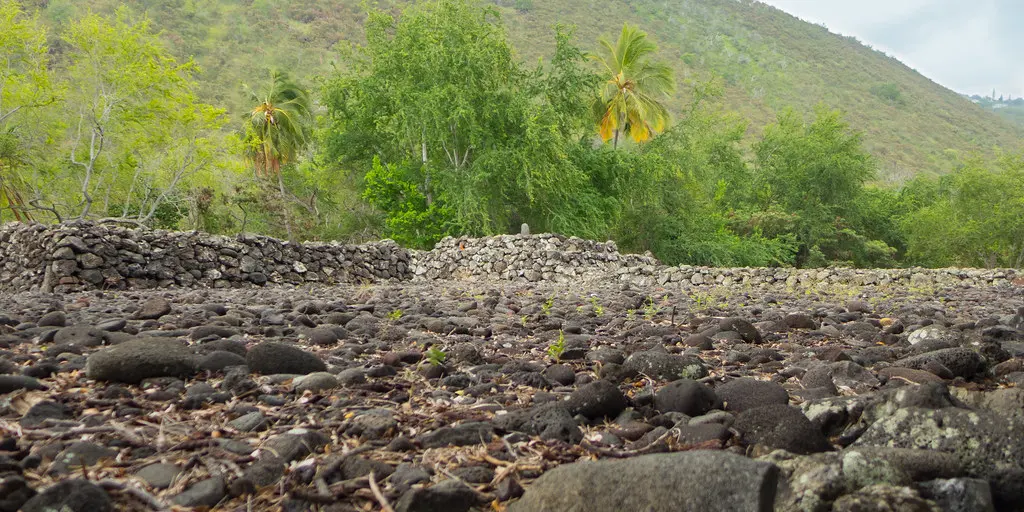
Image of Hikiau Heiau, Hawaii. Image source
Visit essentials
Before you go
- Address
- 82-6044 Puuhonua Rd, Captain Cook, HI 96704, USA
- Duration
- 1 hour for contemplative experience
- Etiquette
- Hikiau Heiau is kapu, sacred and forbidden.
Overview
Chief Kalani'opu'u built Hikiau Heiau in the 18th century at Kealakekua Bay. About 250 feet long, 100 feet wide, and over 16 feet high, it is among Kona's most important luakini heiau and remains sacred ground. Dedicated to Lono, one of the four major gods of Hawaiian religion, rather than war-god Ku, it centered agriculture, fertility, rain, and abundance. During the four-month Makahiki beginning around October, warfare ceased while communities feasted, danced hula, competed, offered, and gave thanks.
On January 17, 1779, Captain James Cook landed during Makahiki; his masts resembled Lono procession standards, and Hawaiian priests led him here, performed ceremonies, and wrapped him in red tapa like god images. Whether they understood him as returning Lono or honored him as an exceptional chief remains debated. Eleven days later Cook read a crewmember's burial rites here, the first Christian service in Hawaiian history. Traditional practices declined by 1804; the kapu system ended in 1819.
Today the 'Aha Pule 'Aina Holo relay carries Lono's Akua Loa by wa'a through Miloli'i and Honaunau and ashore at Hikiau, joining living Makahiki tradition to ancient stones.
Why this place is sacred
What makes Hikiau Heiau sacred extends beyond the massive stones themselves. The location speaks first. Kealakekua Bay curves beneath dramatic cliffs, its waters among the clearest and most protected on the Kona coast. The name Hikiau means 'Moving current,' referring to the strong offshore waters where ancient Hawaiians practiced surfing. Where powerful ocean meets stable land, where currents converge and energies concentrate, the Hawaiians built their temple to Lono. The scale announces sacred purpose.
Those who constructed Hikiau carried and fitted stones without mortar to create a platform larger than many modern buildings. Such effort was never spent on the merely practical. The ali'i and kahuna who directed this construction were building a bridge between worlds, a place where human voices could reach divine ears, where the god of rain and harvest might receive what was offered and return blessing in kind. Centuries of accumulated devotion leave their mark.
Generation after generation brought offerings to this lele, this altar. Priests chanted the prayers passed down from teachers who had learned from teachers before them. The spiritual weight of such sustained attention persists in stone. Many visitors report a quality of presence at Hikiau, a sense that the space is not empty but attentive. History adds its own layers. The ceremonies for Captain Cook, whether worship or honor, enacted something unprecedented on these stones.
Two civilizations met here for the first time, each seeing the other through the lens of their own understanding. The first Christian words spoken publicly in Hawai'i were spoken here, at a temple built for a Hawaiian god. Such convergences charge a place with meaning that goes beyond any single tradition. The contemporary continuation of Makahiki ceremonies grounds what might otherwise become purely historical.
When the staff of Lono arrives each year, carried by paddlers and swimmers through the same waters the ancient Hawaiians knew, Hikiau Heiau is not a museum but a functioning sacred site. The boundary between past and present thins. The offerings have changed, but offering continues.
Temple for Lono worship and Makahiki celebration, center of royal and priestly ceremony in the Kona district.
Built 18th century by Chief Kalani'opu'u. Central to Makahiki festivals during the reign of Kalani'opu'u and later Kamehameha I. Site of Captain Cook's reception ceremonies January 1779 and first Christian service in Hawai'i. Rededicated by Kamehameha I around 1812-1813. Declining use after 1804 as traditional religion faded. Restored 1917. Listed on National Register of Historic Places 1973. Now designated State Monument within Kealakekua Bay State Historical Park. Annual Makahiki ceremonies continue.
Experience and orientation
The approach to Hikiau Heiau follows a winding road down to Napo'opo'o Beach at the southern end of Kealakekua Bay. The drive itself prepares you, narrow passages through tropical growth opening to views of the bay's dramatic setting, cliffs rising on the far side, water of remarkable clarity below. When you arrive, the heiau announces itself through sheer presence. The platform rises above the surrounding landscape, its stones fitted with the precision that characterizes Hawaiian sacred architecture.
Walking the accessible perimeter of two exterior walls, you encounter a scale that modern construction has made us forget. These stones were moved without machinery, fitted without mortar, by people who believed what they were building mattered enough to justify the enormous effort. The prohibition on entering the heiau platform is not merely regulatory. The kapu signs marking the boundary continue a tradition older than Western contact.
This space remains sacred to Native Hawaiians, not as historical curiosity but as living connection to ancestors and gods. Respecting the boundary is itself a practice, an acknowledgment that not all places are yours to enter. From outside, you see clearly nonetheless. The platform stretches before you, the smaller raised area where the lele once stood still visible. Interpretive signs provide context, explaining Lono worship, Makahiki traditions, the events of January 1779. But the stones communicate beyond words.
The silence here differs from other silences. Kealakekua Bay is calmer than most Hawaiian shores, its protected waters creating an unusual stillness. The heiau sits in this stillness, patient, waiting. Many visitors report feeling watched, not threateningly but attentively, as if the place were taking notice of those who come to notice it. The bay itself extends the experience.
These same waters saw Cook's ships anchor, saw canoes approach with priests and chiefs, see paddlers arrive each Makahiki with the staff of Lono. Looking across the water to the cliffs, to the monument marking where Cook died weeks after the ceremonies at Hikiau, you stand at one of history's pivotal locations. What began here changed everything that followed.
Hikiau Heiau is located at Napo'opo'o Beach at the south end of Kealakekua Bay. The heiau platform rises prominently; you cannot miss it. Walking is permitted along the perimeter of two exterior walls. The kapu boundary is clearly marked. Picnic tables and restrooms are available at the adjacent beach park. The Captain Cook Monument is visible across the bay, accessible by kayak, boat, or a strenuous trail.
Context and lineage
Chief Kalani'opu'u ruled the island of Hawai'i at the height of traditional Hawaiian civilization. He commissioned Hikiau Heiau as one of the most important temples in the Kona district, dedicated to Lono, the god who brought rain for crops and fish to waters. The heiau was classified as luakini, the most sacred category, where the highest ceremonies were conducted by the highest priests under the direction of the ruling ali'i.
When Captain Cook's ships appeared at Kealakekua Bay in January 1779, they arrived during Makahiki, the festival honoring Lono. The coincidence of timing, combined with the visual similarity between ship masts and the kapa cloth standards carried in Lono processions, created an encounter unlike any other. Cook was brought to Hikiau Heiau, seated above the altar, covered in sacred red tapa, and honored with chants and ceremonies.
Two weeks later, Cook conducted a burial service for a crewmember at the same heiau, speaking Christian prayers where Hawaiian prayers had been offered. The god of peace and harvest had welcomed visitors; soon the god of war would respond. Cook was killed at Kealakekua Bay on February 14, 1779, after returning with damaged ships and stretching Hawaiian hospitality past its limits. Kamehameha I, who would unite the Hawaiian Islands under his rule, was present during these events.
He later rededicated Hikiau Heiau around 1812-1813 when he returned to Hawai'i from O'ahu, celebrating Makahiki at the temple where he had witnessed history turn.
Hikiau Heiau represents the tradition of Lono worship and luakini heiau construction that developed across the Hawaiian Islands. It connects to other major heiau on Hawai'i Island and throughout the archipelago. The site's proximity to Pu'uhonua o Honaunau, the ancient place of refuge, places it within a sacred geography that concentrated spiritual power on this stretch of Kona coast. The ongoing Makahiki ceremonies link Hikiau to the broader revival of traditional Hawaiian cultural practices.
Kalani'opu'u
Captain James Cook
Kamehameha I
Henry Opukaha'ia
Traditions and practice
Hikiau Heiau hosted Makahiki festival celebrations honoring Lono, including offerings of agricultural produce, feasting, hula performances, and competitive games. As a luakini heiau, it also served as a site for the most solemn ceremonies, including human sacrifice during wartime or for major consecrations. High priests conducted rituals under the direction of the ruling ali'i.
The Akua Loa, a long pole with tapa cloth representing Lono, was carried in clockwise procession around the island during Makahiki, with tribute collected in the god's name.
Each year during Makahiki season, the 'Aha Pule 'Aina Holo ceremonial relay brings the Akua Loa around Hawai'i Island, following the clockwise path of traditional processions. The staff travels by wa'a through Miloli'i and Honaunau before reaching Kealakekua Bay, where paddlers swim it ashore to Hikiau Heiau. This six-day community ceremony reflects the practices of ancient ali'i and kahuna who journeyed around the island in Lono's honor. Native Hawaiian cultural practitioners may conduct private ceremonies at the site.
Visit with an attitude of respect for a living sacred site. Walk the accessible perimeter of two exterior walls. Read the interpretive signs to understand what you are seeing. Take time to simply be present with the stones and the silence. If visiting during Makahiki season, you may learn about or witness contemporary ceremonial activities in the broader Kona region. The experience at Hikiau is one of contemplation and respect, not participation.
Hawaiian Lono worship and Makahiki festival
ActiveLono is one of the four major Hawaiian gods, associated with agriculture, fertility, rainfall, music, and peace. The annual Makahiki festival, lasting approximately four months from October/November through February/March, honored Lono with offerings, feasting, hula, and competitive games. Warfare was forbidden during Makahiki. Hikiau Heiau was a central location for these celebrations in the Kona district.
During Makahiki, the Akua Loa, a long pole with tapa cloth and other embellishments representing Lono, was carried by priests in clockwise procession around the island. Tribute in the form of produce was collected for the chiefs in Lono's name. Today, the annual 'Aha Pule 'Aina Holo ceremonial relay continues this tradition, with the staff of Lono traveling by wa'a to Hikiau Heiau.
Luakini heiau practices
HistoricalAs a luakini heiau, Hikiau was among the most important class of Hawaiian temples where the highest ceremonies were conducted, including human sacrifice in times of war or for major consecrations. Luakini heiau were restricted to the highest chiefs and conducted by high priests. The massive scale of Hikiau reflects its status as a major ceremonial center.
Ceremonies at luakini heiau involved elaborate rituals conducted by kahuna under the direction of the ruling ali'i. The lele stood atop a smaller platform built on the main platform. Offerings included produce, animals, and in times of war, human sacrifices. These practices ended with the abolition of the kapu system in 1819.
Perspectives and open questions
Hikiau Heiau exists at the intersection of Hawaiian religious tradition, world history, colonial encounter, and ongoing cultural revitalization.
Scholarly perspective
Historians agree that Hikiau Heiau was a major luakini heiau dedicated to Lono, serving as one of the most important temples in the Kona district during the reign of Kalani'opu'u and later Kamehameha I. The site's significance as the location of first sustained Hawaiian-Western contact in January 1779 is well documented through journals from Cook's voyage.
Scholarly debate continues regarding whether Hawaiians genuinely believed Captain Cook to be the god Lono or whether the ceremonies performed honored him as a high-ranking chief. The convergence of Cook's arrival with Makahiki season and the visual similarity between ship masts and Lono standards likely contributed to Hawaiian interpretations of the encounter.
Living and traditional perspectives
For Native Hawaiians, Hikiau Heiau represents a sacred connection to ancestors, gods, and traditional practices. The heiau embodies the mana accumulated through centuries of worship and ceremony. Lono remains a significant deity in Hawaiian spirituality, and the Makahiki season continues to be observed by cultural practitioners. The site demands respect as a kapu place where the boundaries between human and divine were honored.
Contemporary Native Hawaiian communities maintain connection to Hikiau through ceremonial practices including the annual Makahiki relay that brings the staff of Lono to the heiau.
Alternative interpretations
Some visitors are drawn to Hikiau Heiau's energy and historical resonance without deep knowledge of Hawaiian traditions. The site may be experienced as a place of power due to its age, the devotion invested over generations, and the dramatic events that occurred here. Such perspectives should be balanced with respect for Native Hawaiian understanding and the living traditions that continue at the site.
Open questions
Questions remain about the specific ceremonies conducted at Hikiau before Western contact and the exact nature of the rituals performed for Captain Cook. The full cosmological and spiritual framework within which Hawaiian priests operated is not completely documented. The heiau's gradual abandonment after 1804, as traditional Hawaiian religion declined following Western contact and the later abolition of the kapu system in 1819, left many practices undocumented.
The story of Henry Opukaha'ia, who was destined for priesthood at or near Hikiau before his family was killed and he eventually became the first Hawaiian Christian convert, adds complexity to the site's spiritual significance.
Plan your visit
Access and arrival
Kailua-Kona offers a full range of accommodations 12 miles north. Captain Cook village has smaller inns and vacation rentals. No accommodations at Napo'opo'o Beach itself.
Respectful visit
No specific dress code, but modest, respectful attire is appropriate for visiting a sacred site. Practical clothing for the Hawaiian climate, including sun protection, is recommended.
Photography is permitted from respectful distances outside the heiau platform. Do not climb on structures for better angles. Be mindful of any ceremonies or practitioners who may be present; seek permission before photographing people. Commercial photography may require permits from the state parks system.
Do not leave offerings or any items at the heiau. Unlike some sacred sites that welcome offerings, Hawaiian heiau are best honored by leaving them undisturbed. Your presence, attention, and respect are the appropriate gifts.
Do not walk on, climb, or enter the heiau platform. This is clearly marked with kapu signs. Do not remove any stones, artifacts, or plant material. Do not disturb any features. Stay on designated areas and paths. Treat the site with the reverence due a sacred space that remains significant to Native Hawaiian communities.
The heiau platform is kapu and must never be entered or walked upon. Do not attempt to participate in Hawaiian ceremonies. Do not leave offerings. The appropriate honor for this site is respectful observation and acknowledgment of its ongoing sacred significance to Native Hawaiian communities.
Current practical details
Address
82-6044 Puuhonua Rd, Captain Cook, HI 96704, USA
Hours
Hours, fees, and access can change — verify on the official source before you travel. Practical details last checked Jun 2026.
Location
Map loads as you approach this section.
Pilgrim reflections
A portrait of encounter, not a score
Pilgrims describe what they felt, how present they could become, and whether the place would shape a journey. There are no stars and no ranking of traditions.
No reviewed reflections yet
The first pilgrims can help describe the character of being here.
Share a reflection
Available after an account-backed “Been there.” Every reflection is reviewed before publication.
Nearby sacred places
Explore other sacred places in the region. Proximity does not establish access or travel time; check each place’s guidance.

References
Sources consulted for this page. Source categories describe the publication, not a guarantee that every claim is verified. Traditional accounts and outside interpretations may differ.
- 01Hikiau Heiau ~ Written in Stone — Kona Historical SocietySource contextLocal historical society with detailed cultural and historical information
- 02Hiki'au Heiau | Images of Old Hawai'i — Images of Old Hawai'iacademicHistorical documentation with period images and detailed accounts
- 03Kealakekua Bay State Historical Park — Hawaii Division of State ParksofficialOfficial state park information and visitor guidelines
- 04Cultural History of Three Traditional Hawaiian Sites — National Park ServiceacademicAcademic historical research on Hawaiian cultural sites
- 05Kealakekua Bay State Historical Park — Hawaii Tourism AuthorityofficialOfficial tourism information
- 06Hikiau Heiau, Big Island — To-Hawaii.comSource contextComprehensive visitor-focused information with historical context
- 07Kealakekua Bay - WikipediaSource contextGeneral overview of the bay and its historical significance
- 08Death of James Cook - WikipediaSource contextHistorical account of Captain Cook's final days
- 09Makahiki - WikipediaSource contextOverview of the Makahiki festival and Lono worship
- 10Ceremonial relay around Hawai'i Island welcomes the season of Makahiki — Big Island NownewsContemporary coverage of ongoing Makahiki ceremonies
Share a photo
Help visitors recognize Hikiau Heiau, Hawaii. Every submission is reviewed before publication.