Grishneswar Jyotirlinga Temple, Verul, Maharashtra
The twelfth and final Jyotirlinga — Shiva's last light-pillar in the Deccan basalt beside Ellora
Ellora, Maharashtra, India
Plan this visit
Practical context before you go
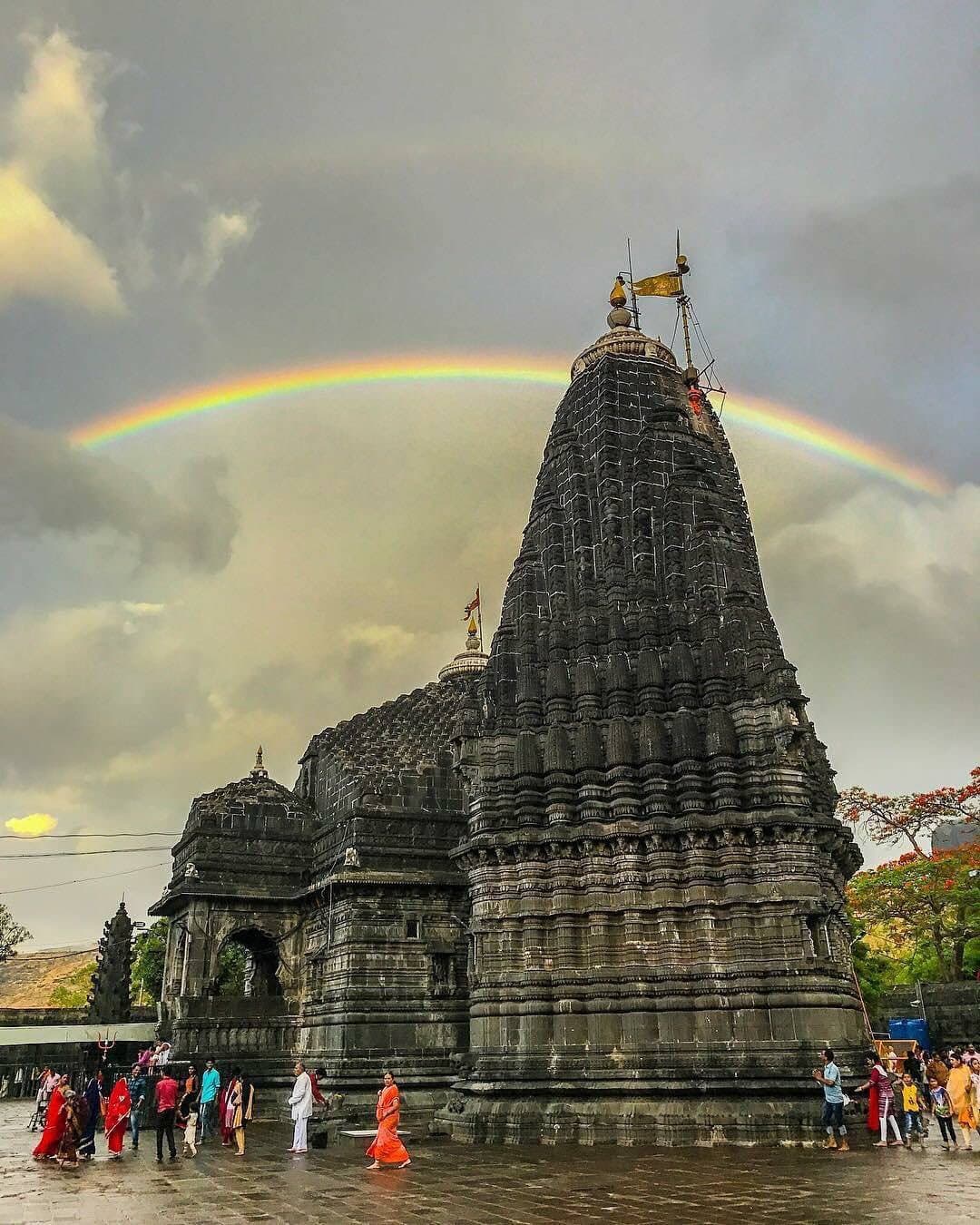
Allow 1–1.5 hours at the temple. Combined Ellora + Grishneswar day: full day. Many pilgrims also pair with Bhimashankar Jyotirlinga (~440 km west near Pune) and Trimbakeshwar Jyotirlinga (~220 km north near Nashik) over a 3–4 day Maharashtra Jyotirlinga circuit.
Verul village, about 30 km north-west of Aurangabad (now officially Chhatrapati Sambhajinagar) and approximately 1 km from the Ellora Caves complex. Frequent buses, taxis, and shared autos from Aurangabad. Nearest railway: Aurangabad. Nearest airport: Aurangabad (~30 km). Free parking and a covered queue area on site.
Modest traditional dress; no leather, no photography inside; men remove shirts before entering the inner sanctum.
At a glance
- Coordinates
- 20.0249, 75.1698
- Type
- Religious
- Suggested duration
- Allow 1–1.5 hours at the temple. Combined Ellora + Grishneswar day: full day. Many pilgrims also pair with Bhimashankar Jyotirlinga (~440 km west near Pune) and Trimbakeshwar Jyotirlinga (~220 km north near Nashik) over a 3–4 day Maharashtra Jyotirlinga circuit.
- Access
- Verul village, about 30 km north-west of Aurangabad (now officially Chhatrapati Sambhajinagar) and approximately 1 km from the Ellora Caves complex. Frequent buses, taxis, and shared autos from Aurangabad. Nearest railway: Aurangabad. Nearest airport: Aurangabad (~30 km). Free parking and a covered queue area on site.
Pilgrim tips
- Modest traditional dress preferred. Men must remove shirts and upper garments (vests, kurtas) before entering the inner sanctum — strictly enforced. Women wear sari, salwar-kameez, or modest western clothing with shoulders and knees covered.
- Permitted in the outer compound and around the temple's basalt exterior. Strictly prohibited inside the garbhagriha; phones and cameras deposited at the entrance.
- Men must remove shirts before entering the inner sanctum — a strictly enforced rule. Photography is prohibited inside the garbhagriha; phones and cameras are deposited at the entrance. The combined Ellora and Grishneswar day requires substantial walking; bring water and sun protection.
Pilgrim glossary
- Mantra
- A sound, word, or phrase repeated as part of meditation or ritual.
Overview
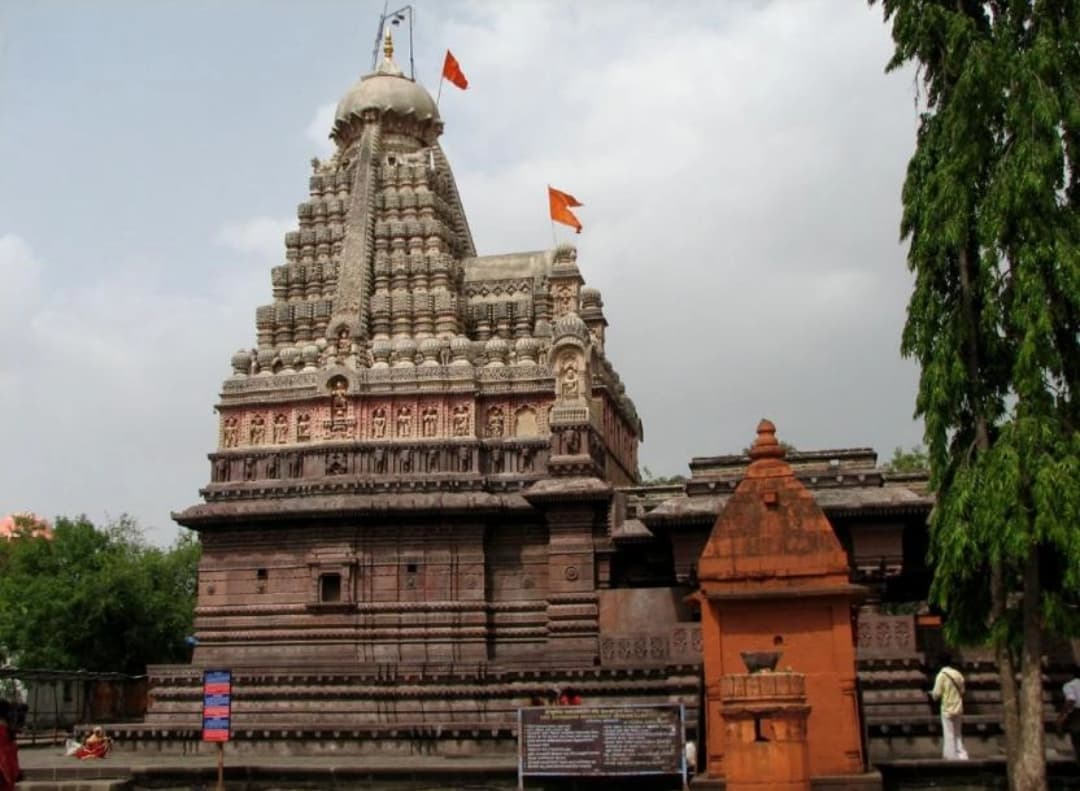
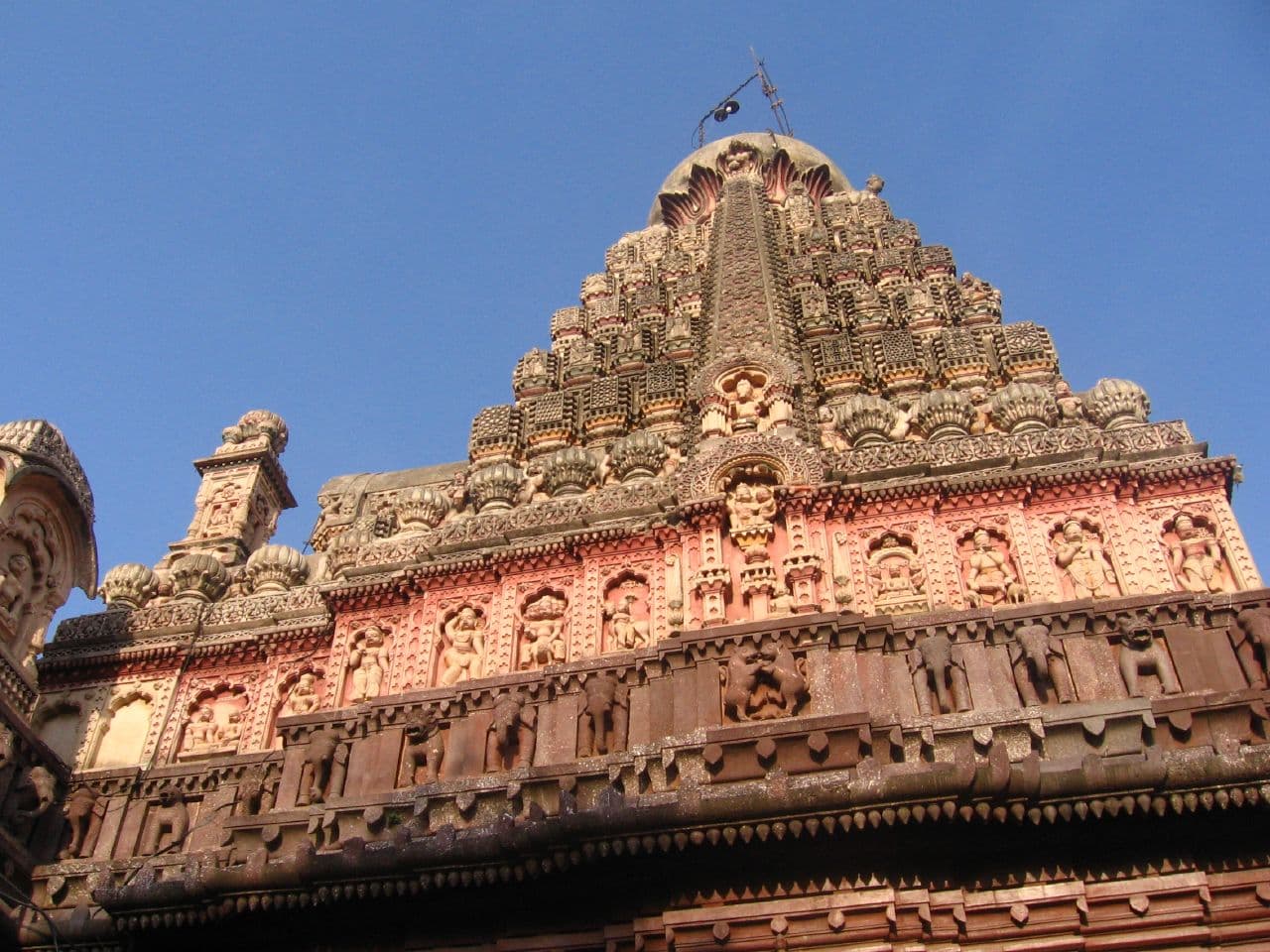
At Verul in the Deccan, less than a kilometre from the rock-cut monasteries of Ellora, stands the closing verse of the Dwadasha Jyotirlinga Stotram. Grishneswar is the twelfth and traditionally last of Shiva's self-manifest light-pillars — a temple of red volcanic basalt rebuilt in the eighteenth century by Ahilyabai Holkar, beside a sacred lake where the Ghushma legend is set.
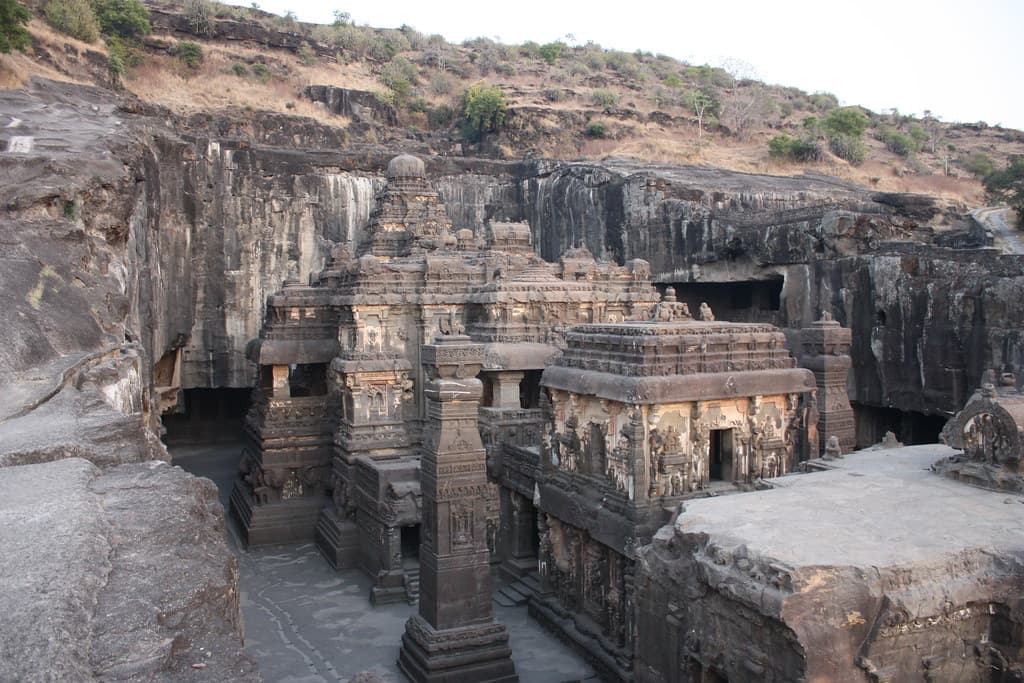
Grishneswar holds the seal-position in the twelve-Jyotirlinga sequence: the temple where pilgrims completing Shiva's twelve light-pillars finish the circuit. The site is named in the closing verse of the Dwadasha Jyotirlinga Stotram traditionally attributed to Adi Shankaracharya. Its setting at Verul, in the basalt landscape that also produced the Ellora rock-cut shrines, places it at one of the densest intersections of sacred Hindu, Buddhist, and Jain geography in India — the Kailasanatha cave at Ellora, the world's largest monolithic excavation, sits roughly one kilometre away, cut top-down from a single cliff of the same dark volcanic stone that the temple's walls are built from.
The present structure is largely the eighteenth-century reconstruction by Queen Ahilyabai Holkar of Indore, whose pan-Indian temple-restoration programme also rebuilt Somnath in Gujarat and Kashi Vishwanath in Varanasi after centuries of disturbance. An earlier Bhosale-era fabric (c. 1599, under Shivaji's grandfather Maloji) is partly preserved within the Holkar walls. Yadava-era inscriptional traces from Devagiri suggest still earlier patronage. The sacred lake immediately east of the temple — Shivalaya Tirtha — is the setting of the Ghushma legend: the parable of devotion overcoming bereavement that the Shiva Purana places at the origin of this shrine.
Context and lineage
The Shiva Purana relates the story of Sudharma, a devout Brahmin of Devagiri, and his pious second wife Ghushma (also spelled Kusuma). Each day Ghushma fashioned 101 small clay lingams, worshipped them with care, and immersed them in a nearby lake. Sudharma's first wife Sudeha, jealous of Ghushma's son, killed the boy and threw his body in the same lake. The next morning Ghushma continued her worship with unbroken devotion. As she immersed the day's clay lingams, her son emerged alive from the lake — restored by Shiva. Pleased by her unshakable devotion, Shiva manifested as a self-arisen Jyotirlinga at that spot — Grishneswar (literally, 'lord of the rubbed-down clay lingams'). The temple stands beside the lake — Shivalaya Tirtha — to this day.
Shaiva Hinduism (Jyotirlinga tradition) within the Maharashtrian Maratha devotional revival; the temple is part of a Deccan Shaiva landscape that also includes the rock-cut Hindu shrines of Ellora.
Ghushma (Kusuma)
The pious Brahmin woman whose unbroken devotion is said to have provoked Shiva's manifestation here; the temple takes its name from her clay-lingam practice
Sudharma
Ghushma's husband, the Devagiri Brahmin in whose household the foundational legend unfolds
Maloji Bhosale (c. 1599)
Shivaji's grandfather; first major Maratha-era restorer of the temple
Ahilyabai Holkar (1725–1795)
The Indore queen whose 1730s reconstruction defined the present red-basalt temple, within her pan-Indian temple-restoration programme that also rebuilt Somnath and Kashi Vishwanath
Grishneshwar Temple Trust
Current administering body under the Government of Maharashtra
Why this place is sacred
Grishneswar sits at an unusual convergence. The temple's red volcanic basalt is the same stone that forms the cliffs of Ellora, where Buddhist (Caves 1–12), Hindu (13–29), and Jain (30–34) monastic communities carved more than thirty interconnected shrines over four centuries. The Kailasanatha cave (Cave 16), a Shiva temple hewn top-down from a single basalt cliff, stands less than a kilometre away. The juxtaposition is striking: a temple built up from cut stone beside a temple cut down from living rock, both dedicated to Shiva, both finding the same deity in opposite movements of architectural intention. Pilgrims completing the twelve-Jyotirlinga circuit reach Grishneswar last by long tradition; many describe an unexpected sense of synthesis here — Shiva's twelve light-pillars internalised as one — rather than triumphant culmination.
A Puranic Shaiva shrine marking the site of Shiva's self-manifestation in response to Ghushma's unbroken devotion — the twelfth and traditionally last Jyotirlinga.
Treated in Puranic tradition as svayambhu (self-manifest, timeless). Inscriptional and architectural evidence indicates a temple under the Yadavas of Devagiri (13th–14th c.). The temple was damaged during the Delhi Sultanate-Mughal centuries; partially restored by Maloji Bhosale around 1599; the present red-basalt structure was rebuilt in the 1730s by Queen Ahilyabai Holkar of Indore as part of her pan-Indian temple-restoration programme.
Traditions and practice
Daily abhishekam of the Grishneshwar lingam with milk, water, panchamrita, and Gangajal carried by pilgrims; bilva-patra and white flower offerings; recitation of the Dwadasha Jyotirlinga Stotram, Shiva Mahimna Stotra, and Mahamrityunjaya mantra; morning and evening aarti; ritual bathing at Shivalaya Tirtha (the adjacent sacred lake) is traditional but optional.
Temple open daily, typically 5:30 AM–9:30 PM (subject to seasonal change). Mangala Aarti at dawn; midday and evening pujas. Sponsored Rudrabhishek through the trust office. Maha Shivratri (Feb/Mar) draws overnight crowds; the month of Shravan (July–August) is heaviest, especially on Mondays. Tripurari Pournima (Kartik full moon) is celebrated with lamps around the temple and tank.
For pilgrims completing the twelve Jyotirlinga circuit, Grishneswar is traditionally the final stop — the closing verse of the Dwadasha Jyotirlinga Stotram. The Ghushma legend, with its theme of devotion overcoming bereavement, is widely cited by pilgrims undertaking the journey in memory of deceased family members. Pair the morning darshan with a long afternoon at Ellora's cave-temples.
Shaiva Hinduism (Jyotirlinga tradition)
ActiveThe twelfth and final Jyotirlinga in the standard Dwadasha Jyotirlinga Stotram. Pilgrims completing the twelve-Jyotirlinga yatra culminate the circuit here, often pairing the visit with Bhimashankar and Trimbakeshwar.
Daily abhishekam of the lingam with milk, water, panchamrita, and bilva-patra; recitation of the Dwadasha Jyotirlinga Stotram; circumambulation of the sanctum; participation in morning and evening aartis.
Maharashtrian Maratha devotional tradition
ActiveGrishneswar is a major symbol of Maratha-era religious restoration — rebuilt in the 1730s by Queen Ahilyabai Holkar of Indore within the same patronage programme that rebuilt Somnath in Gujarat and Kashi Vishwanath in Varanasi.
Local Marathi-language abhanga singing and bhajans by Warkari and other devotional groups; festivals of the Maharashtrian Shaiva calendar (Mahashivratri, Shravani Somvar, Tripurari Pournima).
Experience and perspectives
The temple's modest scale tends to surprise visitors. After the kilometric corridors of Rameswaram or the colossal precincts of Madurai, Grishneswar's sanctum reads as close and contained. The lingam is approached very closely — the priest stands within arm's reach as the abhishekam unfolds. The red basalt of the temple absorbs Deccan light differently than the granite or sandstone of South Indian shrines, giving the interior a darker, earthier quality.
Many pilgrims structure the day as a walk between two Shaiva architectures: an early-morning darshan at Grishneswar followed by a long afternoon at Ellora, ending at the Kailasanatha cave (Cave 16). The combined Ellora-and-Grishneswar day is widely reported as one of the most moving days in the western India Shaiva circuit — the temple and the cave-temple reading each other in a single stretch of basalt cliff. The shirt-removal requirement for men inside the sanctum is initially unusual for visitors unfamiliar with the practice; like at Nageshwar, most find the gesture itself becomes a focusing act.
Allow 1–1.5 hours at the temple. Combined Ellora and Grishneswar takes a full day; many pilgrims also pair with Bhimashankar Jyotirlinga (~440 km west near Pune) and Trimbakeshwar Jyotirlinga (~220 km north near Nashik) over a 3–4 day Maharashtra circuit. Early morning at the temple is the quietest slot; arrive between 5:30 and 7 AM.
Grishneswar is read in scholarship as a fine example of eighteenth-century Maharashtrian temple revival in red Deccan basalt; in Marathi Shaiva tradition as the culminating Jyotirlinga; and in tantric Shaiva theology as the seal — the closure of Shiva's manifest light-pillars on earth.
Art-historians treat Grishneswar as a fine example of eighteenth-century Maharashtrian temple revival in red Deccan basalt, built within the Ahilyabai Holkar pan-Indian reconstruction programme. The site's deep connection to Ellora — the temple stands at the foot of the basalt ridge in which the Kailasanatha and the other rock-cut shrines were carved — places it at the historical centre of Deccan Shaivism. The Yadava-era antecedents are inferred from regional patterns.
Marathi Shaiva tradition treats Grishneswar as the culminating Jyotirlinga, the seal on the twelve-lingam circuit. Local Warkari and broader Maharashtrian devotional communities maintain a continuous calendar of bhajan, kirtan, and procession at the temple. The Ghushma legend is taught widely in popular Shaiva literature and discourse.
In Jyotirlinga theology, Grishneswar as the twelfth lingam is read as the seal — the closure of Shiva's manifest light-pillars on earth. The Ghushma story is interpreted as the supreme parable of one-pointed devotion (ekagrata bhakti) overcoming worldly misfortune. The juxtaposition with the rock-cut Kailasanatha at Ellora — Shiva's mountain hewn from a single rock — gives the area a unique density of Shaiva sacred geography.
The pre-Yadava history of the site is poorly documented; the relationship between the medieval temple and the Ellora cave-temples (Buddhist, Hindu, and Jain phases between the 6th and 10th centuries) remains an open scholarly question. The exact extent of damage and restoration through the medieval period is partly conjectural.
Visit planning
Verul village, about 30 km north-west of Aurangabad (now officially Chhatrapati Sambhajinagar) and approximately 1 km from the Ellora Caves complex. Frequent buses, taxis, and shared autos from Aurangabad. Nearest railway: Aurangabad. Nearest airport: Aurangabad (~30 km). Free parking and a covered queue area on site.
Aurangabad (Chhatrapati Sambhajinagar), 30 km east, has the full range of pilgrim and tourist accommodation. Limited lodging at Verul itself.
Modest traditional dress; no leather, no photography inside; men remove shirts before entering the inner sanctum.
Modest traditional dress preferred. Men must remove shirts and upper garments (vests, kurtas) before entering the inner sanctum — strictly enforced. Women wear sari, salwar-kameez, or modest western clothing with shoulders and knees covered.
Permitted in the outer compound and around the temple's basalt exterior. Strictly prohibited inside the garbhagriha; phones and cameras deposited at the entrance.
Bilva leaves, white flowers, milk, water, panchamrita, and Ganga jal (carried by pilgrims). Money offerings into the official hundi or via the trust counter.
No leather inside the sanctum (belts, wallets, shoes deposited). No videography. Maintain silence and unidirectional flow during peak darshan.
Plan your visit
Address
Ghrushneshwar, Ghrushneshwar Mandir Rd, Ellora, Verul, Maharashtra 431102, India
Phone
Hours
Hours, fees, and access can change — verify on the official source before you travel. Practical details last checked Jun 2026.
Nearby sacred places
Sacred places within a half-day’s reach. Pilgrims often visit them together: walk one, stay for the other.
Grishneshwar Jyotirlinga
Verul, Verul, Chhatrapati Sambhaji Nagar district, Maharashtra, India
0.0 km away
Ellora caves, Maharashtra
Khuldabad, Maharashtra, India
0.9 km away

Ajanta caves, Maharashtra
Phardapur, Maharashtra, India
80.8 km away
Trimbakeshwar Jyotir Linga Shiva Temple, Trimbak, Maharashtra
Trimbak, Maharashtra, India
171.6 km away
References
Sources consulted when researching this page. Independent verification by readers is welcome.
- 01Grishneshwar Jyotirlinga — Wikipedia — Wikipedia contributorshigh-reliability
- 02Jyotirlinga — Wikipedia — Wikipedia contributorshigh-reliability
- 03Maharashtra Tourism — Grishneshwar Temple — Maharashtra Tourism Development Corporationhigh-reliability
- 04Ellora Caves — UNESCO World Heritage List — UNESCO World Heritage Centrehigh-reliability
- 05Shiva Purana, Koti Rudra Samhita — translations — J. L. Shastri / Motilal Banarsidasshigh-reliability
- 06Archaeological Survey of India — protected monuments, Aurangabad circle — Archaeological Survey of Indiahigh-reliability
- 07Ahilyabai Holkar's restoration of Hindu temples — historical context — Times of India / The Hindu retrospectives
- 08Grishneshwar Temple — Tripadvisor visitor reviews — Tripadvisor / pilgrim community
Key questions
What pilgrims usually ask
- Why is Grishneswar Jyotirlinga Temple, Verul, Maharashtra considered sacred?
- Grishneswar at Verul beside Ellora — the twelfth and final Jyotirlinga, rebuilt in red Deccan basalt by Queen Ahilyabai Holkar in the 1730s.
- What should I wear at Grishneswar Jyotirlinga Temple, Verul, Maharashtra?
- Modest traditional dress preferred. Men must remove shirts and upper garments (vests, kurtas) before entering the inner sanctum — strictly enforced. Women wear sari, salwar-kameez, or modest western clothing with shoulders and knees covered.
- Can I take photos at Grishneswar Jyotirlinga Temple, Verul, Maharashtra?
- Permitted in the outer compound and around the temple's basalt exterior. Strictly prohibited inside the garbhagriha; phones and cameras deposited at the entrance.
- How long should I spend at Grishneswar Jyotirlinga Temple, Verul, Maharashtra?
- Allow 1–1.5 hours at the temple. Combined Ellora + Grishneswar day: full day. Many pilgrims also pair with Bhimashankar Jyotirlinga (~440 km west near Pune) and Trimbakeshwar Jyotirlinga (~220 km north near Nashik) over a 3–4 day Maharashtra Jyotirlinga circuit.
- How do you visit Grishneswar Jyotirlinga Temple, Verul, Maharashtra?
- Verul village, about 30 km north-west of Aurangabad (now officially Chhatrapati Sambhajinagar) and approximately 1 km from the Ellora Caves complex. Frequent buses, taxis, and shared autos from Aurangabad. Nearest railway: Aurangabad. Nearest airport: Aurangabad (~30 km). Free parking and a covered queue area on site.
- What offerings are appropriate at Grishneswar Jyotirlinga Temple, Verul, Maharashtra?
- Bilva leaves, white flowers, milk, water, panchamrita, and Ganga jal (carried by pilgrims). Money offerings into the official hundi or via the trust counter.
- What etiquette should visitors follow at Grishneswar Jyotirlinga Temple, Verul, Maharashtra?
- Modest traditional dress; no leather, no photography inside; men remove shirts before entering the inner sanctum.
- What is the history of Grishneswar Jyotirlinga Temple, Verul, Maharashtra?
- The Shiva Purana relates the story of Sudharma, a devout Brahmin of Devagiri, and his pious second wife Ghushma (also spelled Kusuma). Each day Ghushma fashioned 101 small clay lingams, worshipped them with care, and immersed them in a nearby lake. Sudharma's first wife Sudeha, jealous of Ghushma's son, killed the boy and threw his body in the same lake. The next morning Ghushma continued her worship with unbroken devotion. As she immersed the day's clay lingams, her son emerged alive from the lake — restored by Shiva. Pleased by her unshakable devotion, Shiva manifested as a self-arisen Jyotirlinga at that spot — Grishneswar (literally, 'lord of the rubbed-down clay lingams'). The temple stands beside the lake — Shivalaya Tirtha — to this day.