Conímbriga
Portugal's most fully excavated Roman city, cut through by the wall that ended it
Understand sacred places, explore living traditions, and learn how to engage respectfully with Pilgrim Map.
Access has not been verified. Check current local guidance before planning a visit.
Condeixa-a-Nova, Coimbra, Portugal
Read the sources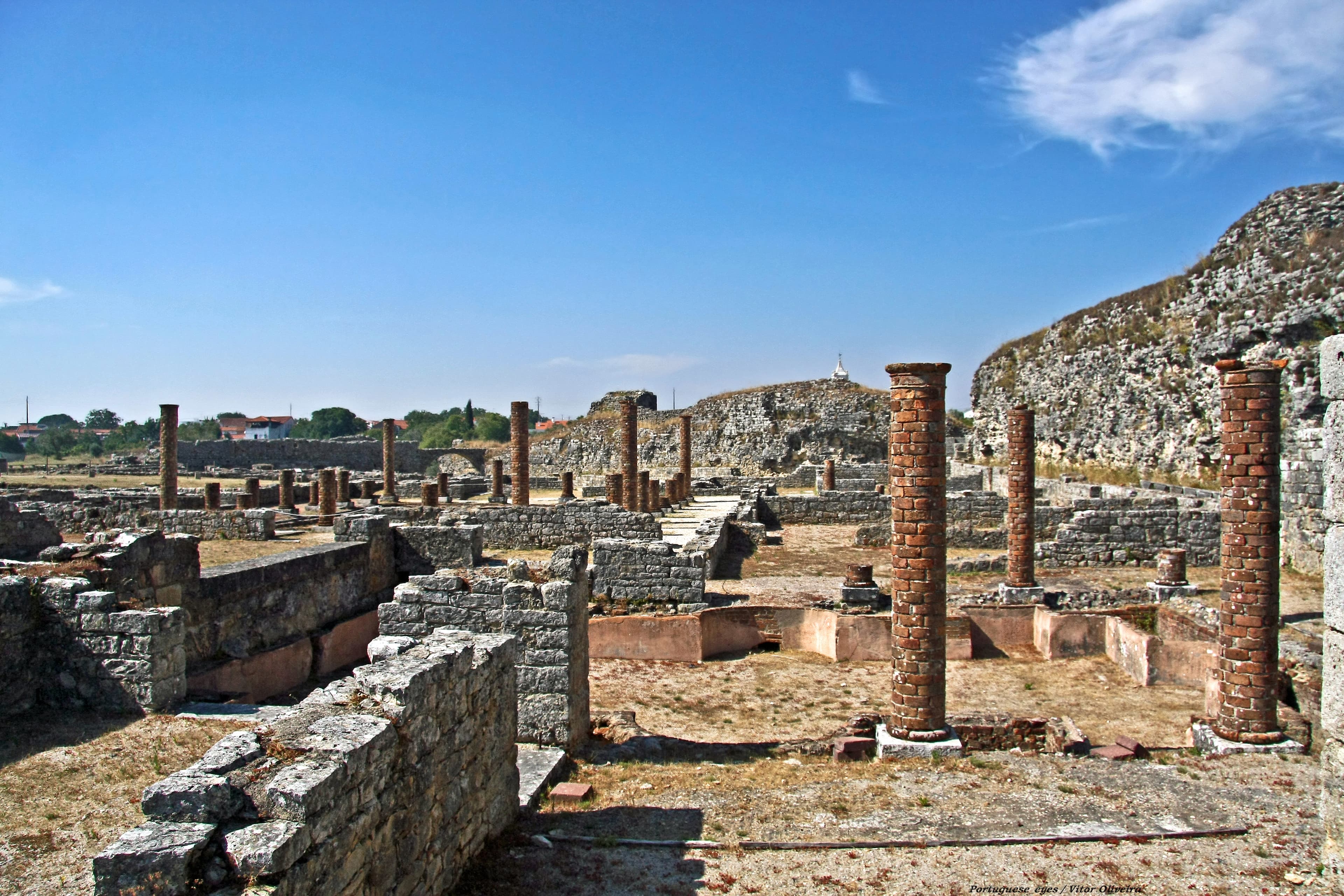
Image of Conímbriga. Image source
Visit essentials
A quick read before you go
- Duration
- Roughly 2–3 hours to cover both the outdoor ruins and the on-site museum at an unhurried pace.
- Access
- Located in Condeixa-a-Velha, municipality of Condeixa-a-Nova, about 16 km southwest of Coimbra.
Overview
Sixteen kilometers southwest of Coimbra, Conímbriga's plateau preserves Portugal's clearest Roman townscape: forum, baths, aristocratic houses, basilica, and a defensive wall that failed. Conii or Castro-culture inhabitants occupied it from the 9th century BCE and supplied its name—conim, rocky height; briga, citadel. Rome absorbed it after Decimus Junius Brutus's 2nd-century BCE campaigns. By the Flavian era it held municipium status, an imperial-cult forum temple, and houses whose mosaics remain visible.
Its end is unusually legible. A hurried 3rd-century wall against Germanic incursions cuts through the House of Fountains' peristyle garden; in 468 CE the Suebi breached it, sacked the town, and scattered or enslaved its people. The city stopped mid-sentence yet is now excavated and interpreted more thoroughly than any other in the country.
Why this place is sacred
What makes Conímbriga distinctive is not a single sacred motif but the visibility of an ending. Most Roman towns in the western provinces faded gradually, their walls repurposed, their temples converted stone by stone over centuries until the transition disappears into slow accretion. Conímbriga's transition is instead abrupt and physically embedded: the defensive wall raised in the 3rd century runs directly through the House of Fountains' peristyle garden, an elegant space built for leisure now bisected by rough emergency masonry.
Anxiety made concrete. The Suebi's 468 CE sack, recorded in Bishop Hydatius's contemporary chronicle, followed not long after, and the town's own bishopric — established sometime between 561 and 572 CE by one account — was relocated to Aeminium, the settlement that became Coimbra, closing Conímbriga's run as a living town and administrative seat for good. Walking the site means walking through that compressed sequence: peace, fortification, sack, abandonment, all in one plateau.
A pre-Roman Conii hilltop settlement that grew into a Roman municipium, serving as a civic and religious center of provincial Lusitania — forum, imperial-cult temple, aristocratic housing, and eventually a Christian basilica and short-lived episcopal see.
Continuous occupation from roughly the 9th century BCE through Roman conquest (c. 139–136 BCE) and the town's Flavian-era apogee, to militarization in the 3rd century, the Suebi sack of 468 CE, and final administrative eclipse when the bishopric moved to Aeminium/Coimbra (by 589 CE at the latest). First excavated in 1873; the pivotal Luso-French mission under Robert Étienne and Jorge de Alarcão ran 1964–1968. The on-site museum opened in 1962 and was redesignated a national museum in 2017.
Experience and orientation
Enter from the site's museum end and the plateau opens gradually — first the outline of the forum, its portico foundations still legible as a rectangle of stone against the grass, then the residential quarter where the House of Fountains sits behind its low modern railings.
The mosaic floors here, roughly 570 square meters of them, depict hunting scenes and mythological medallions with enough figural detail that a slow pass rewards attention: a deer mid-leap, a hound closing in, patterns that repeat and resolve as you move along the walkway.
At scheduled intervals the garden's ancient water-jet system still runs, and the fountains rising among the geometric beds are the closest thing the site offers to a living demonstration of how the house was meant to be experienced, rather than simply viewed as ruin. Then the wall: rougher stone, thicker, obviously later, driving through the garden's northern edge in a way that reads immediately as intrusion rather than design.
Visitors consistently register the contrast — refinement interrupted by urgency — before they read the placards explaining it. The museum, entered separately, holds the statuary, coinage, and household and religious objects recovered from the houses, and gives the ruins outside a context that the walking tour alone doesn't supply.
Visit the museum either first, for context before encountering the walls, or last, to let the objects settle what you've already seen in the ground. Either order works; what matters is giving both halves — ruin and museum — unhurried time rather than compressing the visit around one or the other.
Context and lineage
The town's name is generally explained through Celtic roots — conim, a rocky eminence, and briga, a fortified citadel — pointing to its origin as a defensible indigenous hilltop settlement well before Roman urbanization. No corroborated founding myth of the kind attached to Rome itself survives for Conímbriga; its story begins in documented settlement pattern rather than legend.
Conii/Castro-culture hilltop settlement (from c. 9th century BCE) → Roman conquest and provincial absorption (c. 139–136 BCE) → municipium status and monumental building under the Flavians (late 1st century CE) → hasty 3rd-century militarization → Suebi sack (468 CE) → paleo-Christian basilica and short-lived bishopric (561–572 CE) → episcopal relocation to Aeminium/Coimbra (by 589 CE) → rediscovery and excavation (1873–present)
Traditions and practice
The forum temple hosted rites of the Roman imperial cult — public sacrifice, festival, and dedication tied to the emperor's genius — standard practice across provincial towns of the early empire, though the specific ceremonial detail at Conímbriga itself is not documented in sources reviewed. The paleo-Christian basilica later held liturgy under a bishopric established sometime in the 560s CE.
Neither survives in any active form; both are known only through the buildings and, for the imperial cult, through comparison with practice elsewhere in the Roman world.
Walk the forum's portico line first, at the pace its columns once set, before moving into the residential quarter — the shift from public to domestic space is one of the site's clearest legible transitions.
At the House of Fountains, stand still at the garden's edge rather than only walking its perimeter; let the water-jet cycle run its interval if you're there when it's active, and notice how the sound changes the quality of the space compared to the surrounding silence of the ruins.
Trace the defensive wall with your hand along its base — not because touching is encouraged, but because its masonry is visibly cruder than the walls it cuts through, a fact easier to register at close range than from a placard's description. In the museum, spend time with the religious and votive objects specifically; they are easy to walk past en route to the mosaics but are the closest surviving evidence of what worship at Conímbriga actually involved.
Pre-Roman Conii / Lusitanian indigenous settlement
HistoricalThe site was inhabited from the 9th century BCE by Castro-culture / Conii peoples, whose Celtic-derived name for the settlement — conim, rocky eminence, plus briga, citadel — survives as Conímbriga's own name. Specific pre-Roman cult or ritual practice at the site is not well documented; what is documented is the persistence of the pre-Roman urban plan into more than twenty Roman-era residential buildings, indicating cultural, if not clearly religious, continuity.
Roman imperial cult
HistoricalThe forum housed a large temple associated with the imperial cult of Augustus and his successors, a central feature of civic-religious life in Roman provincial towns and the sacred anchor of Conímbriga's apogee as a municipium in the 1st–3rd centuries CE.
Imperial-cult veneration typically involved public sacrifice, festival, and dedication tied to the emperor's genius or numen — standard Roman provincial practice; ritual detail specific to Conímbriga's own temple is not documented in sources reviewed.
Early Christianity / Conímbriga bishopric
HistoricalA paleo-Christian basilica — reportedly adapted from a repurposed domus, dated variously to the 4th–5th or 5th–6th century — and a formal bishopric (established 561–572 CE by one account) mark Conímbriga's final religious role before the see transferred to Aeminium. That transfer effectively passed the town's religious and administrative identity to what became Coimbra.
Archaeological and scholarly research
ActiveExcavation at Conímbriga has run, with interruptions, from 1873 to the present, including the foundational 1964–1968 Luso-French mission; the site remains an active subject of Portuguese and international Roman-provincial scholarship, with roughly 80–90% of the ancient city still unexcavated and a live subject for future research.
Ongoing archaeological survey and excavation; academic publication; museum curation and reinterpretation as new finds emerge.
Heritage conservation and stewardship
ActiveSince its 1910 designation as a National Monument and the 1962 opening of its on-site museum (redesignated Museu Nacional in 2017), Conímbriga has been maintained as a state-managed heritage site, with active conservation of in-situ mosaics, structural remains, and the interpretive museum program.
Ongoing conservation of exposed mosaics and masonry; museum curation; public interpretation and educational programming.
Perspectives and open questions
Conímbriga is read differently depending on the lens: as Portugal's premier record of Roman provincial urbanism, as a case study in late-antique militarization and collapse, and — more speculatively — as a site whose pre-Roman and unexcavated depths still withhold most of their own story.
Scholarly perspective
Archaeologists regard Conímbriga as the most extensively and continuously excavated Roman urban site in Portugal, with an excavation history running from 1873 to the present and a pivotal stratigraphic foundation laid by the 1964–1968 Luso-French mission under Robert Étienne and Jorge de Alarcão.
It is valued particularly for its record of pre-Roman-to-Roman urban continuity, its domestic mosaic art — especially the House of Fountains — and the unusually direct material evidence of late-imperial militarization followed by violent destruction, corroborated by Hydatius's contemporary chronicle of the 468 CE sack.
Living and traditional perspectives
No surviving Conii or Lusitanian indigenous religious tradition or oral memory tied to the site was identified in sources reviewed. What is documented instead is structural continuity — pre-Roman building plans persisting into more than twenty Roman-era residential structures — a continuity of urban plan rather than confirmed continuity of belief or ritual.
Open questions
An estimated 10–20% of the ancient city has been excavated, based on assessments made around 2005; the remainder — including any additional temples, shrines, or religious infrastructure beyond the known forum temple and paleo-Christian basilica — remains unexcavated and undocumented.
The exact identity of the forum temple's dedicatee, beyond the generic imperial cult, is not confirmed in available sources, and the sequence between the bishopric's initial establishment (561–572 CE by one account) and its formal transfer to Aeminium (as late as 589 CE by another) is not fully reconciled across sources.
Plan your visit
Access and arrival
Located in Condeixa-a-Velha, municipality of Condeixa-a-Nova, about 16 km southwest of Coimbra. Reachable by car or by organized bus/tour excursion from Coimbra; a single entrance ticket covers both ruins and museum. Mobile phone signal in the immediate area is not documented in sources reviewed — visitors relying on mobile connectivity for navigation or ticketing should plan to have directions and tickets available offline, and note that the nearest town with confirmed services is Condeixa-a-Nova.
No booking or keyholder contact is required for general admission; for group visits or current access arrangements, contact the Museu Nacional de Conímbriga directly via its official site.
Respectful visit
Personal photography is generally permitted in the outdoor ruins. Rules specific to the museum galleries (flash near mosaics or fragile artifacts, for instance) were not confirmed in sources reviewed at time of writing; check current on-site signage or the official museum site.
Stay on marked paths to protect in-situ mosaics and excavated remains. Reported (low-reliability, travel-blog sourced, and worth re-verifying) as: dogs are permitted on a leash in the outdoor ruins but not inside the museum building.
Stay on the marked walkways — the mosaic floors and excavated foundations are original and not reinforced for foot traffic. Do not touch wall surfaces or mosaic tesserae. Sources describing photography or handling rules inside the museum specifically were not confirmed in research; follow on-site signage.
Location
Map loads as you approach this section.
Pilgrim reflections
A portrait of encounter, not a score
Pilgrims describe what they felt, how present they could become, and whether the place would shape a journey. There are no stars and no ranking of traditions.
No reviewed reflections yet
The first pilgrims can help describe the character of being here.
Share a reflection
Available after an account-backed “Been there.” Every reflection is reviewed before publication.
Nearby sacred places
Explore other sacred places in the region. Proximity does not establish access or travel time; check each place’s guidance.


References
Sources consulted for this page. Source categories describe the publication, not a guarantee that every claim is verified. Traditional accounts and outside interpretations may differ.
- 01Conímbriga — Wikipedia — Wikipedia contributorsencyclopediaPrimary source for chronology: Castro-culture occupation from 9th century BCE, Conii/Celtic name etymology, Roman conquest c. 139-136 BCE, municipium status under Vespasian, Casa dos Repuxos and Casa de Cantaber, defensive wall dimensions, paleo-Christian basilica, bishopric 561-572 CE transferred to Aeminium by 589 CE, 465-468 CE Suebi destruction, 1873 first excavations, 1962 museum opening, 1964-1968 Luso-French mission under Robert Étienne and Jorge de Alarcão, 1910 National Monument designation.
- 02National Museum of Conímbriga | Museu Nacional de Conímbriga — Direção-Geral do Património Cultural / Museu Nacional de ConímbrigaofficialOfficial museum site; confirms museum founded 1962 as Museu Monográfico de Conímbriga, redesignated Museu Nacional in 2017; scope covers excavated ruins plus archaeological reserves.
- 03Kingdom of the Suebi — Wikipedia — Wikipedia contributorsencyclopediaCorroborates the 468 CE Suebi destruction of part of Conímbriga's walls, sack, and dispersal/enslavement of inhabitants, drawing on Hydatius' Chronicle as the primary historical source for the event.
- 04Virgílio Correia — Wikipedia — Wikipedia contributorsencyclopediaConfirms Virgílio Correia (1888-1944), Portuguese archaeologist and museum director, led 1930s-1940s excavations at Conímbriga and was instrumental in establishing the on-site museum.
- 05The 'Deer Hunt Mosaic' of the 'Domus dos Repuxos' in Conímbriga (Coimbra, Portugal) — Academia.edu (academic paper, author affiliation not independently verified in this pass)academicAcademic analysis of the Deer Hunt medallion mosaic in the House of Fountains, supporting the mythological/hunting iconography described in other sources.
- 06Conimbriga - History and Facts | History Hit — History HitguideGeneral history/visitor overview corroborating settlement chronology and excavation extent (10% excavated as of 2005).
- 07Conímbriga Roman Ruins | The Beiras, Portugal | Attractions - Lonely Planet — Lonely PlanetguideTravel-publication corroboration of site layout, defensive wall built hastily in the 3rd century against Germanic raids, and description of it as Portugal's largest/most impressive Roman site.
- 08Casa dos Repuxos, Conímbriga - Portugal — PortugalTravel.orgguideDescribes Casa dos Repuxos (House of Fountains) mosaic floor (~569 m2), peristyle garden with fountains, mythological and hunting-scene mosaic imagery, attribution to a resident named Rufus, 2nd-century dating.
- 09Conimbriga Roman Ruins | Portugal Visitor Travel Guide To Portugal — PortugalVisitor.comguideDescribes the forum's monumental portico and a temple associated with the imperial cult of Augustus and his successors; notes museum galleries covering daily life, public architecture, domestic architecture, and religion.
- 10Conimbriga Roman Ruins (Coimbra, Portugal) - 2026 Guide — CoimbraPortugalTourism.comguideGeneral visitor and historical overview, corroborates settlement location and excavation narrative.
- 11Visiting Conimbriga Roman Ruins - Backpacks & Rugrats — Backpacks & Rugrats (travel blog)blogUsed with epistemic hedging only for practical visitor details (opening hours ~10:00-18:00, ticket office closes 17:15, closed Jan 1/Easter Sunday/May 1/Dec 25, admission ~€4.50, free for Portugal residents and on Sunday/holiday afternoons after 2pm, dogs allowed on leash outdoors but not in museum, café/shop on site). These operational details should be re-verified against the official museum site before publication as they may change.
Share a photo
Help visitors recognize Conímbriga. Every submission is reviewed before publication.