Broch of Burrian
An Iron Age tower on Orkney's most remote inhabited island, where Pictish Christians carved their faith into bone and stone
Understand sacred places, explore living traditions, and learn how to engage respectfully with Pilgrim Map.
Access has not been verified. Check current local guidance before planning a visit.
North Ronaldsay, Scotland, United Kingdom
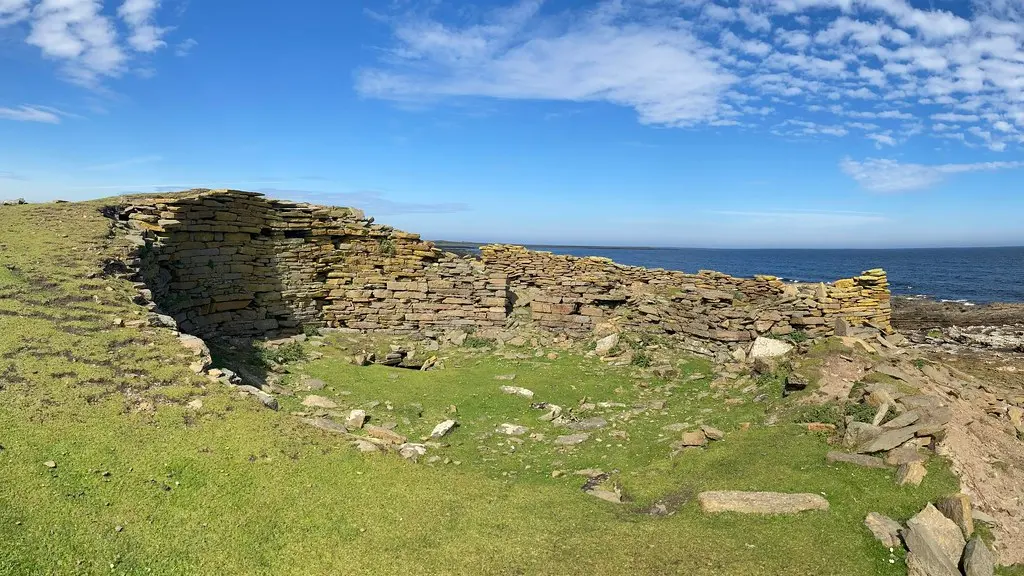
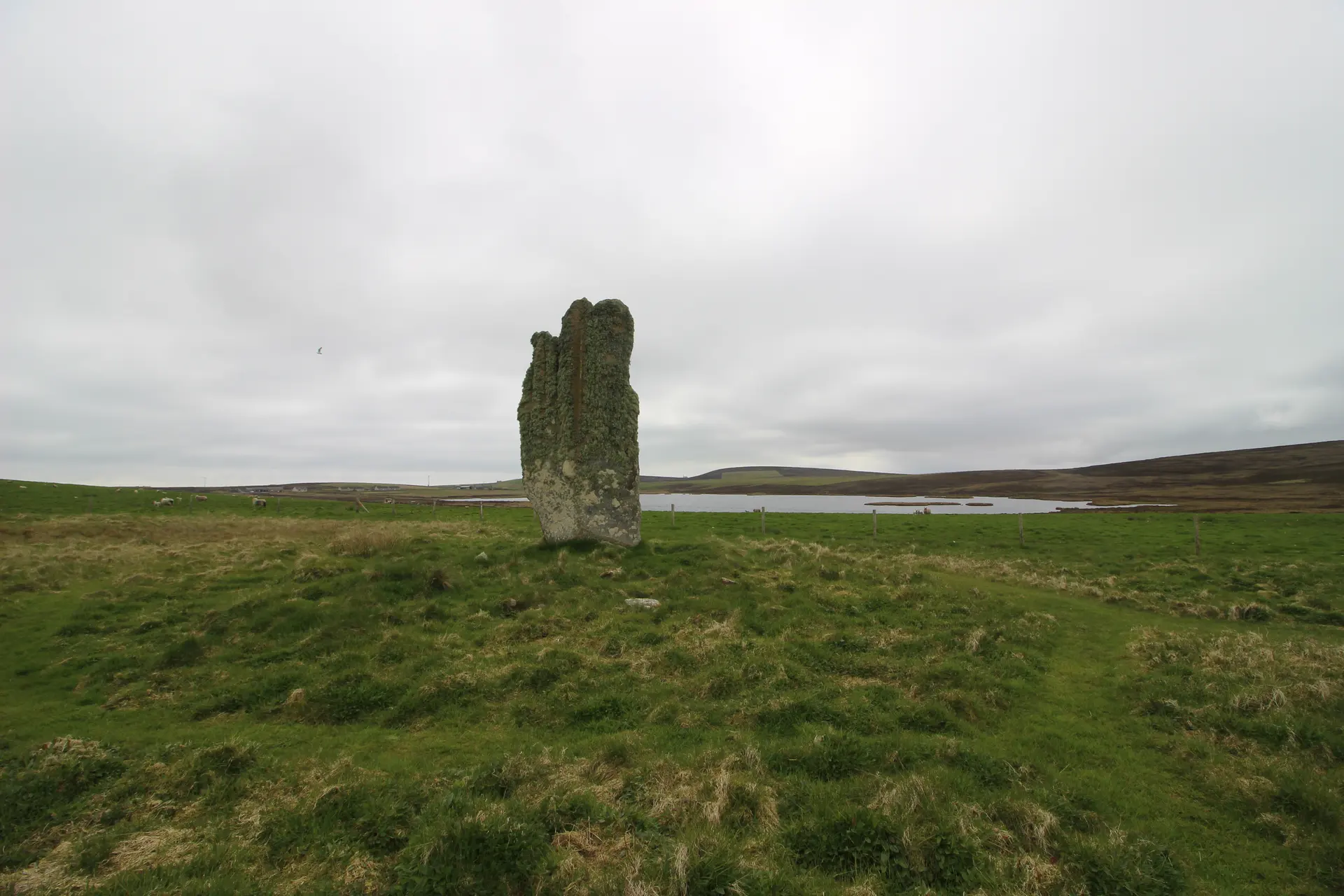
Image of Broch of Burrian. Image source
Visit essentials
A quick read before you go
- Duration
- One to two hours to combine the broch visit with exploration of the southern coastline.
- Access
- North Ronaldsay is reached by Orkney Ferries from Kirkwall (approximately two and a half hours,…
Overview
North Ronaldsay, Orkney's northernmost and most remote inhabited island, is reached by an infrequent Kirkwall ferry or small plane from the Orkney Mainland. Seaweed-eating sheep live behind a centuries-old coastal dyke amid the light and isolation of habitable Europe's far edge.
At the island's southernmost Point of Burrian, an Iron Age tower survives as a circular foundation about 9.4 metres across internally, with entrance walls up to 4.5 metres thick. Its southeast entry retains a checked doorway, scarcement ledge for an upper floor, mural cell, and well. Such hollow dry-stone towers, unique to the Scottish Iron Age around 300 BCE to 100 CE, are commonly interpreted as high-status residences expressing power and identity.
Island proprietor William Traill's 1870-71 excavation revealed the original broch and a Pictish conversion to a wheelhouse-like interior, perhaps in the sixth to ninth centuries CE. Finds included early-medieval Pictish symbols on bone and an ogham-inscribed cross slab, among Orkney's most important early Christian artefacts.
Now in the National Museum of Scotland, the slab joins a Christian cross to early-Celtic ogham, marking an Atlantic-edge meeting of Pictish culture, Christianity, and Celtic language where an Iron Age chieftain's tower became a home for Pictish Christians carving faith into animal bone.
Why this place is sacred
There is a particular quality to standing on the southernmost point of Orkney's most northerly island. The sea surrounds you on three sides. The mainland of Scotland is invisible beyond the horizon. The nearest settlement is a scattering of houses along North Ronaldsay's single road. The wind, which is nearly constant at this latitude, strips away the cushion of modern life and leaves you exposed to the same elements that shaped every community that lived here.
The broch's layered occupation deepens the sense of accumulated time. Iron Age builders chose this promontory, perhaps for defence, perhaps for prestige, perhaps for reasons we cannot recover. Centuries later, Pictish people rebuilt the interior, converting the broch into a different kind of dwelling. They brought with them artistic traditions that produced carved bone objects of remarkable sophistication and a cross slab that marks the arrival of Christianity in this remote place.
The transition from Iron Age paganism to Pictish Christianity happened here, in this small circular space, on this narrow promontory. The cross slab found at Burrian is evidence not of a grand institutional conversion but of faith arriving at the margins, in a community small enough to know each member's name. There is something deeply moving about that intimacy of conversion, about Christianity taking root in a broch at the edge of the world.
The artefacts themselves have been removed to museums, as is appropriate for their preservation. What remains at the site is the architecture, the coastline, the wind, and the knowledge of what was found here. The absence of the artefacts does not diminish the place. If anything, it adds a layer of loss that amplifies the site's meditative quality.
The broch was originally built as a high-status Iron Age residence, its thick walls and tower form serving both practical and symbolic functions. During the Pictish period, it was reoccupied and converted, likely serving as a domestic and possibly devotional space for a small community.
The site evolved through at least two major phases: original Iron Age broch construction (roughly 300 BCE to 100 CE) and Pictish-era reoccupation (roughly sixth to ninth centuries CE). The Pictish phase saw the interior converted into a wheelhouse-like structure. William Traill's excavation in 1870-71 recovered the artefacts that established the site's significance. The ruins are now a scheduled monument.
Experience and orientation
North Ronaldsay is reached by Orkney Ferries from Kirkwall, a sailing of approximately two and a half hours, or by Loganair flight from Kirkwall Airport, one of the shortest scheduled flights in the world. Either approach reinforces the island's remoteness.
The walk to the Point of Burrian follows the island's southern coast, passing inside the famous sheep dyke that contains the seaweed-eating flock. The landscape is flat, the sky enormous. Seabirds are abundant. The promontory appears as a low rocky extension into the sea, enclosed on the landward side by remnants of rampart walls.
The broch remains are visible as a circular stone foundation, the wall thickness still apparent, the entrance orientation still legible. The interior is open to the sky, the upper courses long since collapsed. A well survives within the wall thickness, now dry.
There is no interpretation panel at the site. The visitor must bring their own knowledge or imagination. Standing within the circular wall, looking south toward the open sea, you occupy the same space where Iron Age chieftains lived and where Pictish Christians carved crosses and ogham inscriptions.
The seaweed-eating sheep graze the foreshore nearby. The sea washes the rocks below the promontory. The light, on clear days, has the particular clarity of Orkney's far north, where the atmosphere seems thinner and colours more vivid.
The Broch of Burrian is located at the Point of Burrian, the southernmost tip of North Ronaldsay. It is accessible on foot from the island's road network. The North Ronaldsay Bird Observatory, located at the island's southern end, can provide local guidance. Allow at least an hour for the walk to the broch and back from the nearest road.
Context and lineage
No foundation narrative survives for either the Iron Age broch or its Pictish reoccupation. The broch was built within the broader Scottish tradition of broch construction, likely as a high-status residence for a local family or chieftain. Its later Pictish occupation reflects the wider process of Pictish settlement and Christianisation in Orkney during the early medieval period.
The Iron Age community that built the broch is unknown. The Pictish community that reoccupied it practised a form of Christianity inflected with Pictish artistic and linguistic traditions. Both communities have left no descendants on the island who maintain continuous connection to the site. The artefacts are preserved in the National Museum of Scotland.
William Traill
Traditions and practice
The original Iron Age practices at the broch are unknown. During the Pictish period, the community appears to have practised Christianity, as evidenced by the cross slab. The ogham inscription suggests Celtic linguistic and possibly liturgical traditions. The carved bone objects indicate sophisticated artistic practice, though whether this was connected to religious observance is uncertain.
No organised spiritual practices take place at the site. The broch is visited by those with archaeological or historical interests, and by birdwatchers exploring North Ronaldsay's coastline.
The site rewards contemplation of cultural transition. Standing within the broch walls, consider the people who moved from one world to another, from Iron Age to Pictish, from pagan to Christian, in this small circular space at the edge of the Atlantic. The absence of the artefacts invites imagination rather than passive observation.
Iron Age Broch Culture
HistoricalThe Broch of Burrian represents the Scottish Iron Age tradition of broch building, which produced approximately 500 hollow stone towers across Scotland between roughly 300 BCE and 100 CE. Brochs are interpreted as high-status residences, their imposing architecture serving both practical and symbolic functions.
The specific practices of Iron Age broch inhabitants are poorly understood. The well found within the wall thickness suggests domestic self-sufficiency. The broch's promontory location implies concern with defence or territorial display. Daily life would have revolved around farming, fishing, and the social hierarchies that produced these monumental structures.
Pictish Christianity
HistoricalThe cross slab and ogham inscription from the Broch of Burrian provide evidence of Christianity reaching North Ronaldsay during the Pictish period (roughly sixth to ninth centuries CE). This represents Christianity at the extreme margin of its early medieval spread in Scotland, arriving not in a grand cathedral but in a reused Iron Age broch on the outermost island of Orkney.
The cross slab implies Christian worship or devotion at the site. The ogham inscription suggests literacy and connection to Celtic Christian traditions. The carved bone objects, bearing Pictish symbols, indicate the continuation of pre-Christian artistic traditions alongside the new faith.
Perspectives and open questions
The Broch of Burrian is primarily significant for its artefacts rather than its surviving architecture. The cross slab, the carved bones, the ogham inscriptions tell a story of cultural and religious transformation that the ruins alone cannot convey. The site invites engagement with what was found here, even though the finds are now elsewhere.
Scholarly perspective
The broch is classified as an Iron Age structure with significant Pictish-period reoccupation. William Traill's 1870-71 excavation recovered one of the most important assemblages of Pictish-period artefacts from Orkney, including an ogham-inscribed cross slab, Pictish symbols on bone, and a large collection of worked bone objects. The ogham inscription connects the site to the broader Celtic world. The Pictish symbols place it within the artistic traditions of eastern Scotland.
The cross slab, now in the National Museum of Scotland, is one of the earliest pieces of evidence for Christianity on Orkney's outer islands. Two phases of occupation are identified: the original Iron Age broch and a later Pictish-period conversion to a wheelhouse-like interior.
Living and traditional perspectives
No oral tradition survives from either the Iron Age or Pictish inhabitants. The site's religious significance, evidenced by the cross slab, places it within the broader history of Christianity's spread to the margins of the known world during the early medieval period.
Alternative interpretations
Some visitors are drawn to the site's sense of cultural layering, the way successive communities claimed and transformed the same space. The broch's promontory position, surrounded by sea on three sides, has been noted as characteristic of sites chosen for their spiritual as well as defensive qualities.
Open questions
The precise dates of the Pictish reoccupation, the identity and size of the Pictish community, whether the broch served as a church or purely domestic space during the Christian period, and the meaning of the ogham inscription all remain debated or unknown.
Plan your visit
Access and arrival
North Ronaldsay is reached by Orkney Ferries from Kirkwall (approximately two and a half hours, limited sailings) or by Loganair flight from Kirkwall Airport (approximately two minutes, the world's shortest scheduled flight route). Advance booking is essential for both ferry and air services. On the island, the broch is reached on foot from the road network. No public transport operates on the island.
Very limited accommodation on North Ronaldsay: the Bird Observatory offers hostel-style rooms and full board, and a small number of B&Bs operate. Book well in advance, especially in summer. More extensive options in Kirkwall.
Respectful visit
No specific requirements. Practical outdoor clothing and sturdy footwear essential for the coastal walk.
Unrestricted. The coastal setting provides dramatic backgrounds.
Not traditional or expected. Do not leave objects at the site.
Do not damage, disturb, or excavate any part of the monument. Take care near cliff edges. Keep dogs under control around the famous North Ronaldsay sheep.
The promontory can be exposed to rough seas and high winds. The rocks may be slippery. Take care near the cliff edges. The site is not fenced.
Current practical details
Address
North Ronaldsay, Orkney KW17 2BE, UK
Hours
Hours, fees, and access can change — verify on the official source before you travel. Practical details last checked Jun 2026.
Location
Map loads as you approach this section.
Pilgrim reflections
A portrait of encounter, not a score
Pilgrims describe what they felt, how present they could become, and whether the place would shape a journey. There are no stars and no ranking of traditions.
No reviewed reflections yet
The first pilgrims can help describe the character of being here.
Share a reflection
Available after an account-backed “Been there.” Every reflection is reviewed before publication.
Nearby sacred places
Explore other sacred places in the region. Proximity does not establish access or travel time; check each place’s guidance.
Share a photo
Help visitors recognize Broch of Burrian. Every submission is reviewed before publication.