Bhabanipur Shaktipeeth Temple
A Shakti Pitha on the banks of the Karatoya where the Goddess's broken body met the earth
Understand sacred places, explore living traditions, and learn how to engage respectfully with Pilgrim Map.
Access has not been verified. Check current local guidance before planning a visit.
Chandaikona, Rajshahi, Bangladesh
Read the sources
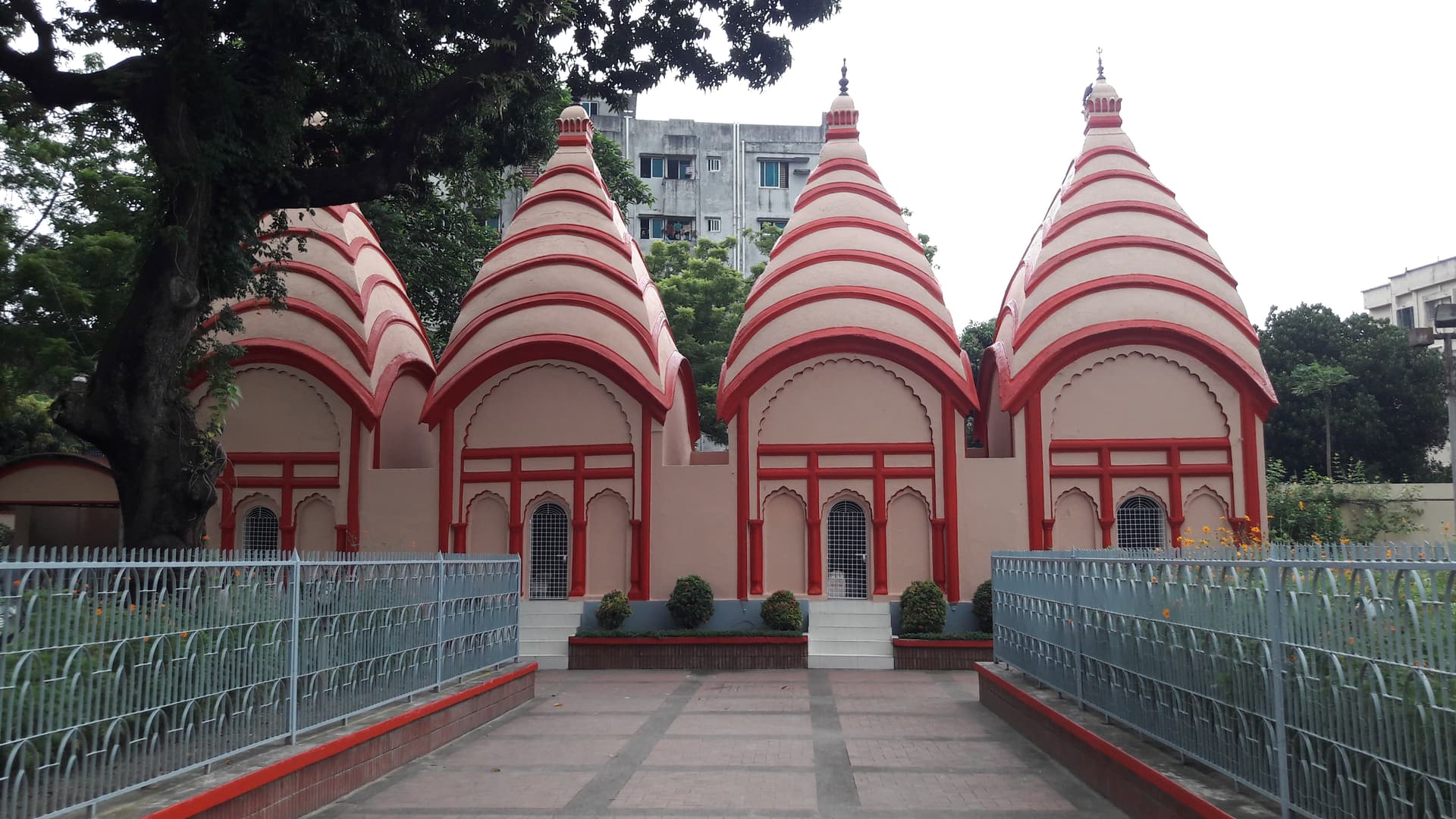
Image of Bhabanipur Shaktipeeth Temple. Image source · CC-BY-SA-3.0
Visit essentials
A quick read before you go
- Duration
- 1 to 2 hours to explore the full complex.
- Access
- Located in Sherpur Upazila, Bogra District, approximately 33 km from Bogra town.
Overview
Bhabanipur Shaktipeeth spreads across four acres near the Karatoya River at Sherpur in Bogra District. It is one of 51 Shakti Pithas, where parts of the Goddess Sati's body fell after Vishnu's discus ended Shiva's destructive dance of grief; tradition holds that her left anklet rests here.
The main temple is dedicated to Ma Aparna, this Pitha's Shakti, with Vaman as Bhairava. Four Shiva temples surround it; a Patal Bhairav temple serves Vaman, and shrines to Gopal and Vasudev complete the compound. A Panchamunda Asana idol carries tantric significance, while Belbaran Tala and Shakha Pukur add ritual water elements.
Daily worship moves from dawn Pravati through Balyo Bhog for the young and afternoon Anna Bhog of rice to evening Arati. Larger pilgrim gatherings come at Magha's full moon and through the three days of Chaitra Ashtami to Dashami, seeking blessings for marriage, health, and longevity at riverside ground long recognized as charged with the Goddess's presence.
Why this place is sacred
The mythology behind the Shakti Pithas is a story of love, grief, and destruction arrested by divine intervention. When Sati immolated herself to protest her father's insult to Shiva, the grief-maddened god carried her body through the cosmos in a dance that threatened existence itself. Vishnu's discus cut through the corpse, scattering it across the landscape. At each point of contact between the divine body and the earth, a new center of power came into being.
This is a theology of sacred fragmentation. The Goddess's wholeness was not destroyed but distributed — each Pitha holding a specific quality of her power, each one both incomplete and sufficient. At Bhabanipur, the anklet connects the site to the Goddess's foundation, her contact with the ground she walks. The Karatoya River, itself once considered among Bengal's sacred waterways, adds a dimension of flowing water to the grounded power of the anklet.
The daily ritual cycle — from dawn to evening arati — mirrors this theology of distributed presence. The Goddess does not arrive and depart; she is present in the rhythm of offering itself.
The temple's founding date is unknown, but its identification as a Shakti Pitha places it within a theological geography that has organized Hindu devotion across the subcontinent for centuries.
The temple complex has grown to include multiple sub-temples and ritual spaces. The Bhabanipur Temple Development, Renovation and Management Committee now oversees the complex, providing pilgrim services including transport and accommodation.
Experience and orientation
Enter the compound and the scale of the complex reveals itself: the main temple of Ma Aparna at the center, the four Shiva temples distributed around it, the Patal Bhairav shrine, the Gopal and Vasudev temples, the Nat Mandir. This is not a single point of focus but a sacred landscape in miniature — each structure holding its own devotional energy while contributing to the whole.
The main shrine draws the most concentrated devotion. Here the stone representing Ma Aparna receives the daily cycle of offerings that has continued without interruption. The atmosphere during worship is one of focused intensity — the priests' chanting, the bell, the incense, the flowers laid before the stone.
The subsidiary temples offer quieter encounters. The four Shiva temples are more intimate spaces, each housing a lingam and each inviting a different quality of contemplation. The Patal Bhairav temple, dedicated to Vaman, carries the darker, subterranean energy that the Bhairava tradition holds.
Beyond the built structures, the Karatoya River adds its own dimension. This is not incidental landscape; the river has its own history as a sacred waterway, and its presence beside the Shakti Pitha creates a complementarity between the fixed power of the fallen fragment and the moving power of water.
Begin at the main temple of Ma Aparna. If possible, time your arrival to coincide with one of the daily worship sessions — the dawn Pravati or the evening Arati. Then move through the subsidiary temples, allowing each one its own time. End at the riverside if the Karatoya is accessible.
Context and lineage
When Sati burned herself in the sacrificial fire to protest her father Daksha's insult to Shiva, the god of destruction was consumed by grief. He lifted her body and began a cosmic dance that threatened to unmake creation. The other gods, led by Vishnu, intervened: Vishnu's Sudarshana Chakra cut through Sati's body, and its fragments fell across the landscape. Each point of contact became a Shakti Pitha. At Bhabanipur, the left anklet touched the earth beside the Karatoya.
The 51 Shakti Pithas form a sacred geography that maps the Goddess's body onto the Indian subcontinent. Bhabanipur's place within this network connects it to every other Pitha — from Kamakhya in Assam to Hinglaj in Balochistan — creating a web of feminine divine power that spans thousands of kilometres.
Ma Aparna (Goddess Sati)
The Shakti Devi of this Pitha — the specific form of the Goddess worshipped here
Vaman (Bhairava)
The Bhairava (Shiva's fierce form) associated with this Pitha
Traditions and practice
The daily ritual cycle consists of the Pravati (dawn worship), Balyo Bhog (feeding of boys), the afternoon Anna Bhog (rice offering), and the evening Arati and Bhog. This cycle has the character of tending — a continuous care of the divine presence that requires daily renewal.
The temple committee provides practical support for pilgrims, including transportation and accommodation services. The biannual festivals — the one-day celebration on Magha Purnima and the three-day Chaitra worship on Ashtami through Dashami — remain the peaks of devotional intensity.
Timing a visit to coincide with one of the daily worship sessions, particularly the evening Arati, offers the most immersive encounter with the temple's devotional life. During the Chaitra festival period, the three days of sustained worship create an atmosphere of concentrated collective devotion.
Shaktism
ActiveOne of the 51 Shakti Pithas. The Shakti is Ma Aparna; the Bhairava is Vaman.
Daily four-part worship cycle. Biannual festivals on Magha Purnima and Chaitra Ashtami-Dashami.
Perspectives and open questions
Bhabanipur invites reflection on the theology of sacred fragmentation — the idea that divine power can be distributed rather than concentrated.
Scholarly perspective
The 51 Shakti Pithas represent one of Hinduism's most significant sacred geographies. Bhabanipur's place within this network reflects the historical depth of Shakta practice in Bengal, which has sustained these sites through centuries of political and social change.
Living and traditional perspectives
For devotees, the site is a living seat of the Goddess's power. The anklet fragment is not a metaphor but a reality — the Goddess's touch upon this ground is permanent, and the daily worship renews the connection between human devotion and divine presence.
Alternative interpretations
In tantric interpretation, the Shakti Pithas function as nodes in an energy grid spanning the subcontinent. The anklet, as the part of the body that touches the earth, connects to themes of grounding and the Goddess's relationship to materiality itself.
Open questions
The disagreement among sources about which body part fell here — left anklet, right eye, or left ribs — may reflect competing local traditions or the inherent fluidity of mythological geography.
Plan your visit
Access and arrival
Located in Sherpur Upazila, Bogra District, approximately 33 km from Bogra town. Accessible by road from Bogra. The temple committee provides bus and car services.
Pilgrim accommodations available through the temple committee. Hotels in Bogra town.
Respectful visit
Modest dress covering shoulders and knees. Remove shoes before entering any temple building.
Permitted in exterior areas. Ask permission before photographing the inner sanctum or during active worship.
Flowers and sweets are traditional offerings. Temple priests can guide appropriate offerings.
Remove shoes before entering temple buildings | Do not touch deity images or ritual objects | Maintain quiet during worship | Some areas may be restricted during specific rituals
The temple serves a Hindu minority community in Bangladesh. Visitors should approach with sensitivity to this context. Inner sanctum access during specific rituals may be limited.
Current practical details
Address
HC4P+R64, Bhawanipur, Bangladesh
Phone
Hours
Hours, fees, and access can change — verify on the official source before you travel. Practical details last checked Jun 2026.
Location
Map loads as you approach this section.
Pilgrim reflections
A portrait of encounter, not a score
Pilgrims describe what they felt, how present they could become, and whether the place would shape a journey. There are no stars and no ranking of traditions.
No reviewed reflections yet
The first pilgrims can help describe the character of being here.
Share a reflection
Available after an account-backed “Been there.” Every reflection is reviewed before publication.
Nearby sacred places
Explore other sacred places in the region. Proximity does not establish access or travel time; check each place’s guidance.


References
Sources consulted for this page. Source categories describe the publication, not a guarantee that every claim is verified. Traditional accounts and outside interpretations may differ.
- 01Hindu Pilgrimage Site Shaktipeeth Bhabanipur — Bhabanipur.orgofficialTemple committee official website with detailed ritual descriptions
- 02Bhabanipur Shaktipith - Wikipedia — Wikipedia contributorsencyclopediaGeneral overview of temple and Shakti Pitha significance
- 03Bhabanipur Shaktipeeth, Bangladesh - Temple Purohit — Temple PurohitguideDetailed temple information including rituals and practices
- 04Aparna Shaktipeeth Bhabanipur - The Temple Guru — The Temple GuruguideTemple listing with location and significance details
- 05Shree Aparna Shaktipeeth Bhabanipur Temple - Bengal Chronicle — Bengal ChroniclenewsNews article on temple history and significance
- 06Exploring the Seven Shakti Peeths in Bangladesh - Organiser — OrganiserSource contextContextual article on Bangladesh's Shakti Peeths
Photo gallery
3 curated photos
Share a photo
Help visitors recognize Bhabanipur Shaktipeeth Temple. Every submission is reviewed before publication.