Basilica of the Virgin Mary, Matraverebely Szentkut, Hungary
Szentkút, the Holy Well — Hungary's national Marian shrine in a wooded valley between the hills
Understand sacred places, explore living traditions, and learn how to engage respectfully with Pilgrim Map.
Access has not been verified. Check current local guidance before planning a visit.
Mátraverebély, Nógrád, Hungary
Read the sources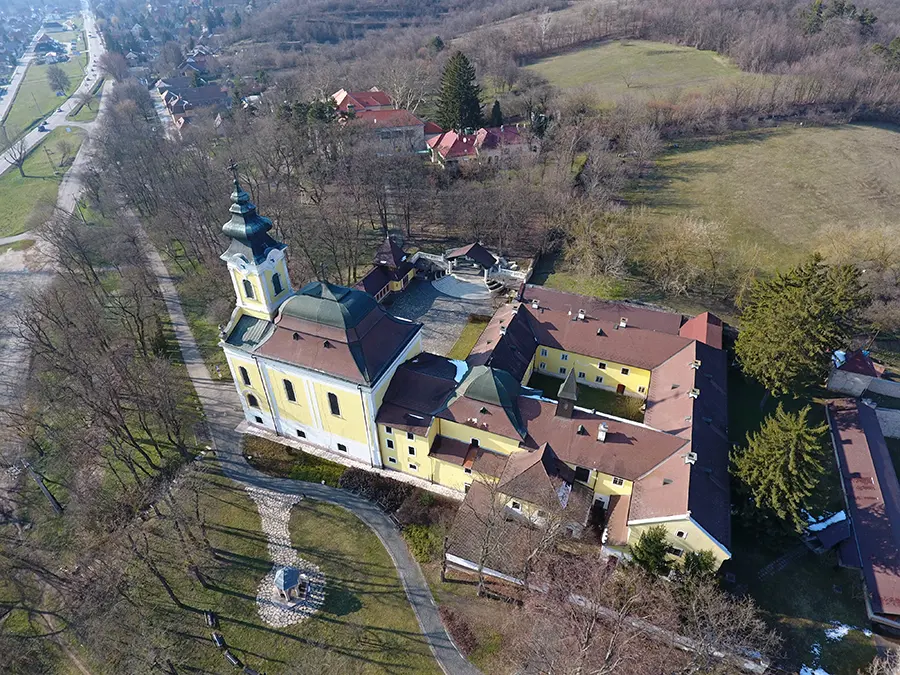
Image of Basilica of the Virgin Mary, Matraverebely Szentkut, Hungary. Image source · CC-BY-SA-4.0
Visit essentials
A quick read before you go
- Duration
- Half a day, longer to include the spring-gorge and hermit-cave circuit.
- Access
- In Mátraverebély, Nógrád County, about two hours by bus from Budapest, with free parking;…
Overview
In a wooded gorge between the Cserhát and Mátra ranges, Szentkút—“Holy Well”—centers on a spring medieval pilgrims believed could heal. For more than eight hundred years, the faithful have come to drink, pray before Our Lady's image, and seek reconciliation in the valley.
Two traditions give the spring its sacred charge: a mute shepherd healed at the Virgin's bidding and King St Ladislaus leaping the chasm on horseback. Both belong to faith rather than documented history.
Franciscans serve the shrine, declared a National Shrine in 2006. Open year-round and free, it includes a baroque two-tower basilica, a crowd-sized open-air altar, the Holy Well, and hillside hermit caves. Great August feasts draw pilgrims, while quieter visits continue throughout the year.
Why this place is sacred
Szentkút's thinness gathers around its perennial holy spring, the focus of centuries of healing testimony, in a forested gorge between the Cserhát and Mátra mountains. The water is approached as a source of healing, and the seeking of reconciliation — with God, with others, with oneself — is woven into the act of coming here. Above the church, hermit caves inhabited by solitaries from the thirteenth to the eighteenth century deepen the valley's contemplative quality.
The shrine is framed as a place to step out of everyday routine — the spring, the caves and the surrounding hills together foster contemplation and healing devotion.
A medieval Marian pilgrimage shrine centered on a miraculous healing spring, with a church built for pilgrims at Mátraverebély by 1210.
Served historically by Cistercians and, from 1772, by Franciscans, the shrine saw its baroque two-tower basilica completed in 1763. It was raised to minor basilica status by Pope Paul VI in 1970 and declared a Hungarian National Shrine in 2006, now receiving around 200,000 pilgrims a year.
Experience and orientation
Pilgrims most often describe the water first: the octagonal stone Holy Well, crowned with a Madonna-and-Child statue, where you may freely drink. Around it lies the quiet of the wooded valley, the baroque twin towers of the basilica, and an open-air altar built to hold the great crowds that gather on feast days. On those days the shrine fills with processions and song; through the rest of the year it is calm.
Above the church, a circular route climbs to the Saint Ladislaus spring gorge and the hermit caves on the Meszes-tető, where solitaries once made their homes and chapels — the last hermit died in 1767. Walking there, between spring, basilica and caves, the place reveals itself as both a destination for devotion and a landscape for contemplation. Many pilgrims arrive on foot along the Blue Trail, drawn into the valley's stillness before they reach the well.
In Mátraverebély, Nógrád County. The basilica, monastery grounds, open-air altar and Holy Well are at the valley floor; a circular route leads up to the Saint Ladislaus spring gorge and the hermit caves. Open year-round and free of charge.
Context and lineage
Pilgrimage to Szentkút is attested from the twelfth and thirteenth centuries, with a church built at Mátraverebély in 1210. Devotion centers on a spring associated with apparitions of the Virgin Mary holding the Child Jesus, and with King St Ladislaus. The shrine held a plenary indulgence privilege from 1258, and was served by Cistercians and, from 1772, by Franciscans.
The baroque basilica, financed by the Verebélyi and Almásy families, was completed in 1763; the Franciscans, suppressed under communism in 1950, returned in 1989.
Roman Catholic Marian devotion, served historically by Cistercians and from 1772 by Franciscans, alongside an eremitic tradition in the hillside caves.
The Blessed Virgin Mary (Nagyboldogasszony)
Patroness of the shrine
The mute shepherd of Verebély
Figure of the founding legend
King St Ladislaus
Figure of the spring legend
The Franciscans (Order of Friars Minor)
Custodians from 1772
The hillside hermits
Solitaries of the caves
Traditions and practice
Devotion centers on Marian pilgrimage processions, drinking and blessing the Holy Well water, and votive prayer before the Madonna-and-Child statue.
Year-round Masses, the patronal Assumption feast on the nearest Sunday to 15 August, the Franciscan Youth Pilgrimage of 15–20 August, confession and open-air liturgies for the large crowds that gather.
Drink from the Holy Well and pause before Our Lady's image; the shrine is framed as a place to set down everyday routine. If you have time, walk the Saint Ladislaus spring-gorge and hermit-cave circuit above the basilica, where the eremitic stillness of the caves invites longer reflection. Arriving on foot along the Blue Trail lets the valley prepare you before you reach the well.
Roman Catholic Marian devotion (Franciscan)
ActiveHungary's foremost national Marian shrine, centered on a miraculous healing spring associated with apparitions of the Virgin Mary with the Child Jesus and with King St Ladislaus.
Pilgrimage processions, drinking from and praying at the Holy Well, Masses at the basilica and open-air altar, the Assumption patronal feast, and the Franciscan Youth Pilgrimage.
Perspectives and open questions
Szentkút is understood as a documented medieval pilgrimage site, as Hungary's principal Marian shrine, and as a place of healing spring and eremitic mystique.
Scholarly perspective
Documented through the Historia Domus and archives as a continuously significant medieval-to-modern Marian pilgrimage site, holding privileges from the thirteenth century onward and following the institutional arc traced above — Cistercian then Franciscan custody, the eighteenth-century basilica, and twentieth-century recognition.
Living and traditional perspectives
Hungarian Catholic devotion treats Szentkút as the nation's principal Marian shrine, its Holy Well a place of miraculous healing under the patronage of Nagyboldogasszony — Our Great Lady, the Assumption.
Alternative interpretations
Popular accounts dwell on the healing power of the spring and the ascetic mystique of the hillside hermit caves.
Open questions
The historical kernel behind the twelfth-century apparition and the St Ladislaus spring legends cannot be verified and remains a matter of faith and tradition; the St Ladislaus dating in one source is anachronistic and is treated here as devotional legend.
Plan your visit
Access and arrival
In Mátraverebély, Nógrád County, about two hours by bus from Budapest, with free parking; reachable on foot via the Blue Trail from the Mátraverebély stop, roughly 5 km.
Respectful visit
Modest dress appropriate to a Catholic shrine and basilica.
Generally permitted on the grounds; be discreet during liturgies and around praying pilgrims.
Lighting candles, votive prayers, and reverent use of the Holy Well water.
Respect ongoing services and the sanctity of the well; stay on marked paths around the hermit caves and gorge.
Respect ongoing services and the sanctity of the well; be discreet during liturgies and around praying pilgrims; stay on marked paths around the hermit caves and gorge.
Current practical details
Address
Mátraverebély, Szentkút 14, 3077 Hungary
Hours
Hours, fees, and access can change — verify on the official source before you travel. Practical details last checked Jun 2026.
Location
Map loads as you approach this section.
Pilgrim reflections
A portrait of encounter, not a score
Pilgrims describe what they felt, how present they could become, and whether the place would shape a journey. There are no stars and no ranking of traditions.
No reviewed reflections yet
The first pilgrims can help describe the character of being here.
Share a reflection
Available after an account-backed “Been there.” Every reflection is reviewed before publication.
Nearby sacred places
Explore other sacred places in the region. Proximity does not establish access or travel time; check each place’s guidance.

Fallóskút Marian Shrine
Fallóskút (Mátraszentimre), Fallóskút (Mátraszentimre), Heves County, Hungary
12.0 km away

Bélapátfalva Cistercian Abbey Church
Bélapátfalva, Bélapátfalva, Heves County, Hungary
45.2 km away

Máriabesnyő Basilica
Máriabesnyő (Gödöllő), Máriabesnyő (Gödöllő), Pest County, Hungary
52.3 km away

Márianosztra Basilica
Márianosztra, Márianosztra, Pest County, Hungary
68.0 km away
References
Sources consulted for this page. Source categories describe the publication, not a guarantee that every claim is verified. Traditional accounts and outside interpretations may differ.
- 01History of the shrine — Mátraverebély-Szentkút official site — Mátraverebély-Szentkút National ShrineofficialPrimary shrine source: 12th-century Marian apparition to a mute shepherd healed by the spring; 1210 church built for pilgrims; Cistercians then Franciscans (from 1772); baroque two-tower basilica completed 1763; minor basilica 1970; National Shrine declared 2006; affiliation with Santa Maria Maggiore in 2016.
- 02Mátraverebély-Szentkút — official site — Mátraverebély-Szentkút National ShrineofficialConfirms ~200,000 pilgrims annually, open year-round and free of charge, holy well still flowing, Franciscan monastery, open-air altar; visitors may drink from the Holy Well and pray before Our Lady's image.
- 03Mátraverebély — Wikipedia — Wikipedia contributorsacademicConfirms village location in Nógrád County between the Cserhát and Mátra ranges by the Zagyva river.
- 04Hungary's Camino: The Road to Mary's Shrine — National Catholic Register — National Catholic RegisterSource contextDetails the St Ladislaus spring legend, the Assumption patronal feast and Franciscan Youth Pilgrimage (15–20 August, ~90 miles), 1258 plenary indulgence privilege, communist suppression of the Franciscans 1950 and their 1989 return.
- 05The History of the National Shrine of Mátraverebély-Szentkút according to the Historia Domus and archival sources — Interreg Slovakia-Hungary — Interreg SKHUacademicArchival/scholarly account of the shrine's documented history drawn from the Historia Domus.
- 06Mátraverebély-Szentkút (Holy Well) — outdooractive.com — OutdooractiveSource contextVisitor/route detail: octagonal stone Holy Well with Madonna-and-Child statue; hermit caves on Meszes-tető; access via Blue (K) Trail; ~2 hours from Budapest.
- 07Mátraverebély-Szentkút Nemzeti Emlékhely — Digital map of pilgrimage sites V4 — EuropePilgrimeSource contextCorroborates national-shrine pilgrimage status, hermit caves used as chapels/homes 13th–18th century (last hermit died 1767), Saint Ladislaus spring gorge circular route.
Share a photo
Help visitors recognize Basilica of the Virgin Mary, Matraverebely Szentkut, Hungary. Every submission is reviewed before publication.