Basilica of Begoña
Where the Basque mother came to rest — patron of Biscay, first light on the sailor's return
Understand sacred places, explore living traditions, and learn how to engage respectfully with Pilgrim Map.
Access has not been verified. Check current local guidance before planning a visit.
Bilbao, Biscay, Spain
Read the sources
Visit essentials
A quick read before you go
- Duration
- 30 to 60 minutes for a standard visit to the interior.
- Access
- The basilica is in the Begoña district above Bilbao's Old Town (Casco Viejo).
Overview
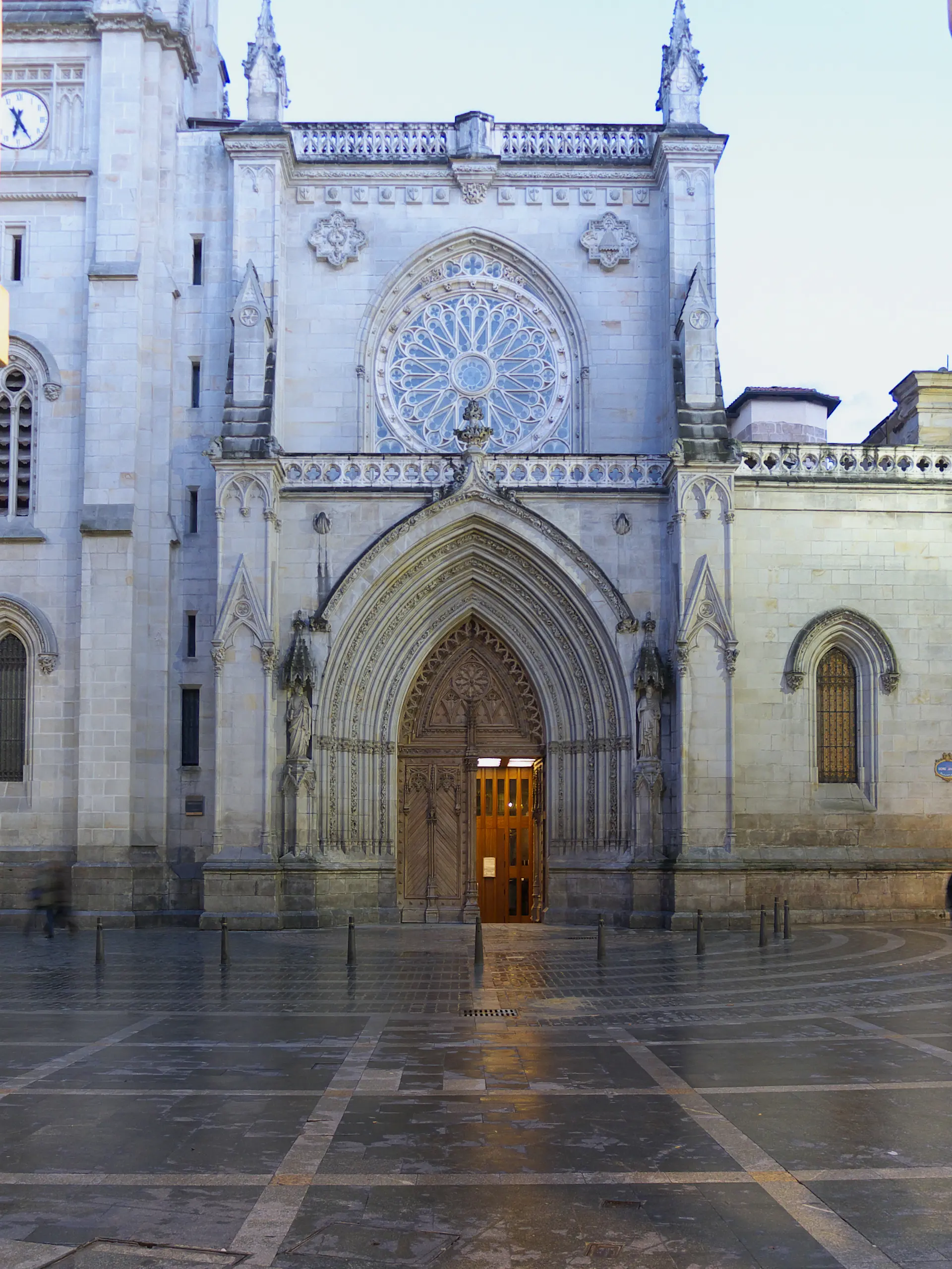
High on Artagan hill above Bilbao, a gilded spire marks the home of the Basque people's Amatxu—their little mother. A basilica has stood here since at least the fifteenth century, when a wooden hermitage sheltered a carved Virgin that tradition says refused to be moved. Begun in 1511, the present Gothic church has three limestone naves, a Hispano-Flemish altarpiece, a Parisian Cavaillé-Coll organ, and a Swiss-cast 24-bell clock tower.
For centuries, sailors returning upriver on the Nervión measured homecoming by their first sight of Begoña's steeple. That quarter became La Salve, named for their prayer of thanks. Return, elevation, and protection seen from the water still shape a basilica understood to watch over Bilbao.
This Virgin carries a Basque name, legendary Basque voice, and intimate epithet. Amatxu expresses more than the formal title patron saint of Biscay: across seven centuries, the mother-people relationship has absorbed Catholic devotion, maritime anxiety, political identity, and folk memory. Each August 15 pilgrimage joins religious solemnity with Basque culture—txakoli wine, talo cornbread, txistulari flutes, and the aurresku welcome dance at the basilica doors.
Why this place is sacred
The hill of Artagan holds several interlocking qualities that make this more than a church built on a convenient rise. The first is the founding story itself: not a vision at a grotto or beside a river, but an act of miraculous resistance. The statue refused to be carried away. It took root. A voice spoke in Basque and commanded that it stay.
This is not a site chosen by human architects but one that, in tradition, chose itself — and the name 'Begoña' carries that divine command in every syllable.
The elevation is its own layer of meaning. From the basilica steps you can see the old city spread below and the Nervión threading toward the Basque coast. For centuries this view was the last sight of departing sailors and the first of those returning. The devotional logic is simple and deep: you look up at Amatxu when you leave, and she looks down at you when you come back.
The basilica's steeple is an axis between human vulnerability on the water and divine protection on the hill.
The third thread is language. 'Amatxu' is a Basque word, and the Basque Country's relationship to its own language — to its survival, its distinctiveness, its connection to an identity that predates the modern nation-state — is charged. That the patron saint speaks Basque, however legendarily, gives her a cultural weight that Catholic institutional recognition alone cannot account for.
When the Basque diaspora in Venezuela or Mexico venerates Our Lady of Begoña, they are holding a thread not only to Catholic faith but to a specific people and a specific place.
Finally there is the Calzadas de Mallona: the long stone stairway that climbs from the Old Town to the basilica. Some pilgrims ascend on their knees. The stairway converts the act of arrival into labor, and labor into offering. By the time you reach the basilica doors, the height of the climb is felt in the body. The transition from city to sanctuary has been physically marked.
A Marian hermitage, possibly established in the thirteenth or fourteenth century, on a prominent hillside above the medieval town of Bilbao — combining the widespread Iberian tradition of hilltop Marian shrines with the particular devotional needs of a maritime and mercantile community.
The hermitage gave way to a Gothic parish church begun in 1511 and dedicated as a basilica in 1908. The site accumulated institutional honors across four centuries — canonical coronation of the statue in 1900, papal designation of the Virgin as patron saint of Biscay in 1903 — while simultaneously deepening as a center of Basque folk devotion.
The 19th century saw the church damaged when it was absorbed into Bilbao's military fortifications; the 1942 incident in which Carlist political rivals threw grenades during a post-Civil War ceremony left a bomb scar still visible on the stonework. Restoration work in 1993–1994 stabilized the structure. The basilica now functions as an active parish, a shrine visited year-round, and the focal point of one of the largest annual pilgrimage gatherings in northern Spain.
Experience and orientation
The approach shapes the experience before you enter. If you climb the Calzadas de Mallona — the traditional stairway from the Old Town — the ascent is gradual, the city falling away beneath you, Bilbao's rooflines visible between the buildings lining the steps. By the top, you have earned the elevation. The basilica's west facade meets you at the top of the stairs, the Renaissance entrance arch — attributed to the influence of Gil de Hontañón — framing the doorway.
Inside, the three Gothic limestone naves offer a measured, vertical space: high vaults, modest side chapels, and at the far end the main altarpiece, which houses the enthroned figure of Amatxu. The statue is small for what it represents — 117 centimeters of linden wood, Romanesque in form, Gothic in refinement, painted and crowned. It is easy to walk past it without understanding the weight it carries for the people who fill this church each August.
Looking at it in the context of a quiet weekday morning, when a handful of visitors move through without ceremony, it is simply an old carved figure. Looking at it when the nave is full of pilgrims who walked through the night to arrive here at dawn, it becomes something harder to describe without resorting to language that undersells it.
On August 15, the atmosphere outside the basilica is unlike most religious sites in Europe. The plaza and surrounding streets host traditional food stalls, txistulari musicians, and groups gathering for the aurresku — a formal Basque welcome dance performed in front of the basilica doors before the noon Pontifical High Mass.
There is a quality of genuine festivity combined with genuine devotion that the two streams — the folk cultural and the liturgical — have never been separated here into secular and sacred compartments. They flow together, as they apparently always have.
Enter from the Plaza de la Basílica at the top of the Calzadas de Mallona stairs. The main altarpiece with the statue of the Virgin is visible from the nave entrance. The Cavaillé-Coll organ is installed in the choir loft. Votive candle stands are positioned near the main chapel. The basilica is single-storey and navigable without guidance. On pilgrimage days, expect crowds at the doors from early morning; the noon mass on August 15 fills the interior to capacity.
Context and lineage
The foundational legend centers on a shepherd who found a carved image of the Virgin on Mount Artagan — in one telling, in the hollow of a holm oak; in another, on a hawthorn bush. When the community attempted to move the statue to a church in the town below, it became immovably fixed to the ground and a voice called out in Basque: 'Bego Oina!' — variously translated as 'Be still' or 'Stay underfoot.'
The community understood this as a divine command to build the church at the exact spot of the discovery. The name 'Begoña' is held to derive from this utterance, though 'Begoña' also existed as the name of the hillside district before the legend's recorded form, making the etymology contested.
Art-historical scholarship offers a different account. Father Lizarralde's 1932 study dated the wooden statue to the early fourteenth century on stylistic grounds — Romanesque form with Gothic refinements — and proposed that it was likely donated by Diego López de Haro, Lord of Biscay, or one of his predecessors. This would place the statue's arrival within the documented history of medieval Biscay's ruling dynasty rather than in a miraculous discovery.
A third tradition places the original hidden statue in the eighth century, concealed during the period of Moorish expansion across Iberia — a pattern repeated in many Iberian Marian devotions — though no documentary evidence bridges the gap between this claim and the fourteenth-century art-historical assessment.
A 1503 inventory of the hermitage, predating the Gothic construction, documents a Flemish altarpiece already housed there, indicating an established and furnished place of worship before the 1511 building project began.
The site descends from a medieval Basque hilltop hermitage tradition into a fully institutionalized minor basilica of the Roman Catholic Church. Its elevation to minor basilica in 1908 placed it in formal affiliation with the Archbasilica of St. John Lateran in Rome. The canonical coronation of the statue in September 1900 was one of the first such ceremonies in the Basque Country, and the 1903 patronage declaration brought the devotion into formal universal Catholic recognition.
Throughout this institutional history, the Basque folk dimension — 'Amatxu,' the sailor traditions, the cultural festival on August 15 — ran alongside without being absorbed or erased.
Diego López de Haro (attributed)
Possible donor of the statue and founding patron of the shrine
Sancho Martínez de Arego
Principal architect of the Gothic basilica
Gil de Hontañón (attributed influence)
Renaissance architect whose style influenced the entrance arch
José María Basterra
Architect, tower redesign
Aristide Cavaillé-Coll
Organ builder
Pope Pius X
Declared canonical patronage
Father José Antonio Lizarralde
Historian and art-historical scholar
Traditions and practice
The oldest continuous practice is the overnight pilgrimage walk converging from across Biscay on the night of August 14–15. Pilgrims walk through the night to arrive at the basilica before dawn on the Feast of the Assumption, some ascending the Calzadas de Mallona on their knees as a devotional act. The August 15 program includes hourly masses from early morning, culminating in the Pontifical High Mass at noon celebrated by the Bishop of Bilbao with civic authorities present.
Before the noon mass, the aurresku — a ceremonial Basque welcome dance — is performed on the basilica steps by a group of traditional dancers. The novena, nine days of preparatory prayer preceding the feast, is observed in the weeks before both the August and October celebrations. On extraordinary historical occasions — most notably during the 1855 cholera epidemic — the statue of the Virgin was processed down into the city itself, a practice understood as direct divine intervention.
The basilica functions as a fully active parish with daily masses at 09:00 and at multiple times throughout the day. Sacraments including baptism, marriage, and confession are administered regularly. Votive candles are lit before the statue of the Virgin throughout opening hours. The statue is dressed in seasonal liturgical capes — white, maroon, and light blue — changed according to the liturgical calendar, a tradition maintained by the basilica's sacristans.
The October 11 feast of Our Lady of Begoña is observed with a solemn mass, processions, and in recent years musical concerts in the basilica. Outside the major feast periods, the basilica receives a steady flow of individual visitors — devotional, cultural, and tourist — year-round.
For a visitor without a devotional framework, the most meaningful engagement is the physical ascent via the Calzadas de Mallona stairway rather than the funicular. The climb takes fifteen to twenty minutes and delivers an embodied sense of why this hill was chosen: the city recedes, the elevation becomes felt, the steeple appears incrementally above the roofline. Inside, sit in the nave and give your eyes time to adjust to the interior light before moving toward the altarpiece.
The statue is best read slowly — it is not large or dramatically posed, but the accumulated weight of devotion in the space around it is present. If you are in Bilbao on August 15, arrive early in the morning rather than for the noon mass; the hours before the ceremony carry a different quality than the ceremony itself.
Roman Catholicism
ActiveThe basilica is the premier Marian shrine of Biscay and the Basque Country. It holds the status of minor basilica of the Catholic Church, in formal affiliation with the Archbasilica of St. John Lateran in Rome since 1908. The Virgin of Begoña was declared patron saint of Biscay by Pope Pius X in 1903 and was canonically crowned in 1900. Daily masses, sacraments, and an active parish life make this a continuously functioning Catholic institution.
Daily mass at 09:00 and throughout the day; annual August 15 celebrations with hourly masses and a Pontifical High Mass; solemn October 11 feast with processions; novena observances; devotional candle lighting and prayer before the statue; seasonal changing of the Virgin's liturgical capes; administration of sacraments including baptism and marriage.
Basque Folk Devotion
ActiveBeyond formal Catholic practice, the Virgin of Begoña is a pillar of Basque cultural identity. 'Amatxu' — little mother in Basque — is an affectionate vernacular title expressing a relationship of intimacy and belonging. Sailors named their vessels after her from the fifteenth century onward, and the 'La Salve' quarter of Bilbao takes its name from the prayer they offered upon first glimpsing her steeple on returning upriver. Basque emigrants carried her image to Venezuela and Mexico. The August 15 pilgrimage blends Catholic solemnity with txakoli wine, talo cornbread, txistulari musicians, and the aurresku dance — a fusion that expresses something the distinction between 'religious' and 'cultural' cannot contain.
Overnight pilgrimage walk from across Biscay on August 14–15; traditional Basque foods and txakoli wine at festival stalls on feast days; aurresku ceremonial dance performance at the basilica entrance; year-round individual visits and private prayer; October 11 processions with banners; devotional naming of vessels and places after the Virgin in maritime tradition.
Perspectives and open questions
The Basilica of Begoña is simultaneously an art-historical object (a well-documented Gothic church with a dateable statue), a center of Marian devotion with direct papal recognition, a vessel of Basque cultural identity, and a site that touches older patterns of Iberian sacred geography. These perspectives do not resolve into a single interpretation; the site holds them in productive tension.
Scholarly perspective
Art historians and historians of religion find the basilica to be a straightforward, well-documented example of Basque Gothic ecclesiastical architecture from the early sixteenth century, its origins traceable through the 1503 inventory and the 1511 construction record. The statue's fourteenth-century dating, established by Lizarralde in 1932, places it within the broader tradition of Iberian Romanesque-Gothic Marian statuary.
The social history of the site — its role in Bilbao's maritime economy, the 1855 cholera procession, the 1942 political violence, the Carlist devotional inheritance — makes it a useful case study in the overlapping functions of Catholic shrines as sites of institutional religion, civic identity, and political contestation. The canonization acts (1900, 1903, 1908) are read as part of the late nineteenth and early twentieth century movement of Marian patronage declarations across Spain.
Living and traditional perspectives
The Basque Catholic devotional tradition does not experience the basilica primarily as a building or an art-historical object. It is the home of the Amatxu — the little mother who chose this hill, whose voice named the place, who stopped the cholera in 1855 and watched over the sailors who left and returned for five centuries.
The institutional events (coronation, patronage declaration) are understood not as acts that created the Virgin's power here but as the Church formally recognizing what had already been known for generations. The pilgrimage walk through the night is not a performance of faith but an act of it — the body's labor offered as relationship.
Alternative interpretations
Some accounts situate the Begoña tradition within the 'hidden image' pattern common to Iberian Marian shrines: an old statue concealed at the time of Muslim expansion, rediscovered on a hillside by a shepherd or child, and establishing a shrine at the discovery point. This pattern appears at Montserrat, at the Virgin of Guadalupe in Extremadura, and at dozens of smaller shrines across the peninsula.
Whether the Begoña statue genuinely predates the fourteenth century — the folk tradition places it in the eighth — is historically undocumented, but the pattern itself may reflect a genuine cultural memory of sacred objects preserved through periods of disruption. The hilltop location also resonates with the cosmology of Basque pre-Christian mythology, where Mari — the supreme Basque deity, female, associated with weather and the peaks — dwelt in mountain summits and caves.
Whether the Christian hillside shrine consciously or unconsciously occupied older sacred geography has not been archaeologically examined.
Open questions
The gap between the eighth-century folk tradition and the fourteenth-century art-historical assessment of the statue remains unbridged by documentary evidence. Whether a pre-Christian sacred site preceded the Christian hermitage on Artagan hill has never been the subject of archaeological investigation. The identity of the original donor, if any, and the full circumstances of the statue's arrival at the site are not established.
The bomb scar from the 1942 Carlist-Falangist grenade incident remains visible in the stonework, but the full political history of how the basilica was implicated in the Spanish Civil War's aftermath has not been comprehensively written.
Plan your visit
Access and arrival
The basilica is in the Begoña district above Bilbao's Old Town (Casco Viejo). Three routes: (1) Funicular from Casco Viejo — the most direct, lifts visitors to the Begoña neighborhood in minutes; (2) Calzadas de Mallona — the historic pilgrim stairway, a 15–20 minute ascent on foot from the Old Town; (3) Elevator near Casco Viejo for those with mobility limitations. Bus lines 03, 30, 38, A9, and G2 serve the 'Basílica de Begoña' stop.
The site is accessible for people with disabilities. Address: Plaza de la Basílica, 1, 48006 Bilbao. Opening hours: Monday–Sunday 09:30–13:30 and 16:30–20:30. Entry is free.
Bilbao's Old Town (Casco Viejo) is a 10–15 minute walk or short funicular ride from the basilica and offers a full range of accommodation. There are no accommodations specific to the basilica or Begoña district. On August 15, all Bilbao accommodations book early — reserve weeks in advance if attending the pilgrimage.
Respectful visit
Modest dress is expected as in any active Catholic church. Shoulders and knees should be covered. Sleeveless tops and very short shorts or skirts are inappropriate when entering the church proper, though the plaza and festival areas outside operate under no such restriction during feast day celebrations.
Photography is generally permitted inside the basilica. Flash photography should be avoided during active masses and services. Be discreet when photographing in the presence of people engaged in prayer; moving quietly and not positioning yourself between worshippers and the altar is the basic standard.
Votive candles may be lit before the Virgin's statue at the stands provided. Monetary donations for the basilica's upkeep are accepted. During pilgrimage season, pilgrims traditionally bring flowers as offerings.
Maintain silence or quiet tones inside, particularly during masses. Do not obstruct the aisles or chapel access when worshippers are moving through or kneeling. On August 15 and October 11, large crowds fill the space; give particular care not to disrupt devotees engaged in prayer during what is, for them, a significant annual act of faith.
On August 15 and October 11, the basilica and surrounding plaza receive very large crowds — over 150,000 on the major feast day. Those with difficulty in dense crowds or who are seeking contemplative quiet should plan visits on other dates. The noon mass on August 15 fills the nave to capacity; access may be restricted to those who arrive well in advance.
Location
Map loads as you approach this section.
Pilgrim reflections
A portrait of encounter, not a score
Pilgrims describe what they felt, how present they could become, and whether the place would shape a journey. There are no stars and no ranking of traditions.
No reviewed reflections yet
The first pilgrims can help describe the character of being here.
Share a reflection
Available after an account-backed “Been there.” Every reflection is reviewed before publication.
Nearby sacred places
Explore other sacred places in the region. Proximity does not establish access or travel time; check each place’s guidance.


References
Sources consulted for this page. Source categories describe the publication, not a guarantee that every claim is verified. Traditional accounts and outside interpretations may differ.
- 01History — The Basilica of Begoña, Bilbao — Basilica of BegoñaofficialOfficial basilica website. Construction timeline, Cavaillé-Coll organ (1884), canonical coronation (September 8, 1900), minor basilica status (1908), Murillo school paintings, baptismal font, Hispano-Flemish tabernacle
- 02History of the Virgin — The Basilica of Begoña, Bilbao — Basilica of BegoñaofficialOfficial account of the statue: Romanesque-Gothic linden wood carving, 117 cm, early 14th century, attributed gift of Diego López de Haro; global diaspora veneration in Venezuela and Mexico
- 03Festivities of the Virgin — The Basilica of Begoña, Bilbao — Basilica of BegoñaofficialOfficial festival page. Documents Oct 11 patronage declaration (1903), Aug 15 Assumption observances, liturgical cape tradition (white, maroon, light blue), novena practices
- 04Basilica of Begoña — Bilbao City Council — Bilbao City CouncilofficialMunicipal official page; confirms opening hours, mass schedule, accessibility, bus routes
- 05Basilica of Begoña — Wikipedia — Wikipedia contributorsacademicCovers construction dates (1511 start), architects, clock tower (24 bells, Sumiswald 1922), 1942 Carlist-Falangist incident, 1993–1994 restoration, and maritime 'La Salve' quarter legend
- 06Our Lady of Begoña — Wikipedia — Wikipedia contributorsacademicCovers statue iconography, patronage declaration by Pope Pius X (1903), minor basilica elevation (1908), Basque maritime devotion, cholera epidemic of 1855
- 07Pilgrimage to the Basilica of Begoña — Disfruta Bizkaia — Disfruta BizkaiaSource contextProvincial tourism board. Details August 15 pilgrimage (150,000+ attendees), Calzadas de Mallona ascent route, overnight opening, novena and hourly masses
- 08The Basilica of Our Lady of Begoña: the incredible history of the sanctuary of amatxu — Barceló Experiences — Barceló ExperiencesSource contextGood narrative overview: shepherd legend, 1503 inventory with Flemish altarpiece, Gil de Hontañón influence on entrance arch, 19th-century city wall damage
- 09Basilica of Begoña — Bilbao Visita Virtual — Bilbao Visita VirtualSource contextVirtual Bilbao heritage platform; confirms Gothic three-nave structure, limestone construction, western facade orientation
- 10Begoñako Basilica, Bilbao, Spain — Catholic Shrine Basilica — Catholic Shrine BasilicaspiritualDevotional overview of the basilica's status as a minor basilica and shrine; confirms Basque cultural and spiritual identity connection
Share a photo
Help visitors recognize Basilica of Begoña. Every submission is reviewed before publication.