Bahauddin Naqshband Memorial Complex
Where a walking staff became a tree and three pilgrimages became one hajj
Understand sacred places, explore living traditions, and learn how to engage respectfully with Pilgrim Map.
Access has not been verified. Check current local guidance before planning a visit.
Bukhara, Bukhara, Uzbekistan
Read the sources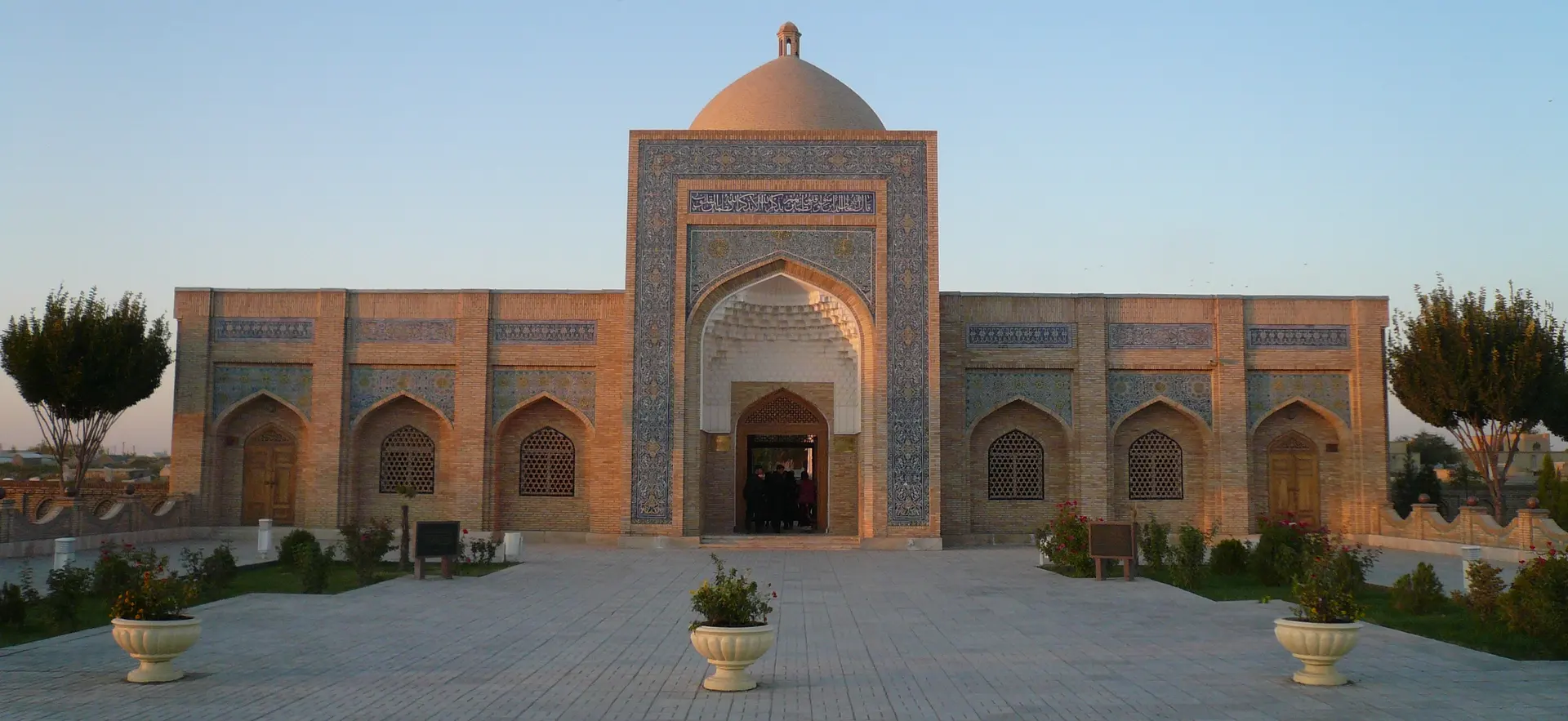
Visit essentials
A quick read before you go
- Duration
- Most visitors spend 1-2 hours at the complex.
- Access
- The complex is located approximately 10-12 km northeast of Bukhara city center, in the village…
Overview
Baha-ud-Din Naqshband taught engagement, not withdrawal: 'Let the heart be with God and the hands be with work.' Locating practice in marketplace, field, and workshop defined both his life and the Naqshbandiyya.
Born in 1318 twelve kilometers from Bukhara, he made multiple pilgrimages to Mecca, studied with several masters, and founded an order that spread from Turkey to Indonesia, becoming one of history's largest Sufi fraternities. His grave drew the faithful after his 1389 death; the expanding complex survived Soviet suppression, reopened in 1993, and joined UNESCO's Silk Roads corridor in 2023.
Called the 'Central Asian Mecca', the complex receives more than two million pilgrims annually. They pray at the tomb, circle the Sangi Murod wishing stone, and pass beneath the mulberry traditionally grown from his staff, seeking blessing, healing, and fulfilled hopes before returning to ordinary life—the setting Naqshband made sacred.
Why this place is sacred
More than six centuries of pilgrims walking from Bukhara, praying at the tomb, circling the stone, and passing beneath the tree have accumulated here. Naqshband's teaching adds a particular quality: butchers, weavers, and farmers could keep the heart with God while their hands worked, so visitors bring illness, hopes for children, and business troubles rather than leave the world behind.
Wish practices make that contact tangible. Pilgrims circle the wall-set Sangi Murod and crawl beneath a mulberry said to have grown from Naqshband's staff; countless hands have smoothed the stone and knees worn the ground. Without resolving the traditions' literal claims, these repeated gestures give pilgrims a point of contact.
Soviet closure from 1917 to 1993 forced faith underground. Reopening made restoration spiritual as well as architectural: a community reclaimed what had been taken. Tradition also places a pre-Islamic fire temple here, suggesting a sacred geography that may have drawn worshippers before the present tradition.
The resulting thinness is quiet, practical, and communal. Pilgrims come not for theatrical ecstasy but to wish, remember God, and return renewed to daily life.
The site was established as a burial ground for Baha-ud-Din Naqshband in 1389. The mausoleum built in 1544 formalized what had already become a pilgrimage destination. The location may have been sacred before Islam, with tradition suggesting a fire temple stood here in pre-Islamic times.
From simple grave to mausoleum (1544), the site grew to include the Kushbegi mosque, Muzafar Khan mosque, a madrasah, a khanqah (Sufi lodge), a minaret (1885), and pilgrim hostels. Soviet suppression closed the shrine from roughly 1920 to 1993. Major restorations occurred in 1993, 2003, and 2010. A Sufi museum and scientific center opened in 2004. UNESCO inscription came in 2023 as part of the Silk Roads: Zarafshan-Karakum Corridor.
Experience and orientation
The twenty-minute drive from Bukhara crosses cotton-field countryside to Kasri Orifon, 'Castle of the Knowledgeable', where minaret and domes mark the complex. A landscaped courtyard and rectangular reflecting reservoir receive tourists with cameras alongside devotees with prayer beads.
Naqshband's modest mausoleum centres on a tombstone behind carved wood. Pilgrims pray, touch and circle the wall-set Sangi Murod, and lean their foreheads against it. In the courtyard, supports hold an ancient gnarled mulberry; generations have worn smooth the gap beneath it while crawling through with wishes. The staff-origin legend is unverified, while hopeful visitors, tied rags, and whispered prayers are observable.
Kushbegi and Muzafar Khan mosques serve regular prayer. A Sufi museum explains Naqshband and his order, and many pilgrims complete the visit at his mother's smaller tomb. The atmosphere is modest and sustained rather than theatrical, matching a teaching woven into ordinary life.
Open roughly 8 AM–7 PM, with hours subject to change. From the reservoir courtyard, orient around Naqshband's mausoleum and Sangi Murod, the sacred mulberry, Kushbegi and Muzafar Khan mosques, his mother's nearby tomb, and the Sufi museum. Allow 1–2 hours.
Context and lineage
Baha-ud-Din Naqshband was born in March 1318 in the village of Qasr-i Hinduvan (now Kasri Orifon), about twelve kilometers from Bukhara. His life was marked by the number seven, considered holy in Sufism: born in the seventh month, he memorized the Quran by age seven and died at seventy. He studied with various Sufi masters and eventually founded his own order, the Naqshbandiyya, which would become one of the largest in the world.
Unlike many Sufi orders that emphasized withdrawal from society, Naqshband taught that spiritual practice should happen amid daily work. His famous principle—'Let the heart be with God and the hands be with work'—attracted followers who wanted to pursue the mystical path without abandoning their trades and families.
After his death in 1389, his grave immediately became a pilgrimage destination. The faithful came to pray at his tomb, and traditions of wish fulfillment developed around the site. Khan Abdulaziz built the formal mausoleum in 1544, 155 years after Naqshband's death. Over subsequent centuries, the complex expanded to include mosques, a madrasah, a khanqah (Sufi lodge), a minaret, and pilgrim hostels.
Legend holds that Naqshband once planted his walking staff in the ground at this site, and from it grew the sacred mulberry tree whose trunk still stands in the courtyard. Another legend suggests a fire temple occupied this spot before Islam, indicating the location's deep sacred history.
The Naqshbandi Sufi order traces its spiritual lineage (silsila) through a chain of masters back to the Prophet Muhammad via Abu Bakr as-Siddiq, the first Caliph. This distinguishes it from most other Sufi orders, which trace their lineage through Ali, the Prophet's son-in-law. The order emphasizes silent remembrance (dhikr khafi) rather than the vocal dhikr common in other orders.
After Naqshband's death, the order continued through various masters and spread across the Islamic world, establishing major branches in Turkey, India, Indonesia, and elsewhere. The order remains active today, with followers in many countries.
Baha-ud-Din Naqshband
Founder of the Naqshbandi Order
Khan Abdulaziz
Builder of the mausoleum
Traditions and practice
The core pilgrimage ritual involves circumambulating and praying at Naqshband's tombstone. Pilgrims press their foreheads against the stone, recite prayers, and make requests for blessing. The Sangi Murod—a stone set into the mausoleum wall—is circled by those seeking wish fulfillment. Pilgrims crawl beneath the trunk of the sacred mulberry tree while making wishes, a practice that has worn the ground smooth over centuries. Rags, small offerings, and written wishes are tied to the tree's branches.
Local tradition holds that walking from Bukhara to the mausoleum three times equals one hajj to Mecca. This equivalence elevates the pilgrimage's spiritual significance and draws devotees who may be unable to travel to Mecca.
Many pilgrims visit the tomb of Naqshband's mother before approaching the main shrine, following a traditional sequence that honors the saint's family. When wishes are granted, pilgrims return to make offerings, which are cooked in the mass kitchens established for this purpose.
The site continues to function as both an active pilgrimage destination and a tourist attraction. Over two million visitors come annually. Regular prayers occur in the Kushbegi and Muzafar Khan mosques; Friday prayers draw larger crowds. The Sufi museum, established in 2004, educates visitors about Naqshband's teachings and the history of the order. Pilgrim hostels accommodate those staying for extended periods. The wish-fulfillment traditions remain active and are practiced by pilgrims of various ages.
Non-Muslim visitors are welcome to observe the pilgrimage rituals respectfully. The courtyard, mausoleum exterior, sacred tree, and museum are accessible to all. Consider sitting quietly in the courtyard and observing the rhythm of pilgrimage—the circling, the prayers, the hope expressed in simple gestures. The Sufi museum provides helpful context for understanding what you witness.
Naqshbandi Sufism
ActiveBaha-ud-Din Naqshband (1318-1389) founded one of the largest Sufi orders in the world. The Naqshbandi order is distinctive in tracing its spiritual lineage (silsila) through Abu Bakr as-Siddiq, the first Caliph, rather than through Ali—a lineage shared by almost all other Sufi orders. The order emphasizes silent remembrance of God (dhikr khafi) rather than vocal practices, and teaches that Sufis should engage fully with the world rather than withdraw as ascetics. Naqshband's famous principle was: 'Let the heart be with God and the hands be with work.' The order spread from Central Asia to Turkey, South Asia, Southeast Asia, and beyond, becoming one of the most influential spiritual movements in Islamic history. This site, the burial place of the founder, is the holiest location for the order.
Pilgrims circumambulate Naqshband's tomb, pressing their foreheads against the tombstone and reciting prayers. They circle the Sangi Murod (wishing stone) for wish fulfillment. They crawl beneath the trunk of the sacred mulberry tree—believed to have grown from Naqshband's walking staff—while making wishes. Rags, money, and written wishes are tied to the tree branches. When wishes are granted, pilgrims return to cook offerings in the mass kitchens. The tradition holds that walking from Bukhara to the mausoleum three times equals one hajj to Mecca, elevating the pilgrimage's spiritual significance. Many pilgrims visit the tomb of Naqshband's mother before the main shrine.
Sunni Islam
ActiveThe complex includes functioning mosques (Kushbegi and Muzafar Khan) used for regular prayers. The site represents mainstream Sunni Islam's embrace of Sufi spirituality—the two are not opposed but integrated. The architectural ensemble (mausoleum, mosques, madrasah, minaret) reflects classical Islamic built traditions. The number seven, considered holy in Islamic and Sufi tradition, pervades the saint's biography and the site's symbolism.
Regular daily prayers occur in the mosques. Friday prayers draw larger crowds. Islamic holidays (Eid al-Fitr, Eid al-Adha) see increased activity. The site functions as both a pilgrimage destination for the saint's tomb and a community worship space for regular Islamic observance. The presence of a madrasah historically made this an educational as well as devotional center.
Perspectives and open questions
The Bahauddin Naqshband Memorial Complex invites interpretation from multiple angles: as the shrine of one of history's most influential Sufi masters, as a living pilgrimage destination, as a case study in the survival of faith through political suppression, and as a place where ancient sacred geography persists beneath Islamic devotion.
Scholarly perspective
Historians of Sufism recognize Baha-ud-Din Naqshband as one of the most significant figures in Islamic mysticism. The order he founded became one of the largest Sufi fraternities in the world, with millions of followers across Turkey, Central Asia, South Asia, and Southeast Asia.
The Naqshbandi order is distinctive in several ways: it traces its spiritual lineage through Abu Bakr rather than Ali, it emphasizes silent remembrance (dhikr) rather than vocal practices, and it teaches engagement with the world rather than withdrawal.
The 2023 UNESCO inscription recognized the site's importance within the broader Silk Roads network. The memorial complex represents not just religious architecture but the intersection of spirituality, trade, and cultural exchange that defined the medieval Central Asian world. Scholars note that pilgrimage sites like this one functioned as nodes in a network of sacred geography spanning the Islamic world.
Living and traditional perspectives
For Naqshbandi Sufis, this is the holiest site in Central Asia—the 'Central Asian Mecca.' The traditions surrounding the site (the three-visits-equal-hajj belief, the wish-fulfilling stone, the sacred tree from the master's staff) reflect centuries of accumulated devotion. The survival of the site through Soviet persecution adds to its sacred significance; the community's faith outlasted those who sought to suppress it.
Naqshband's teaching that spiritual practice should happen amid worldly work remains influential. Many pilgrims are not ascetics or contemplatives but merchants, farmers, professionals—people who find in Naqshband's message permission to seek God without abandoning their responsibilities.
Alternative interpretations
The site's location on what tradition identifies as a pre-Islamic fire temple suggests sacred geography that transcends any single religion. Some visitors experience the thinness here as connected to the land itself rather than to any particular tradition. The wish-fulfillment practices—circumambulation, crawling beneath the tree, tying offerings—resemble practices at sacred sites in many cultures, suggesting universal patterns of devotion.
Open questions
Several mysteries surround the site. The exact number of hajj pilgrimages Naqshband made varies wildly between sources—2, 3, or 32. The pre-Islamic fire temple is mentioned in tradition but not well documented archaeologically. How much of the sacred mulberry tree is original and how much has regenerated over centuries is unclear. The specific nature of Naqshband's spiritual experiences and teachings has been filtered through six centuries of hagiography; the historical figure beneath the legends remains somewhat obscure.
Plan your visit
Access and arrival
The complex is located approximately 10-12 km northeast of Bukhara city center, in the village of Kasri Orifon. By taxi from central Bukhara, the journey takes about 20 minutes and should cost a modest fare (negotiate in advance or use a metered taxi). The site can be combined with a broader Bukhara tour. Tour operators include the complex in many standard itineraries. No public transport directly serves the site.
Bukhara offers accommodation ranging from budget guesthouses to boutique hotels housed in historic buildings. Many visitors stay in the Old City for easy access to historical sites and combine the Naqshband complex with a day of Bukhara exploration. The complex itself has pilgrim hostels for those wishing to stay near the shrine.
Respectful visit
Modest dress expected: shoulders and knees covered for all visitors. Women should cover their hair in mosque areas and may wish to bring a long skirt or loose trousers. Men should avoid shorts. Light, breathable fabrics are practical given Bukhara's summer heat.
Photography is generally permitted in exterior areas and the courtyard. Avoid photographing pilgrims engaged in prayer or ritual without permission. The mausoleum interior may have restrictions; observe posted signs. Drone photography is likely prohibited. The sacred mulberry tree is a popular subject; photograph respectfully.
Offerings are a traditional practice for pilgrims, especially when wishes have been granted. Food offerings are prepared in the on-site mass kitchens. Rags, small items, and written wishes are tied to the sacred mulberry tree. Non-Muslims are not expected to make offerings but may do so if moved to participate.
Remove shoes before mosque interiors. Do not walk before people at prayer or interrupt pilgrims circling the tombstone or Sangi Murod. Join the prayer queue before touching the tombstone enclosure, and observe the personal mulberry rite from a distance unless participating. Keep voices low and phones silent. Do not eat or drink in sacred areas; dispose of waste properly. Do not climb structures or the sacred tree.
Wish-fulfilment rites are living Muslim practices, not performances. Do not interrupt prayer or ritual; Fridays and Islamic holidays bring larger crowds and more intensive activity.
Location
Map loads as you approach this section.
Pilgrim reflections
A portrait of encounter, not a score
Pilgrims describe what they felt, how present they could become, and whether the place would shape a journey. There are no stars and no ranking of traditions.
No reviewed reflections yet
The first pilgrims can help describe the character of being here.
Share a reflection
Available after an account-backed “Been there.” Every reflection is reviewed before publication.
Nearby sacred places
Explore other sacred places in the region. Proximity does not establish access or travel time; check each place’s guidance.


References
Sources consulted for this page. Source categories describe the publication, not a guarantee that every claim is verified. Traditional accounts and outside interpretations may differ.
- 01Bahoutdin Architectural Complex - Wikipedia — Wikipedia contributorsencyclopediaOverview of complex and UNESCO status
- 02Baha-ud-din Naqshband Complex, Bukhara, Uzbekistan — Central Asia TravelguideComprehensive visitor and historical information
- 03Bakhautdin Naqshband Mausoleum, Bukhara, Uzbekistan — Uzbek TravelguideHistory and pilgrimage practices
- 04Memorial Complex of Naqshbandi near Bukhara — AdvantourguideRituals and visitor information
- 05Baha' al-Din Naqshband - Wikipedia — Wikipedia contributorsencyclopediaBiographical information about the saint
- 06Bahauddin Naqshband Mausoleum | Bukhara, Uzbekistan — Into Far LandsguidePilgrimage site description
- 07Bukhara - World Pilgrimage Guide — Sacred SitesofficialPilgrimage context
- 08Bakhautdin Naqsband Mausoleum, Bukhara - Tripadvisor — TripadvisorguideVisitor reviews and practical information
Photo gallery
3 curated photos
Share a photo
Help visitors recognize Bahauddin Naqshband Memorial Complex. Every submission is reviewed before publication.