Zuojiang Huashan Rock Art
Seven hundred years of ceremony painted in red on river cliffs, still vivid after two millennia
Understand sacred places, explore living traditions, and learn how to engage respectfully with Pilgrim Map.
Access has not been verified. Check current local guidance before planning a visit.
Guangxi, Guangxi, China
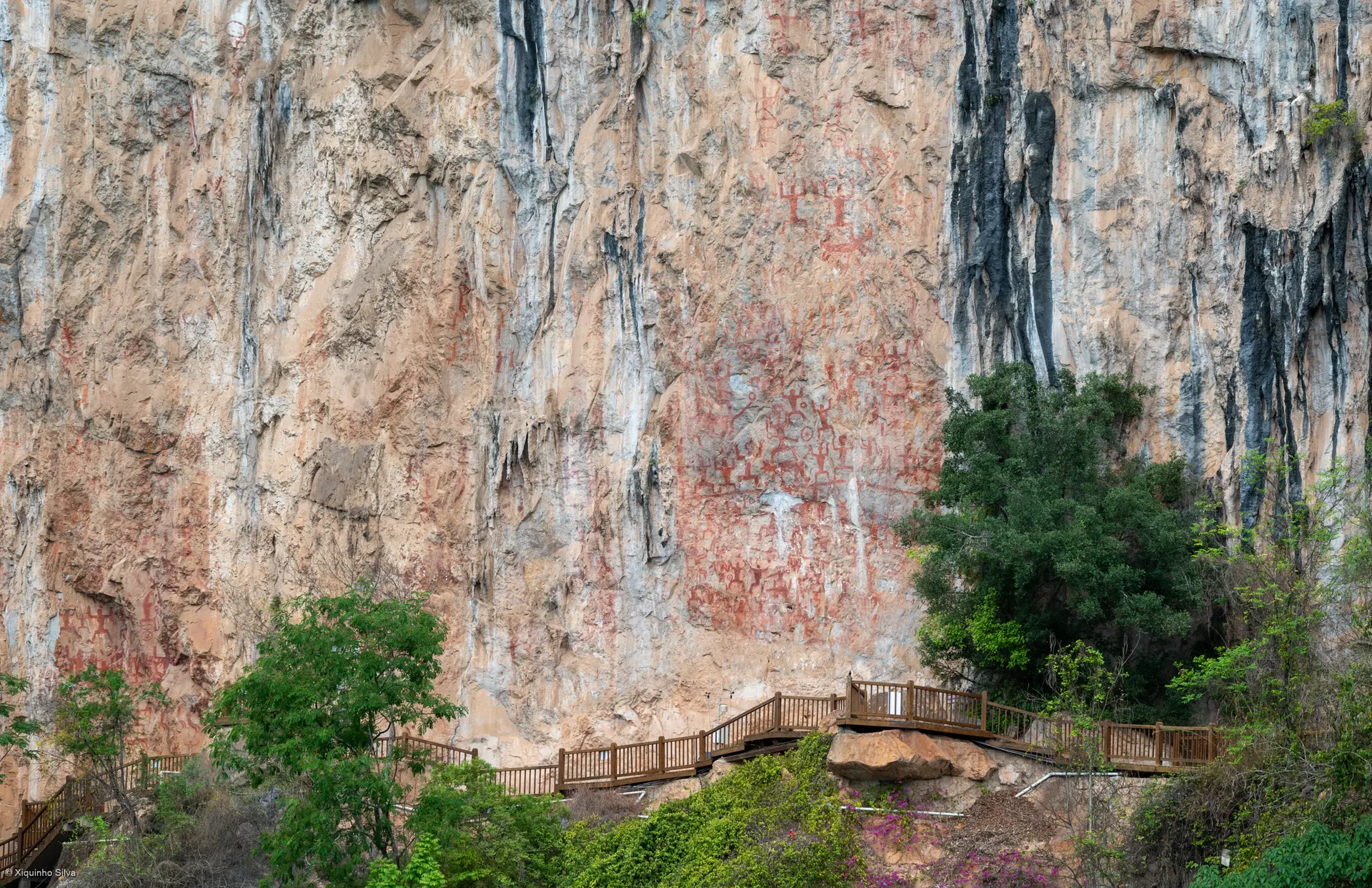
Image of Zuojiang Huashan Rock Art. Image source · CC-BY-2.0
Visit essentials
A quick read before you go
- Duration
- Half day for the boat tour and visitor center (approximately 2-3 hours for the tour).
- Etiquette
- The rock art is viewed entirely from boats and cannot be physically approached.
Overview
For roughly seven hundred years, southern China's Luoyue people climbed or were lowered down sheer limestone cliffs to paint ceremonies above flowing water. Red hematite pigment, likely mixed with animal blood or plant resin, formed a consistent vocabulary: raised-arm figures in the 'frog pose,' bronze drums, swords, dogs, boats, and stars.
Huashan's main panel at Ningming is the largest, 172 meters wide and 45 meters high, with over 1,800 figures. They range from 30 centimeters to 3.58 meters tall and all face the river.
The ceremonies remain uncertain. Scholars propose rain-making, harvest celebrations, military commemorations, or ancestor veneration. Archaeological finds identify the depicted bronze drums as Luoyue and Zhuang ritual objects of power associated with fertility, authority, and spirit-world communication. The splayed 'frog pose' may reference Southeast Asian associations between frogs and rain.
Location provides the strongest evidence of sacred purpose. No practical reason explains placing images at heights of 100 meters on vertical cliff faces. The effort required to reach these positions, the risk involved, and the river-facing orientation all suggest that painting was itself a ritual event and the cliff face a boundary between the visible world and something beyond it.
In 2016, Zuojiang Huashan became China's first rock-art UNESCO World Heritage Site, recognized for Luoyue cultural testimony and the integration of art, landscape, and ritual.
Why this place is sacred
Standing in a boat on the Ming River, looking up at the main Huashan panel, the visitor sees something unmistakable: human figures in postures of ceremony, celebration, or supplication, painted at a scale and in a location that required extraordinary commitment. The images are clear. Their meaning is not.
This gap between what can be seen and what can be known defines the encounter. The 'frog pose' figures, with their arms raised and legs spread, communicate something across two millennia. The gesture is legible as joy, or prayer, or ecstasy, but the specific context that gave it meaning, the words that accompanied it, the music that the depicted bronze drums produced, the beliefs that sustained seven hundred years of cliff-face painting, all of this is lost.
What remains is the evidence of devotion itself: the irreducible fact that generation after generation of Luoyue people considered this activity worth the extraordinary effort and risk it required.
The cliff face amplifies the encounter. The paintings exist at the interface of three elements: the vertical stone, the open sky, and the flowing river below. The Luoyue chose these locations with precision, placing their images where limestone overhangs provided natural protection from rain and where the river would carry their ceremonies' visual record past anyone traveling the waterway.
The river approach, still the only way to view the paintings, preserves the original encounter: the images reveal themselves gradually as the boat rounds a bend, emerging from landscape into visibility as if the act of arrival were part of the intended experience.
The red pigment's survival is its own form of testimony. Over two thousand years, the hematite has maintained its vivid color against the grey limestone, a visual insistence that reads as permanence in a world defined by erosion and loss. The paint outlasted the civilization that made it.
Created between the 5th century BCE and the 2nd century CE by the Luoyue people as part of communal ceremonial practice, likely integrating rain-making, agricultural fertility, military ritual, and ancestor veneration. The act of cliff-face painting was itself a ritual event.
The painting tradition ceased in the 2nd century CE, possibly due to Han dynasty acculturation and changing ritual practices. First Chinese textual references appear in the Song dynasty. Modern archaeological survey began in the 1950s. UNESCO World Heritage inscription in 2016 marked international recognition of the site's significance. The Zhuang people maintain cultural connections through bronze drum traditions, the frog dance, and seasonal festivals.
Experience and orientation
The boat departs from the visitor center and moves along the Ming River into a landscape of karst formations that defines this region of Guangxi. The river is calm, the limestone hills rise steeply from the water, and the initial impression is of natural beauty rather than archaeological significance.
Then the first painted figures appear. High on a cliff face, barely visible at first, the red images register as something other than natural rock coloring. The boat approaches, and the figures become legible: human forms with raised arms, geometric shapes that resolve into bronze drums, smaller figures that might be animals or attendants. The guide's narration provides context, but the visual impact is immediate and pre-verbal.
The main Huashan panel is the culmination. At 172 meters wide and 45 meters high, it fills the cliff face above the river with over 1,800 painted figures. From the boat, the eye moves across the panel trying to grasp the whole, then focuses on individual figures and their relationships. The largest human figure, at 3.58 meters, is visible from a distance. The smallest require binoculars or a telephoto lens.
The height of the paintings above the river, ranging from 15 to 130 meters, produces a physical sensation of looking up that mirrors what must have been required of those who created them: the dizzying awareness of vertical space between the water and the painted surface. How they reached these positions, whether by scaffold, rope, or methods now unknown, has not been definitively explained.
The return journey by boat provides a second encounter with the panels from a receding perspective, the figures shrinking back into the cliff face and returning to landscape. This arrival and departure, the paintings emerging and dissolving, feels like a complete experience rather than an interruption of a natural scene.
The surrounding karst landscape, with its formations rising from the river like a Chinese ink painting made three-dimensional, provides context that no museum could replicate. The rock art belongs to this river, these cliffs, this particular configuration of water and stone.
The boat tour departs from the visitor center near Ningming along the Ming River. Tours last approximately 2-3 hours with hourly departures. The main Huashan panel is the primary destination. The visitor center includes educational exhibits. Binoculars or a telephoto lens are recommended for seeing detail from the boat.
Context and lineage
Local Zhuang legends describe the rock art as created by ancestor spirits or culture heroes. One tradition holds that a great leader organized the ceremonies depicted to ensure the prosperity and protection of the Luoyue people. Another connects the paintings to celebrations of military victory, with the raised-arm figures dancing in triumph. The red color is associated with life force, blood, and the power to repel evil spirits.
Archaeological interpretation suggests the paintings depict communal ceremonies involving bronze drum music, group dance, and rituals connected to water, agriculture, or the ancestral spirit world.
The Luoyue rock art tradition belongs to the broader bronze drum culture of mainland Southeast Asia, which extended across southern China and northern Vietnam. The Zhuang people, at approximately 18 million the largest ethnic minority in China, maintain cultural continuity with the Luoyue through festivals, music, and folk traditions.
The Luoyue people
Tai-speaking ancestors of today's Zhuang who created the rock art over approximately 700 years
Zhuang communities
Living descendants of the Luoyue, maintaining cultural connections through bronze drum traditions, frog dance, and seasonal festivals
Modern archaeological teams
Researchers who began systematic documentation in the 1950s and continue to study the sites
Traditions and practice
Large communal ceremonies depicted in the rock art involved bronze drum music, group dance in the raised-arm 'frog pose,' weapons display, and rituals likely connected to water, agriculture, and ancestor veneration. The act of painting the cliff face was itself a ritual event requiring extraordinary physical effort and courage.
No direct continuation of the rock art ceremonial tradition exists. Zhuang cultural festivals incorporate bronze drum traditions and the frog dance that echo ancient practices. The Sanyuesan festival, on the 3rd day of the 3rd lunar month, includes community singing, dancing, and rice offerings that may preserve elements of ancient ritual. Conservation and educational programs operate at the site.
Take the boat tour slowly, allowing the paintings to emerge from the cliff face gradually rather than rushing to the main panel. Bring binoculars for detail work. At the main Huashan panel, spend time with individual figure groups rather than trying to absorb the entire 172-meter composition at once. Notice the 'frog pose' figures and consider what the gesture communicates to you across two millennia, before the guide explains the scholarly interpretations.
If timing permits, visit during the Zhuang Sanyuesan festival in April to experience living cultural traditions that echo the ancient practices depicted in the rock art.
Ancient Luoyue Ceremonial Tradition
HistoricalThe Luoyue created the rock art between the 5th century BCE and the 2nd century CE as part of communal ceremonies involving bronze drum music, dance, and rituals connected to water, agriculture, and the ancestral spirit world. The tradition's seven-century duration across 38 sites indicates a stable and deeply held practice.
Communal ceremonies with bronze drum music and group dance. The raised-arm 'frog pose' as a ritual gesture. Weapons display. River-oriented rituals. The act of cliff-face painting as ritual in itself.
Zhuang Cultural Heritage
ActiveThe Zhuang people maintain cultural continuity with the Luoyue through festivals, bronze drum traditions, the frog dance, and folk religion. The UNESCO inscription strengthened Zhuang cultural identity and pride.
Bronze drum music and performances. The frog dance (wa wu). The Sanyuesan festival with community singing, dancing, and offerings. Folk religious practices honoring ancestors and natural spirits.
Archaeological Conservation
ActiveSystematic documentation began in the 1950s, with UNESCO inscription in 2016 bringing international conservation standards. The site's natural protection (cliff-face locations accessible only by river) has been augmented by managed visitor access.
Archaeological survey and documentation. Pigment analysis. Environmental monitoring. Controlled boat-tour access to minimize impact. Educational programming.
Perspectives and open questions
The Zuojiang Huashan rock art invites interpretation as an archaeological treasure, as an ancestral heritage of the Zhuang people, and as evidence of spiritual practices whose specific meaning exists beyond the reach of modern understanding.
Scholarly perspective
Archaeologists recognize the rock art as one of the most significant sites in East Asia, documenting the ritual life of the Luoyue over seven centuries. UNESCO inscription cited its outstanding testimony to Luoyue/Zhuang cultural traditions and its integration of art, landscape, and ritual. Scholars debate whether the depicted ceremonies served rain-making, military, agricultural, or ancestral purposes, with most acknowledging multiple functions.
Living and traditional perspectives
For the Zhuang people, the rock art represents the visible legacy of their ancestors. The paintings are a source of ethnic pride and cultural identity. The UNESCO inscription was celebrated as international recognition of Zhuang heritage. Zhuang scholars emphasize connections between ancient ceremonial practices and surviving cultural traditions.
Alternative interpretations
The creation of paintings at heights of over 100 meters on sheer cliff faces has attracted attention from those interested in ancient engineering capabilities. The raised-arm 'frog pose' figures have been compared to similar motifs in rock art worldwide, prompting speculation about universal spiritual expressions.
Open questions
How the paintings were applied to sheer cliff faces at heights of up to 130 meters remains unexplained. Why the tradition ceased in the 2nd century CE is debated. The precise composition of the remarkably durable pigment has not been fully analyzed. Whether the paintings encode astronomical or calendrical information is unresolved.
Plan your visit
Access and arrival
Ningming has basic hotel and guesthouse options. Chongzuo offers more variety. Nanning, as the provincial capital, has the full range of accommodations and is the most comfortable base for a day trip.
Respectful visit
Comfortable outdoor clothing. Sun protection essential for the open-air boat tour. Rain gear advisable. Comfortable shoes for the visitor center and riverbank areas.
Permitted from boats and viewing areas. Telephoto lens recommended for detail. No flash needed (outdoor). Respect any posted restrictions. When photographing Zhuang community members, ask polite permission.
Not applicable at the rock art site. If visiting Zhuang community temples or cultural sites, follow local customs.
Do not attempt to approach or climb cliff faces | Stay on the boat during tours | Do not litter in the river or on riverbanks | Respect all conservation barriers | No climbing or touching rock art (not physically accessible)
The boat tour is in open air. Bring sun protection, as exposure can be intense on the water. Rain gear is advisable in the wet season. The rock art is strictly view-only from the boat. Do not attempt to approach the cliff faces by any means.
Current practical details
Address
62VQ+QPF, Ningming County, Chongzuo, Guangxi, China, 532501
Hours, fees, and access can change — verify on the official source before you travel. Practical details last checked Jun 2026.
Location
Map loads as you approach this section.
Pilgrim reflections
A portrait of encounter, not a score
Pilgrims describe what they felt, how present they could become, and whether the place would shape a journey. There are no stars and no ranking of traditions.
No reviewed reflections yet
The first pilgrims can help describe the character of being here.
Share a reflection
Available after an account-backed “Been there.” Every reflection is reviewed before publication.
Nearby sacred places
Explore other sacred places in the region. Proximity does not establish access or travel time; check each place’s guidance.


Share a photo
Help visitors recognize Zuojiang Huashan Rock Art. Every submission is reviewed before publication.