Wangdue Phodrang Dzong
A dzong built on a prophecy, destroyed by fire, and resurrected through collective devotion — impermanence made visible in stone
Understand sacred places, explore living traditions, and learn how to engage respectfully with Pilgrim Map.
Access has not been verified. Check current local guidance before planning a visit.
Dzonkhag Thromde, Wangdue Phodrang, Bhutan
Read the sources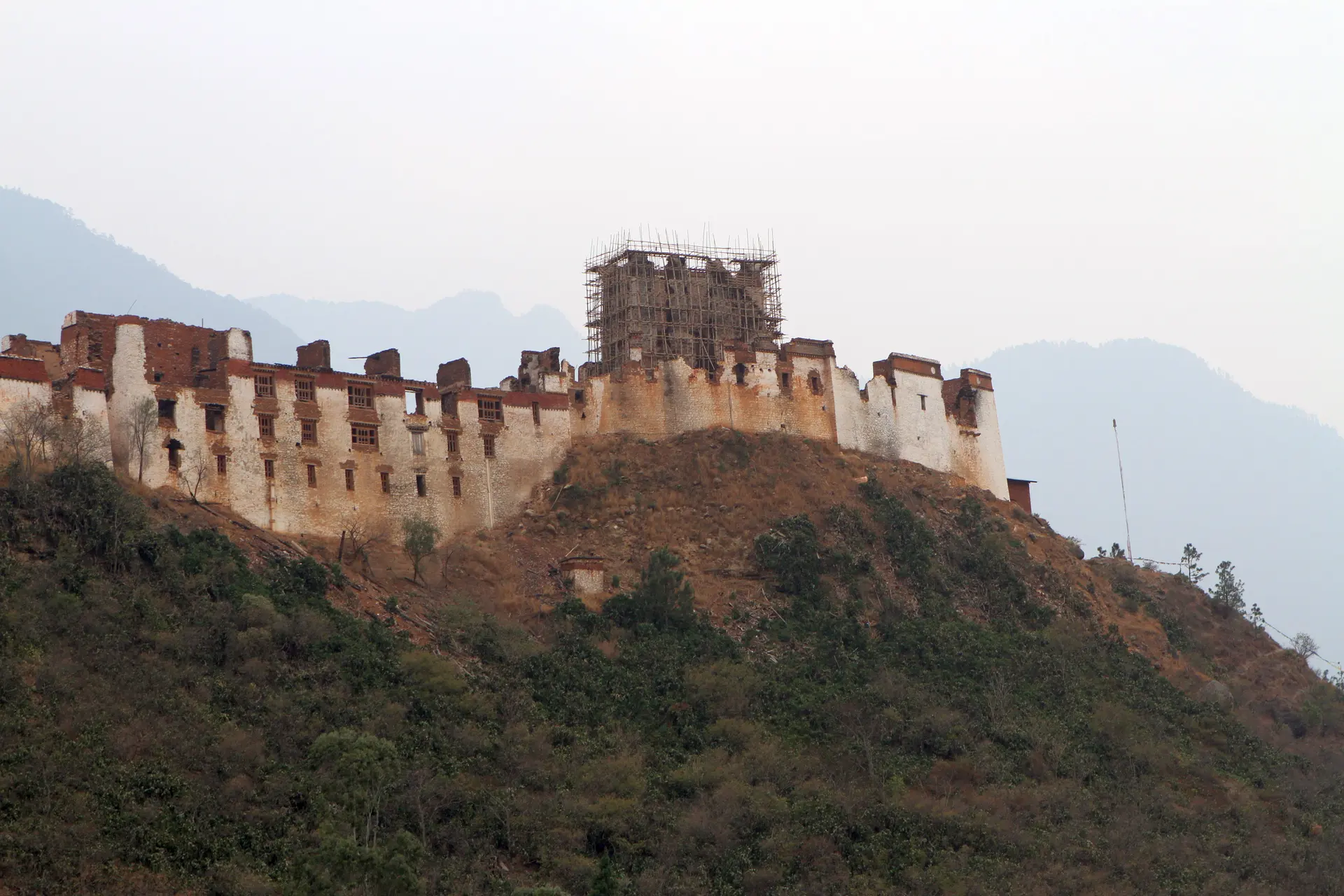
Image of Wangdue Phodrang Dzong. Image source · CC-BY-SA-4.0
Visit essentials
A quick read before you go
- Duration
- 1 to 2 hours.
- Access
- Approximately 70 km east of Thimphu (about 3 hours by road).
Overview
In the 12th century, Tshalpa Kagyu master Zhang Yudrakpa prophesied above the Puna Tsang Chhu valley that an emanation of the Glorious Naropa would build a palace promoting happiness in the southern valley on an elephant-trunk hill below, at two rivers' confluence. Five centuries later, Zhabdrung Ngawang Namgyal recognized the hill, tamed the local spirit Chudugang Tsan, and built the third of his great dzongs there in 1638.
For nearly four centuries, Wangdue Phodrang Dzong stood. It survived an 1837 fire and 1897 earthquake, but on June 24, 2012, an afternoon blaze attributed to a faulty electrical water cooker consumed it in daylight as the nation watched.
National grief brought a national response. His Majesty King Jigme Khesar Namgyel Wangchuck granted Nu 200 million; private donors, organizations, and foreign governments also contributed. Reconstruction began in January 2014 using traditional methods throughout. The King installed the central tower's golden pinnacle on May 29, 2018, and the dzong was consecrated on November 11, 2022.
In 2023, after more than a decade away, the annual Wangdue Phodrang Tshechu returned. Sacred dances filled a place ancient in form and new in material: the dzong summoned by prophecy and reduced by fire had risen again.
Why this place is sacred
Impermanence is the first teaching of Buddhism. It is one thing to hear this teaching. It is another to stand in a dzong that burned to the ground within living memory and has risen again from the ashes through the collective will of a nation.
The prophecy is eight hundred years old. Zhang Yudrakpa saw the elephant-trunk hill and spoke of what would come. The Zhabdrung arrived five centuries later and built. The fire came after four more centuries and unmade the building in a single afternoon. And then the rebuilding — traditional methods, royal command, communal devotion — restored what was lost in form if not in age.
The tamed spirit Chudugang Tsan, enlisted as protector deity in 1638, did not prevent the fire. This is not understood as failure. In the Vajrayana framework, protector deities do not promise permanence. They promise that what matters will survive. And what survived — most of the relics, saved because renovation work had already placed them in storage — suggests the tradition holds.
The newly rebuilt dzong carries a paradox: it is four hundred years old in design and less than a decade old in material. The whitewash is fresh. The wood smells new. But the proportions, the layout, the spiritual program are unchanged. What does this mean for a place? Is it the same dzong? The question itself is a teaching.
Built in 1638 by Zhabdrung Ngawang Namgyal, fulfilling a 12th-century prophecy, as the third of his great dzongs, to promote unified spiritual and temporal governance.
From 1638 construction through fire (1837), earthquake (1897), catastrophic fire (2012), and complete reconstruction (2014-2022). The 2023 return of the Tshechu marked the dzong's full functional restoration.
Experience and orientation
The dzong sits on its elephant-trunk hill above the valley, commanding the same view that Zhang Yudrakpa saw eight centuries ago. The whitewashed walls are white in a way that older dzongs are not — the newness is visible. This is not a deficiency. It is a fact that carries meaning.
Inside, the courtyards and temples follow the original layout. The architecture is traditional in every detail: no steel, no concrete, only wood and stone and earth and prayer. The golden pinnacle installed by the King in 2018 catches the light. The fourteen temples, including the Kunrey (monks' assembly hall), have been restored to function.
The absence of patina — the lack of the accumulated darkness that centuries of butter lamps and incense leave on walls — is itself an experience. You are standing in a place that was once four hundred years old and is now new. The Buddhist teaching of impermanence is not illustrated here. It is demonstrated.
Allow the newness to register. Do not mistake it for inauthenticity. The reconstruction used traditional methods and followed the original plan. The fresh whitewash and new wood are the marks of a community's devotion, not a departure from the dzong's identity. If attending the Tshechu, note that the sacred dances — returned after a decade of absence — carry a particular emotional charge in this space.
Context and lineage
Zhang Yudrakpa Tsondru Drakpa (1122-1193) prophesied that an emanation of Naropa would build a palace on an elephant-trunk hill at a river confluence. When Zhabdrung Ngawang Namgyal arrived at the site five centuries later, he recognized the hill, tamed the spirit Chudugang Tsan, and built the dzong in 1638.
Drukpa Kagyu through Zhabdrung Ngawang Namgyal. The prophecy connects the site to the broader Kagyu lineage through Zhang Yudrakpa and Naropa.
Zhang Yudrakpa Tsondru Drakpa
12th-century Tshalpa Kagyu master who prophesied the dzong's construction
Zhabdrung Ngawang Namgyal
Built the dzong in 1638, fulfilling the prophecy
King Jigme Khesar Namgyel Wangchuck
Commanded reconstruction and installed the golden pinnacle in 2018
Traditions and practice
The annual Wangdue Phodrang Tshechu with sacred cham dances, returned to the reconstructed dzong in 2023 after more than a decade of absence.
Monastic community and administrative center restored to full function. Daily rituals resume. The dzong serves as district headquarters.
Visit during the Tshechu to witness sacred dances performed in a space that has been reborn. The emotional resonance of the festival's return after a decade of absence adds a dimension that newer visitors should be aware of.
Drukpa Kagyu
ActiveThird dzong built by Zhabdrung Ngawang Namgyal, fulfilling a 12th-century prophecy. Destroyed by fire in 2012 and reconstructed through collective devotion by 2022.
Annual Tshechu, daily monastic rituals, administrative governance
Perspectives and open questions
Wangdue Phodrang Dzong invites reflection on prophecy, impermanence, and the relationship between a community and its sacred architecture.
Scholarly perspective
The reconstruction is studied as a case in traditional building methods applied to total reconstruction. The use of traditional techniques without modern structural materials is significant for heritage conservation globally.
Living and traditional perspectives
The destruction and rebuilding are understood within the Buddhist framework of impermanence and renewal. The fire did not end the dzong's identity; it revealed the community's attachment to it and generated the devotion necessary to rebuild. The return of the Tshechu completed the cycle.
Alternative interpretations
The elephant-trunk hill, the river confluence, the tamed spirit-protector, and the fulfilled prophecy create a site where landscape, time, and spiritual authority converge. The fire and reconstruction add a layer that resonates with the Buddhist teaching that nothing endures and yet nothing is truly lost.
Open questions
The degree to which the reconstructed interior matches the pre-fire layout in every detail is not fully documented in public sources. Whether all historical relics survived the fire remains uncertain despite official statements.
Plan your visit
Access and arrival
Approximately 70 km east of Thimphu (about 3 hours by road). The dzong sits on a hilltop overlooking the Puna Tsang Chhu valley. Located on the main road between Thimphu/Punakha and central/eastern Bhutan.
Hotels and guesthouses in Wangdue Phodrang town and nearby Bajo.
Respectful visit
Long sleeves, long trousers or skirts. No hats, sunglasses, shorts, or flip-flops.
Permitted in courtyards and exterior. Prohibited inside temples.
Butter lamp offerings possible.
Shoes removed in temples | Clockwise movement | Quiet behavior | Respect newly restored sacred spaces
The reconstruction is recent and some areas may have ongoing maintenance work. Check locally for any access restrictions.
Current practical details
Address
FVFW+QP9, Bhutan
Phone
Hours, fees, and access can change — verify on the official source before you travel. Practical details last checked Jun 2026.
Location
Map loads as you approach this section.
Pilgrim reflections
A portrait of encounter, not a score
Pilgrims describe what they felt, how present they could become, and whether the place would shape a journey. There are no stars and no ranking of traditions.
No reviewed reflections yet
The first pilgrims can help describe the character of being here.
Share a reflection
Available after an account-backed “Been there.” Every reflection is reviewed before publication.
Nearby sacred places
Explore other sacred places in the region. Proximity does not establish access or travel time; check each place’s guidance.


References
Sources consulted for this page. Source categories describe the publication, not a guarantee that every claim is verified. Traditional accounts and outside interpretations may differ.
- 01Wangdue Phodrang - Wikipedia — VariousencyclopediaHistory, fire, reconstruction
- 02Wangduephodrang Dzong Reconstruction Project — Government of BhutanSource contextOfficial reconstruction details
- 03Wangdue Phodrang Dzong - Bhutan Pilgrimage — Bhutan PilgrimageguideSpiritual significance and prophecy
- 04UNESCO World Heritage Centre - Tentative List — UNESCOSource contextUNESCO tentative listing
- 05Wangdue Phodrang Tshechu returns to newly reconstructed Dzong — BBSnews2023 reopening for tshechu
- 06Wangdue Phodrang Dzong - Treasury of Lives — Treasury of LivesacademicScholarly institution profile
Share a photo
Help visitors recognize Wangdue Phodrang Dzong. Every submission is reviewed before publication.