Ughtasar Petroglyphs, Armenia
Thousands of stone carvings on an extinct volcano, accessible only in summer, spanning millennia of highland devotion
Understand sacred places, explore living traditions, and learn how to engage respectfully with Pilgrim Map.
Access has not been verified. Check current local guidance before planning a visit.
Syunik, Armenia
Read the sourcesVisit essentials
A quick read before you go
- Duration
- Full day including travel from Sisian (1.5-2 hours each way by 4x4, plus 3-4 hours minimum on…
- Access
- Located 30 km from Sisian in Syunik Province.
Overview
Mount Ughtasar rises above Sisian in Armenia's southern highlands, where volcanic stones spread from an extinct volcano's caldera to its foot. More than two thousand fragments bear images ranging from the possible Paleolithic—perhaps twelve thousand years ago—through the Bronze and Iron Ages.
Goats dominate. Wild ibex with exaggerated curving horns appear so often that the tradition is locally called itsagir, 'goat letters.' Ancient Armenian used 'dig' for goat and 'diq' for gods. Whether this linguistic proximity reflects a conceptual link between animal and divine remains an unanswered interpretive question.
Hunting scenes, people, geometric patterns, spirals, circles, and forms some researchers identify as zodiac signs join the goats. These carvings were made at extreme altitude, accessible only during brief summer months, by people carrying tools and intentions into terrain with no shelter, permanent water, or fertile ground. Such commitment suggests purpose beyond documentation: people came here to mark something ordinary ground could not hold.
Why this place is sacred
What makes Ughtasar thin is not a building, a text, or a tradition that has been transmitted through generations. It is the sheer improbability of the carvings' location. Above three thousand metres, on the slopes of a dead volcano, in a landscape covered by snow for most of the year, someone carved a goat into a rock.
And then, over centuries or millennia, others came and carved more goats, more hunters, more spirals and circles, on the same stones and neighbouring ones.
The remoteness is not incidental. These were not casual marks made by passing shepherds with idle hands. The stones are volcanic basalt — hard, resistant, requiring sustained effort to incise. The altitude ensures that the carvers came here only during the narrow window of summer access, when the snow retreated enough to reveal the stones. They brought their tools, their intentions, and their images up the mountain and left them there, accumulating over what may be ten thousand years.
The result is a landscape that reads as a library whose language has been partially lost. The goats with their exaggerated horns are legible as animals but also as something more — symbols, perhaps, or letters in a writing system that used images instead of characters. The spirals and circles resist any reading. They simply persist, cut into volcanic stone at an altitude where human presence is brief and seasonal, marking something that mattered enough to justify the climb.
The site likely served as a seasonal gathering place for nomadic cattle-herding tribes during summer pasturing periods. The petroglyphs may represent a combination of ritual expression, territorial marking, astronomical observation, and communication across generations.
The petroglyphs accumulated across millennia as successive groups of nomadic peoples added their own carvings to the stones. The practice eventually ceased, and the site became an archaeological curiosity known to scholars and a challenging destination for determined travellers.
Experience and orientation
The journey is part of the experience and cannot be separated from it. From Sisian, a 4x4 vehicle climbs a 17-kilometre track from Ishkhanasar village, ascending 1,500 metres over terrain that tests vehicle and nerve alike. The drive takes one and a half to two hours. There is no road in any conventional sense for most of the route.
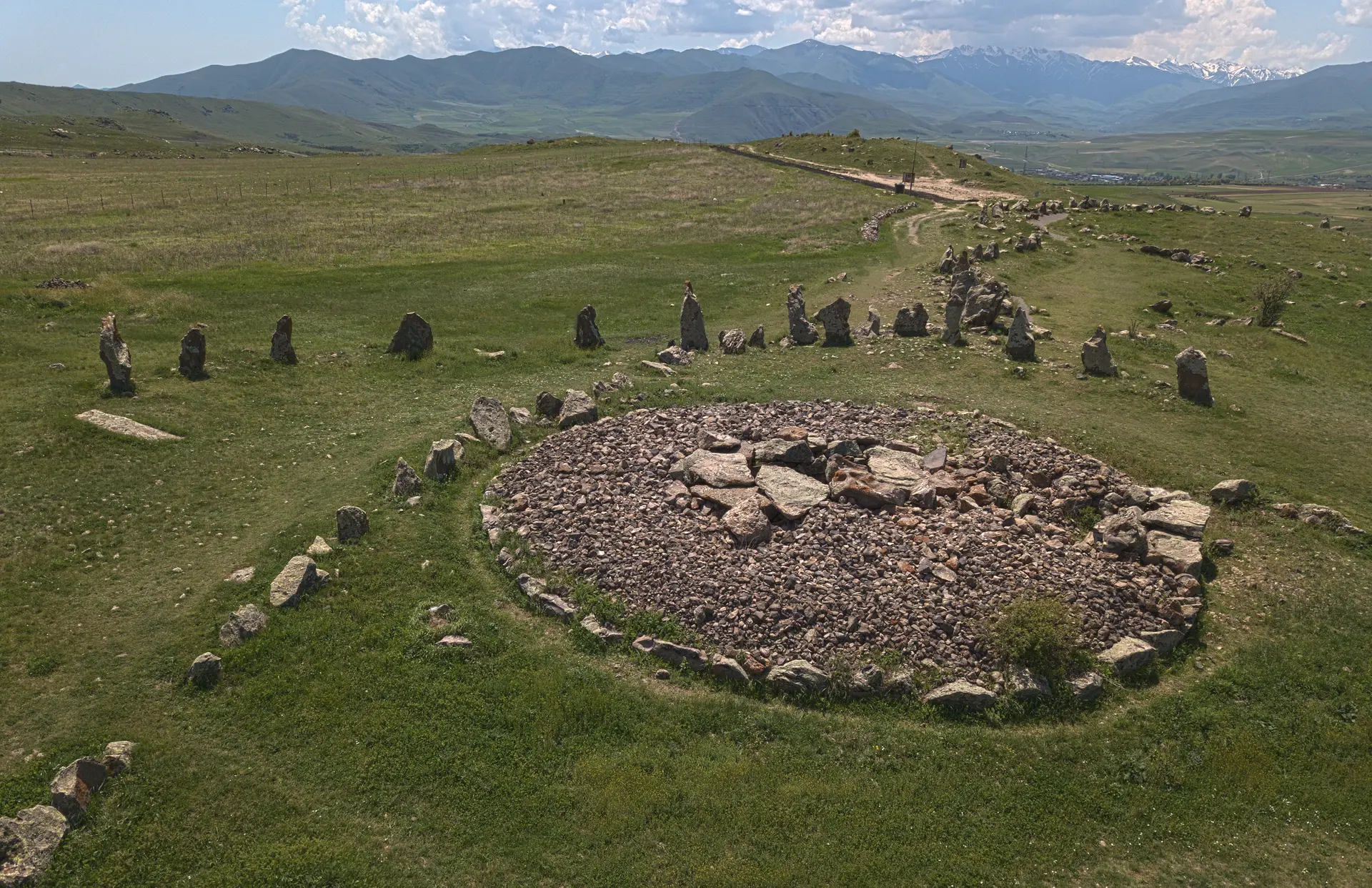
Arrival is not announced by a sign or a gate. The petroglyphs begin appearing on stones scattered across the volcanic landscape — some embedded in the ground, others perched on slopes, a few standing like markers in the wild grass. In July, when the snow has recently retreated, the slopes blaze with wildflowers of improbable colour, creating a contrast with the dark stone that no one planned.
The carvings require attention. They are not bold or immediately visible on every stone. Many reveal themselves only when light falls at the right angle — morning and late afternoon are best, when shadows fill the incised lines. A goat emerges from what looked like weathered stone. Then another. Then a hunting scene, a spiral, a figure that might be human or might be something else. The process of finding and reading the carvings is slow, intimate, and cumulative.
There is no infrastructure. No interpretive panels, no fences, no buildings. The stones sit in the landscape as they have for thousands of years, and the visitor stands among them with nothing between body and carved surface except air and time.
Allow a full day for the journey from Sisian and back. Bring food, water, warm clothing, and rain gear regardless of the forecast — weather at this altitude changes rapidly. Begin with the densest cluster of carvings near the caldera and work outward. Use low-angle light (morning or late afternoon) to make the incised lines visible. Sit with individual stones rather than trying to survey the entire site quickly.
Context and lineage
No origin narrative survives. The name Ughtasar has been speculatively linked to the Armenian word for pilgrimage (ughtagnatsutiun), suggesting the mountain was understood as a destination — a place one travels to deliberately. The petroglyphs themselves constitute the only record of their makers' presence and purposes.
No continuous lineage connects the petroglyph makers to any present-day community. The carvings are evidence of a practice that lasted millennia and then ceased. What remains is the stone record and the mountain.
Hamlet Martirosyan
Researcher who proposed that the petroglyphs represent a writing system ('goat writing' or 'itsagir'), noting the linguistic connection between 'dig' (goat) and 'diq' (gods) in ancient Armenian
Traditions and practice
The act of petroglyph carving itself appears to have been the primary practice — a seasonal ritual of ascending the mountain and leaving marks on stone that accumulated across generations. The predominance of hunting scenes and animal imagery suggests practices related to the hunt, to herd animals, and to the relationship between human communities and the wild.
The site is visited by archaeologists, hikers, and cultural tourists. No organised spiritual or religious practices take place.
Treat the visit as a pilgrimage of attention. The carvings do not announce themselves; they require the slow, close looking that the site's remoteness naturally encourages. Spending time with individual stones, tracing the images with eyes rather than hands, creates an encounter that approximates the patience of the original carvers.
Prehistoric highland ritual practices
HistoricalThe petroglyphs represent millennia of seasonal engagement with a high-altitude volcanic landscape by nomadic and semi-nomadic peoples. The consistency of the goat motif across time periods suggests a shared symbolic vocabulary that persisted across generations and cultural changes.
Seasonal ascent to the mountain for petroglyph carving, possible astronomical observation, hunting rituals, and communal gathering during summer pasturing periods.
Perspectives and open questions
Ughtasar invites interpretation but resists conclusion. The carvings are clearly intentional, clearly ancient, and clearly significant to their makers — but the meaning they held is not fully recoverable.
Scholarly perspective
The Ughtasar Rock Art Project has conducted systematic documentation and dating of the petroglyphs. Most scholars agree the main concentration dates from the Chalcolithic, Bronze Age, and Iron Age, with ceramic finds providing supporting chronology. The 'goat letters' motif is consistent across Armenian rock art traditions and represents one of the most extensive high-altitude rock art complexes in the Caucasus.
Hamlet Martirosyan's theory that the petroglyphs constitute a writing system remains controversial but has generated productive scholarly debate about the boundary between image and text.
Living and traditional perspectives
No living tradition maintains a connection to the site's original users. Local awareness of the petroglyphs is mixed — some residents of Sisian know the site well, others are unaware of it. The name Ughtasar itself, if connected to 'pilgrimage,' preserves a folk memory of the mountain as a destination requiring intentional journey.
Alternative interpretations
The high-altitude location, the possible astronomical imagery, and the goat-god linguistic connection have drawn interest from those who see ancient mountain sites as nodes in a global network of sacred landscapes. The volcanic origin of the stones — shaped by eruption, then by human hands — has been read as a metaphor for creation itself.
Open questions
The meaning of the geometric patterns and spirals remains genuinely uncertain. The relationship between the goat imagery and possible theomorphic belief systems is suggestive but unproven. Whether the site's name preserves a memory of pilgrimage or is a later folk etymology cannot be determined. The deepest question — why people climbed to this altitude to carve on stone for thousands of years — has no definitive answer.
Plan your visit
Access and arrival
Located 30 km from Sisian in Syunik Province. The 17 km track from Ishkhanasar village requires a serious 4x4 with high clearance. Local drivers in Sisian can be hired for approximately 25,000 AMD (about $70) for up to 4 passengers. CRITICAL: Since the 2020 Karabakh war, this area may be off-limits due to border proximity with Azerbaijan. Inquire at hotels in Sisian for current conditions before planning a visit.
Accommodation in Sisian town only. No facilities whatsoever at the site. Bring food, water, warm clothing, and basic emergency supplies.
Respectful visit
Mountain hiking gear: sturdy boots, warm layers, waterproof jacket. The altitude and exposure make proper equipment essential, not optional.
Photography strongly encouraged — use low-angle light to reveal the incised lines. Do not use chalk or other materials to enhance carvings for photography.
None traditional.
Do not touch, trace, or make rubbings of the petroglyphs | Do not move, stack, or rearrange stones | Carry out all waste — no facilities exist | Verify border security situation in Sisian before attempting the journey | A serious 4x4 vehicle is mandatory — do not attempt in a standard car
The site is remote, at extreme altitude, and without any facilities. Weather changes rapidly. The security situation near the Azerbaijan border must be verified locally in Sisian before attempting the journey, as access may be restricted following the 2020 Karabakh war.
Current practical details
Address
Ughtasar Lake, Armenia
Hours, fees, and access can change — verify on the official source before you travel. Practical details last checked Jun 2026.
Location
Map loads as you approach this section.
Pilgrim reflections
A portrait of encounter, not a score
Pilgrims describe what they felt, how present they could become, and whether the place would shape a journey. There are no stars and no ranking of traditions.
No reviewed reflections yet
The first pilgrims can help describe the character of being here.
Share a reflection
Available after an account-backed “Been there.” Every reflection is reviewed before publication.
Nearby sacred places
Explore other sacred places in the region. Proximity does not establish access or travel time; check each place’s guidance.


References
Sources consulted for this page. Source categories describe the publication, not a guarantee that every claim is verified. Traditional accounts and outside interpretations may differ.
- 01Ughtasar Rock Art Project — Ughtasar Rock Art ProjectacademicDedicated research project with dating and classification data
- 02Ughtasar Petroglyphs - Wikipedia — Wikipedia contributorsencyclopediaBasic overview of the site and its petroglyphs
- 03Off the Beaten Path: The Ughtasar Petroglyphs - Armenian Weekly — Armenian WeeklyacademicCultural journalism about the site's significance
- 04Exploring Mount Ughtasar Petroglyphs - Ecokayan — Ecokayan Dilijan ResortguideVisitor guide with practical access information
- 05Petroglyphs of Ughtasar - Rock Paintings Armenia — Hatis.amofficialArmenian heritage portal with petroglyph descriptions
- 06Mount Ughtasar - Dangerous Roads — Dangerous RoadsguideRoad condition and access information
Share a photo
Help visitors recognize Ughtasar Petroglyphs, Armenia. Every submission is reviewed before publication.