Simtokha Dzong
The oldest dzong in Bhutan, built on the stomach of a subdued demoness, where the idea of unified spiritual-temporal governance was born
Understand sacred places, explore living traditions, and learn how to engage respectfully with Pilgrim Map.
Access has not been verified. Check current local guidance before planning a visit.
Thimphu, Thimphu, Bhutan
Read the sources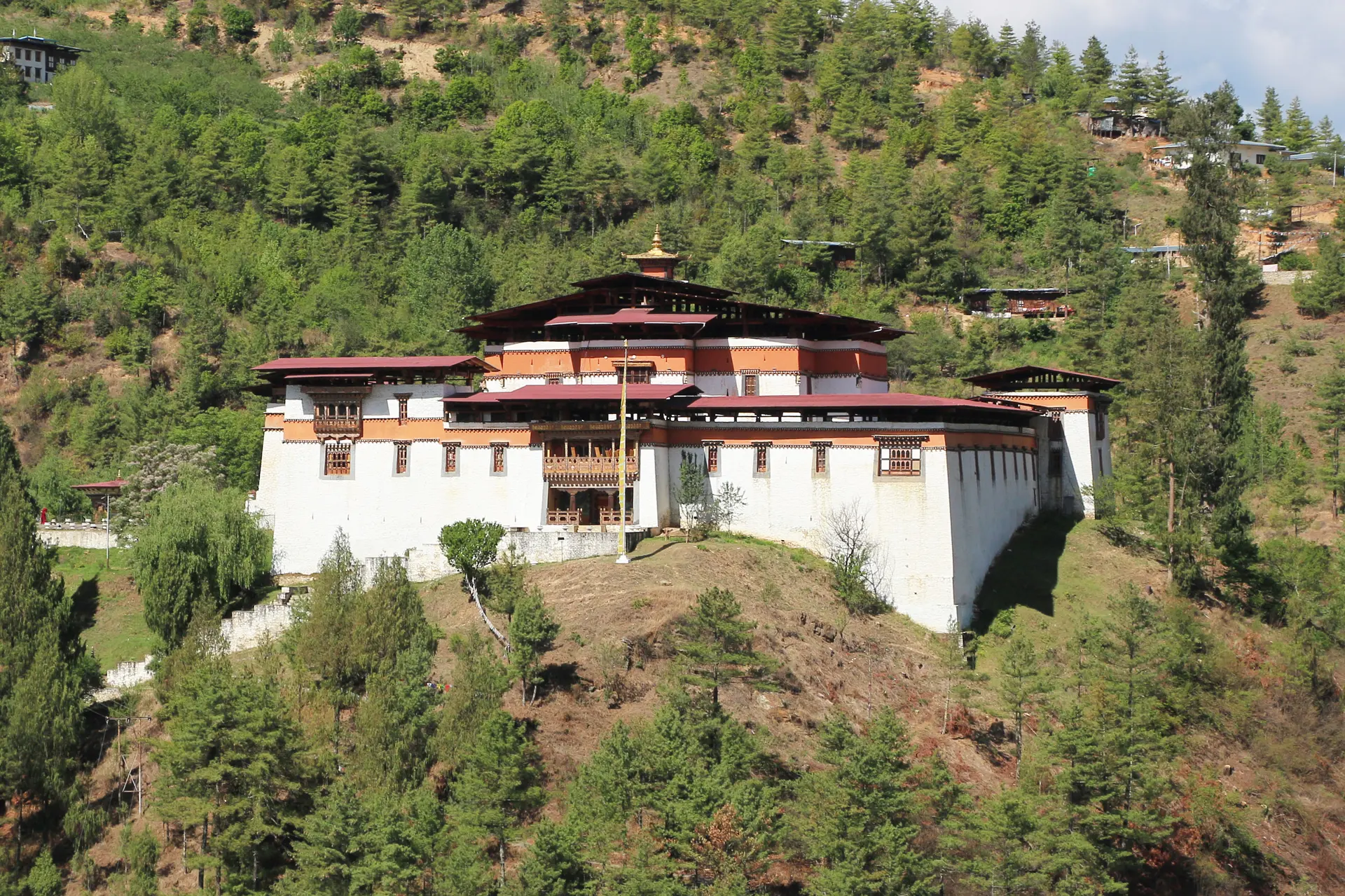
Image of Simtokha Dzong. Image source · CC-BY-SA-4.0
Visit essentials
A quick read before you go
- Duration
- 45 minutes to 1 hour.
- Access
- Located approximately 5 km south of Thimphu on the road to Paro and Punakha.
Overview
Before Bhutan's great dzongs at Punakha and Trongsa stood Simtokha, built in 1629 by Zhabdrung Ngawang Namgyal on a hilltop five kilometres south of Thimphu. Modest but foundational, it was the first structure to combine monastery and administrative center, creating the dual-function model that shaped Bhutanese governance and sacred architecture for four centuries.
Tradition says a demoness, or sinmo, haunted the hill and harmed travellers stopping overnight. The Zhabdrung subdued her, banished her into a rock, and built the dzong around it for permanent containment. Simtokha derives from sinmo (demon), do (stomach), and kha (on): the dzong on the demon's stomach.
A large Sakyamuni Buddha flanked by eight bodhisattvas fills the main chapel. Chapels for Mahakala and Pelden Lhamo, Bhutan's protector deities, anchor the spiritual program. Behind courtyard prayer wheels, more than three hundred slate carvings installed in 1671 depict Buddhist saints, philosophers, Maha Siddhas, manifestations of Tara, and forms of Guru Rinpoche. The dzong now houses one of Bhutan's premier Dzongkha-language institutes, continuing its transmission of Bhutanese cultural foundations.
Why this place is sacred
The Vajrayana Buddhist approach to harmful forces is not destruction but transformation. The demoness beneath Simtokha Dzong was not killed; she was subdued and enclosed. Her energy was redirected — contained within rock, sealed beneath a building that became the blueprint for an entire civilization's sacred architecture. The dzong does not deny what lies beneath it. It holds it.
This is a place of firsts: the first merging of monastery and government, the first expression of the Zhabdrung's vision for Bhutan as a unified state under spiritual authority. What began here would be replicated at Punakha, at Trongsa, at Paro, at Wangdue Phodrang — across the kingdom. Standing in Simtokha's courtyard, you are standing at the origin point.
The three hundred slate carvings installed around the courtyard in 1671 make the philosophical program visible and tangible. Twenty-one forms of Tara, eight manifestations of Guru Rinpoche, eighty Maha Siddhas, bodhisattvas, and philosophers — an entire Buddhist cosmos rendered in stone and arranged around a circuit of prayer wheels. Walking this circuit is not metaphorical study. It is passage through a carved library.
Built in 1629 as the first dzong — the first Bhutanese structure combining monastic and administrative functions — and as a means of subduing and containing a demoness who haunted the hill.
From military and administrative origin to educational institution. In 1961, the Third King established the Buddhist School of Linguistics here. Today it houses one of Bhutan's premier Dzongkha language institutes, making it a place where the foundations of Bhutanese cultural identity continue to be transmitted.
Experience and orientation
Arriving at Simtokha, you notice the scale first. This is not the overwhelming mass of Trongsa or the river-straddling grandeur of Punakha. The dzong is compact, perched on its hilltop, with the intimacy of a beginning rather than a culmination. The exterior walls at ground level are lined with prayer wheels, and behind each section of wheels stand the slate carvings — hundreds of carved figures in stone, faces worn by weather and centuries but still distinct.
Inside, the courtyard is quiet. Students from the Dzongkha institute may be moving between classes. The sound of recitation — whether prayer or language study — may reach you from within the buildings. The main chapel, with its Sakyamuni Buddha and flanking bodhisattvas, has the solidity of a space that has been prayed in, continuously, for nearly four hundred years.
The protector deity chapels — Mahakala and Pelden Lhamo — carry a different weight. These are the guardians of Bhutan itself, and their presence here, at the first dzong, is not incidental. It is foundational.
Walk the prayer wheel circuit slowly, giving attention to the slate carvings behind the wheels. The variety is remarkable: Tara in twenty-one forms, Guru Rinpoche in eight manifestations, eighty Maha Siddhas. Let the circuit be a meditation. Then enter the courtyard and visit the chapels. The scale invites lingering rather than rushing.
Context and lineage
A demoness haunted the hill, harming travellers who stopped overnight. Zhabdrung Ngawang Namgyal subdued her and banished her into the rock. The dzong was built enclosing the rock, trapping the demon beneath. The name derives from sinmo (demon), do (stomach), kha (on) — the building that sits on the demon's stomach.
Simtokha belongs to the Drukpa Kagyu lineage, established in Bhutan by Zhabdrung Ngawang Namgyal. As the first dzong, it represents the origin point of the entire Bhutanese dzong system.
Zhabdrung Ngawang Namgyal
Built the first dzong in 1629, subduing the demoness and establishing the model for all subsequent dzongs
Chogyal Minjur Tenpa
3rd Desi of Bhutan, who installed the 300 slate carvings in 1671
Jigme Dorji Wangchuck
Third King of Bhutan, who established the Buddhist School of Linguistics here in 1961
Traditions and practice
Worship at the chapels of Sakyamuni Buddha, Mahakala (Yeshe Goennpo), and Pelden Lhamo continues. The prayer wheel circuit with the three hundred slate carvings offers a walking meditation through Buddhist iconography.
The Dzongkha language institute, established by the Third King in 1961, trains students in the national language. This educational function carries forward the dzong's identity as a place where Bhutanese cultural foundations are laid.
Walk the prayer wheel circuit with attention to the carved figures. Visit the main chapel and protector deity chapels. If the educational institution is in session, observe from a respectful distance the ongoing transmission of Bhutanese language and culture.
Drukpa Kagyu
ActiveFirst dzong in Bhutan and the prototype for all subsequent dzongs. Houses chapels dedicated to Sakyamuni, Mahakala, and Pelden Lhamo.
Chapel worship, prayer wheel circumambulation past 300 slate carvings, Dzongkha language education
Perspectives and open questions
Simtokha Dzong can be understood as architectural prototype, as an act of spiritual containment, and as the birthplace of a governing philosophy.
Scholarly perspective
Scholars identify Simtokha as the foundational structure of the Bhutanese dzong system. Its dual-function design — monastic and administrative — became the template for all subsequent dzongs and for the Bhutanese state itself.
Living and traditional perspectives
In the Vajrayana Buddhist tradition, the subduing of the demoness represents the transformation of harmful energy rather than its destruction. The demon is not eliminated but contained and, in a sense, put to use — her imprisonment generates the very ground on which the dzong stands. This principle of transformation, rather than opposition, is central to Vajrayana practice.
Alternative interpretations
The idea of building sacred architecture on the body of a subdued spirit echoes broader Himalayan traditions of landscape consecration, in which the earth is understood as a living being whose energies must be harmonized before human habitation. The dzong does not merely occupy the hill; it transforms it.
Open questions
The full iconographic program of the three hundred slate carvings has not been comprehensively catalogued in publicly available sources. Some carvings are heavily weathered and their subjects may no longer be identifiable.
Plan your visit
Access and arrival
Located approximately 5 km south of Thimphu on the road to Paro and Punakha. Easy to visit as a stop when travelling between destinations. No significant physical challenges beyond the hilltop location.
Hotels and guesthouses in Thimphu, 5 km north.
Respectful visit
Long sleeves, long trousers or skirts. No hats, sunglasses, shorts, or flip-flops.
Permitted in exterior and courtyard areas. Prohibited inside chapels. Do not photograph students without permission.
Butter lamp offerings possible in the chapels.
Shoes removed in chapels | Clockwise movement | Quiet behavior | Respect educational activities and students
The dzong functions primarily as an educational institution. Respect class schedules and student privacy. Some areas may be restricted during academic sessions.
Current practical details
Address
846 Je Bamo Lam SE, Tshatshobaykha, Bhutan
Phone
Hours
Hours, fees, and access can change — verify on the official source before you travel. Practical details last checked Jun 2026.
Location
Map loads as you approach this section.
Pilgrim reflections
A portrait of encounter, not a score
Pilgrims describe what they felt, how present they could become, and whether the place would shape a journey. There are no stars and no ranking of traditions.
No reviewed reflections yet
The first pilgrims can help describe the character of being here.
Share a reflection
Available after an account-backed “Been there.” Every reflection is reviewed before publication.
Nearby sacred places
Explore other sacred places in the region. Proximity does not establish access or travel time; check each place’s guidance.

References
Sources consulted for this page. Source categories describe the publication, not a guarantee that every claim is verified. Traditional accounts and outside interpretations may differ.
- 01Simtokha Dzong - Wikipedia — VariousencyclopediaComprehensive history and architecture
- 02Simtokha Dzong the Oldest in Bhutan - Tour Bhutan — Tour BhutanguideHistory and demon legend
- 03Simtokha Dzong - Druk Asia — Druk AsiaguideVisitor overview
- 04Bhutan's First Dzong - Orog Travel — Orog TravelguideEtymology and legend
- 05Lonely Planet - Simtokha Dzong — Lonely PlanetguideVisitor guide
- 06Breathe Bhutan - Etiquette — Breathe BhutanguideVisitor etiquette
Photo gallery
3 curated photos
Share a photo
Help visitors recognize Simtokha Dzong. Every submission is reviewed before publication.