Shri Amarnath Shiva Cave, Kashmir
A self-manifested ice lingam at 3,888 metres, reached only in a narrow summer window
Understand sacred places, explore living traditions, and learn how to engage respectfully with Pilgrim Map.
Access has not been verified. Check current local guidance before planning a visit.
Pahalgam, Jammu and Kashmir, India
Read the sources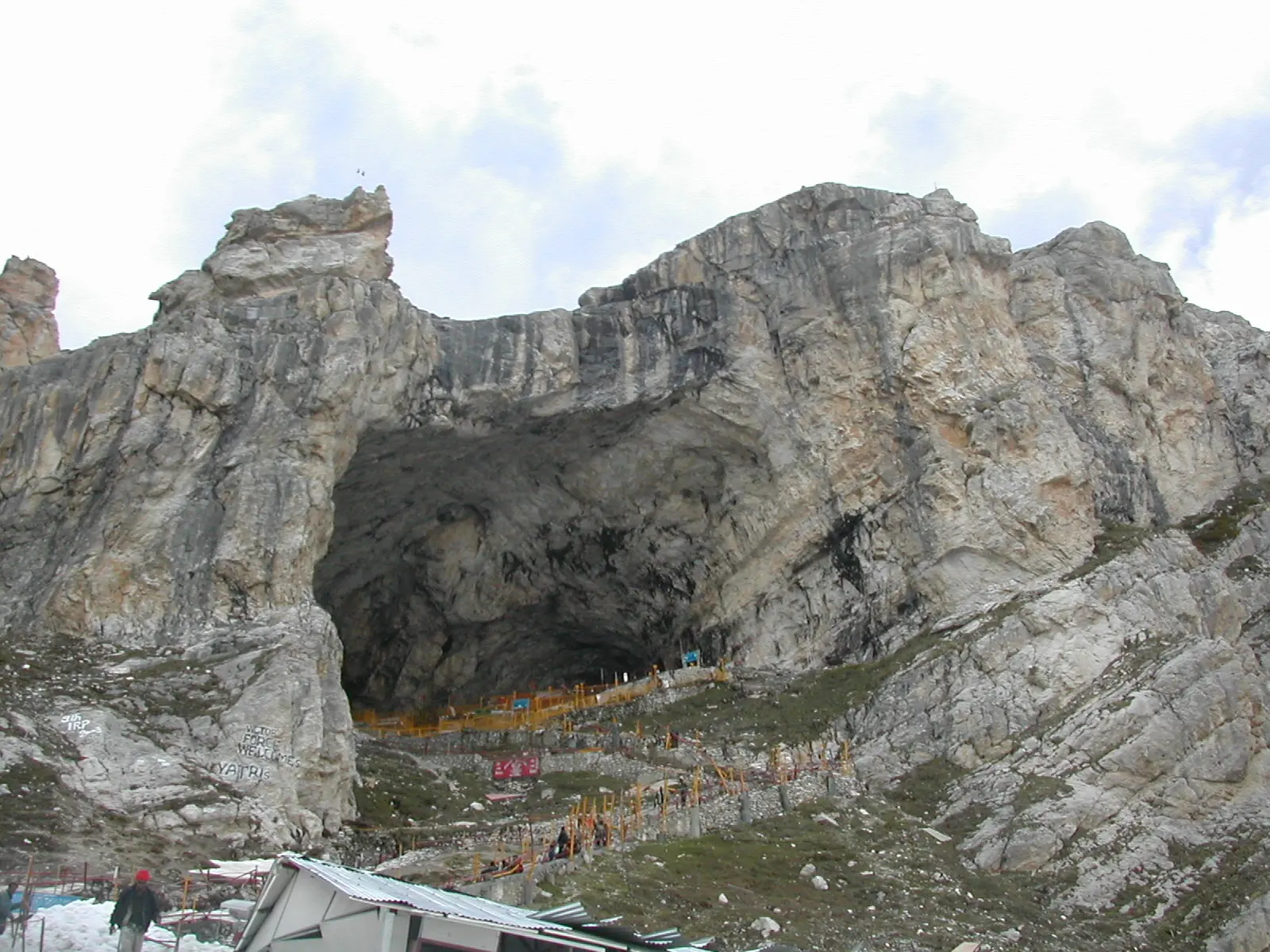
Image of Shri Amarnath Shiva Cave, Kashmir. Image source · Public Domain
Visit essentials
A quick read before you go
- Duration
- Pahalgam route: 3 to 5 days round trip.
- Access
- Pahalgam is reached from Srinagar (~95 km); Baltal is roughly 100 km from Srinagar.
Overview
At 3,888 metres in a limestone cave in Anantnag district's Himalayan range, Shri Amarnath centers on a naturally forming ice lingam regarded in Hindu tradition as svayambhu, self-manifested. Water seeping through the roof freezes into a column that grows and recedes with the lunar cycle, fullest around Shravan Purnima in late July or August.
Tradition venerates the cave as the exact place where Shiva revealed the Amar Katha, the secret of immortality, to Parvati. Beforehand he left Nandi at Pahalgam, the moon at Chandanwari, snakes at Sheshnag, Ganesha at Mahagunas Top, and the five elements at Panchtarni; the modern yatra stages retain this mythic geography.
The Nilamata Purana referenced the cave around the sixth century, followed by Kalhana's twelfth-century Rajatarangini. The modern pilgrimage gained its scale after Muslim shepherd Buta Malik's 1850 rediscovery.
The Shri Amarnathji Shrine Board (SASB), a statutory J&K government body, administers the yatra, which is open for only roughly two months yearly; in 2026 it runs 3 July–9 August. Reaching the cave is itself ritualized austerity, and many pilgrims call the journey their life's spiritual high point.
Why this place is sacred
Amarnath's quality of thinness rests on a rare convergence. The first element is the form of the deity itself: rather than a fixed image, the lingam is a seasonal event, growing and dissolving on a cycle that pilgrims read as Shiva's living presence.
The second is altitude — at 3,888 metres the air is thin, the cold is sharp even in midsummer, and many yatris experience headaches, breathlessness, or mild altitude sickness that is itself folded into the practice as tapasya. The third is the route. Every named station along the Pahalgam approach maps directly onto the mythology of Shiva's journey with Parvati, so that the walk is a recapitulation of the divine narrative rather than a logistical preliminary to it.
The fourth is silence: above Chandanwari mobile coverage drops out, and the high glacial valleys reset the visitor's acoustic environment to wind, breath, and footstep. Pilgrims commonly report that the first sight of the lingam, after days of approach, is the moment when the journey resolves.
A natural limestone cave whose seasonally forming ice column has been venerated as a self-manifested form of Shiva since at least the early medieval period.
Textual references in the Nilamata Purana (~6th c.) and Rajatarangini (~12th c.) establish the cave as a known Shaiva tirtha well before its 1850 'rediscovery' by Buta Malik. The modern yatra under SASB administration dates from 2000, when the Board was established by the J&K government to regulate access and logistics.
Experience and orientation
Two routes lead to the cave. The traditional Pahalgam route covers roughly forty-five kilometres over three to five days, climbing through Chandanwari, Sheshnag, Mahagunas Top, and Panchtarni — each named station echoing the mythology. The Baltal route is shorter (about fourteen kilometres) but steeper, typically done in one to two days. A helicopter service from Neelgrath to Panjtarni cuts the trek to a single day for those unable to walk.
Whichever route, the final approach to the cave is on foot. Inside, the ice lingam stands at the back of a broad chamber, with darshan organised by SASB personnel into a continuous queue. The chamber is cold, dim, and quiet. Many pilgrims describe a profound silence at the moment of darshan; the rest of the experience tends to be remembered as a single sustained passage of weather, breath, and chant.
Pahalgam (J&K) is the traditional starting point. Baltal is the shorter alternative. Both require SASB registration and a current Compulsory Health Certificate (CHC). Helicopter and pony services are regulated; book through SASB-approved operators.
Context and lineage
Tradition holds that Shiva chose this remote cave to reveal the Amar Katha to Parvati. To ensure no other being would overhear, he left his entourage at successive stations along the route — Nandi at Pahalgam, the moon at Chandanwari, the snakes at Sheshnag, Ganesha at Mahagunas Top, the five elements at Panchtarni. A pair of pigeons born from an egg in the cave overheard the discourse and themselves became immortal; pilgrims still report sighting them.
A parallel modern narrative concerns the 1850 rediscovery: the shepherd Buta Malik received a bag of coal from a saint that turned to gold, and returning to thank the saint he found instead the cave with its ice lingam.
Shaiva, with longstanding ties to the Dashnami sanyasi tradition through the Chhari Mubarak procession from Srinagar.
Traditions and practice
Darshan of the ice lingam during the Shravan window, recitation of the Amar Katha, and offerings of bel leaves, flowers, and milk where permitted by SASB. The Chhari Mubarak — Shiva's ceremonial silver mace — is carried in procession from Srinagar's Dashnami Akhara and arrives at the cave on Shravan Purnima (Raksha Bandhan), regarded as the symbolic culmination of the yatra.
Two regulated routes (Pahalgam and Baltal) and a helicopter approach via Panjtarni. SASB rules limit offerings to protect the cave environment — loose flowers and large quantities of liquid are discouraged near the lingam to prevent melting.
Plan the trek early in the window, before the lingam has begun to recede. Walk slowly enough to acclimatise; the altitude is not negotiable. Recite Shiva mantras along the route if the tradition is familiar; otherwise let the walk itself be the practice.
Hinduism (Shaiva)
ActiveThe naturally forming ice lingam is regarded as a svayambhu form of Shiva, making the cave one of the most powerful Shaiva tirthas in the Indian subcontinent. The legend that Shiva revealed the Amar Katha here to Parvati gives the site its name (amar = immortal, nath = lord) and locates it as the cosmic source of the doctrine of liberation.
Perspectives and open questions
Amarnath holds several readings — devotional, glaciological, esoteric — without forcing a single interpretation.
Scholarly perspective
The cave has been a known Shaiva pilgrimage site since at least the medieval period, with textual references in the Nilamata Purana and Rajatarangini. The 1850 rediscovery narrative reflects modern revival under colonial-era infrastructure rather than the initial discovery of the site.
Living and traditional perspectives
For Hindu devotees, the ice lingam is literally Shiva, and the cave is the precise location of the revelation of the Amar Katha. The lunar synchrony of the formation is regarded as direct empirical confirmation of divine presence.
Alternative interpretations
Some tantric traditions read the lingam's seasonal emergence and dissolution as a cosmic enactment of the doctrine of impermanence — the secret of immortality being that nothing is permanent except consciousness itself.
Open questions
The glaciological conditions that produce the lingam are partly understood, but the popular belief in its lunar correlation has not been rigorously studied. The exact path Shiva and Parvati are said to have taken, and whether the named stations of the route reflect ancient ritual or later mapping, remains debated.
Plan your visit
Access and arrival
Pahalgam is reached from Srinagar (~95 km); Baltal is roughly 100 km from Srinagar. Registration via SASB (jksasb.nic.in) opens annually in April; on-site registration available at designated branches of Punjab National Bank, J&K Bank, SBI, and Yes Bank. Helicopter fare (2026): ₹3,250 one-way Baltal–Panjtarni. Phone coverage is limited above Chandanwari.
SASB tented camps at major stations along both routes during the yatra window. Hotels in Pahalgam and Srinagar for pre- and post-yatra stays. Helicopter passengers can complete the visit without overnight accommodation on the route.
Respectful visit
Warm, layered clothing throughout the trek. Modest dress in the cave.
Permitted on the route; restricted inside the cave during peak darshan. Follow SASB and security personnel directions.
Limited to SASB-approved items. Many traditional offerings (loose flowers, large quantities of liquid) are discouraged near the lingam.
No alcohol, smoking, or non-vegetarian food on the yatra route | Age restrictions: no children under 13 or persons over 70 | Pregnant women beyond 6 weeks not permitted | No littering — the route is ecologically fragile | Stay on designated paths; off-route trekking is prohibited
Altitude sickness is the most common medical issue. Pilgrims are required to carry a Compulsory Health Certificate, and children under thirteen, persons over seventy, and pregnant women beyond six weeks are not permitted. Phone coverage above Chandanwari is unreliable; carry emergency contacts and follow SASB and security personnel instructions without exception.
Current practical details
Address
6G83+7MG, Forest Block, 191202
Phone
Hours, fees, and access can change — verify on the official source before you travel. Practical details last checked Jun 2026.
Location
Map loads as you approach this section.
Pilgrim reflections
A portrait of encounter, not a score
Pilgrims describe what they felt, how present they could become, and whether the place would shape a journey. There are no stars and no ranking of traditions.
No reviewed reflections yet
The first pilgrims can help describe the character of being here.
Share a reflection
Available after an account-backed “Been there.” Every reflection is reviewed before publication.
Nearby sacred places
Explore other sacred places in the region. Proximity does not establish access or travel time; check each place’s guidance.

Avanti Swami Temple ruins, Kashmir
Avantipora, Jammu and Kashmir, India
55.7 km away

Chati Patshahi Gurudwara, Srinagar, Kashmir
Srinagar, Jammu and Kashmir, India
64.0 km away

Shri Chakreshwari Devi Temple (Sharika Mata Temple)
Srinagar, Jammu and Kashmir, India
64.4 km away
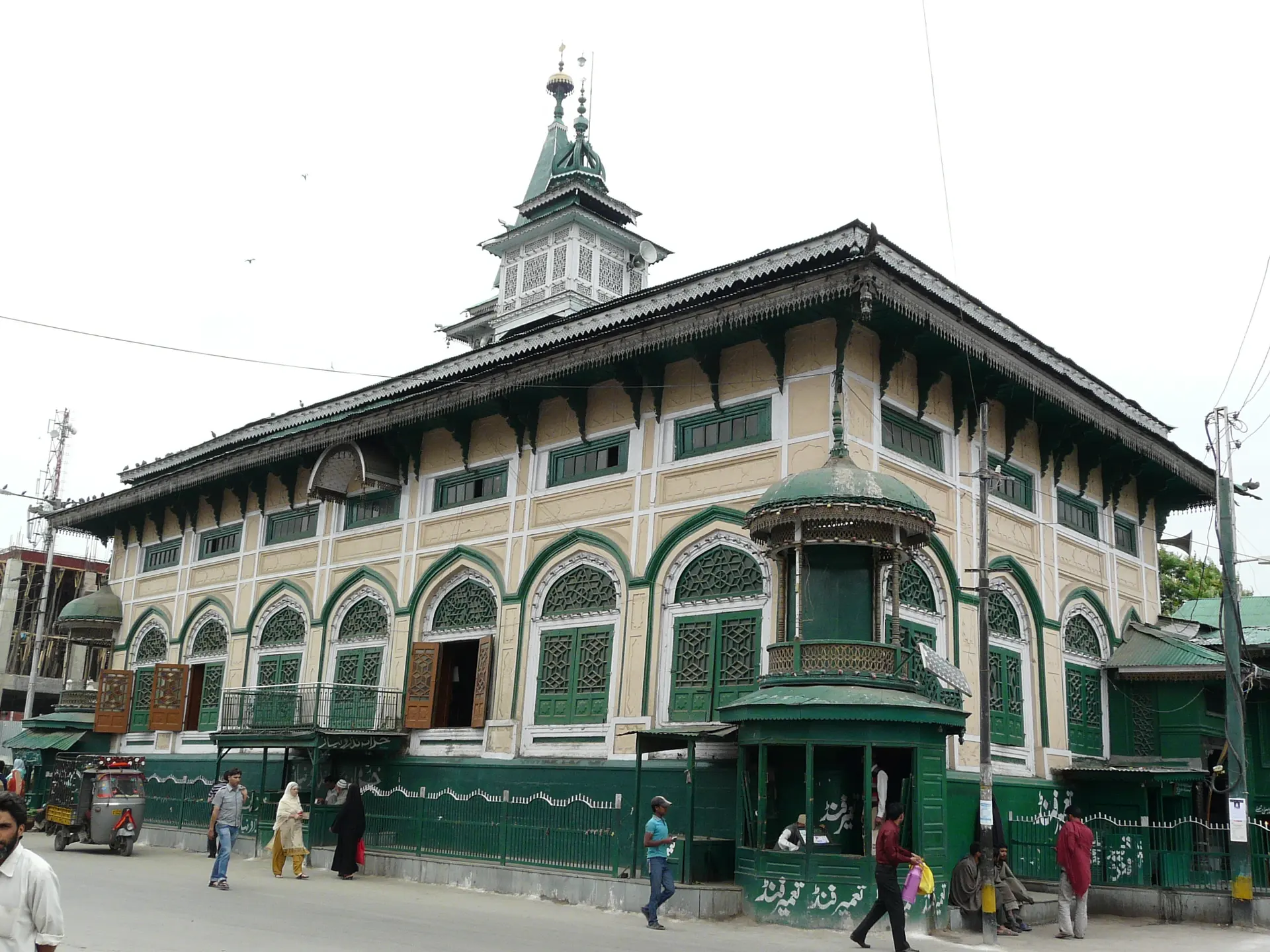
Masjid Dastgeer Sahib, Kashmir
Srinagar, Jammu and Kashmir, India
64.7 km away
References
Sources consulted for this page. Source categories describe the publication, not a guarantee that every claim is verified. Traditional accounts and outside interpretations may differ.
- 01Shri Amarnathji Shrine Board — Holy Shrine — Shri Amarnathji Shrine Board (SASB), J&K GovernmentofficialStatutory body that administers the shrine and yatra; primary source for ritual, route, and access information.
- 02Shri Amarnathji Shrine Board — Yatra — SASBofficialAnnual yatra dates, registration process, route options (Pahalgam vs. Baltal), and helicopter operator approvals.
- 03Amarnath Temple | History, Hinduism, Shiva — Britannica — Encyclopaedia BritannicaencyclopediaVerifies altitude (3,888 m), lunar correlation of ice formation, and core mythology.
- 04Shri Amarnath Ji — Divisional Commissioner Kashmir — Divisional Commissioner Kashmir, J&K GovernmentofficialGovernment overview of the shrine and pilgrimage logistics.
- 05The Amarnath Yatra: Journey to Shiva's Himalayan Abode — DD News — Doordarshan NewsnewsPublic-broadcaster account of the yatra's historical and religious dimensions.
- 06VINTAGE: Amarnath Yatra from 1898 to 1955 — Kashmir Times — Showkat Rashied Wani, Kashmir TimesnewsHistorical photographs and ethnographic detail on the yatra over the past century.
- 07Amarnath Yatra 2026 Registration, Dates, Route — SOTC — SOTC TravelguideCurrent-year practical info: dates (3 July–9 Aug 2026), fees, helicopter pricing.
- 08Amarnath Yatra Historical References — SU YatrablogDiscusses Nilamata Purana and Kalhana's Rajatarangini references to the cave.
Share a photo
Help visitors recognize Shri Amarnath Shiva Cave, Kashmir. Every submission is reviewed before publication.