Rinpung Dzong
A fortress built without a single nail, where a giant thangka unfurled at dawn can wash away a lifetime of accumulated wrong
Understand sacred places, explore living traditions, and learn how to engage respectfully with Pilgrim Map.
Access has not been verified. Check current local guidance before planning a visit.
Hoongrel Gewog, Paro, Bhutan
Read the sources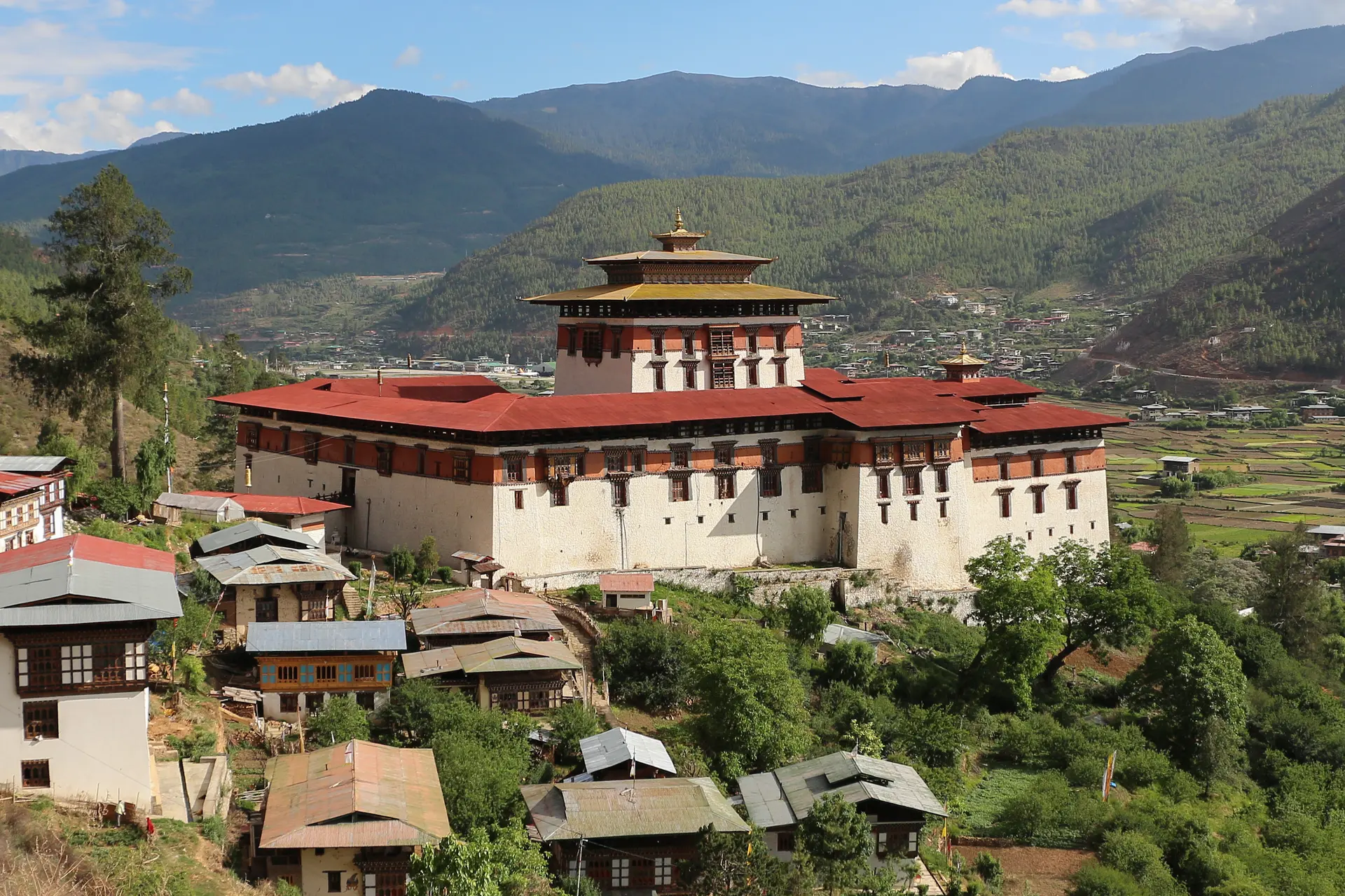
Image of Rinpung Dzong. Image source · CC-BY-SA-4.0
Visit essentials
A quick read before you go
- Duration
- 1 to 2 hours for the dzong.
- Access
- Located in the Paro valley, a short drive from Paro town and a few kilometres from Paro…
Overview
Across a covered wooden bridge in the Paro valley stands Rinpung Dzong, the Fortress of a Heap of Jewels. Zhabdrung Ngawang Namgyal dismantled an earlier fifteenth-century temple, laid new foundations, and consecrated the fortress-monastery in 1646. Built without iron nails or steel, its precisely joined fabric is often read as material purity joining fortification and sacred space.
Half the dzong houses the Paro district monastic body; half serves the district government. This union of prayer and administration has continued since the seventeenth century, embodying the Zhabdrung's intended union of spiritual and temporal authority. The dzong survived the catastrophic 1897 earthquake that destroyed most of Bhutan's other dzongs and endured a damaging fire in 1906.
Each spring, thousands gather for the Paro Tshechu. Before first light on the final morning, a building-high silk Thongdrel depicting Guru Rinpoche is unfurled across the outer wall. Buddhist tradition holds that seeing it grants liberation; the image appears only once each year.
Why this place is sacred
A building constructed without metal fasteners holds together by the precise fitting of wood to wood, stone to stone. There is something in this fact that exceeds its engineering significance. The absence of nails is an act of faith in materials, in craft, in the proposition that a fortress-monastery can be held together by something other than force.
The Thongdrel is another kind of holding-together. Once a year, in the darkness before dawn, a silk thangka so large it covers the face of the building is carried out and unfurled by monks. The gathered crowd — pilgrims, families, visitors — watches in the pre-dawn cold as the image of Guru Rinpoche appears. The tradition holds that merely seeing this image washes away accumulated sins.
Liberation through seeing: the eye does the work that years of practice might not accomplish.
This is a radical claim, and it gives the moment its charge. For the rest of the year, the dzong is a place of quiet monastic routine and administrative function. But on that single morning, the building becomes a surface for revelation. The Thongdrel is rolled away before the sun can damage the silk. The moment passes. The dzong returns to its daily register.
This rhythm — ordinary time punctuated by a single, unrepeatable encounter with the sacred — is what makes Rinpung Dzong thin.
Built in 1644-46 by Zhabdrung Ngawang Namgyal as the combined monastery and administrative center for the Paro valley, replacing an earlier 15th-century temple on the site.
Survived the 1897 earthquake and a 1906 fire. Continues its dual function as monastery and district administrative headquarters. The annual Paro Tshechu has grown from a regional observance to one of the most attended festivals in Bhutan.
Experience and orientation
The approach begins with the covered cantilever bridge over the Paro Chhu. The wooden planks, the light filtering through gaps in the structure, the sound of the river below — these create a threshold between the town and the dzong. On the far side, the path climbs steeply. The whitewashed walls grow taller with each step. By the time you reach the entrance, the valley feels distant.
Inside, the courtyard opens to sky and mountain. Monks move between buildings. The smell of butter lamps reaches you before you enter any temple. The architecture is monumental but not cold; the wood is warm, the proportions human-scaled within the overall grandeur. The central tower rises above, anchoring the space.
During the Paro Tshechu, this same courtyard transforms. Masked dancers — monks performing sacred cham dances — move through choreographies that encode Buddhist teachings in gesture and costume. The audience is not separate from the performance; they are participants in a devotional act. And on the final morning, in the hour before dawn, the gathering is at its most concentrated. The Thongdrel appears, vast and silent, and for a few minutes the building becomes something other than architecture.
Cross the bridge slowly and let the transition register. The climb to the dzong is moderately steep; take it at a pace that allows observation. Inside, move clockwise. If attending the Tshechu, arrive before dawn on the final day for the Thongdrel unfurling. Outside festival time, the dzong's quieter days offer a different but equally valid encounter.
Context and lineage
In the 15th century, the Buddhist lama Drung Drung Gya built a small temple at this site commanding the Paro valley. When Zhabdrung Ngawang Namgyal arrived in the 17th century, he dismantled the old structure and laid new foundations for a dzong that would serve as both fortress and monastery. The dzong was consecrated in 1646 and immediately became the spiritual and administrative center of western Bhutan.
Rinpung Dzong belongs to the Drukpa Kagyu lineage, established in Bhutan by Zhabdrung Ngawang Namgyal. The district monastic body (rabdey) has maintained continuous presence since the 17th century.
Drung Drung Gya
Buddhist lama who built the original 15th-century temple on the site
Zhabdrung Ngawang Namgyal
Dismantled the old temple and built the current dzong, consecrating it in 1646
Traditions and practice
The Paro Tshechu, held from the 11th to the 15th day of the 2nd Bhutanese lunar month (usually March or April), is one of the most important religious festivals in Bhutan. Sacred cham dances performed by monks in elaborate masks and costumes convey Buddhist teachings through movement. The culmination is the pre-dawn unfurling of the Thongdrel — a massive silk thangka depicting Guru Rinpoche — on the final morning.
The image is displayed only until the first rays of sunlight touch it, when it is rolled away to preserve the silk.
The Paro district monastic body resides in the dzong year-round, maintaining daily prayer, study, and ritual observance. Administrative offices for the district government occupy the other half of the building, continuing the dual function established in the 17th century.
If possible, time your visit to coincide with the Paro Tshechu. Arrive before dawn on the final day for the Thongdrel unfurling. Outside festival time, visit in the morning when the monastic body is most active and the light in the courtyard is clear.
Drukpa Kagyu
ActiveHouses the Paro district monastic body and hosts the annual Paro Tshechu, one of the most important festivals in Bhutanese Buddhism.
Daily monastic rituals, annual Tshechu with cham dances and Thongdrel unfurling, administrative governance
Perspectives and open questions
Rinpung Dzong invites consideration as architecture, as fortress, as living monastery, and as the stage for one of Bhutan's most sacred annual events.
Scholarly perspective
Architectural historians note that Rinpung Dzong's survival of the 1897 earthquake — which destroyed most other dzongs — makes it one of the oldest standing dzong structures in Bhutan. Its construction without metal fasteners is studied as an example of traditional Bhutanese building techniques that achieved remarkable seismic resilience.
Living and traditional perspectives
Within the Drukpa Kagyu tradition, the Thongdrel unfurling is not a spectacle but a dispensation of grace. The belief in liberation through seeing — that the eye, encountering the image of Guru Rinpoche, accomplishes what practice alone might not — gives the annual moment its weight. The dzong exists, in a sense, for this one dawn.
Alternative interpretations
The construction without nails is sometimes read as an expression of spiritual purity — the refusal to pierce wood with metal, maintaining the organic integrity of the materials. Whether or not this was the builders' conscious intention, the fact has accrued symbolic meaning over centuries.
Open questions
The full contents and arrangement of the inner temple chambers are not well documented in publicly available sources. The Thongdrel itself, kept carefully stored for the rest of the year, is not publicly accessible outside the festival.
Plan your visit
Access and arrival
Located in the Paro valley, a short drive from Paro town and a few kilometres from Paro International Airport — the only international airport in Bhutan. The dzong is approached via a traditional covered cantilever bridge.
Hotels and guesthouses of various grades available in Paro town. During the Tshechu, accommodation fills quickly and should be booked months in advance.
Respectful visit
Long sleeves and long trousers or skirts required. No hats, sunglasses, shorts, or flip-flops inside the dzong.
Permitted in courtyards and exterior. Prohibited inside temples. During the Tshechu, check specific restrictions for the Thongdrel unfurling.
Butter lamp offerings may be made in accessible temples.
Shoes removed in temples | Clockwise movement in sacred spaces | No pointing at religious objects | Quiet behavior, especially during prayer times
During the Tshechu, the dzong and surrounding area become very crowded. Accommodation should be booked well in advance. The pre-dawn Thongdrel viewing requires rising in darkness and tolerating cold temperatures.
Current practical details
Address
CCGF+Q54, Paro, Bhutan
Hours
Hours, fees, and access can change — verify on the official source before you travel. Practical details last checked Jun 2026.
Location
Map loads as you approach this section.
Pilgrim reflections
A portrait of encounter, not a score
Pilgrims describe what they felt, how present they could become, and whether the place would shape a journey. There are no stars and no ranking of traditions.
No reviewed reflections yet
The first pilgrims can help describe the character of being here.
Share a reflection
Available after an account-backed “Been there.” Every reflection is reviewed before publication.
Nearby sacred places
Explore other sacred places in the region. Proximity does not establish access or travel time; check each place’s guidance.


References
Sources consulted for this page. Source categories describe the publication, not a guarantee that every claim is verified. Traditional accounts and outside interpretations may differ.
- 01Rinpung Dzong - Wikipedia — VariousencyclopediaComprehensive history and architecture
- 02UNESCO World Heritage Centre - Tentative List — UNESCOSource contextUNESCO tentative listing
- 03Paro Dzong - Druk Asia — Druk AsiaguideVisitor information and history
- 04Paro Tshechu Festival - Himalayan Dream Team — Himalayan Dream TeamguideFestival details and thangka ceremony
- 05Breathe Bhutan - Etiquette — Breathe BhutanguideVisitor etiquette
- 06Lonely Planet - Paro Dzong — Lonely PlanetguideVisitor overview
Photo gallery
3 curated photos
Share a photo
Help visitors recognize Rinpung Dzong. Every submission is reviewed before publication.