Paro National Museum
A conch-shell watchtower above the Paro Valley, holding 1,500 years of Bhutanese sacred art
Understand sacred places, explore living traditions, and learn how to engage respectfully with Pilgrim Map.
Access has not been verified. Check current local guidance before planning a visit.
Hoongrel Gewog, Paro, Bhutan
Read the sources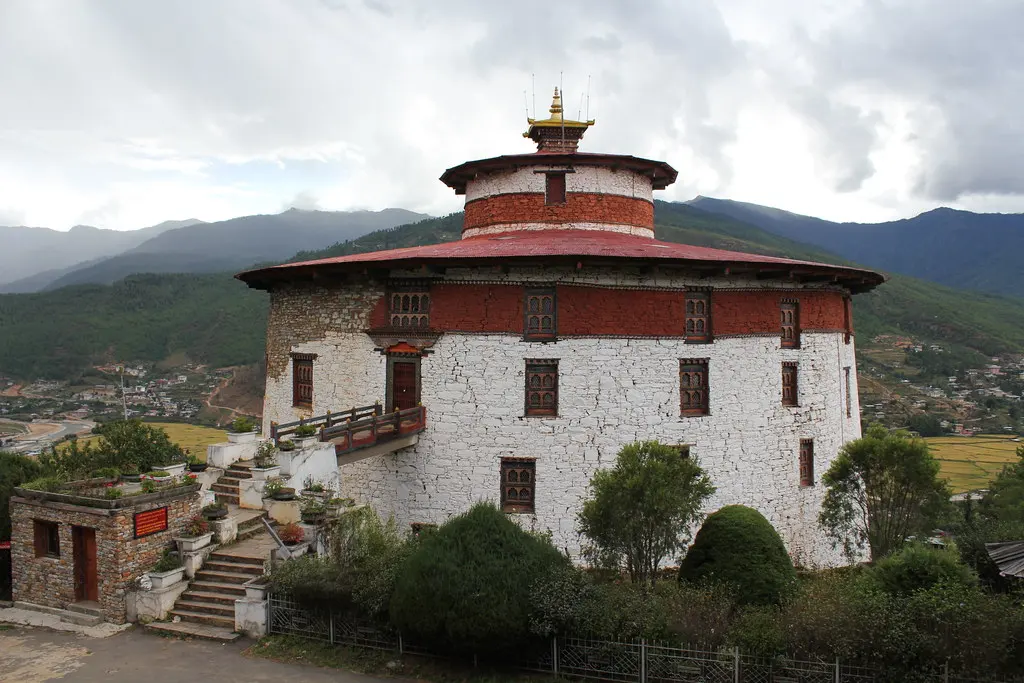
Image of Paro National Museum. Image source
Visit essentials
A quick read before you go
- Duration
- 1-2 hours
- Access
- Located above Rinpung Dzong in Paro town.
Overview
The Ta Dzong—watchtower—was built in 1649 by Ponlop Tenzin Drukdra to protect Rinpung Dzong below. Its unusual round form is said to echo the dharma conch shell, one of Buddhism's eight auspicious symbols. After three centuries watching for military threats, in 1968 under King Jigme Dorji Wangchuck it began safeguarding the material culture of an entire civilization.
The collection spans more than fifteen hundred years. Thangka paintings from the twelfth century onward remain objects of devotion, not merely display; carved masks retain their cham-dance intensity. A tenth-century Kadam stupa stands beside stone-age earthenware, extending the timeline before Buddhism.
A 6.8-magnitude earthquake damaged the building in 2011 after four centuries of structural stability. Restoration supported by the Government of India was completed in 2020. The museum reopened with its 2.5-metre-thick walls, collection, and position above the valley intact. Damage and renewal echo a pattern across Bhutan's sacred sites that this Buddhist kingdom seems to understand as instruction rather than misfortune.
Why this place is sacred
A thangka painted in the fourteenth century was not made to be looked at by tourists. It was made as an act of devotion — each brushstroke a meditation, each pigment ground and mixed with prayer. When it hangs in a museum, it does not stop being what it was made to be. The consecration that accompanied its creation did not expire when the context changed.
This is the Buddhist understanding, and it creates a particular quality in the galleries of the Paro National Museum.
The masks carry a similar charge. A mask used in a cham dance is not a costume but a vehicle — the dancer who wears it becomes, for the duration of the dance, the deity it represents. In the museum, the masks are still. But they are still what they are: vessels for the sacred, temporarily unoccupied.
The building's shape reinforces this quality. The conch shell is one of Buddhism's eight auspicious symbols, representing the sound of the dharma reaching in all directions. A museum in the shape of a conch shell is, perhaps inadvertently, a statement about what its contents are: not artifacts but reverberations of the dharma, still sounding.
Military watchtower built in 1649 to defend Rinpung Dzong.
From watchtower (1649) to museum (1968) to earthquake-damaged site (2011) to restored and reopened museum (2020). The building's transformation from military to cultural function mirrors Bhutan's own transition from defensive kingdom to cultural preserver.
Experience and orientation
The walk from Rinpung Dzong to the museum climbs a short hill through pine trees. The building's round form is immediately distinctive — there is nothing else like it in the valley. The walls, 2.5 metres thick, create an interior that is cool and quiet, insulated from the world outside.
The galleries are arranged across multiple levels within the round structure, each floor revealing a different aspect of Bhutanese civilization. The thangka gallery is the spiritual heart of the collection — scroll paintings depicting deities, scholars, and cosmological diagrams, their colors still vivid after centuries. The Chapel of the Wealth Deity houses a tenth-century Kadam stupa and twenty-one Tara carvings. Cham masks, displayed together, create a silent assembly of the divine and demonic figures that animate Bhutan's festival life.
Lower floors hold earlier material — stone-age pottery, bronze-age tools, evidence that the Paro Valley was inhabited long before Buddhism arrived. These objects provide depth to the collection, reminding visitors that the sacred in this landscape did not begin with any particular tradition but with the human relationship to the ground itself.
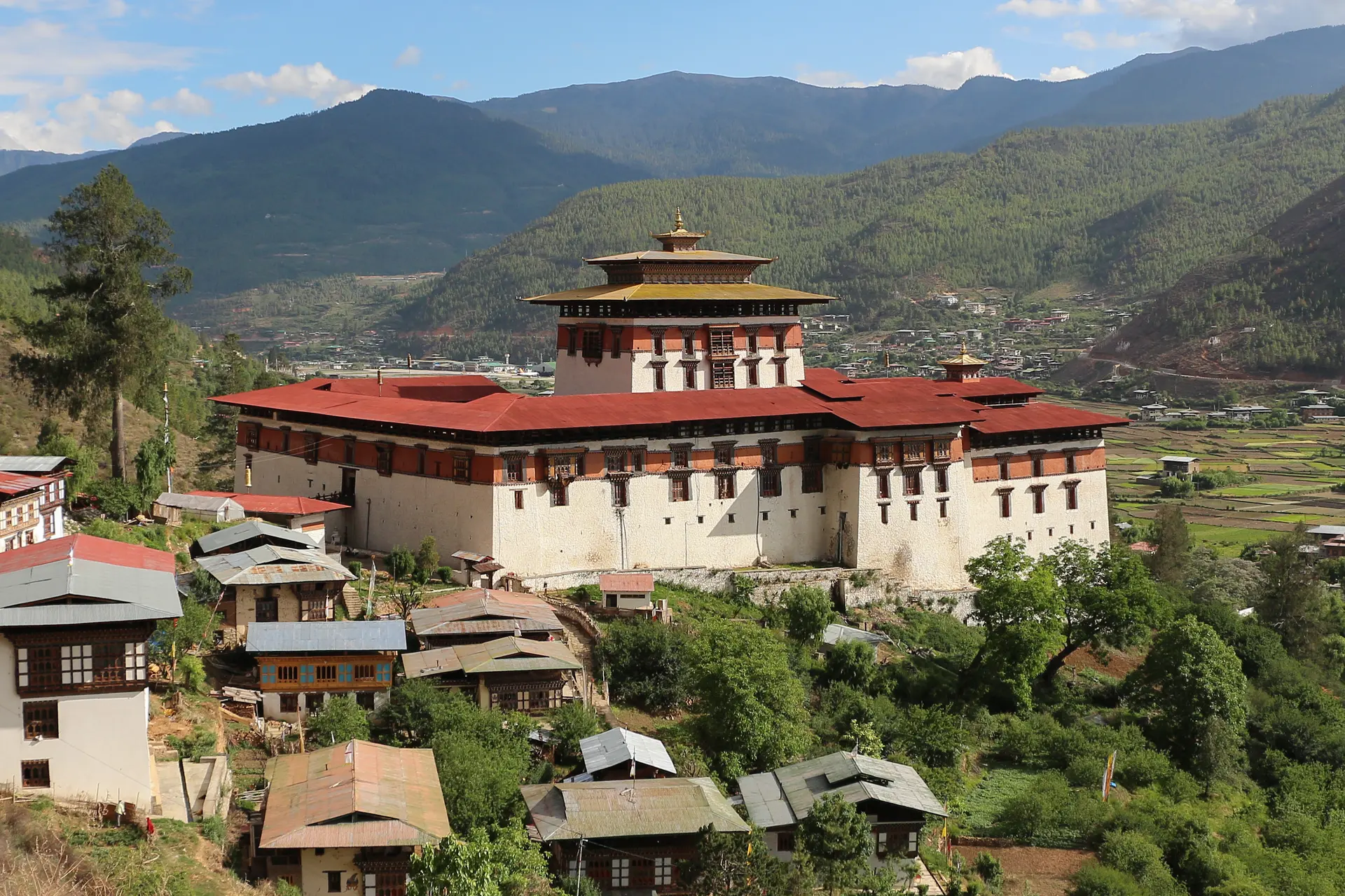
From the upper floors, the views extend across the Paro Valley to the mountains beyond. Rinpung Dzong sits below, and the relationship between watchtower and dzong — guardian and guarded — is visible in a single glance.
Begin at the top floor and descend. The chronological journey from ancient to recent mirrors the physical descent from sky to ground. Let the thangkas hold your attention longer than you think necessary — they were painted to be contemplated, not glanced at. Stand at a window and look down at Rinpung Dzong to understand the relationship between this building and the valley it once protected.
Context and lineage
The Ta Dzong was built in 1649 by Ponlop Tenzin Drukdra to serve as a watchtower protecting Rinpung Dzong. Its unusual round design, said to resemble a conch shell, distinguished it from other Bhutanese fortifications. In 1968, King Jigme Dorji Wangchuck converted it to the National Museum, giving the building a new purpose as guardian of cultural heritage rather than military frontier.
The museum's collection represents virtually every Buddhist tradition active in Bhutan — Drukpa Kagyu, Nyingmapa, and the broader Vajrayana tradition — as well as pre-Buddhist material culture.
Ponlop Tenzin Drukdra
Built the Ta Dzong in 1649 as a watchtower for Rinpung Dzong
King Jigme Dorji Wangchuck
Converted the building to the National Museum in 1968
Traditions and practice
The objects in the collection were created within active devotional traditions — thangkas as meditation aids, masks as ritual vessels, stupas as repositories of relics. Their original contexts involved daily worship, festival performance, and monastic practice.
Museum exhibition, preservation, research, and education. Bhutanese visitors often treat sacred objects with devotional gestures — bowing, circumambulating — even in the museum context.
Spend time with the thangkas. These are not illustrations but objects of meditation, and they reward sustained attention. If you notice Bhutanese visitors treating certain objects with devotional respect, understand that the objects retain their sacred character regardless of their museum setting.
Bhutanese Buddhist Heritage
HistoricalThe museum preserves and presents the material culture of Bhutanese Buddhism across 1,500 years, including objects from multiple Buddhist schools and traditions.
Museum preservation, exhibition, and education
Perspectives and open questions
The Paro National Museum can be understood as a repository, a transformed fortress, or a place where sacred objects continue to function outside their original ritual contexts.
Scholarly perspective
The museum holds one of the most comprehensive collections of Bhutanese art and material culture, spanning from prehistory to the modern period. Its thangka collection is particularly significant for the study of Himalayan Buddhist painting traditions. The building's architectural history documents the evolution of Bhutanese military and cultural infrastructure.
Living and traditional perspectives
Within the Buddhist understanding, consecrated objects do not lose their power when removed from their original context. The thangkas, masks, and sculptures in the museum continue to radiate the blessings of their creation and consecration. For Bhutanese devotees, the museum is not merely an exhibition space but a repository of living sacred presence.
Alternative interpretations
The museum represents Bhutan's negotiation between preservation and modernization — the decision to protect the material culture of the past within an institutional framework borrowed from the West, while maintaining the objects' traditional significance. The building's transformation from watchtower to museum mirrors the nation's own transformation.
Open questions
The significance of some of the museum's oldest objects — stone-age artifacts from various regions of Bhutan — remains under investigation. They represent a sacred relationship to landscape that predates any surviving tradition.
Plan your visit
Access and arrival
Located above Rinpung Dzong in Paro town. A short uphill walk from the dzong. Entry fee applies.
Hotels in Paro town
Respectful visit
Respectful casual clothing.
Not permitted inside the museum galleries.
Not applicable in the museum context.
No photography inside | Do not touch exhibits | Follow museum staff guidance | Give space to devotional visitors
Do not photograph inside the galleries. The thick walls and limited windows mean interior light is dim — allow time for your eyes to adjust.
Current practical details
Address
CCHG+F6R, Paro, Bhutan
Phone
Hours
Hours, fees, and access can change — verify on the official source before you travel. Practical details last checked Jun 2026.
Location
Map loads as you approach this section.
Pilgrim reflections
A portrait of encounter, not a score
Pilgrims describe what they felt, how present they could become, and whether the place would shape a journey. There are no stars and no ranking of traditions.
No reviewed reflections yet
The first pilgrims can help describe the character of being here.
Share a reflection
Available after an account-backed “Been there.” Every reflection is reviewed before publication.
Nearby sacred places
Explore other sacred places in the region. Proximity does not establish access or travel time; check each place’s guidance.


References
Sources consulted for this page. Source categories describe the publication, not a guarantee that every claim is verified. Traditional accounts and outside interpretations may differ.
- 01National Museum of Bhutan - WikipediaencyclopediaComprehensive overview
- 02The National Museum of Bhutan - Official Website — National Museum of BhutanSource contextOfficial source
- 03Paro Museum - Paro Dzongkhag Administration — Government of BhutanSource contextOfficial government source
- 04Paro Ta Dzong - Breathe Bhutan — Breathe BhutanguideVisitor experience
- 05National Museum - Lonely Planet — Lonely PlanetguideTravel guide overview
Pilgrim glossary
- Stupa
- A dome-shaped Buddhist monument that holds relics or marks a sacred place.
- Dharma
- The teachings of the Buddha; also the universal law underlying them.
Share a photo
Help visitors recognize Paro National Museum. Every submission is reviewed before publication.