Our Lady of Cardigan, Wales
Wales's National Catholic Shrine, where a miraculous taper burned for nine years
Understand sacred places, explore living traditions, and learn how to engage respectfully with Pilgrim Map.
Access has not been verified. Check current local guidance before planning a visit.
Cardigan, Wales, United Kingdom
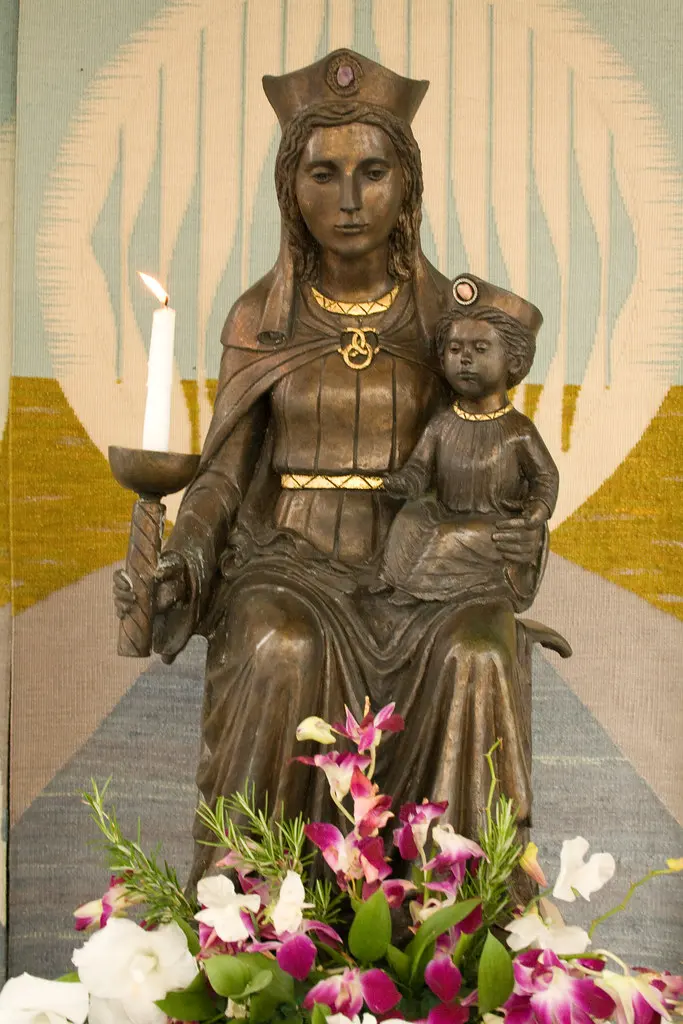
Image of Our Lady of Cardigan, Wales. Image source
Visit essentials
A quick read before you go
- Duration
- Thirty minutes to an hour for a visit outside Mass.
- Access
- Located on North Road in Cardigan town, opposite the rugby field.
Overview
Medieval accounts place a statue of the Virgin Mary beside the River Teifi, carrying the Child Jesus and a taper that burned for nine years. Each time the image was moved to the local church it returned, prompting a church where it wished to remain. The original was destroyed in 1538, but Welsh Catholics preserved its memory through more than four centuries of marginalization.
The shrine revived in 1952, and in 1986 Pope John Paul II declared Our Lady of the Taper the National Shrine of Wales. Sister Concordia Scott, a Benedictine nun, carved the present Mary-and-Child image; a candle blessed by the Pope burns before it. Pilgrims meet Welsh Catholic heritage, Marian devotion, and the traditional image of a light—and a community—that refused to go out.
Why this place is sacred
The candle before the statue carries more than its flame: the taper said to have burned for nine years, faith surviving the Reformation's destruction, and the Pope's blessing of Welsh Catholics who maintained devotion through difficulty. Our Lady of Sorrows has neither soaring vaults nor ancient stones; its presence comes from prayer, the statue, the candle, and a silence able to hold what visitors bring.
Practicing Catholics come for Mass and pilgrimage intentions, others for ancestral heritage, and others for stillness. The taper can signify light against darkness and persistence against destruction. Whatever literally happened in medieval Cardigan, this image sustained devotion across five centuries of interruption without requiring the historical uncertainty to be resolved.
The medieval shrine served as a Marian pilgrimage destination, one of many in pre-Reformation Wales. The miraculous story of the statue and burning taper drew pilgrims seeking healing, blessing, and connection with the Virgin Mary.
The Reformation of 1538 destroyed the original statue and ended official pilgrimage. Welsh Catholic tradition preserved memory of the shrine through centuries of marginalization. Revival began in 1952. Papal recognition as National Shrine came in 1986, establishing Our Lady of the Taper as the center of Welsh Catholic Marian devotion.
Experience and orientation
Finding the shrine requires no arduous journey. The Church of Our Lady of Sorrows stands on North Road, opposite the rugby field, accessible to anyone who comes to Cardigan. The building is modest, as Welsh Catholic churches tend to be, built in an era when the faith remained marginal in its own land.
Inside, the eye moves naturally toward the shrine. The statue of Our Lady of the Taper, carved by Sister Concordia Scott, shows Mary holding the Child Jesus and the lit taper. The style is contemporary but devotional, meant to serve prayer rather than art historical appreciation. Before the statue, the candle blessed by Pope John Paul II burns.
The experience of visiting varies with what visitors bring. Those who come during Mass participate in the living tradition, receiving the Eucharist in the same space where the taper burns. Those who come outside services find a church open for prayer, the statue and candle available for quiet devotion. The rhythm of a working parish shapes the space: Mass schedules, devotional practices, the comings and goings of regular congregants.
Pilgrims may wish to participate in the candlelight processions held on major Marian feast days. These events make visible the communal dimension of the shrine, Welsh Catholics gathered around their national patroness, carrying candles that echo the original taper.
Check Mass times before visiting if you wish to attend services. The shrine is always accessible during church opening hours. Pilgrimage events, particularly on Marian feast days, provide opportunities for communal devotion. Come prepared for quiet prayer; this is not primarily a heritage tourism site.
Context and lineage
The founding narrative, preserved in medieval accounts, tells of a statue found by the River Teifi. According to these accounts, the image depicted Mary holding both Child and burning taper. When carried to Christ Church of Cardigan, the statue repeatedly returned to its original location. A church was built there to honor the Virgin's apparent wish. The taper continued burning for nine years.
This narrative belongs to a recognizable type: miraculous image discovery, repeated return to chosen site, sustained supernatural phenomenon. Such stories appear throughout medieval Marian devotion. Their historical accuracy cannot be verified, but their power to inspire devotion is evident from the pilgrimage tradition they generated.
Our Lady of the Taper belongs to the tradition of Marian pilgrimage shrines that flourished throughout medieval Europe. Pre-Reformation Wales had numerous such sites. Most did not survive; Our Lady of the Taper is unusual in that devotional memory persisted through the centuries of Catholic marginalization, allowing revival when conditions permitted.
Sister Concordia Scott
Benedictine nun who carved the current statue in 1986
Pope John Paul II
Declared the site National Shrine of Wales and blessed the current candle
Traditions and practice
Catholic Marian devotion centers on prayer to the Virgin Mary as intercessor. Traditional practices include the rosary, Marian hymns, and candlelight processions. The shrine continues these practices within the context of regular parish worship.
Regular Sunday Mass is celebrated at the shrine. Saturday Vigil Mass is held at Newcastle Emlyn. Pilgrimage events occur on major Marian feast days, including candlelight processions. The shrine welcomes visitors for individual prayer outside service times.
Those seeking the fullest experience should attend Mass at the shrine. Lighting a candle before the statue and praying the rosary connects visitors to the devotional tradition. Timing a visit to coincide with a Marian feast day allows participation in communal pilgrimage. Those who are not Catholic are welcome to attend Mass as observers or to visit for quiet prayer.
Roman Catholicism
ActiveThe National Catholic Shrine of Wales, declared by Pope John Paul II in 1986. Center of Welsh Marian devotion and pilgrimage.
Mass, rosary, candlelight processions, Marian devotions, pilgrimage. The candle before the statue was blessed by the Pope.
Perspectives and open questions
The shrine stands at the intersection of medieval miracle tradition, Reformation destruction, and modern Catholic revival. Different frameworks illuminate different aspects of its significance.
Scholarly perspective
Scholars of medieval religion recognize the founding narrative as typical of miraculous image discoveries common across European Marian devotion. The nine-year burning taper motif appears extreme even within this genre, suggesting possible legendary elaboration. The shrine's significance today lies less in historical verification than in its role as a focus for Welsh Catholic identity and Marian devotion.
Living and traditional perspectives
Catholic teaching holds Mary as ever-virgin Mother of God and powerful intercessor. The shrine honors this understanding through its dedication and devotional practices. The papal recognition of 1986 confirms the shrine's place within the universal Church while affirming its particular Welsh character.
Alternative interpretations
Some scholars note parallels between Marian shrines and pre-Christian goddess veneration in Celtic regions. The finding of a sacred female figure beside water echoes earlier sacred narratives. These parallels are noted without claiming direct continuity; Marian devotion developed within Christian tradition even while potentially incorporating earlier sacred geographies.
Open questions
The historical circumstances of the original statue's discovery cannot be verified. What the taper literally did, and for how long, remains unknown. What survived the Reformation was devotional memory, not documentary evidence. The shrine's power today does not depend on resolving these historical questions.
Plan your visit
Access and arrival
Located on North Road in Cardigan town, opposite the rugby field. Accessible by car or public transport to Cardigan. The church is wheelchair accessible.
Cardigan is a market town with hotels, B&Bs, and holiday rentals. Pilgrim-specific accommodations are not offered; book through standard channels.
Respectful visit
Modest dress appropriate for a place of worship. Shoulders and knees should be covered. No specific color requirements.
Photography may be permitted outside of services. Always ask permission. Flash photography is inappropriate. Do not photograph individuals at prayer.
Candles can be lit at the shrine. Monetary donations support the parish. The shrine accepts prayer intentions.
Non-Catholics should not receive communion at Mass. Maintain quiet respect. Do not interrupt those at prayer.
This is an active place of worship. During services, observe Catholic Mass protocols even if not participating in communion. Photography may be restricted during services; ask permission. Approach the shrine space with the reverence due to sacred space in a living tradition.
Current practical details
Address
North Rd, New Town, Cardigan SA43 1LT, UK
Phone
Hours, fees, and access can change — verify on the official source before you travel. Practical details last checked Jun 2026.
Location
Map loads as you approach this section.
Pilgrim reflections
A portrait of encounter, not a score
Pilgrims describe what they felt, how present they could become, and whether the place would shape a journey. There are no stars and no ranking of traditions.
No reviewed reflections yet
The first pilgrims can help describe the character of being here.
Share a reflection
Available after an account-backed “Been there.” Every reflection is reviewed before publication.
Nearby sacred places
Explore other sacred places in the region. Proximity does not establish access or travel time; check each place’s guidance.
Share a photo
Help visitors recognize Our Lady of Cardigan, Wales. Every submission is reviewed before publication.