Mt. Qian Shan, Liaoning
A thousand lotus peaks where Buddhism and Taoism share a mountain in quiet coexistence
Understand sacred places, explore living traditions, and learn how to engage respectfully with Pilgrim Map.
Access has not been verified. Check current local guidance before planning a visit.
Wenquan Subdistrict, Liaoning, China
Visit essentials
A quick read before you go
- Duration
- Half a day for the Giant Jade Buddha and one or two temples.
- Access
- Located approximately 20 km southeast of Anshan, Liaoning Province.
Overview
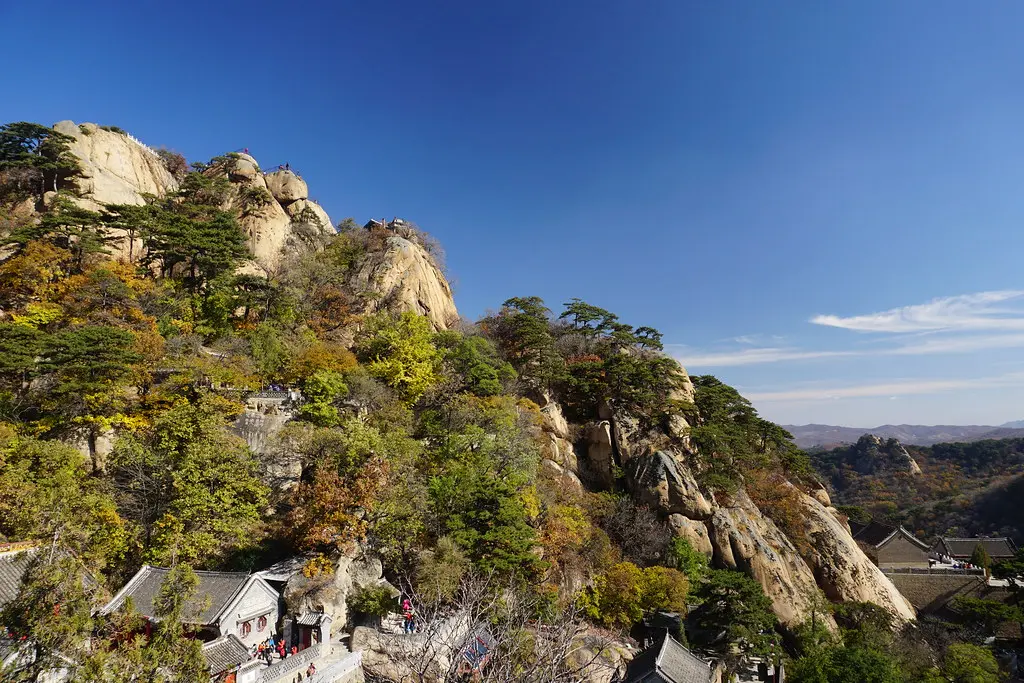
Chinese religious history is often told as a story of competition — Buddhist and Taoist temples vying for imperial patronage, for followers, for the choicest sites. Qian Shan tells a different story. On this mountain in Liaoning Province, the two traditions have coexisted for over fifteen hundred years, occupying different peaks and valleys of the same landscape in a practical arrangement that looks, from the ground, less like theology and more like neighborliness.
The Buddhist temples appeared first, during the Northern Wei or Sui Dynasty in the fifth or sixth century. The Taoist temples followed during the Tang Dynasty. Rather than displacing or competing, the two traditions distributed themselves across the mountain's extraordinary topography — 999 peaks spread across forty-four square kilometers, each peak said to resemble a lotus petal, together forming a vast stone flower.
The mountain's Buddhist significance was dramatically amplified in 1993 with the discovery of the Giant Jade Buddha — a natural rock formation approximately seventy meters tall that strikingly resembles the seated figure of Maitreya, the Future Buddha. The formation is not a carved image. It is geological accident — or, in the Buddhist reading, not accidental at all. The mountain had been sculpting a sacred image for millions of years, waiting for the moment of recognition.
The reception of this discovery illuminates the difference between seeing the world as a collection of objects and seeing it as a field of meaning. The rock was always there. What changed was that someone looked at it with eyes prepared by tradition and recognized what it already was.
Qian Shan sits far from the tourist circuits of southern and central China. This northeastern location gives it a quality that the more famous sacred mountains have largely lost: quiet. The autumn foliage — red maples against grey granite against blue sky — rivals anything in China. The winter snowscapes transform the peaks into something from a classical ink painting.
And the temples, both Buddhist and Taoist, conduct their services with an unpretentious continuity that comes from being far enough from the spotlight to simply keep practicing.
Why this place is sacred
The thinness at Qian Shan operates through multiplicity. Nine hundred and ninety-nine peaks, each contributing to a landscape that reads, from elevation, as a single enormous lotus flower — the Buddhist symbol of purity arising from mud. The mountain's sacred geometry is not imposed. It is found. The peaks were not arranged by human hands. They were recognized by human perception as already carrying a sacred form.
The dual tradition deepens this quality. Walking from a Buddhist temple to a Taoist shrine and back, the visitor passes through different devotional vocabularies — different sounds of chanting, different colors of robes, different arrangements of altar and image — while the mountain remains the same beneath both. The harmony is not theoretical. It is spatial.
The mountain is large enough for both traditions to practice without compromise, and this spatial generosity has been the foundation of fifteen centuries of coexistence.
The Giant Jade Buddha adds a dimension of scale that operates below conscious attention. The formation is seventy meters tall. It resembles Maitreya — the Buddha who will come in the future — seated in contemplation. When you stand at the viewing platform and allow the resemblance to register, something shifts. The mountain is not merely a setting for religious practice.
The mountain is itself a religious image, shaped by geological processes over millions of years, recognizable as sacred only when someone knew what to look for.
The mist that frequently covers the peaks contributes its own quality. Qian Shan in mist is a mountain of suggestion — peaks appearing and disappearing, the paths between temples becoming passages between visible and invisible worlds. The Chinese aesthetic tradition, which values what is partially concealed over what is fully revealed, finds its ideal landscape here.
Buddhist temples were established at Qian Shan from the Northern Wei or Sui Dynasty, followed by Taoist temples from the Tang Dynasty. The mountain served as a shared sacred landscape where both traditions could practice in proximity, reflecting the characteristically Chinese synthesis of religious traditions.
Temple construction peaked during the Ming and Qing Dynasties. The Cultural Revolution caused damage, but restoration from the 1980s onward has revived both traditions. The 1993 discovery of the Giant Jade Buddha added a new dimension of pilgrimage significance, drawing visitors specifically for the natural Maitreya formation. The mountain's national scenic area designation in 1982 formalized its status as a site of combined natural and cultural significance.
Experience and orientation
The approach from Anshan passes through the industrial outskirts of a city built on steel production. The contrast between the factory landscape and the mountain that rises behind it is stark — and instructive. Sacred sites do not always sit in pristine settings. Qian Shan exists in relationship with the industrial city at its feet, and the transition from one to the other carries its own meaning.
The scenic area divides into northern and central sections. The Buddhist temples tend toward the lower slopes and valleys, while the Taoist shrines favor the higher ridges and more exposed positions — a distribution that may reflect each tradition's aesthetic preferences. Longquan Temple, the largest Buddhist temple, dates to the Sui Dynasty and occupies a site among ancient trees where the sound of a spring gives the temple its name.
Wuliang Guan, the primary Taoist temple, sits higher, with views across the peaks. The contrast between the two — the Buddhist temple's warmth and enclosure, the Taoist temple's exposure and elevation — makes the walk between them a lesson in how different traditions inhabit the same landscape differently.
The Giant Jade Buddha requires a dedicated visit. A path leads to a viewing platform from which the natural formation is visible — a seventy-meter figure seated in the posture of Maitreya. The resemblance is not subtle. It is immediately recognizable, and the knowledge that no human hand shaped it produces a specific quality of wonder.
The mountain's seasonal changes offer distinct experiences. Autumn, when the red maples color the slopes between grey granite peaks, is widely considered the finest season. Winter snow transforms the peaks into a monochrome landscape of extraordinary beauty. The mist and cloud effects that occur in spring and early summer create the atmosphere of classical Chinese landscape painting — peaks appearing and dissolving, the mountain seeming to breathe.
Enter at the scenic area entrance southeast of Anshan. A cable car from the base provides access to the upper areas. The main paths are paved but include steep sections. The Giant Jade Buddha viewing platform is accessible from the southeastern slope. Plan a full day to explore both Buddhist and Taoist areas. The mountain is large — forty-four square kilometers — so prioritize either the northern or central section unless you have two days.
Context and lineage
The mountain's nine hundred and ninety-nine peaks are likened in Buddhist tradition to the petals of a thousand-petal lotus — the sacred flower of Buddhism. The mountain is a natural mandala. When the Giant Jade Buddha was recognized in 1993, it was interpreted as Maitreya revealing his presence — the Future Buddha manifesting in stone before his coming.
In the Taoist reading, the mountain's mist-shrouded peaks, ancient pines, and hidden caves mark it as a landscape shaped by the Tao — a natural dwelling for immortals. The peaks and valleys form a visible balance of yin and yang.
The dual Buddhist-Taoist lineage at Qian Shan represents the broader Chinese pattern of religious synthesis — what scholars call the Three Teachings (Buddhism, Taoism, Confucianism) existing in complementary rather than competitive relationship. The mountain embodies this principle in its spatial organization.
Maitreya (弥勒佛)
The Future Buddha, whose natural likeness in rock was discovered on the mountain in 1993. The seventy-meter formation is recognized as the world's largest natural Maitreya image.
Traditions and practice
Buddhist morning and evening chanting at Longquan Temple and other temples. Taoist liturgical services at Wuliang Guan. Seasonal festivals from both traditions observed according to their respective calendars. Incense burning and prostrations at the Giant Jade Buddha.
Daily services continue at functioning temples of both traditions. The Giant Jade Buddha has become a focal point for Maitreya devotion, with pilgrims offering incense, performing prostrations, and circumambulating the formation. Mountain hiking as contemplative practice draws visitors who may not identify with either formal tradition but who find the mountain's atmosphere conducive to reflection.
Plan your visit to include at least one Buddhist and one Taoist temple. The walk between them — the transition from one devotional vocabulary to another while the mountain remains constant beneath both — is Qian Shan's distinctive offering.
At the Giant Jade Buddha, allow the resemblance to emerge gradually. Stand at the viewing platform and let your eyes adjust. The formation does not leap out at you. It assembles itself in your perception, and the moment of recognition — when the seated Maitreya becomes unmistakable — is the mountain's own teaching about attention and readiness.
If you visit in autumn, walk slowly enough to register the color. The red maples against grey granite against blue sky produce combinations that explain why Chinese landscape painting uses such limited palettes — the natural world of Qian Shan already looks like art.
Chinese Buddhism — Qianshan Temples
ActiveBuddhist presence at Qianshan dates from the fifth or sixth century. The 1993 discovery of the Giant Jade Buddha — a natural rock formation resembling Maitreya — elevated the mountain's Buddhist pilgrimage significance.
Morning and evening chanting at functioning temples, pilgrimage to the Giant Jade Buddha with incense and prostrations, Maitreya devotion practices, Buddhist festivals, and vegetarian feast days.
Taoism — Qianshan Taoist Temples
ActiveTaoist presence dates from the Tang Dynasty. The mountain's natural landscape — thousand peaks, ancient pines, mist, and hidden caves — embodies Taoist ideals of harmony with nature. Qianshan represents a distinctive dual-tradition site where Buddhism and Taoism have coexisted for over a millennium.
Liturgical services at Wuliang Guan, seasonal festivals aligned with the Taoist calendar, cultivation practices in the mountain's natural setting, and incense offerings at Taoist shrines.
Perspectives and open questions
Qian Shan can be understood as a case study in religious coexistence, a geological landscape with sacred overtones, or a place where the distinction between natural formation and sacred image dissolves.
Scholarly perspective
Qian Shan is recognized in Chinese religious studies as a significant example of Buddhist-Taoist coexistence on a shared sacred mountain — a pattern common in Chinese religious history but preserved here with unusual clarity. The Giant Jade Buddha discovery in 1993 added a modern dimension to the site's pilgrimage significance.
Living and traditional perspectives
For local devotees, Qian Shan is a living sacred landscape where two great traditions exist in harmony. The Giant Jade Buddha is not a geological curiosity but a genuine manifestation of Maitreya — the Future Buddha revealing himself in the rock of the mountain.
Alternative interpretations
Some practitioners of Chinese geomancy consider the mountain's 999 peaks to form an exceptional pattern of concentrated natural energy. The dual religious presence is sometimes interpreted as evidence of the site's spiritual power attracting multiple traditions.
Open questions
Whether the Giant Jade Buddha formation was known to earlier inhabitants but not documented remains an open question. The full history of the transition from single to dual-tradition sacred mountain is not well understood. Possible pre-Buddhist and pre-Taoist sacred use of the mountain's peaks and caves has not been investigated. The extent of Cultural Revolution-era damage to the temple network has not been comprehensively documented.
Plan your visit
Access and arrival
Located approximately 20 km southeast of Anshan, Liaoning Province. Bus or taxi from Anshan city center, thirty to forty minutes. Anshan is on the Shenyang-Dalian high-speed rail line, two hours from Shenyang, 1.5 hours from Dalian. Shenyang Taoxian International Airport is the nearest major airport. Cable car from base to upper areas. Main paths are paved but include steep sections. Entrance ticket approximately 80 CNY. Mobile phone signal available at the scenic area entrance and major sites.
No specific emergency facility information was available at time of writing; Anshan city hospitals are within 20 km.
Hotels in Anshan city center range from budget to mid-range. Some guesthouses near the scenic area entrance. Anshan is a functional industrial city — accommodation serves practical purposes rather than aesthetic ones.
Respectful visit
Modest clothing. Comfortable hiking shoes essential for mountain paths. Layers for weather variability.
Permitted of landscapes and temple exteriors. Ask permission inside halls. Flash prohibited near statues.
Incense available at temple entrances. Three sticks is standard. Monetary donations may be placed in designated boxes.
No smoking in temple areas. Step over thresholds. No touching statues or altar objects. Follow posted signs. Do not climb on rock formations near the Giant Jade Buddha.
The mountain is in northeastern China and experiences genuinely cold winters. Snow and ice can make paths hazardous from December through February. Summer can be hot and humid with afternoon thunderstorms.
Current practical details
Address
24JQ+H6P, Tiedong District, Anshan, Anshan, Liaoning, China, 114045
Hours, fees, and access can change — verify on the official source before you travel. Practical details last checked Jun 2026.
Location
Map loads as you approach this section.
Pilgrim reflections
A portrait of encounter, not a score
Pilgrims describe what they felt, how present they could become, and whether the place would shape a journey. There are no stars and no ranking of traditions.
No reviewed reflections yet
The first pilgrims can help describe the character of being here.
Share a reflection
Available after an account-backed “Been there.” Every reflection is reviewed before publication.
Nearby sacred places
Explore other sacred places in the region. Proximity does not establish access or travel time; check each place’s guidance.

Photo gallery
2 curated photos
Pilgrim glossary
- Mandala
- A symbolic diagram of the cosmos used in meditation and ritual.
Share a photo
Help visitors recognize Mt. Qian Shan, Liaoning. Every submission is reviewed before publication.