Mt. Dinghushan
An ancient forest temple in the Pearl River Delta where stillness resists the speed of southern China
Understand sacred places, explore living traditions, and learn how to engage respectfully with Pilgrim Map.
Access has not been verified. Check current local guidance before planning a visit.
Dinghu District, Guangdong, China
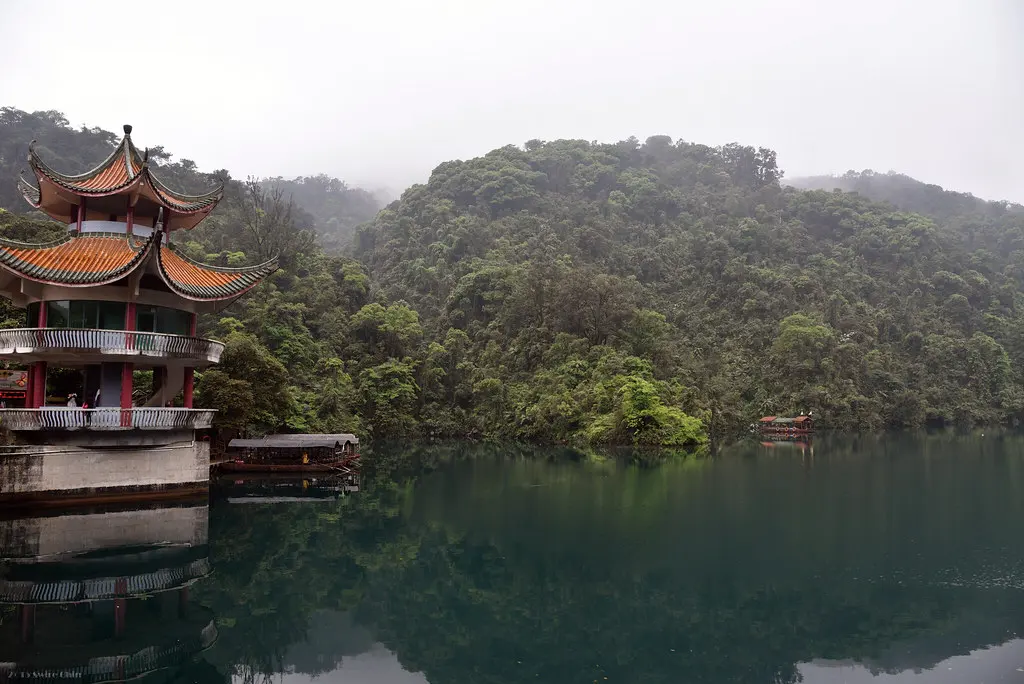
Image of Mt. Dinghushan. Image source
Visit essentials
A quick read before you go
- Duration
- Half day for a focused temple visit and short forest walk.
- Access
- Located 18 km from Zhaoqing city center, approximately 30 minutes by taxi or local bus.
Overview
In one of the most industrialized regions on earth, where the cities of the Pearl River Delta blur into a continuous urbanized corridor, Dinghushan persists as an interruption. The mountain is not tall by Chinese standards, reaching just over 1,000 meters at its highest point. What it offers is not altitude but age.
The subtropical forest that covers its slopes is one of the best-preserved examples of its kind in China, a remnant of what the entire region looked like before factories, highways, and megacities transformed it beyond recognition.
Qingyun Temple sits within this forest as though the canopy grew the building rather than human hands raising it. Founded during the late Ming Dynasty by the monk Zaihu during the turbulent final years of that dynasty, the temple was conceived as a refuge where the Dharma could survive a civilization's collapse. It survived.
The dynasty ended, the Qing came and went, the republic rose and fell, and Qingyun Temple remains: monks chanting in the morning, vegetarian meals served at noon, incense drifting through trees older than any of the empires that have governed this land.
The mountain's name tells a deeper story. Dinghushan means Tripod Lake Mountain, referencing a legend in which the Yellow Emperor cast a sacred bronze tripod at the summit and a divine dragon descended from heaven. The tripod sank into a lake, giving the mountain its name. This connection to the mythical ancestor of the Chinese people places the mountain at the origin of Chinese civilization itself, a layer of significance that predates both Buddhism and Taoism.
Why this place is sacred
The transition is the teaching. To walk from the ticket gate into the old-growth forest of Dinghushan is to move from one century to another in the space of a hundred meters. The air changes. The temperature drops. The sound environment shifts from traffic and commerce to running water and birdsong. The canopy closes overhead, filtering sunlight into green-gold columns that fall between trees whose trunks are wider than any human construction in the vicinity.
This is not a subtle shift. The Pearl River Delta is one of the world's most densely urbanized regions, home to hundreds of millions of people living amid factories, construction sites, and relentless economic activity. Dinghushan exists as the ecological and spiritual counterpoint to all of this. The UNESCO Biosphere Reserve designation confirms what visitors have long sensed: this forest is exceptional, a surviving fragment of the subtropical world that once covered southern China.
Qingyun Temple draws its contemplative power from this setting. The temple's integration into the forest creates a blurring of categories: where does the garden end and the wilderness begin? Where does the built environment yield to the natural one? The sounds of the temple, the bell and the chanting, merge with the sounds of the forest, the water and the birds, until the boundary between sacred practice and natural world dissolves.
The water is omnipresent. Springs, streams, and waterfalls thread through the mountain, creating a constant soundtrack of movement that becomes the aural foundation of any visit. The Feishui Tan, the Flying Water Pool, is the most famous of these water features, but the mountain's hydrological generosity means that running water accompanies the visitor at almost every point. In Chinese feng shui tradition, this abundance of flowing water is understood as concentrated vital energy.
Whether or not one accepts that framework, the effect is tangible: the air is cleaner, cooler, and more humidity-rich than anywhere in the surrounding region.
Dinghushan's sacred significance begins with the Yellow Emperor legend, which connects the mountain to the origin of Chinese civilization. Before the Buddhist establishment, the mountain was associated with Taoist cultivation, with its natural springs and old-growth forest traditionally linked to Taoist longevity practices. Qingyun Temple was founded during the late Ming Dynasty as a place of pure practice in a time of political chaos.
The mountain's evolution from Taoist cultivation site to Buddhist temple complex to UNESCO Biosphere Reserve represents a characteristic Chinese layering of significance. Each era added meaning without erasing what came before. The Yellow Emperor legend persists alongside the Buddhist chanting. The Taoist feng shui principles are visible in the temple's siting within the forest. The Biosphere Reserve designation confirms the ecological exceptionalism that generations of practitioners sensed through non-scientific means.
The temple's designation as a National Key Buddhist Temple in 1983 placed it among China's most officially recognized religious sites.
Experience and orientation
The walk into Dinghushan begins before the forest does. The road from Zhaoqing passes through the typical outskirts of a Chinese city: construction, traffic, commerce. Then the mountain gate appears, and beyond it the world changes.
The forest path ascends through subtropical canopy that grows denser with each hundred meters. Epiphytes drape from branches. Ferns carpet the understory. The trees themselves are the primary presence: some over 400 years old, their trunks wide and buttressed, their canopies forming a continuous roof that reduces the sky to intermittent glimpses. The air quality improves noticeably, and visitors arriving from Guangzhou or Shenzhen often comment on the sensation of breathing something different.
Qingyun Temple appears within this forest not as a clearing but as a continuation. The buildings integrate with the landscape through gardens that blur the distinction between cultivation and wilderness. The main hall houses Buddhist images before which monks chant at morning and evening services. The Hall of 500 Gilded Arhats presents five hundred individual expressions of enlightenment, each face distinct.
The Qing Dynasty thousand-person rice pot, once used to feed a monastic community that numbered in the hundreds, testifies to a time when the mountain sustained a much larger religious population.
The temple's vegetarian restaurant has its own reputation in a province famous for its food culture. The mushroom-based dishes, prepared by temple cooks following recipes refined over centuries, draw visitors who come for the cuisine as much as for the spiritual atmosphere. Eating here, surrounded by forest, with the sound of water and the scent of incense, is an experience that dissolves the boundary between nourishment and practice.
The Feishui Tan, the Flying Water Pool, offers a natural counterpoint to the temple's constructed calm. The waterfall drops into a pool where visitors swim in water that has filtered through the ancient forest, emerging colder and cleaner than anything available in the surrounding lowlands.
Enter through the main gate and follow the forest path uphill to Qingyun Temple. Early morning arrival, before eight o'clock, allows the quietest experience and the opportunity to hear morning chanting. The temple's vegetarian restaurant serves lunch. The Feishui Tan and associated trails can be explored in the afternoon. The cable car provides an alternative to the walking path for those with limited mobility. Allow a half day for a focused visit or a full day for thorough exploration.
Context and lineage
The mountain's oldest story connects it to the Yellow Emperor, the mythical ancestor of the Chinese people. According to legend, Huangdi came to this mountain to cast a sacred bronze tripod. When the tripod was complete, a divine dragon descended from heaven. The tripod then sank into a lake at the summit, giving the mountain its name: Ding (tripod) Hu (lake) Shan (mountain). The event marked the Yellow Emperor's ascension to heaven.
The monk Zaihu sought a place of exceptional natural purity for meditation during the turbulent last years of the Ming Dynasty. Guided by the mountain's feng shui, its abundant water, ancient trees, and sheltered aspect, he founded Qingyun Temple, the Temple of Green Clouds, as a refuge where the Dharma could survive the dynasty's collapse. That the temple persists nearly four centuries later suggests he chose well.
Dinghushan's religious lineage begins with the Taoist association of the mountain with the Yellow Emperor and Taoist cultivation practices. The Buddhist establishment in the late Ming Dynasty layered Chan practice onto a landscape already understood as sacred. The temple's Chan tradition connects to the broader lineage of southern Chinese Buddhism established by the sixth patriarch Huineng at Nanhua Temple. The 1979 UNESCO Biosphere Reserve designation added a scientific framework of ecological significance to the mountain's spiritual identity.
The Yellow Emperor (Huangdi)
The mythical progenitor of Chinese civilization, said to have cast a sacred bronze tripod on the mountain and ascended to heaven when a divine dragon descended. This legend connects Dinghushan to the deepest layer of Chinese cultural identity.
Zaihu
The monk who founded Qingyun Temple during the Chongzhen reign of the late Ming Dynasty (circa 1633 to 1636 CE), establishing the Buddhist institution that has continued for nearly four centuries. His choice of location, guided by feng shui principles, created a temple that integrates seamlessly with its forest setting.
The sixth patriarch Huineng
While not directly associated with Dinghushan, Huineng's Nanhua Temple, the most important Chan Buddhist site in southern China, lies 200 km northeast. Dinghushan's Chan tradition exists within the lineage that Huineng established in Guangdong, connecting the mountain to the broader history of Chinese Buddhism in the south.
Traditions and practice
Daily morning and evening chanting at Qingyun Temple follows the rhythms of Chan monastic life. Incense offerings before the main Buddha images and at the Hall of 500 Arhats are the primary devotional practices. Vegetarian feasts on Buddhist holy days draw larger numbers of worshippers. A tea ceremony using leaves from the temple's ancient white tea tree, said to be over 300 years old, is reserved for honored guests.
Festivals including Vesak, Ullambana, and Chinese New Year are celebrated with expanded services and larger crowds.
Temple services and festivals continue under the care of resident monks. The vegetarian restaurant serves meals to visitors year-round, and its reputation within Guangdong food culture draws visitors who come specifically for the cuisine. Chinese New Year sees especially large crowds for incense offerings and prayers for the coming year. Some visitors come to the mountain primarily for the forest environment, the clean air, and the natural swimming at the waterfall pools, combining ecological appreciation with the temple's spiritual atmosphere.
Arrive early, before the tourist crowds, and follow the forest path uphill in silence. Let the sounds of the forest establish themselves: running water, birdsong, wind through the canopy. The transition from the urban world to the mountain world is the practice. By the time you reach Qingyun Temple, the pace of your thinking has already shifted.
If morning chanting is in progress, stand quietly at the rear of the hall and listen. The rhythmic quality of the chanting, combined with the forest sounds filtering through the temple walls, creates an auditory environment that is itself a form of meditation. After the service, offer incense at the main altar if you wish.
Eat at the vegetarian restaurant. This is not an afterthought but a central part of the Dinghushan experience. The temple's cuisine, refined over centuries, demonstrates that simplicity and care produce something that no amount of elaboration can improve. Eat slowly. The forest is visible through the windows.
Chinese Buddhism (Chan)
ActiveQingyun Temple is one of Guangdong Province's most important Buddhist institutions, designated a National Key Buddhist Temple by the State Council in 1983. Founded during the late Ming Dynasty, the temple houses 500 gilded arhat statues, a Qing Dynasty thousand-person rice pot, and is known for its vegetarian cuisine. The temple's integration into the ancient forest embodies the southern Chinese Buddhist understanding of nature as a dharma teaching.
Daily morning and evening chanting. Incense offerings and prostrations. Vegetarian meals served year-round. Buddhist festivals including Vesak, Ullambana, and Chinese New Year. Tea ceremony using the ancient white tea tree for honored guests.
Taoism and Chinese mythology
HistoricalThe mountain's name derives from the legend of the Yellow Emperor casting a sacred tripod at the summit, connecting Dinghushan to the origin of Chinese civilization. Before the Buddhist establishment, the mountain was associated with Taoist cultivation. Elements of Taoist geomancy remain visible in the temple's siting and the mountain's landscape design.
Taoist cultivation practices are no longer institutionally maintained. The mountain's natural springs and old-growth forest were traditionally associated with Taoist longevity practices. The feng shui principles visible in the temple's position within the landscape continue to influence how visitors and practitioners relate to the site.
Perspectives and open questions
Dinghushan can be read as an ecological treasure, a Buddhist sanctuary, a connection to the Yellow Emperor mythology, or a commentary on what industrial society has lost. Each reading sharpens the others.
Scholarly perspective
Scholars value Dinghushan as both an ecological and cultural heritage site. The Biosphere Reserve is one of China's most important ecological research stations, with continuous data collection since the 1950s. Culturally, the mountain represents the southern Chinese model of Buddhism integrated with landscape appreciation and ecological stewardship, a tradition where the beauty of the natural world is itself understood as a dharma teaching. The Yellow Emperor legend connects the site to broader Chinese mythology studies.
Living and traditional perspectives
In Guangdong folk tradition, the mountain is a place of exceptional feng shui where the natural energies of water, forest, and mountain converge to create an auspicious site. The forest's preservation is attributed not just to modern conservation but to the spiritual protection of the mountain's deities and the respect of generations of local communities. The vegetarian tradition at Qingyun Temple is part of Guangdong's broader food culture, where temple cuisine represents the purest expression of the region's culinary philosophy.
Alternative interpretations
Feng shui practitioners consider Dinghushan a dragon's lair, a point where the earth's vital energy is concentrated by the convergence of mountain ridges, water courses, and forest. The mountain's exceptional ecological health is interpreted as evidence of this concentrated qi. Some qigong practitioners visit specifically for the reputed healing energy attributed to the combination of clean air, negative ions from the waterfalls, and the accumulated spiritual energy of centuries of practice.
Open questions
Whether Taoist hermits practiced on the mountain before the documented Buddhist establishment, and what traces of their presence might remain, is not established. The exact age and genetic origins of the ancient white tea tree at Qingyun Temple have not been scientifically determined. The mountain's role in a broader network of sacred mountains in Guangdong, and whether a coherent sacred geography connects them, has not been mapped.
Whether the lake from which the mountain takes its name still exists at the summit, or has disappeared, remains uncertain.
Plan your visit
Access and arrival
Located 18 km from Zhaoqing city center, approximately 30 minutes by taxi or local bus. Zhaoqing is connected to Guangzhou by frequent high-speed trains taking about 30 minutes. From Guangzhou, the mountain is approximately 90 km, reachable in under two hours by car or by rail to Zhaoqing plus local transport. Entry fee is approximately 70 CNY for the scenic area. Temple entry may be separate or included.
Well-developed tourist infrastructure includes a visitor center, marked hiking trails, the temple vegetarian restaurant, restrooms, and parking. Mobile phone signal is available throughout the site.
Zhaoqing offers a full range of hotels and guesthouses suitable as a base. Day-trip from Guangzhou is feasible. No overnight accommodation on the mountain itself, but the Zhaoqing area has extensive hospitality options.
Respectful visit
Comfortable hiking clothes suitable for a subtropical climate. Modest dress when entering temple buildings, with shoulders and knees covered. Comfortable walking shoes for forest trails. Bring rain gear in the wet season.
Permitted in most outdoor areas. Ask permission before photographing inside temple halls. Do not photograph monks without asking. Flash photography is not appropriate in temple interiors.
Incense sticks can be purchased at the temple. Small monetary donations at temple altars are customary. Place incense in designated burners only, as fire safety in the forested environment is paramount.
Do not collect plants, animals, or geological specimens from the Biosphere Reserve. Do not litter. Stay on designated trails in conservation zones. Do not smoke in forest areas. Respect the quiet atmosphere of the temple. Do not touch or handle the Three Treasures or other temple antiquities.
The Biosphere Reserve's ecological sensitivity means that visitors should stay on designated trails in conservation zones. Do not collect plants, animals, or geological specimens. Fire safety is critical in the forested environment. Do not smoke in forest areas.
Current practical details
Address
Dinghu Mountain, Dinghu District, Zhaoqing, China, 526070
Hours, fees, and access can change — verify on the official source before you travel. Practical details last checked Jun 2026.
Location
Map loads as you approach this section.
Pilgrim reflections
A portrait of encounter, not a score
Pilgrims describe what they felt, how present they could become, and whether the place would shape a journey. There are no stars and no ranking of traditions.
No reviewed reflections yet
The first pilgrims can help describe the character of being here.
Share a reflection
Available after an account-backed “Been there.” Every reflection is reviewed before publication.
Nearby sacred places
Explore other sacred places in the region. Proximity does not establish access or travel time; check each place’s guidance.


Pilgrim glossary
- Dharma
- The teachings of the Buddha; also the universal law underlying them.
Share a photo
Help visitors recognize Mt. Dinghushan. Every submission is reviewed before publication.