Sacred sites in China

Lake Yamzho Yumco

The turquoise talisman whose survival, Tibetans believe, is the survival of Tibet itself

Ngarzhag, Tibet, China

Open in Maps

Plan this visit

Practical context before you go

Duration

Most visitors spend one to two hours at the Kamba La viewpoint and lakeshore as part of the Lhasa-Gyantse journey. A full day allows lakeside exploration and a visit to Samding Monastery. The full kora requires seven to nine days on foot.

Access

Approximately 110 km southwest of Lhasa via the Friendship Highway. The Kamba La pass (4,794 m) is reached in about two to three hours by car. Most visitors see the lake as part of the Lhasa-Gyantse-Shigatse overland route. Foreign visitors require a Tibet Travel Permit (TTP) and must travel with a licensed guide and tour group. Permits are arranged through a registered travel agency. Altitude acclimatization in Lhasa (at least two to three days) is essential before crossing the pass. Bring altitude medication if needed. Mobile phone signal is available at the main viewpoint. No medical facilities at the lake.

Etiquette

Do not pollute the lake. Respect the Kamba La pass as a sacred crossing, not merely a photo opportunity. Walk clockwise around religious structures.

At a glance

Coordinates
29.0008, 90.6665
Type
Lake
Suggested duration
Most visitors spend one to two hours at the Kamba La viewpoint and lakeshore as part of the Lhasa-Gyantse journey. A full day allows lakeside exploration and a visit to Samding Monastery. The full kora requires seven to nine days on foot.
Access
Approximately 110 km southwest of Lhasa via the Friendship Highway. The Kamba La pass (4,794 m) is reached in about two to three hours by car. Most visitors see the lake as part of the Lhasa-Gyantse-Shigatse overland route. Foreign visitors require a Tibet Travel Permit (TTP) and must travel with a licensed guide and tour group. Permits are arranged through a registered travel agency. Altitude acclimatization in Lhasa (at least two to three days) is essential before crossing the pass. Bring altitude medication if needed. Mobile phone signal is available at the main viewpoint. No medical facilities at the lake.

Pilgrim tips

  • Approximately 110 km southwest of Lhasa via the Friendship Highway. The Kamba La pass (4,794 m) is reached in about two to three hours by car. Most visitors see the lake as part of the Lhasa-Gyantse-Shigatse overland route. Foreign visitors require a Tibet Travel Permit (TTP) and must travel with a licensed guide and tour group. Permits are arranged through a registered travel agency. Altitude acclimatization in Lhasa (at least two to three days) is essential before crossing the pass. Bring altitude medication if needed. Mobile phone signal is available at the main viewpoint. No medical facilities at the lake.
  • Warm layers essential. Wind protection recommended. Sun protection critical. Modest dress when visiting Samding Monastery.
  • Permitted at outdoor locations. At the Kamba La viewpoint, local Tibetans with decorated yaks charge for photographs — this is their livelihood; negotiate respectfully or decline. Interior photography at Samding may require permission or a fee. Be sensitive when photographing pilgrims.
  • The Kamba La pass reaches 4,794 meters and the lake sits at 4,441 meters. Altitude acclimatization in Lhasa is essential before crossing the pass. UV radiation at this altitude is extreme — sun protection is critical. Wind can be strong and cold even in summer. The viewpoint area can be crowded with tour groups during peak season. Moving away from the main stop provides a quieter experience.

Pilgrim glossary

Mandala
A symbolic diagram of the cosmos used in meditation and ritual.

Overview

Lake Yamzho Yumco — Yamdrok — is one of Tibet's three holiest lakes and the one most charged with existential meaning. Tibetans believe that if this lake dries up, Tibet will cease to be habitable. Its waters have been used as an oracle for locating reincarnated lamas, including Dalai Lamas. On its shore sits Samding Monastery, home to the only female incarnate lama lineage in Tibet. The construction of a hydroelectric station at the lake edge has made Yamdrok a contested symbol of sacred landscape under threat.

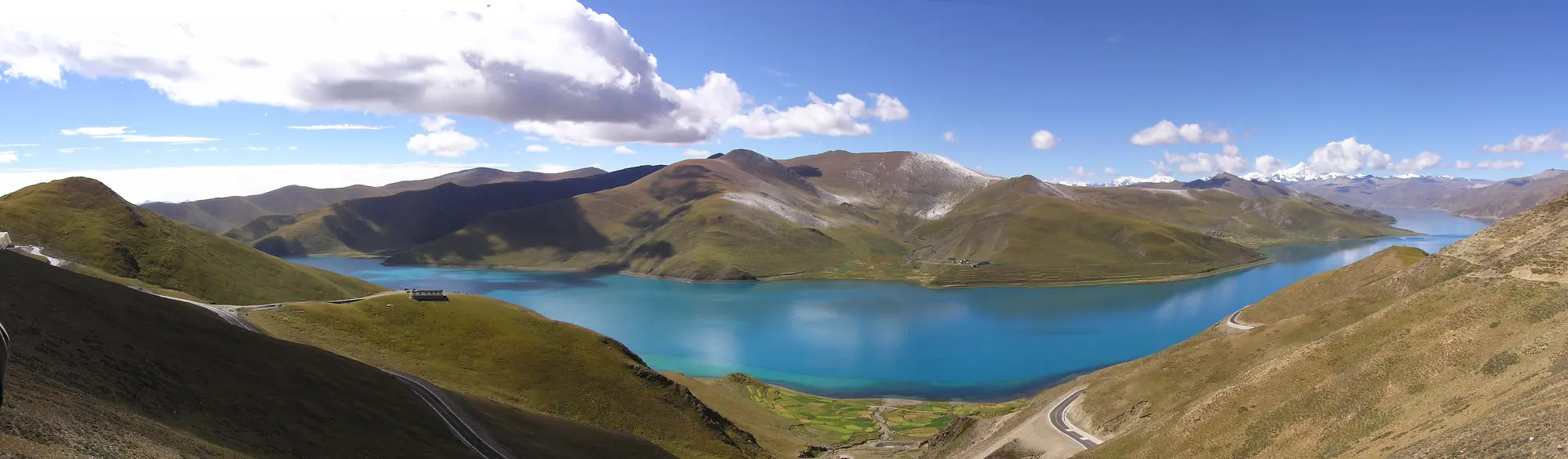
The first sight of Yamdrok Lake comes from the Kamba La pass, 4,794 meters above sea level, on the road from Lhasa to Gyantse. The lake appears suddenly below — a branching, irregular body of turquoise water surrounded by barren brown mountains, its color so vivid it seems artificial. It is not. The turquoise shifts throughout the day from pale aquamarine to deep cobalt, responding to light, cloud, and wind with a sensitivity that Tibetans understand as the lake's living mood.

Yamdrok's shape is often described as resembling a scorpion or a fan of coral — arms reaching in multiple directions, wrapping around mountain spurs, creating hidden bays and peninsulas. The lake is approximately seventy-two kilometers long, with a surface area that varies between 638 and 678 square kilometers depending on season and long-term water level changes. It sits at 4,441 meters, fed by glacial meltwater and several small rivers, with no outlet.

The lake's significance reaches beyond the spiritual into the existential. A widely held Tibetan belief states that if Yamdrok Lake ever dries up, Tibet will become uninhabitable. This is not metaphor. It is understood as a literal connection between the lake's survival and the nation's survival. The lake is a talisman — a protector deity in liquid form — and its health is Tibet's health.

This belief gained political urgency in the 1990s when a hydroelectric power station was constructed at the lake's edge, over the strong opposition of Tibetans including the 10th Panchen Lama. For many Tibetans, the station represents not merely an environmental threat but a wound inflicted on Tibet's spiritual body.

Samding Monastery on the southwestern shore adds another dimension. It is home to the Dorje Phagmo (Thunderbolt Sow) incarnation lineage — the highest-ranking female tulku in Tibetan Buddhism. In a tradition where male incarnations dominate, the presence of this feminine lineage at the lake that is itself understood as a goddess creates a concentration of feminine sacred authority found nowhere else in Tibet.

Context and lineage

Yamdrok's sacredness is layered: Bon water spirit worship, Buddhist goddess identification, the Dorje Phagmo lineage, the oracular tradition, and the modern threat that has made the lake a symbol of contested sacred landscape.

The Tibetan Buddhist tradition tells of a celestial goddess who descended to earth and transformed herself into the lake to protect Tibet. Her body became the water, her spirit the lake's guardian deity. As long as the lake endures, Tibet endures. If the lake dries up, Tibet will become a wasteland.

The Bon tradition offers an older account: the lake was formed when a great lu spirit settled in the valley and filled it with her tears of compassion for suffering beings. The scorpion shape represents her protective power.

The most distinctive origin story belongs to Samding Monastery. When Mongol invaders approached in the fifteenth century, the first Dorje Phagmo transformed herself and all the monks and nuns into pigs. The Mongols, seeing only a monastery full of pigs, left in confusion. This story established the Thunderbolt Sow incarnation lineage as one of Tibet's most powerful.

Yamdrok belongs to Tibet's system of three holiest lakes, alongside Nam Tso and Manasarovar. The three lakes represent different aspects of feminine sacred geography across the plateau. Yamdrok is distinguished by its existential connection to Tibet's survival, its oracular function, and the presence of the Dorje Phagmo lineage. The lake's role in locating reincarnated lamas connects it to the deepest institutional mechanism of Tibetan Buddhism — the tulku system — and makes its preservation a matter of lineage continuity as well as national identity.

Dorje Phagmo (Thunderbolt Sow)

The highest-ranking female incarnate lama in Tibetan Buddhism, residing at Samding Monastery on the lake's shore. Now in her twelfth incarnation. The lineage was established in the fifteenth century and represents the institutional embodiment of the feminine sacred authority that the lake itself symbolizes.

10th Panchen Lama

The senior Buddhist leader who opposed the construction of the hydroelectric station at Yamdrok, arguing that draining the lake would damage Tibet's spiritual foundations. His opposition was overruled, and the project was built in the 1990s.

Why this place is sacred

Yamdrok's thinness arises from its identification as Tibet's life force, its use as an oracle, its impossible colors, and the feminine sacred authority concentrated at its shore.

The qualities that make Yamdrok more than a body of water are layered and mutually reinforcing.

The first is existential stakes. Most sacred sites carry spiritual significance. Yamdrok carries national significance — the belief that its death would be Tibet's death elevates the lake from a place of worship to a matter of collective survival. This existential charge colors every encounter with the lake. Its beauty is not merely aesthetic but urgent.

The second is the oracular tradition. Yamdrok has been used for centuries to locate reincarnated lamas. High lamas gaze at the lake's surface, and visions arise in the shifting patterns of light and water that guide the search for the next incarnation. This practice connects the lake to the continuity of Tibetan Buddhist lineages at the highest level, including the identification of Dalai Lamas.

The third is the goddess. Yamdrok is not understood as a body of water that represents a goddess. It IS a goddess — Dorje Gegkyi Tso — in physical form. The scorpion shape is her body. The water is her substance. To circumambulate the lake is to honor a protector deity in the most literal possible sense.

The fourth is the feminine authority concentrated at Samding Monastery. The Dorje Phagmo incarnation lineage — the highest-ranking female tulku in Tibetan Buddhism — has resided at the lake for six centuries. The legend of the first Dorje Phagmo, who transformed herself and her monastery's inhabitants into pigs to confuse Mongol invaders, adds a quality of fierce, transformative feminine power.

The fifth is vulnerability. The hydroelectric station at the lake's edge introduces a dimension that most sacred sites do not carry: the real possibility that the sacred place could be diminished or destroyed by human action. This vulnerability makes the beauty more poignant and the devotion more urgent.

The lake was venerated in Bon tradition as a powerful lu dwelling and source of agricultural fertility long before Buddhism arrived. The scorpion shape linked it to protective energies in Bon cosmology. Buddhist incorporation identified the lake with a protective goddess and integrated it into the system of oracular lakes used for divination.

The lake's significance deepened through successive layers: Bon nature worship, Buddhist cosmological incorporation, the establishment of the Dorje Phagmo lineage at Samding in the fourteenth century, and the development of the oracular tradition. The modern period has added a layer of political and ecological meaning through the hydroelectric controversy. The improved road from Lhasa to Gyantse has made the Kamba La viewpoint one of Tibet's most visited sites, bringing tourism alongside pilgrimage.

Traditions and practice

The kora circumambulation, oracular divination, pilgrimage to Samding Monastery, and offerings at lakeshore shrines constitute the primary practices. The lake's role in lama identification is the most distinctive.

The full kora — circumambulation of the entire lake on foot — covers approximately 113 kilometers and takes seven to nine days. Offerings at multiple shrines and monasteries around the lakeshore mark the route. The oracular tradition is the lake's most distinctive practice: high lamas gaze at the water's surface, reading the patterns of light and shadow for visions that guide the search for reincarnated lamas. Ritual bathing purifies negative karma. Butter lamp and incense offerings are made at the lakeshore shrines.

Tibetan pilgrims continue the kora, though vehicular circumambulation is now possible on the improved road. The road has changed the character of the pilgrimage — what once required days on foot can now be driven — but walking pilgrims still follow the traditional route. Offerings at the Kamba La viewpoint and along the shore are practiced by most visitors. Visits to Samding Monastery maintain connection to the Dorje Phagmo lineage. The lake's role in lama-identification oracles continues as a living practice.

At the Kamba La viewpoint, resist the impulse to photograph and leave. Stand still for five minutes. Watch the lake's color shift as clouds move across the sun. Let the scale settle. The lake is not a scenic viewpoint but a presence.

If time allows, descend to the shore and walk along the water's edge. Remove yourself from the road and the other visitors. The lake's character changes at water level — the color deepens, the silence thickens, and the mountains close around you. Pick up a stone from the shore and hold it. Consider that this stone has rested at the edge of what Tibetans call their nation's life force.

If you visit Samding Monastery, approach with the awareness that you are visiting the residence of one of the most important feminine spiritual authorities in Asian Buddhism. The Dorje Phagmo lineage has endured invasion, upheaval, and political transformation for six centuries. What survives here is not merely an institution but a statement about the resilience of feminine sacred authority.

At any point along the shore, you may string prayer flags if you have them, or simply sit and look. The lake will teach you what it teaches, in its own time.

Tibetan Buddhism

Active

Yamdrok is one of Tibet's three holiest lakes, understood as a living protective goddess whose survival is bound to Tibet's survival. The lake is used for oracular divination, including the identification of reincarnated lamas. Samding Monastery houses the Dorje Phagmo, the highest-ranking female tulku in Tibetan Buddhism.

Full kora circumambulation (113 km, 7-9 days on foot)Oracular divination by high lamas reading the lake's surfacePilgrimage to Samding Monastery and the Dorje PhagmoOfferings at lakeshore shrines and monasteriesRitual bathing for purificationButter lamp and incense offeringsPrayers for the lake's preservation and Tibet's protection

Bon

Active

In pre-Buddhist Bon tradition, Yamdrok was a powerful lu dwelling and source of fertility. The scorpion shape connects to protective and wrathful energies in Bon cosmology. Bon practitioners consider the lake's sacredness older than Buddhism.

Counter-clockwise circumambulationOfferings to lu water spiritsSang (incense) offerings along the shoreAgricultural fertility rituals connected to the lake's water

Experience and perspectives

Most visitors encounter Yamdrok from the Kamba La pass, where the lake's impossible color appears below in a moment of visual shock. Deeper engagement requires descending to the shore and visiting Samding Monastery.

The road from Lhasa to Gyantse crosses the Kamba La pass at 4,794 meters, and the lake's first appearance is one of the most photographed moments in Tibet. The turquoise water fills the valley below, branching between brown mountains, its color shifting in real time as clouds pass overhead. Travelers who have seen photographs of Yamdrok are uniformly unprepared for the reality. The color is more saturated, more luminous, and more changeable than any image conveys.

At the viewpoint, Tibetan families with decorated yaks offer photographs for a fee. Prayer flags snap in the wind. The air is cold and thin. Below, the lake extends to the horizon in multiple directions, its arms disappearing behind mountain spurs. The sense of the landscape's spiritual weight is immediate, even for visitors who arrive without knowledge of the lake's significance.

Descending from the pass, the road follows the lakeshore for several kilometers. At water level, the lake's mood shifts from panoramic grandeur to intimate encounter. The water's edge is stone and sparse grass. The silence is deep. Away from the main viewpoint, you may find yourself alone with the lake, the wind, and the mountains.

Samding Monastery, on the southwestern shore, is accessible by a side road. The monastery is modest in scale, perched on a hill above the lake. It houses the current Dorje Phagmo incarnation — the twelfth in the lineage. Visiting Samding adds a human dimension to the lake's mythology: the feminine authority that the lake represents in cosmic terms is embodied here in an actual person, an actual lineage, an actual institution.

The lakeshore itself rewards walking. Follow the shoreline in either direction from the road, and within minutes the tourism infrastructure falls away. The lake's color changes with every shift in light and angle. Islands dot the surface, some hosting small hermitages visible as white specks. Nomadic yak herders may be visible on the distant slopes. The eerie quiet intensifies the further you walk from the road.

For visitors continuing to Gyantse, the lake recedes behind you as the road climbs away from the shore. The final views are of turquoise water framed by barren brown mountains under an enormous sky. The image persists.

Most visitors see Yamdrok as part of the overland route from Lhasa to Gyantse and Shigatse. The Kamba La viewpoint is reached in two to three hours from Lhasa. Allow time to stop, absorb, and walk along the shore rather than treating the lake as a drive-by photograph. A side trip to Samding Monastery adds depth. Bring warm layers, sun protection, and water. The altitude is significant — the pass reaches 4,794 meters.

Yamdrok sits at the intersection of cosmology, ecology, politics, and the question of what it means when a sacred landscape faces existential threat.

Scholars recognize Yamdrok as exemplifying how Tibetan sacred geography serves functions beyond the purely religious — anchoring collective identity and expressing political sovereignty through spiritual landscape. The lake's role as a national talisman demonstrates the inseparability of the sacred and the political in Tibetan culture. The hydroelectric controversy is studied as a case where sacred landscape preservation directly conflicts with state development priorities, raising questions about whose values determine the fate of shared landscapes.

For Tibetans, Yamdrok is not a metaphor — it IS Tibet's life force in material form. The lake's health is Tibet's health. Its beauty is Tibet's beauty. The hydroelectric station is not merely environmental damage but an attack on spiritual foundations. The Dorje Phagmo incarnation at Samding represents the endurance of feminine spiritual authority in a tradition often dominated by male institutions. The oracular tradition — reading visions in the lake's surface — connects the water to the deepest mechanism of Tibetan religious continuity.

Some practitioners view the lake's irregular, branching shape as forming a natural mandala when seen from above, with each arm reaching toward a different cardinal direction. The lake's use for hydromantic divination connects it to practices of water-reading found across Asian shamanic traditions. The combination of extraordinary color, high altitude, and vast emptiness creates conditions that some practitioners associate with naturally arising meditative states.

The full mechanism by which the lake is used for lama-identification oracles has not been publicly documented in detail. The long-term impact of the hydroelectric project on the lake's hydrology remains uncertain. The pre-Buddhist significance of the lake's scorpion shape in Bon cosmology is incompletely understood. Whether any of the lake's islands contain undocumented hermitages or sealed retreat caves is unknown.

Visit planning

110 km southwest of Lhasa, on the overland route to Gyantse. The Kamba La viewpoint is 2-3 hours from Lhasa. Tibet Travel Permit required.

Approximately 110 km southwest of Lhasa via the Friendship Highway. The Kamba La pass (4,794 m) is reached in about two to three hours by car. Most visitors see the lake as part of the Lhasa-Gyantse-Shigatse overland route. Foreign visitors require a Tibet Travel Permit (TTP) and must travel with a licensed guide and tour group. Permits are arranged through a registered travel agency. Altitude acclimatization in Lhasa (at least two to three days) is essential before crossing the pass. Bring altitude medication if needed. Mobile phone signal is available at the main viewpoint. No medical facilities at the lake.

No accommodation at the lake viewpoint or along the shore. The journey from Lhasa to Gyantse is typically completed in a single day, with the lake as an extended stop. Hotels in Gyantse (90 km southwest) or Shigatse (150 km west) provide overnight accommodation.

Do not pollute the lake. Respect the Kamba La pass as a sacred crossing, not merely a photo opportunity. Walk clockwise around religious structures.

Yamdrok's primary etiquette requirement is respect for the lake as a living being. Do not throw anything into the water. Do not wash or bathe in ways that introduce chemicals or soap. The lake is a goddess, and polluting her body carries spiritual weight in Tibetan understanding. At the Kamba La viewpoint, recognize that the pass is a sacred crossing marked by prayer flags and offering cairns — it is a place of prayer, not merely a scenic overlook. When visiting Samding Monastery, follow standard Tibetan monastery etiquette: walk clockwise, remove hats in chapels, do not touch sacred objects.

Warm layers essential. Wind protection recommended. Sun protection critical. Modest dress when visiting Samding Monastery.

Permitted at outdoor locations. At the Kamba La viewpoint, local Tibetans with decorated yaks charge for photographs — this is their livelihood; negotiate respectfully or decline. Interior photography at Samding may require permission or a fee. Be sensitive when photographing pilgrims.

Prayer flags and khatags are appropriate at designated sites. Do not throw anything into the lake. Small donations at Samding Monastery are customary.

Do not pollute the lake. Do not remove stones, prayer flags, or mani stones. Walk clockwise around religious structures. Respect the Kamba La pass as a sacred site.

Nearby sacred places