Kyichu Monastery
One of Bhutan's two oldest temples, where a seventh-century statue and ever-bearing orange trees resist the passage of time
Understand sacred places, explore living traditions, and learn how to engage respectfully with Pilgrim Map.
Access has not been verified. Check current local guidance before planning a visit.
Satsam, Paro, Bhutan
Read the sources
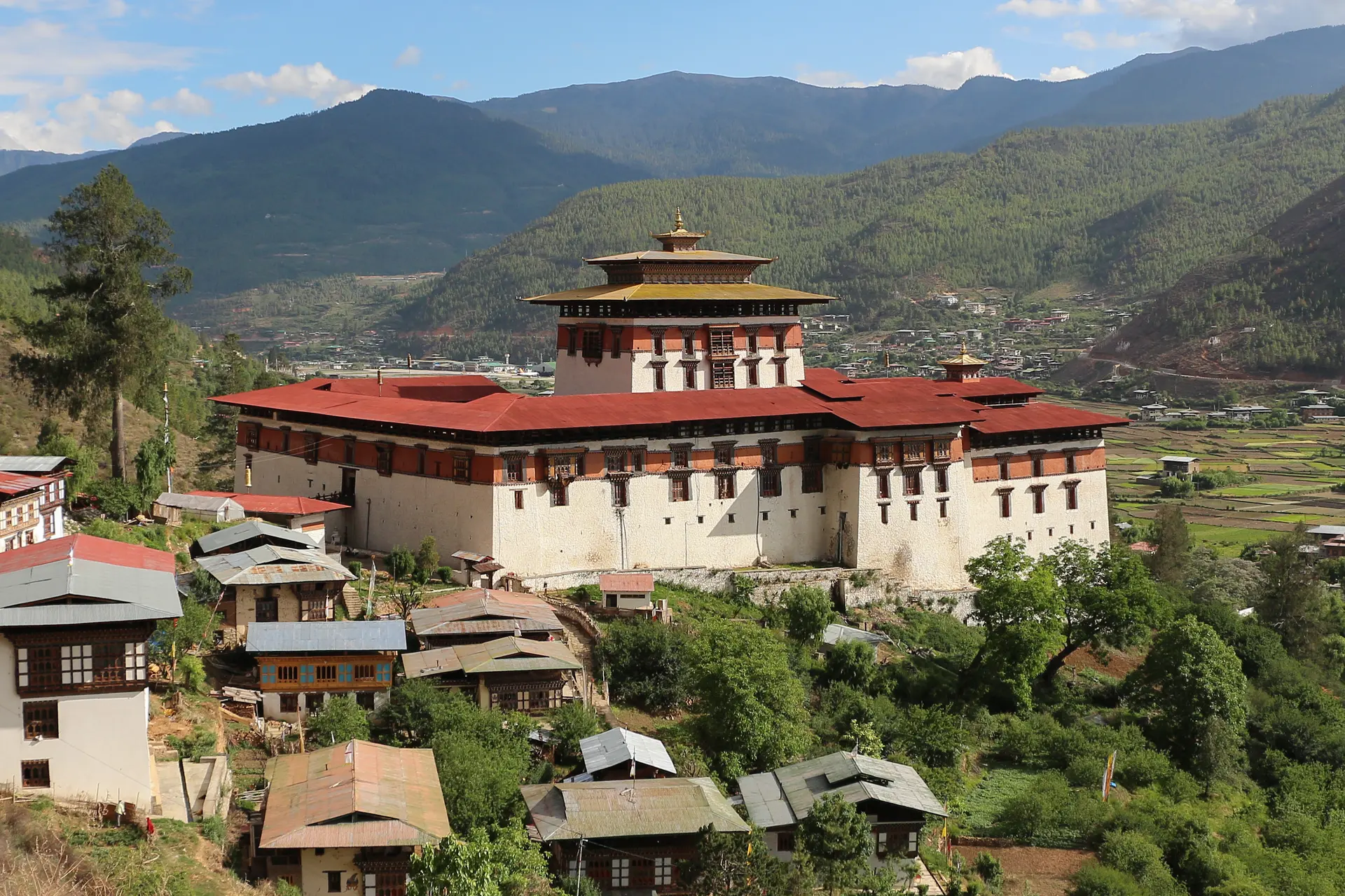
Image of Kyichu Monastery. Image source · CC-BY-2.0
Visit essentials
A quick read before you go
- Duration
- 1 hour
- Access
- Located in the Paro Valley, a short drive from Paro town.
Overview
Kyichu Lhakhang has stood in the Paro Valley since 659 CE. King Songtsen Gampo of Tibet built it within the network of 108 temples that also produced Jampa Lhakhang in Bumthang; Kyichu pins the left foot of the demoness who obstructed Buddhism's Himalayan spread.
The main Jowo Lhakhang holds a seventh-century Jowo Sakyamuni, said to have been cast with its companion in Lhasa's Jokhang Temple. These sacred twins, separated by the Himalayas, anchor Songtsen Gampo's geomantic network. Inside, darkness and closeness carry thirteen centuries of butter-lamp smoke, incense, and prayer.
In 1968 Queen Mother Ashi Kesang Choden Wangchuck built the adjacent Guru Lhakhang. Consecrated by Dilgo Khyentse Rinpoche, it holds a five-metre Guru Rinpoche and Kurukulla, the Red Tara. The temples, thirteen centuries apart, share a courtyard whose orange trees fruit in every season. Tradition credits Guru Rinpoche; botany offers no complete explanation for their year-round bearing.
Why this place is sacred
Thirteen hundred years of continuous veneration creates a quality in a space that no new construction can replicate. The Jowo Sakyamuni statue at Kyichu has been lit by butter lamps, circled by devotees, and addressed in prayer since the seventh century. The walls have absorbed this attention. The air has been shaped by it.
When visitors describe the inner hall as 'atmospheric,' they are noting a physical fact — centuries of smoke, oil, breath, and murmured mantra have literally altered the environment.
The ever-bearing orange trees in the courtyard extend this quality of temporal exception from the interior to the open air. A tree that produces oranges in all seasons, without interruption, behaves as though it occupies a different relationship with time than the trees around it. Whether Guru Rinpoche planted them or not, they embody a principle that the temple also embodies: that some places do not fully participate in the ordinary passage of time.
The existence of a companion Jowo statue in Lhasa adds a spatial dimension. The two statues, cast together and separated, maintain a connection across the Himalayas that is not physical but not merely symbolic either. Kyichu is thin in part because it is one end of a relationship that spans the Buddhist world.
Built in 659 CE by King Songtsen Gampo to pin the left foot of a cosmic demoness and enable Buddhism to spread across the Himalayas.
From seventh-century foundation through the addition of a golden roof in 1839 to the construction of the Guru Lhakhang by Queen Mother Ashi Kesang in 1968. Each addition has expanded the complex without altering its center — the Jowo statue in its dim inner hall.
Experience and orientation
Kyichu Lhakhang sits beside the road in the Paro Valley, easy to reach but not easy to leave quickly. The exterior is traditional Bhutanese temple architecture — whitewashed walls, decorated eaves, prayer flags. Nothing prepares the visitor for the interior.
The Jowo Lhakhang is dark. Butter lamps provide most of the light. The air is thick with the accumulated scent of thirteen centuries of offerings. The Jowo Sakyamuni statue sits in the center, illuminated by flickering flames, its features softened by time and devotion. This is not a museum piece behind glass but a living object of worship, attended daily by monks whose chanting fills the small space.
The intimacy of the encounter — close quarters, low light, the weight of age — distinguishes Kyichu from larger, more visited temples.
Stepping into the courtyard is a release. Light returns. The orange trees stand in the open air, their fruit visible in every season. Monks may be crossing between the old and new temples. The Guru Lhakhang, built in 1968, offers a different quality — newer, brighter, housing its five-metre Guru Rinpoche in a space that breathes more easily than the ancient Jowo hall.
The relationship between the two temples across the courtyard creates the full experience: the seventh century and the twentieth century, the Jowo Sakyamuni and the Guru Rinpoche, the dark and the light, connected by orange trees that belong to neither time entirely.
Enter the Jowo Lhakhang first. Let your eyes adjust. Stay until the darkness becomes not an obstacle but a medium. Then step into the courtyard, notice the orange trees, and cross to the Guru Lhakhang. The sequence from ancient to modern, dark to light, creates a passage that mirrors the tradition's own movement through time.
Context and lineage
King Songtsen Gampo built Kyichu Lhakhang in 659 CE as one of 108 temples to subdue a supine demoness. This temple pins her left foot. The Jowo Sakyamuni statue was cast at the same time as the companion statue in Lhasa's Jokhang, creating a paired sacred geography across the Himalayas. Guru Rinpoche is traditionally credited with planting the courtyard's orange trees during a later visit.
The temple connects the earliest Tibetan imperial Buddhism (Songtsen Gampo) to the Nyingmapa tradition (Guru Rinpoche, Dilgo Khyentse) and to the Bhutanese royal family, whose patronage has sustained the site through the modern era.
King Songtsen Gampo
Built the original temple in 659 CE
Guru Rinpoche
Traditionally credited with planting the ever-bearing orange trees
Queen Mother Ashi Kesang Choden Wangchuck
Built the Guru Lhakhang in 1968
Dilgo Khyentse Rinpoche
Consecrated the Guru Lhakhang
Traditions and practice
Daily monastic chanting and butter lamp offerings at the Jowo statue. Circumambulation of the temple complex. Devotional attention to the Guru Rinpoche statue in the newer temple.
Active worship continues in both temples. The site receives steady pilgrimage traffic and is one of the most visited temples in the Paro Valley.
Light a butter lamp in the Jowo Lhakhang. Sit in the dim hall and let the sounds and scents accumulate. In the courtyard, stand near the orange trees and look for fruit — it will be there regardless of the season. Visit the Guru Lhakhang for the contrast in atmosphere and era.
Vajrayana Buddhism
ActiveOne of Bhutan's two oldest temples, housing a seventh-century Jowo statue and maintaining over 1,300 years of continuous worship.
Daily worship, butter lamp offerings, circumambulation, pilgrimage
Perspectives and open questions
Kyichu Lhakhang can be approached as an archaeological site, a living temple, or a place where the ordinary laws of time appear to bend.
Scholarly perspective
Art historians consider the Jowo Sakyamuni one of the finest early Buddhist sculptures in the Himalayan region. The temple's claim to seventh-century origins, while rooted in religious tradition, is supported by architectural and artistic evidence of great antiquity. The pairing with the Jokhang Jowo in Lhasa represents one of the most significant sacred geographies in Himalayan Buddhism.
Living and traditional perspectives
Within the Buddhist tradition, the two Jowo statues maintain a resonance across the Himalayas. Each statue anchors a point in the sacred geography established by Songtsen Gampo, and the connection between them is understood as active and continuous — not a historical artifact but a living relationship between consecrated objects.
Alternative interpretations
The orange trees that bear fruit year-round propose an alternative temporality — a place where the cyclical logic of seasons does not fully apply. This can be understood as miracle, as microclimate, or as a reminder that the categories we impose on the natural world are not always adequate.
Open questions
Why the orange trees bear fruit continuously remains genuinely unexplained. The tradition attributes it to Guru Rinpoche's blessing. Whether the trees predate or postdate the eighth century is uncertain.
Plan your visit
Access and arrival
Located in the Paro Valley, a short drive from Paro town. Easily accessible by road.
Hotels in Paro town
Respectful visit
Shoulders and knees covered.
Restricted inside the temples. Courtyard photography generally permitted.
Butter lamp offerings are widely practiced and welcome.
Do not touch statues or sacred objects | No photography inside temples | Do not pick oranges from the courtyard trees | Walk clockwise | Maintain silence inside the Jowo Lhakhang
The interior of the Jowo Lhakhang is very dark. Allow time for adjustment. Do not touch the statues or the orange trees.
Current practical details
Address
C9RG+C6V, Bhutan
Hours
Hours, fees, and access can change — verify on the official source before you travel. Practical details last checked Jun 2026.
Location
Map loads as you approach this section.
Pilgrim reflections
A portrait of encounter, not a score
Pilgrims describe what they felt, how present they could become, and whether the place would shape a journey. There are no stars and no ranking of traditions.
No reviewed reflections yet
The first pilgrims can help describe the character of being here.
Share a reflection
Available after an account-backed “Been there.” Every reflection is reviewed before publication.
Nearby sacred places
Explore other sacred places in the region. Proximity does not establish access or travel time; check each place’s guidance.


References
Sources consulted for this page. Source categories describe the publication, not a guarantee that every claim is verified. Traditional accounts and outside interpretations may differ.
- 01Kyichu Lhakhang - WikipediaencyclopediaComprehensive overview
- 02Kyichu Lhakhang - Bhutan Pilgrimage — Bhutan PilgrimageguideDetailed history and features
- 03Kyichu Lhakhang - Atlas Obscura — Atlas ObscuraguideCultural context
- 04Kyichu Lhakhang - Lonely Planet — Lonely PlanetguideVisitor guide
- 05Kyichu Lhakhang - Druk Asia — Druk AsiaguideHistorical overview
Pilgrim glossary
- Mantra
- A sound, word, or phrase repeated as part of meditation or ritual.
Share a photo
Help visitors recognize Kyichu Monastery. Every submission is reviewed before publication.