Karahundj
Two hundred stones on a windswept plateau, their purpose still genuinely uncertain after millennia
Understand sacred places, explore living traditions, and learn how to engage respectfully with Pilgrim Map.
Access has not been verified. Check current local guidance before planning a visit.
Syunik, Armenia
Read the sources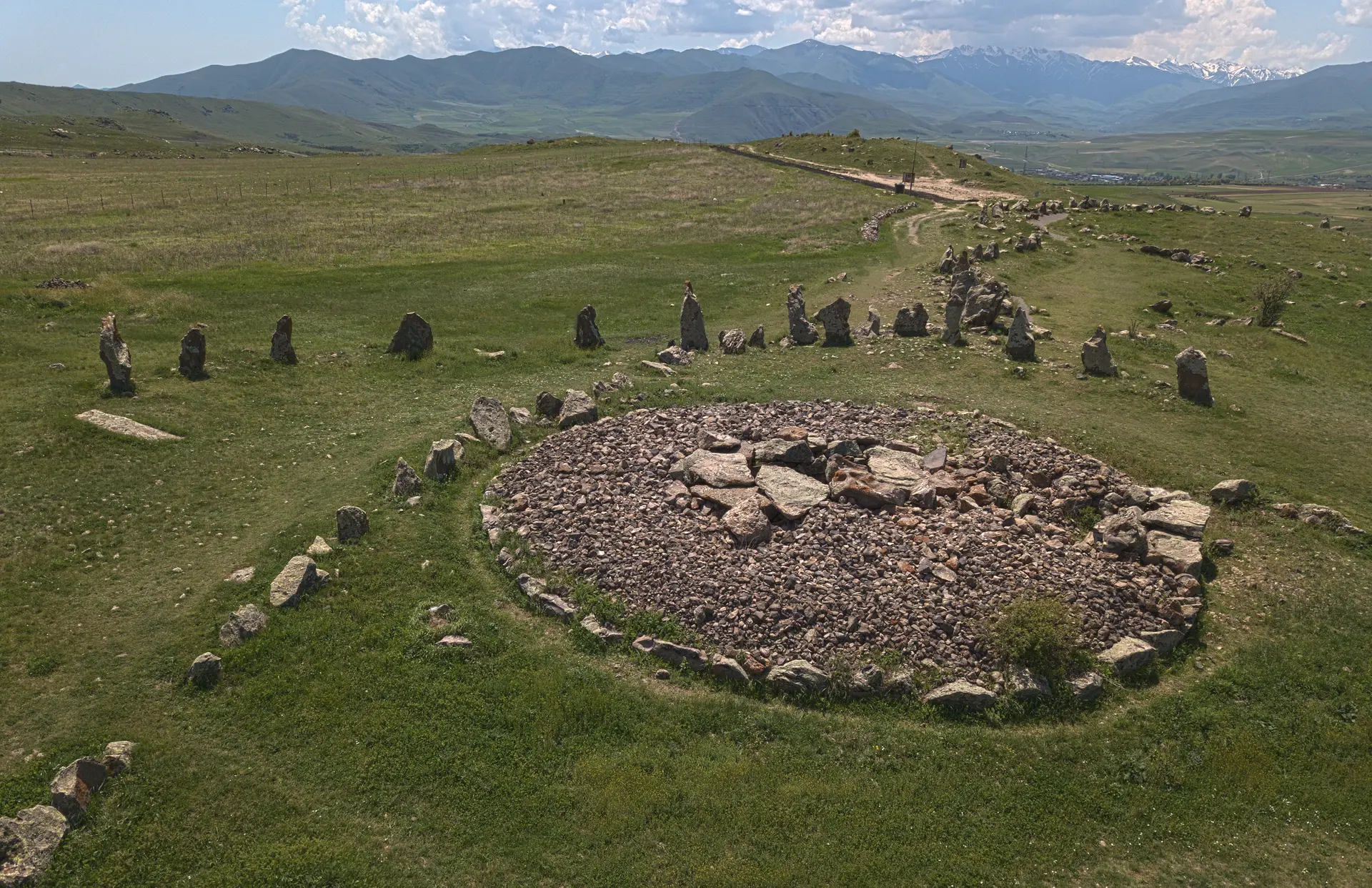
Visit essentials
A quick read before you go
- Duration
- 1-2 hours for walking among the stones.
- Access
- Located 3 km north of Sisian in Syunik Province, Armenia.
Overview
Karahunj stands at 1,770 metres on a plateau three kilometres north of Sisian. Its 223 basalt blocks form a central circle, northern and southern arms, a northeast alley, and scattered outliers. Eighty-four stones have holes bored at various angles; wind across them can produce a low whistle, inspiring Carahunge—'speaking' or 'sounding stones.'
The site's identity remains contested. After seven years of study, radiophysicist Paris Herouni concluded he had found the world's oldest astronomical observatory, dating to 5500 BCE. University of Munich archaeologists excavating in 2000 instead identified a Middle Bronze and Iron Age necropolis—a city of the dead—with stone tombs and burial chambers. Archaeoastronomer Clive Ruggles called the astronomical claims speculative and not supportable. The Armenian parliament's 2004 designation of Karahunj Observatory was political and settled nothing scientifically.
Some stones stand and others have fallen, but all show intentional arrangement whose purpose cannot be recovered with certainty. Their holes still sound when wind permits without resolving into one meaning.
Why this place is sacred
Most sacred sites acquire their weight through accumulated meaning — layers of story, ritual, and interpretation that thicken the ground. Karahunj works differently. Its weight comes from the absence of settled meaning. The stones are clearly intentional; their arrangement is not random. But what they intend has eluded every discipline that has attempted to answer the question.
This is not the false mystery of a site whose history is merely underpublished. The best archaeologists and archaeoastronomers have studied Karahunj and reached incompatible conclusions. The stones may mark the dead. They may track the stars. They may do both, or something else entirely that none of the proposed frameworks can accommodate. Standing among them, a visitor confronts a rare condition: genuine uncertainty about something that clearly mattered to its makers.
The acoustic dimension deepens this. The holes bored through eighty-four stones are not natural. Someone, or many someones across centuries, deliberately created instruments of wind and stone. Whether these were sighting tubes, sound-makers, or something without modern analogue, they remain functional — they still speak when the wind comes — even as their purpose remains silent.
Contested. The three primary hypotheses are: astronomical observatory (Herouni), Bronze Age-Iron Age necropolis (Munich team), and ritual/ceremonial centre. Local traditions associate the site with weddings, seasonal celebrations, and fertility rituals near the central stone circle.
The site was used continuously for burial and ritual purposes across the Bronze Age and Iron Age. In the modern era, it has been claimed by competing academic disciplines and designated as an observatory by parliamentary decree. Tourism infrastructure has been added modestly since 2022, including entrance fees and guided tours.
Experience and orientation
The approach from Sisian is brief — three kilometres on a paved road to a parking area. From there, the plateau opens. The stones become visible gradually, not as a single dramatic formation but as a dispersed field of basalt chunks, some standing upright to three metres, others fallen or tilted. The central circle provides a focal point, but the arms extending north and south draw the eye outward across the plateau toward the canyon edge.
Walk among the stones. Look for the holes — bored at angles through the basalt, some wide enough to sight through, others narrow. On a windy day, which is most days at this altitude, the stones produce their characteristic sound: a low, intermittent whistling that seems to come from no single source. The effect is not dramatic but persistent, a presence in the periphery of hearing.
The plateau itself is vast and largely treeless, with views extending to distant mountains. The Dar River canyon provides a natural boundary on one side. In autumn, the light turns golden across the dry grass. At night, the absence of light pollution makes the sky enormous — and if the astronomical theories hold any truth, this is the sky these stones were positioned to read.
Begin at the central circle and orient yourself to the arms extending north and south. Walk the full extent of the site to appreciate its scale. Look for the bored holes and, if wind permits, listen. Return to the centre and sit. The site rewards stillness. If you can arrange a nighttime visit, the stargazing is exceptional.
Context and lineage
No origin story survives. The stones themselves are the only testimony of their makers' intentions. The name Carahunge — 'speaking stones' or 'sounding stones' — describes a phenomenon (wind passing through bored holes) rather than explaining a purpose. The etymology itself is debated, with some scholars linking 'hunj' to an Indo-European root for stone rather than the Armenian word for sound.
No continuous lineage of use connects the site's prehistoric makers to the present. The modern engagement is entirely scholarly and touristic, though local traditions about the stones' healing and luck-bringing properties suggest a folk memory that persists outside academic frameworks.
Paris Herouni
Radiophysicist whose 1994-2001 investigations led to the claim that Karahunj is the world's oldest astronomical observatory
Elma Parsamian
Armenian astrophysicist who first hypothesized an astronomical function for the site in 1985
Clive Ruggles
Archaeoastronomer who critically assessed and found the astronomical claims speculative
Traditions and practice
Local tradition holds that weddings and seasonal celebrations were held near the central stone circle, with prayers and rituals for fertility, harvest, and protection. Elders believe that walking around the stones in specific patterns brings good luck or healing energy.
The site is visited primarily by tourists, archaeologists, and those drawn to megalithic sites. No organised spiritual practice takes place. Since 2022, guided tours are available in Armenian, English, and Russian.
Walk the full extent of the site slowly, giving attention to each cluster of stones. If visiting in the evening, stay for stargazing — the minimal light pollution offers conditions that make the astronomical theories feel less abstract. Sitting within the central circle in wind, listening to the stones, is an experience that requires nothing beyond presence.
Bronze Age / Iron Age ritual and burial practices
HistoricalArchaeological evidence identifies the site as a necropolis and ritual centre used from the Middle Bronze Age to the Iron Age. Stone tombs and burial chambers have been excavated within the stone arrangements.
Burial rites, seasonal ceremonies, and possibly astronomical observation. The exact nature of the rituals is not recoverable from the archaeological record alone.
Perspectives and open questions
Karahunj resists resolution. It invites scientific, archaeological, mystical, and aesthetic readings and satisfies none of them completely.
Scholarly perspective
The scholarly landscape is divided. The University of Munich team's 2000 excavation identified the site as a Middle Bronze Age to Iron Age necropolis with stone tombs and burial chambers. Paris Herouni's team argued for a 7,500-year-old astronomical observatory based on stone alignments with celestial bodies. Archaeoastronomer Clive Ruggles found the astronomical claims speculative. The Armenian parliament's 2004 designation as an observatory is a political, not scientific, determination.
The site likely served multiple functions across different periods — burial, ritual, and possibly observation — but no single narrative accounts for all the evidence.
Living and traditional perspectives
Local tradition holds the stones in quiet regard. Elders speak of walking patterns that bring luck or healing. The association with weddings and seasonal celebrations suggests a folk memory of the site as a place where human transitions — marriage, harvest, the turning of seasons — were marked and sanctified.
Alternative interpretations
The 'speaking stones' phenomenon — wind whistling through bored holes — has generated speculation about acoustic ritual dimensions and intentional sound design in megalithic architecture. Comparisons to Stonehenge, while archaeologically tenuous, speak to a perceived kinship among ancient stone arrangements worldwide. The site attracts those drawn to the idea of astronomical knowledge predating written history.
Open questions
Why were holes bored through eighty-four stones? Were they sighting tubes, sound instruments, or something else? How old are the oldest arrangements — Bronze Age as the excavations suggest, or millennia earlier as the astronomical theorists claim? The site is genuinely open, and the honest answer to most questions about it is that we do not know.
Plan your visit
Access and arrival
Located 3 km north of Sisian in Syunik Province, Armenia. Accessible by taxi from Sisian or on foot in pleasant weather. Driving from Yerevan takes approximately 3-4 hours. Entrance fees: guided tours available in Armenian (3000 AMD), English (5000 AMD), and Russian (5000 AMD).
Accommodation available in Sisian (3 km). More extensive options in Goris (35-minute drive).
Respectful visit
No specific requirements. Dress for weather exposure at 1,770 metres — wind protection and sun coverage are practical necessities.
Photography and astrophotography are encouraged.
None traditional.
Do not climb on, lean against, or move stones | Do not insert objects into or attempt to widen the bored holes | Carry out all waste | No camping on the archaeological site itself
The site is exposed and can be very hot in summer or cold and windy in other seasons. There are no facilities. Bring water, sun protection, and warm layers depending on the season.
Location
Map loads as you approach this section.
Pilgrim reflections
A portrait of encounter, not a score
Pilgrims describe what they felt, how present they could become, and whether the place would shape a journey. There are no stars and no ranking of traditions.
No reviewed reflections yet
The first pilgrims can help describe the character of being here.
Share a reflection
Available after an account-backed “Been there.” Every reflection is reviewed before publication.
Nearby sacred places
Explore other sacred places in the region. Proximity does not establish access or travel time; check each place’s guidance.


References
Sources consulted for this page. Source categories describe the publication, not a guarantee that every claim is verified. Traditional accounts and outside interpretations may differ.
- 01Unraveling the Mystery of the Armenian Stonehenge - Smithsonian Magazine — Smithsonian MagazineacademicContextual journalism addressing the scholarly debates
- 02Carahunge - Wikipedia — Wikipedia contributorsencyclopediaBalanced overview presenting multiple interpretations
- 03Karahunj (Zorats Karer): What to Know Before You Go — Absolute ArmeniaguidePractical visitor information
- 04Karahunj (Zorats Karer): Armenia's Ancient Stone Observatory — Armenia TravelofficialOfficial tourism perspective
- 05Megalithic complex Zorats Karer - Bronze Age-Iron Age necropolis — NovoscriptoriumacademicPresents the necropolis interpretation based on Munich excavations
- 06Zorats Karer: The Incredible History - Ancient Origins — Ancient OriginsacademicPopular treatment that favors the observatory theory
Share a photo
Help visitors recognize Karahundj. Every submission is reviewed before publication.