Harold’s Stones
Three ancient stones whose name tells a legend and whose cupmarks hold a mystery
Trellech, Wales, United Kingdom
Plan this visit
Practical context before you go
Twenty to thirty minutes for the stones alone. A combined visit including the Virtuous Well, Tump Terret, and St Nicholas Church could occupy two to three hours.
Located in a field off the B4293, south of Trellech village center. A short walk from the road. Limited roadside parking. The site is not wheelchair accessible due to uneven field terrain.
Standard heritage site protocols apply. Do not climb on or damage the stones. Respect the agricultural setting.
At a glance
- Coordinates
- 51.7378, -2.7217
- Type
- Megalithic Site
- Suggested duration
- Twenty to thirty minutes for the stones alone. A combined visit including the Virtuous Well, Tump Terret, and St Nicholas Church could occupy two to three hours.
- Access
- Located in a field off the B4293, south of Trellech village center. A short walk from the road. Limited roadside parking. The site is not wheelchair accessible due to uneven field terrain.
Pilgrim tips
- No specific requirements. Sturdy footwear recommended as the field can be uneven or muddy.
- Photography is welcome. The cupmarks are most visible in raking light, early morning or late afternoon.
- The stones are a Scheduled Ancient Monument. Do not climb on them or attempt to make rubbings of the cupmarks. The field belongs to a working farm; respect livestock and close gates.
Overview
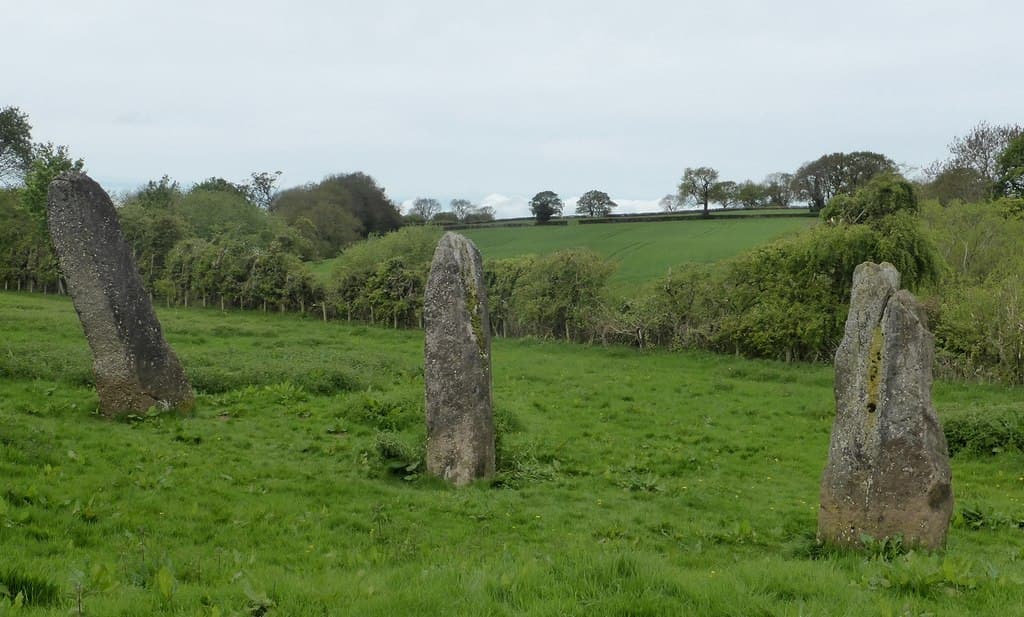
In a field at the edge of Trellech village, three standing stones rise from the Welsh earth, the tallest reaching fifteen feet despite having sunk into the ground. The village takes its name from them, Welsh for 'three stones.' Carved cupmarks on the central stone speak of Bronze Age ritual, while local legend attributes the monument to King Harold or to giants throwing boulders across the hills. The truth is older than either story.
Harold's Stones have defined this place for millennia. The village of Trellech, whose Welsh name means 'three stones,' grew up around them. For over three thousand years, these three pillars of conglomerate rock have stood in alignment, the tallest leaning at an angle, all weathering slowly under Welsh skies.
The central stone holds the greatest mystery. Its surface bears cupmarks, shallow depressions carved by hands that never recorded their purpose. These marks appear on sacred stones across Bronze Age Britain and beyond, yet their meaning remains debated. Some scholars propose they held offerings; others suggest astronomical significance. The honest answer is that we do not know.
Legend has layered the site with stories. One claims King Harold raised the stones to commemorate a victory over the Britons, an impossibility given that the monument predates Harold by over two thousand years. Another tells of the giant Jack o'Kent, who threw the stones from Skirrid Mountain during a game with a rival. Such stories emerge when a monument outlasts the memory of its builders.
The alignment of the stones toward Skirrid, the 'Holy Mountain of Gwent,' may itself hold significance. Whether Bronze Age peoples aimed their monument at a peak already considered sacred, or whether the alignment is coincidence, adds to the layers of meaning that accumulate at places humans have marked as special.
Context and lineage
The stones' original purpose cannot be recovered from archaeological evidence alone. What seems clear is that Bronze Age peoples transported these massive conglomerate blocks to this location and raised them in alignment, an effort requiring community coordination and sustained intention.
The cupmarks suggest the site's significance continued beyond initial construction. Someone, perhaps many generations after the original builders, returned to mark the central stone with carved depressions. Whether these marks recorded events, served ritual purposes, or held meaning now lost cannot be determined.
Local legend offers several origin stories, none of which can be historical. The attribution to King Harold assumes a medieval date for stones that are Bronze Age. The tale of Jack o'Kent, a folk figure associated with various impossible feats, places the stones within a mythological landscape of giants and contests. Such stories emerge when monuments outlast the memory of their builders.
Harold's Stones belong to a tradition of stone alignments that appears across Britain during the Bronze Age. Whether these monuments marked burial places, tracked astronomical events, or served purposes we cannot reconstruct, they share the characteristic of deliberate arrangement in significant landscapes. The Trellech alignment joins sites like Parc y Meirw in Carmarthenshire and numerous examples across Scotland and Ireland.
Why this place is sacred
What survives at Harold's Stones is substantial enough to command attention. Three massive pillars of puddingstone, a brown conglomerate that looks almost organic, as if the earth had raised them itself. The tallest, despite having sunk over centuries, still reaches fifteen feet. They lean at different angles, creating what one archaeologist described as a 'drunken' effect, though this may reflect millennia of earth movement rather than original intent.
The cupmarks on the central stone invite contemplation. Two large depressions on the southwest face, plus additional marks on other surfaces. Each one required sustained effort to carve. Someone considered this stone worth marking, repeatedly, over time perhaps measured in generations. The marks remain visible after more than three thousand years, their message unread.
Visitors report varied experiences here. Some describe a sense of weight or presence, as if the stones anchor something beyond their physical mass. Others notice how the surrounding landscape seems to organize itself around the monument. The church of St Nicholas in the village contains a 17th-century sundial that depicts the three stones, evidence that they continued to hold significance for communities that did not build them.
The relationship with Skirrid Mountain adds another dimension. This peak, visible from the stones, is sometimes called the Holy Mountain of Gwent. Whether the Bronze Age builders aligned their stones toward an already sacred summit, or whether the mountain's holiness developed later and independently, the visual connection between stone row and distant peak is undeniable.
Archaeological interpretation suggests the stone row served ritual or ceremonial purposes, possibly relating to burial practices or astronomical observation. The alignment toward Skirrid may indicate winter solstice significance, though this remains unproven. The cupmarks suggest the site held meaning requiring repeated marking, perhaps over extended periods.
The stones remained a landmark through all subsequent periods of Welsh history. The village that grew around them took its name from the monument. Local folklore developed to explain their presence, attributing them to figures like King Harold and the giant Jack o'Kent. The 17th-century sundial in St Nicholas Church demonstrates continued recognition of the stones' importance.
Traditions and practice
The original practices at Harold's Stones cannot be determined. The alignment suggests possible astronomical observation, perhaps marking the winter solstice sunrise toward Skirrid. The cupmarks indicate ritual activity of unknown nature. What specific ceremonies were performed, and by whom, remains unknown.
Most visitors approach the site from archaeological or historical interest. Some come for quiet contemplation, drawn by the monument's age and the mystery of the cupmarks. There is no organized practice or ceremony associated with the site today.
Take time with the approach rather than rushing to the stones. Once there, observe from multiple angles before focusing on details. Look for the cupmarks on the central stone. Note the alignment toward Skirrid Mountain. Consider combining your visit with the other Trellech sites for fuller context.
Bronze Age Religion
HistoricalHarold's Stones represent Bronze Age sacred landscape marking, possibly connected to astronomical observation, burial practices, or communal ceremony. The cupmarks indicate sustained ritual engagement with the site over time.
Original practices cannot be reconstructed. Possible functions include astronomical marking, funerary commemoration, and ceremonial gathering. The cupmarks suggest repeated ritual activity of unknown nature.
Local Welsh Folklore
ActiveThe stones have given Trellech village its name and identity for centuries. Local folklore preserves legends about their origin, even while being historically impossible. This tradition represents ongoing community relationship with an ancient monument.
Storytelling, heritage interpretation, local identity. The 17th-century sundial in St Nicholas Church shows the stones remained important enough to depict in ecclesiastical art.
Experience and perspectives
Approaching Harold's Stones, you might initially wonder if you have found the right place. From the road, the stones do not dominate the landscape as photographs might suggest. Only when you enter the field and approach closely does their scale become apparent. The tallest stone, leaning at perhaps thirty degrees from vertical, would tower over you if standing straight.
The material itself rewards attention. Puddingstone, a conglomerate of rounded pebbles bound in a matrix of sandy rock, creates a surface of unexpected texture. The stones appear almost geological, as if the earth pushed them up rather than human hands raising them. This organic quality distinguishes them from the hewn monuments of later periods.
Finding the cupmarks requires knowing where to look. The two largest appear on the southwest face of the central stone, shallow depressions about the size of a fist. Additional marks, smaller and more numerous, can be found on close inspection. Run your eyes along the stone's surface and notice what catches light differently. These marks have survived more than three millennia of Welsh weather.
From the stones, Skirrid Mountain is visible to the east, its distinctive notched profile unmistakable. Stand facing the alignment and imagine the same view extending back through time, past King Harold, past the Romans, to whoever first decided this spot deserved marking. The question of why they chose this particular alignment remains open.
Before visiting, note that Trellech contains several sites of interest: the Virtuous Well, the Tump Terret mound, and St Nicholas Church with its sundial depicting the stones. A full visit to all these sites provides richer context for the stones themselves.
Harold's Stones have accumulated interpretations across millennia. Archaeological analysis, folk legend, and contemporary experience each offer partial views of a monument that resists complete understanding.
Archaeologists classify Harold's Stones as a Bronze Age stone alignment of national importance. The cupmarks on the central stone indicate ritual activity, though their precise meaning remains debated. Some scholars propose alignment with Skirrid Mountain for winter solstice observation, though this has not been conclusively demonstrated. A fourth stone may have existed, possibly destroyed in the 18th century, which would alter interpretation of the original configuration.
Welsh tradition preserves multiple origin stories, none of which can be historical. The attribution to King Harold reflects medieval attempts to explain prehistoric monuments through familiar figures. The Jack o'Kent legend places the stones within a mythological landscape of giants and impossible feats. These stories are valuable as folklore even while being unreliable as history.
Some contemporary practitioners interpret the stones as marking ley lines or energy focal points. The alignment with Skirrid, a mountain with its own spiritual reputation, adds to this interpretation. Such views are not supported by mainstream scholarship but reflect how seekers engage with ancient sites.
Fundamental questions remain unanswered. What was the purpose of the cupmarks? Was the Skirrid alignment intentional? Did a fourth stone once exist, and if so, what was the original configuration? What did Bronze Age peoples believe they were creating? These questions may never find definitive answers.
Pilgrim reflections
A portrait of encounter, not a score
Pilgrims describe what they felt, how present they could become, and whether the place would shape a journey. There are no stars and no ranking of traditions.
No reviewed reflections yet
The first pilgrims can help describe the character of being here.
Share a reflection
Available after an account-backed “Been there.” Every reflection is reviewed before publication.
Visit planning
Located in a field off the B4293, south of Trellech village center. A short walk from the road. Limited roadside parking. The site is not wheelchair accessible due to uneven field terrain.
Trellech village has a pub (The Lion Inn). Monmouth, 7km southwest, offers full range of accommodations.
Standard heritage site protocols apply. Do not climb on or damage the stones. Respect the agricultural setting.
No specific requirements. Sturdy footwear recommended as the field can be uneven or muddy.
Photography is welcome. The cupmarks are most visible in raking light, early morning or late afternoon.
Leaving offerings is not traditional at this site. If you wish to mark your visit, consider only natural, biodegradable items.
Do not climb on stones. Do not excavate around stones. Do not damage vegetation or disturb livestock.
Plan your visit
Address
Trellech, Monmouth NP25 4PE, UK
Hours
Hours, fees, and access can change — verify on the official source before you travel. Practical details last checked Jun 2026.
Nearby sacred places
Sacred places within a half-day’s reach. Pilgrims often visit them together: walk one, stay for the other.

References
Sources consulted when researching this page. Independent verification by readers is welcome.
- 01Harold's Stones — The Megalithic Portalhigh-reliability
- 02Harold's Stones, Trellech — Coflein - National Monuments Record Waleshigh-reliability
- 03Harold's Stones, Trellech — Britain Express
- 04Harold's Stones - Visit Monmouthshire — Visit Monmouthshire
Key questions
What pilgrims usually ask
- Why is Harold’s Stones considered sacred?
- Three ancient standing stones with mysterious cupmarks, over 3,500 years old. Aligned with Skirrid Mountain, they gave Trellech village its name.
- What should I wear at Harold’s Stones?
- No specific requirements. Sturdy footwear recommended as the field can be uneven or muddy.
- Can I take photos at Harold’s Stones?
- Photography is welcome. The cupmarks are most visible in raking light, early morning or late afternoon.
- How long should I spend at Harold’s Stones?
- Twenty to thirty minutes for the stones alone. A combined visit including the Virtuous Well, Tump Terret, and St Nicholas Church could occupy two to three hours.
- How do you visit Harold’s Stones?
- Located in a field off the B4293, south of Trellech village center. A short walk from the road. Limited roadside parking. The site is not wheelchair accessible due to uneven field terrain.
- What offerings are appropriate at Harold’s Stones?
- Leaving offerings is not traditional at this site. If you wish to mark your visit, consider only natural, biodegradable items.
- What etiquette should visitors follow at Harold’s Stones?
- Standard heritage site protocols apply. Do not climb on or damage the stones. Respect the agricultural setting.
- What is the history of Harold’s Stones?
- The stones' original purpose cannot be recovered from archaeological evidence alone. What seems clear is that Bronze Age peoples transported these massive conglomerate blocks to this location and raised them in alignment, an effort requiring community coordination and sustained intention. The cupmarks suggest the site's significance continued beyond initial construction. Someone, perhaps many generations after the original builders, returned to mark the central stone with carved depressions. Whether these marks recorded events, served ritual purposes, or held meaning now lost cannot be determined. Local legend offers several origin stories, none of which can be historical. The attribution to King Harold assumes a medieval date for stones that are Bronze Age. The tale of Jack o'Kent, a folk figure associated with various impossible feats, places the stones within a mythological landscape of giants and contests. Such stories emerge when monuments outlast the memory of their builders.