Great Mosque of Djenné
The mosque that must be rebuilt by the community's hands every year or return to the earth
Understand sacred places, explore living traditions, and learn how to engage respectfully with Pilgrim Map.
Access has not been verified. Check current local guidance before planning a visit.
Djenné, Mopti, Mali
Read the sources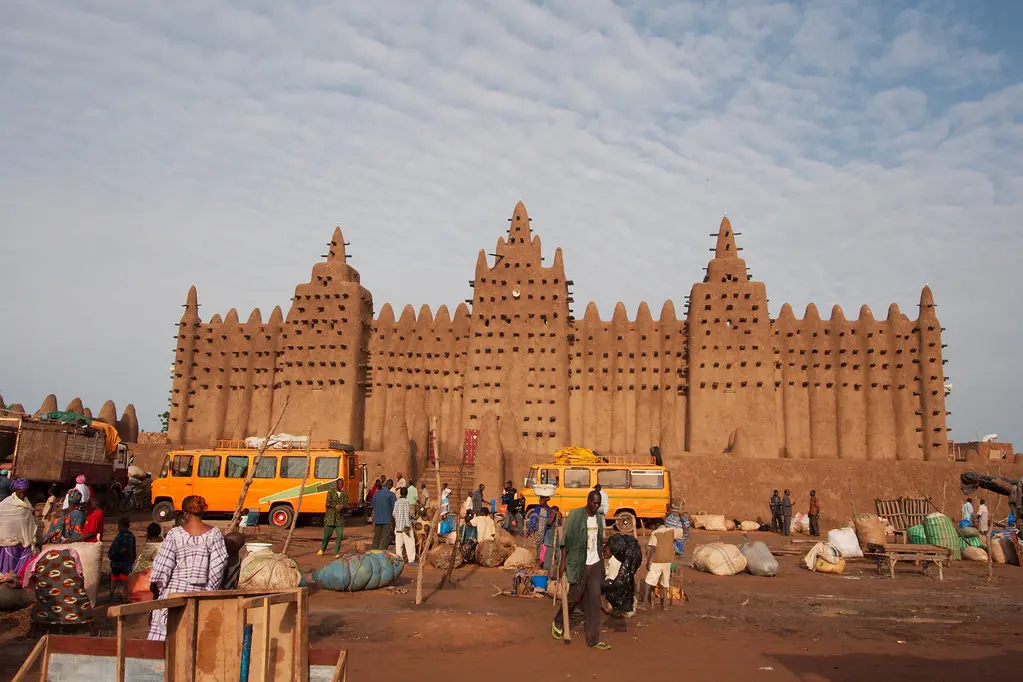
Image of Great Mosque of Djenné. Image source · CC-BY-SA-2.0
Visit essentials
A quick read before you go
- Duration
- A full day allows time to explore the Old Towns and experience the Monday market.
- Access
- Djenné is located approximately 130 km southwest of Mopti (regional capital) and 570 km…
Overview
In the 13th century, a West African king named Koi Konboro converted to Islam and demolished his palace to build a mosque in its place. That original structure is gone now, but its successor rises from the same spot in Djenné, Mali—a building made entirely of sun-dried mud bricks and mud plaster, the largest such structure in the world. Its three minarets pierce the Sahelian sky.
Its walls, studded with projecting wooden beams called toron, glow golden-brown in the morning and evening light.
The mosque is not a static monument. It is alive in a way that stone architecture cannot be. Without annual maintenance, the rains would erode it, and within years it would collapse. So every spring, before the rainy season, the people of Djenné gather for the Crépissage—a festival in which the entire community replasters the mosque together. Young men race up the walls using the toron as scaffolding, carrying mud mixed by hand in pits for weeks before.
Women bring water. Elders supervise. Music and drumming fill the square. The building is renewed, and so is the community's bond to it.
This is what makes the Great Mosque of Djenné unlike any other sacred site in the world: its existence depends on communal faith made physical. The people do not simply worship in this mosque; they rebuild it, year after year, generation after generation. The building is not merely a place of prayer but an embodiment of prayer—devotion made mud, shaped by hands, requiring constant renewal to persist.
Why this place is sacred
What makes a place thin? At the Great Mosque of Djenné, the answer lies in impermanence made sacred. Most sacred architecture is designed to last—stone cathedrals, marble temples, buildings meant to outlive the generations that raised them. The Great Mosque is the opposite: a structure of sun-dried mud that would return to the earth within years if left untended.
This impermanence is not a weakness but a spiritual technology. Because the mosque requires annual renewal, it binds the community in perpetual obligation. Each generation must choose to maintain what the previous generations built. Each year, the faith of Djenné is tested not in doctrine but in action: will we gather, will we mix the mud, will we climb the walls together? The thinness of the place is inseparable from this ongoing commitment.
The founding legend deepens the site's significance. When King Koi Konboro converted to Islam in the 13th century, he demolished his own palace to build the mosque. The transformation of worldly power into sacred space—a king's residence becoming a house of God—gives the site a founding narrative of radical conversion. The current building is not the original; it is the third mosque on the site, rebuilt in 1906-07.
But the continuity of practice, of location, of purpose, persists across the reconstructions.
The architecture itself contributes to the thinness. The walls are not flat but flowing, the surfaces not smooth but textured with the marks of hands. The wooden toron beams project from the facade like spines, casting sharp shadows that shift through the day. The minarets rise organically from the mass of the building, tapering toward the sky. This is architecture that looks grown rather than built, as if the mosque emerged from the floodplain like a living thing.
For Muslims, the mosque is the spiritual center of West African Islam—the most important pilgrimage site in the region, a place where those who cannot reach Mecca come instead. Centuries of continuous worship have accumulated here, Friday prayers upon Friday prayers, Ramadan upon Ramadan. The thinness includes this weight of accumulated devotion.
For non-Muslims, the mosque offers a different kind of encounter. Closed to entry since 1996, it must be experienced from outside. But this limitation has its own power: standing before a building you cannot enter, knowing that thousands of people have rebuilt it with their hands over centuries, knowing that without that communal effort it would dissolve into the earth—this creates its own kind of contemplation. The mosque asks: what would you rebuild every year?
What do you maintain through effort rather than merely possess?
The original mosque was built around 1240 by King Koi Konboro, the twenty-sixth ruler of Djenné and its first Muslim king, after his conversion to Islam. He demolished his palace to build the mosque in its place. The site was intended as a center of Islamic worship and learning in a city that was already a major commercial hub on trans-Saharan trade routes.
The original 13th-century mosque fell into disrepair and was demolished in the early 19th century by the Fulani ruler Seku Amadu, who built a more modest structure. The current mosque—the third on the site—was built in 1906-07 under French colonial administration, reportedly based on the design of the 13th-century original. Master mason Ismaïla Traoré led the construction. In 2009, the southern minaret partially collapsed after heavy rains and was rebuilt.
The mosque was inscribed on the UNESCO World Heritage List in 1988 as part of the Old Towns of Djenné, and placed on the List of World Heritage in Danger in 2016 due to regional instability.
Experience and orientation
The approach to Djenné itself is part of the experience. The town sits on an island in the Bani River, accessible by ferry during the wet season. The landscape is flat, the sky immense. Long before you reach the old town, you see the minarets rising from the plain—three towers against the horizon, announcing the mosque's presence.
Up close, the scale becomes overwhelming. This is the largest mud-brick building in the world, and it looks it: a mass of sun-dried earth rising in flowing walls and tapering towers. The surface is not smooth but textured with the marks of many hands, the application of many years of plaster. The color shifts through the day—golden in the morning light, deep brown at noon, warm ochre as the sun sets.
The wooden toron beams project from the walls at regular intervals. They serve a practical function as permanent scaffolding for the annual replastering, but they also create a distinctive visual rhythm—rows of spines casting sharp shadows that move with the sun. The three minarets rise from conical bases, topped with ostrich eggs symbolizing purity and fertility.
On Mondays, the square before the mosque transforms into one of West Africa's most famous markets. Vendors spread their goods on the ground and under makeshift shelters. The colors of fabrics and produce contrast with the mosque's earth tones. The crowd moves and murmurs. Commerce and worship occupy the same space, as they have for centuries.
You cannot enter the mosque if you are not Muslim. The interior has been closed to non-Muslims since 1996, following a fashion photo shoot that offended local religious sensibilities. This is frustrating for many visitors, but it is also clarifying. The mosque is not a museum. It is an active place of worship, and the community has chosen to protect it from those who might treat it as mere spectacle.
What remains accessible is still substantial: the exterior in all its monumental strangeness, the market, the surrounding old town with its traditional mud-brick houses. The experience is one of witnessing rather than entering—seeing what a community has made and continues to make, understanding that the building exists only because people have chosen, year after year, to maintain it.
The Great Mosque of Djenné is located in the old town of Djenné, in Mali's Mopti Region. The town sits on an island in the Bani River, approximately 130 km southwest of Mopti. The mosque dominates the town's central square, which hosts the famous Monday market. Non-Muslims may view the exterior but not enter the mosque interior (closed since 1996). The surrounding Old Towns of Djenné are a UNESCO World Heritage Site with traditional mud-brick architecture.
If you hope to witness the Crépissage (replastering festival), it typically occurs in April before the rainy season, but timing varies—confirm locally. IMPORTANT: Mali faces significant security challenges. Check travel advisories before planning any visit. Tourism infrastructure has declined; plan transportation and accommodation carefully.
Context and lineage
Around the 13th century, King Koi Konboro ruled as the twenty-sixth sovereign of Djenné. According to oral tradition, he initially persecuted a Muslim cleric named Ismaila, but after supernatural events demonstrated the power of Islam, Koi Konboro converted. As an expression of his new faith, he demolished his own palace and built the first Great Mosque in its place.
This founding act—the transformation of royal residence into sacred space—established the mosque's significance. The king's palace, symbol of worldly power, became a house of God. The gesture was not merely architectural but theological: a demonstration that faith supersedes politics, that the greatest gift a ruler can give is the surrender of his privilege to the divine.
The original 13th-century mosque stood for centuries but eventually fell into disrepair. In the early 19th century, the Fulani ruler Seku Amadu—a reformist who considered the original mosque too grand—demolished it and built a more modest structure. The current mosque was built in 1906-07 under French colonial administration, with funding from the colonial government and construction led by the local master mason Ismaïla Traoré.
It is reportedly modeled on the original 13th-century design, though the degree of fidelity is debated by historians.
The Great Mosque of Djenné represents the Sudano-Sahelian architectural tradition, a distinctive style that emerged from the synthesis of Islamic religious architecture with indigenous West African building techniques. The tradition spread across the Sahel from Mauritania to Sudan. Djenné's mosque is considered its greatest achievement. The building techniques—sun-dried mud bricks (ferey), mud plaster (banco), and wooden toron scaffolding—have been passed down through guilds of masons for centuries. The annual Crépissage represents the continuous transmission of this knowledge.
King Koi Konboro
Founder of the original mosque
Seku Amadu
Fulani ruler who demolished the first mosque
Ismaïla Traoré
Master mason of the current mosque
Traditions and practice
The annual Crépissage (replastering) is the defining ceremony of Djenné. Typically held in April before the rainy season begins, it involves the entire community in the renewal of the mosque. Preparation begins weeks in advance: mud is mixed in pits near the mosque and left to ferment, creating the banco plaster. On the day of the event, young men climb the walls using the toron beams as scaffolding, racing to apply the fresh plaster.
Women and girls carry water from the river. Elders supervise to ensure proper technique. Children participate in age-appropriate ways. Music and drumming accompany the work. Food is prepared and shared.
The Crépissage is simultaneously practical and sacred. Without annual replastering, the rains would erode the walls and the mosque would collapse. But the festival transforms maintenance into celebration, obligation into communal bonding. The entire community participates because the mosque belongs to them all—and because it would cease to exist without their shared effort.
The Hare Festival (Taba ho), held in October, is another significant community event, historically associated with ridding the city of crop-destroying rodents.
Friday prayers (Jumu'ah) gather the community weekly in the mosque. Daily prayers (salat) are observed by individuals throughout the day. Ramadan observances center on the mosque, with nightly tarawih prayers and communal iftar meals. Islamic holidays (Eid al-Fitr, Eid al-Adha, Mawlid) bring special gatherings. The Monday market continues as it has since medieval times, filling the square before the mosque with vendors and buyers from the region.
Non-Muslim visitors cannot enter the mosque interior but may observe the exterior and participate in the Monday market. If timing allows, witnessing the Crépissage festival is a profound experience of communal faith in action—though visitors should maintain respectful distance and seek local guidance on appropriate behavior. The Old Towns of Djenné offer walking tours through traditional mud-brick architecture.
Sunni Islam (Maliki school)
ActiveThe Great Mosque of Djenné is the largest mud-brick mosque in the world and the most significant Islamic structure in Sub-Saharan Africa. It represents the spread of Islam across West Africa beginning in the medieval period and the development of a distinctive regional architectural tradition. The mosque has served as a center of Islamic learning since the 13th century, attracting scholars and students from across the Sahel. For West African Muslims who cannot afford the hajj to Mecca, a pilgrimage to Djenné serves as an important regional substitute, making it the most visited pilgrimage site in West Africa.
Friday prayers (Jumu'ah) gather the community weekly. Daily prayers (salat) are observed throughout the day. The annual Crépissage (replastering) festival before the rainy season is a major communal event that transforms practical maintenance into religious celebration. Ramadan is observed with nightly tarawih prayers and communal iftar meals. Islamic holidays (Eid al-Fitr, Eid al-Adha, Mawlid an-Nabi) bring special gatherings. The Monday market, held since medieval times, combines commerce with religious community.
Perspectives and open questions
The Great Mosque of Djenné invites interpretation from multiple angles: as an architectural achievement, as a center of West African Islam, as a living building requiring communal maintenance, and as a case study in heritage under threat.
Scholarly perspective
Art historians consider the Great Mosque of Djenné the greatest achievement of Sudano-Sahelian architecture and one of the most significant religious buildings in Africa. The style represents the synthesis of Islamic religious requirements with indigenous West African building techniques—mud brick construction adapted to serve the needs of congregational prayer and Islamic ritual.
The current building (1906-07) is a reconstruction under French colonial administration. How closely it reflects the 13th-century original is debated. Some scholars argue that colonial-era reconstructions imposed external interpretations; others note that the construction was led by local masons using traditional techniques. The annual Crépissage is recognized as a remarkable example of living heritage—intangible cultural practice maintaining tangible architecture.
The site's placement on UNESCO's List of World Heritage in Danger in 2016 reflects the broader crisis facing Malian heritage sites in the context of regional instability.
Living and traditional perspectives
For the people of Djenné and Muslims throughout West Africa, the mosque is not a historical artifact but a living center of worship and community life. The annual Crépissage embodies the Islamic principle of communal responsibility (fard kifaya)—an obligation shared by the community as a whole. The fact that the mosque requires constant maintenance is not a problem to be solved but a spiritual opportunity: each year, the community renews its physical commitment to the faith.
Djenné serves as West Africa's most important pilgrimage destination, a regional substitute for those who cannot reach Mecca. The founding legend of Koi Konboro—the king who demolished his palace to build a mosque—represents the transforming power of Islam and the proper relationship between worldly and spiritual authority.
Alternative interpretations
Some visitors experience the mosque's organic mud forms as representing an architecture in harmony with the earth—a building that emerges from and must return to the ground. The need for annual replastering creates a living structure that embodies the cyclical nature of time. The building has been described as 'meditation in mud,' an architecture that refuses the permanence sought by stone monuments.
The closure of the interior to non-Muslims has paradoxically enhanced certain visitors' appreciation—experiencing the building only from outside emphasizes its character as a living religious space rather than a tourist site.
Open questions
Several mysteries surround the mosque. The exact appearance of the original 13th-century building is unknown; no images or detailed descriptions survive. How closely the 1907 reconstruction follows the original is debated. The interior, closed to non-Muslim scholars since 1996, has not been comprehensively documented or photographed. The degree to which pre-Islamic architectural traditions influenced the Sudano-Sahelian style remains unclear. How the building will survive ongoing regional instability is uncertain.
Plan your visit
Access and arrival
Djenné is located approximately 130 km southwest of Mopti (regional capital) and 570 km northeast of Bamako (national capital). Access is by road from Mopti, with a ferry crossing required when the Bani River is high. Transport is most readily available on Mondays due to the market. IMPORTANT: Mali faces significant security challenges. The region has experienced armed conflict, and the Old Towns of Djenné were placed on UNESCO's List of World Heritage in Danger in 2016.
Check current travel advisories before planning any visit. Consider traveling with a reputable guide or tour operator with local knowledge.
Tourism infrastructure in Djenné has severely declined due to regional instability. Hotels that once operated have closed. Homestays may be arranged locally. Mopti, 130 km away, has more accommodation options. Plan carefully and confirm arrangements before traveling.
Respectful visit
Modest dress throughout Djenné. Women should cover shoulders and knees; head covering appreciated but not required outside the mosque. Men should avoid shorts. Light, breathable fabrics are practical given the heat.
Exterior photography of the mosque is permitted. Ask permission before photographing people—some are wary of cameras. Do not attempt to photograph inside the mosque. Early morning and late afternoon offer the best light for the mud walls.
Not applicable for non-Muslim visitors.
Non-Muslims cannot enter the mosque interior (closed since 1996). Respect prayer times. Do not climb on the mosque or touch the walls without permission.
Non-Muslims have been barred from the mosque interior since 1996; do not attempt to enter. Some locals are wary of photographers due to past incidents; always ask permission before photographing people. Mali faces significant security challenges; check travel advisories before visiting. Tourism infrastructure has declined; plan carefully.
Current practical details
Address
WC4V+3R8, Djenne, Mali
Phone
Hours, fees, and access can change — verify on the official source before you travel. Practical details last checked Jun 2026.
Location
Map loads as you approach this section.
Pilgrim reflections
A portrait of encounter, not a score
Pilgrims describe what they felt, how present they could become, and whether the place would shape a journey. There are no stars and no ranking of traditions.
No reviewed reflections yet
The first pilgrims can help describe the character of being here.
Share a reflection
Available after an account-backed “Been there.” Every reflection is reviewed before publication.
Nearby sacred places
Explore other sacred places in the region. Proximity does not establish access or travel time; check each place’s guidance.


References
Sources consulted for this page. Source categories describe the publication, not a guarantee that every claim is verified. Traditional accounts and outside interpretations may differ.
- 01Old Towns of Djenné - UNESCO World Heritage Centre — UNESCOofficialOfficial UNESCO listing and description
- 02Great Mosque of Djenné - Smarthistory — SmarthistoryacademicArt historical analysis
- 03Great Mosque of Djenné (article) - Khan Academy — Khan AcademyacademicEducational resource on art history
- 04Great Mosque of Djenné - Wikipedia — Wikipedia contributorsencyclopediaComprehensive overview
- 05Djenne - World Pilgrimage Guide — Sacred SitesofficialPilgrimage context
- 06Grande Mosquée - Lonely Planet — Lonely PlanetguideVisitor information
Share a photo
Help visitors recognize Great Mosque of Djenné. Every submission is reviewed before publication.