Ganden Monastery
The birthplace of the Gelug school, destroyed and rebuilt on a mountaintop above Lhasa
Understand sacred places, explore living traditions, and learn how to engage respectfully with Pilgrim Map.
Access has not been verified. Check current local guidance before planning a visit.
Lhasa, Tibet Autonomous Region, China
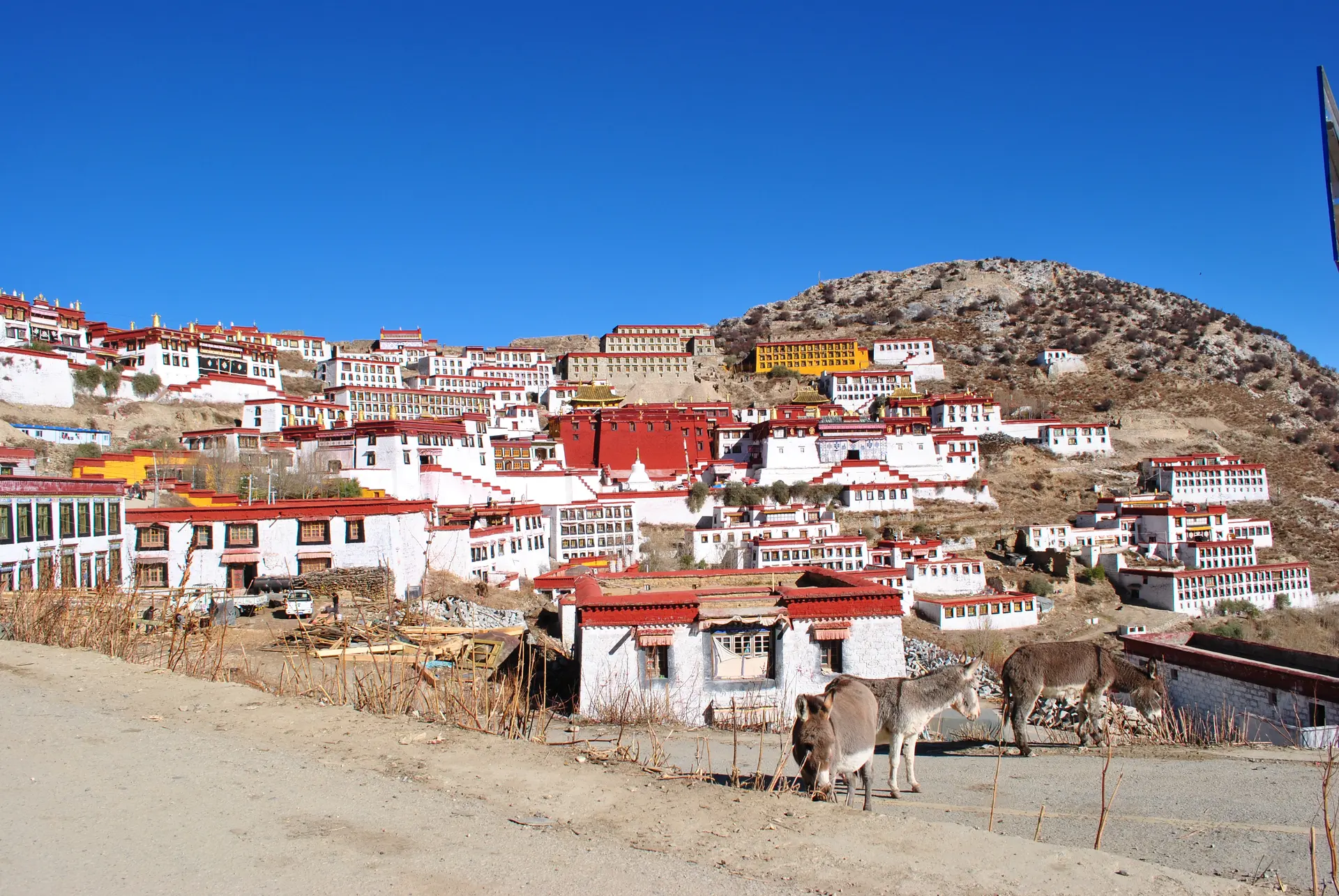
Image of Ganden Monastery. Image source · CC-BY-3.0
Visit essentials
A quick read before you go
- Duration
- Half day minimum.
- Access
- Located 47 km east of Lhasa, approximately one and a half to two hours by car.
Overview
Forty-seven kilometers from Lhasa, Ganden Monastery occupies a mountain amphitheater at 4,300 meters, its white-and-ochre buildings against the dark mountain appearing permanent. They are not. More than ninety percent of its structures were destroyed between 1959 and the late 1960s by artillery, dynamiting, and dismantling stone by stone; Tsongkhapa's golden stupa was smashed, the libraries burned, and the walls leveled. Since the 1980s, monks and laypeople have rebuilt it from memory in a slow, persistent act of cultural resurrection.
Several hundred monks—far fewer than the former five thousand—again sustain Gelug debate, prayer assemblies, and annual festivals. Already the most influential Buddhist teacher of his generation, Tsongkhapa founded Ganden in 1409 after a vision indicated the mountain. He revitalized monastic discipline, systematized philosophical education, established Lhasa's Great Prayer Festival, composed his most important works here, and trained disciples who founded Drepung and Sera.
When he died in 1419, his body was said to show signs of high realization, and his stupa became the Gelug school's most sacred relic. Ganden means `Joyful`, invoking Tushita Heaven, where the future Buddha Maitreya waits and Tsongkhapa is believed to reside; the earthly monastery reflects that abode. Its destruction and rebuilding give severe material form to Tsongkhapa's teaching that all phenomena are impermanent.
Why this place is sacred
The quality that sets Ganden apart from other Tibetan monasteries is what is no longer here and what has returned despite its absence.
The first quality is the founder's presence. Tsongkhapa is not a historical figure at Ganden in the way that a museum preserves a historical figure. He is understood as a living presence — an emanation of Manjushri, the bodhisattva of wisdom, who continues to bless the site from the celestial realm of Tushita. His golden stupa, destroyed and rebuilt, is the physical anchor of this presence.
Pilgrims who touch their foreheads to the stupa are not commemorating the dead but connecting to the living.
The second is the debate. Gelug monasteries are defined by the tradition of formal philosophical debate — monks confronting each other with logical challenges, the answering monk standing while the questioning monk punctuates each challenge with a sharp handclap. The sound of debating monks at Ganden, echoing off stone walls rebuilt from rubble, is not a reenactment. It is a reassertion. The tradition was silenced and has spoken again.
The third is the mountain itself. At 4,300 meters, Ganden sits above most of the world. The kora path that circumambulates the monastery follows the mountain ridge, offering panoramic views of the Kyi Chu valley below and the ranges beyond. The physical elevation mirrors the monastery's spiritual aspiration: to rise above the confusion of the ordinary world.
The fourth is destruction as teaching. For a Buddhist institution, the experience of total loss is not merely tragic. It is instructive. Everything Tsongkhapa taught about impermanence was verified in the most brutal possible way when his monastery was reduced to rubble. That it has been rebuilt demonstrates something else he taught: that the Dharma is indestructible, not because its institutions cannot be destroyed but because its practitioners will rebuild them.
The fifth is the Ganden Tripa — the Throne Holder of Ganden, who is the spiritual head of the Gelug school. This position is formally more important within the school's hierarchy than even the Dalai Lama's role. The Ganden Tripa's residence at this rebuilt monastery maintains the institutional continuity that connects the present to Tsongkhapa's founding vision.
Tsongkhapa founded Ganden as the headquarters of his reform movement within Tibetan Buddhism. The monastery was designed to embody his vision of rigorous monastic discipline, systematic philosophical education through the five great treatises, and the gradual path to enlightenment (lamrim). It was both a monastery and a statement — a declaration that Buddhism in Tibet would be renewed through study, debate, and ethical conduct.
For over five centuries, Ganden grew into one of Tibet's three great Gelug monasteries (alongside Drepung and Sera), housing over five thousand monks at its peak. The monastery's destruction began in 1959 when it was shelled during the Lhasa uprising, and continued through the Cultural Revolution, when over ninety percent of structures were demolished. Reconstruction began in the 1980s and continues today.
The current monastery operates at a fraction of its historical capacity, with several hundred monks in residence under significant political constraints. Despite these limitations, Ganden functions as an active Gelug institution: monks study, debate, perform rituals, and maintain the calendar of festivals that Tsongkhapa established.
Experience and orientation
The drive from Lhasa takes ninety minutes to two hours on a road that climbs steadily through the Kyi Chu valley before ascending steeply to the monastery. The final switchbacks offer increasingly dramatic views as the monastery complex comes into focus, spread across the mountain's natural amphitheater.
Arriving at Ganden, the first impression is of scale and exposure. The buildings occupy a mountain ridge at 4,300 meters, open to sky on all sides. The air is thin. The light is intense. The views extend across the valley to snow-capped ranges. There is nowhere to hide from the altitude or the landscape.
The monastery complex invites exploration without demanding a specific route. The Serdung Lhakhang (Golden Tomb Chapel) houses the rebuilt stupa of Tsongkhapa and is the spiritual center. The Tsokchen (Great Assembly Hall) is where monks gather for prayer. The two main colleges — Shartse (Eastern) and Jangtse (Northern) — continue the educational mission. Throughout the complex, the evidence of reconstruction is visible: new stonework against old foundations, bright paint on rebuilt walls, modern materials filling gaps left by dynamite.
The debate courtyard is where Ganden's ongoing life is most vivid. In the afternoon, monks gather for formal philosophical debate. The questioning monk stands, the answering monk sits, and each challenge is accompanied by a sharp handclap — the sound carries across the mountain. Watching the debate, you are seeing the tradition that Tsongkhapa established in 1409, interrupted by violence and resumed by persistence. The monks are not performing for visitors.
They are doing what monks at Ganden have always done.
The kora path is the experience that opens the widest view, both literally and spiritually. The circumambulation of the mountain ridge takes approximately ninety minutes and reaches over 4,500 meters at its highest point. The path passes rock formations identified as self-arisen deity images, offering cairns draped with prayer flags, and a sky-burial site that pilgrims consider especially auspicious.
The views are panoramic and continuous — the Kyi Chu valley below, the ranges extending to the horizon, the monastery below your feet. Walking the kora alongside Tibetan pilgrims, sharing the effort of altitude and the reward of the view, produces a solidarity that requires no shared language.
Arrive in the morning to observe morning prayers and explore the complex before the afternoon debate sessions. Allow time for the kora in the afternoon. Bring warm layers, sturdy footwear for the kora path, water, and sun protection. Move slowly at this altitude. If the Ganden Ngamchoe (Lamp Festival) coincides with your visit, expect an especially moving experience.
Context and lineage
Tsongkhapa chose the site after receiving a vision indicating this mountain. In 1409, at age fifty-two, he led a group of disciples to the ridge and established the monastery. He had already transformed the religious landscape of Tibet through the Great Prayer Festival in Lhasa and through his writings on the gradual path.
At Ganden, he created the institutional model that the Gelug school would replicate across Tibet: rigorous monastic discipline, systematic philosophical education through debate, and an emphasis on ethical conduct as the foundation of spiritual progress.
He composed many of his most important works at Ganden, including teachings on the middle way philosophy and tantric practice. He trained the disciples who would establish Drepung and Sera monasteries, completing the trio of great Gelug institutions around Lhasa. When Tsongkhapa died at Ganden in 1419, his body was said to have displayed signs of high realization — shrinking, emitting light, and remaining in a meditative posture.
His stupa, enshrined in the Serdung Lhakhang, became the Gelug school's most sacred relic.
Ganden is the mother monastery of the Gelug school, the youngest of the four major schools of Tibetan Buddhism but now the most widespread. The Gelug lineage traces through Tsongkhapa to Atisha's Kadampa tradition, which itself drew on the Indian Buddhist philosophical schools. From Ganden, Tsongkhapa's disciples established Drepung (1416) and Sera (1419), creating the institutional infrastructure that would, through the institution of the Dalai Lama, come to dominate Tibetan religious and political life from the seventeenth century onward.
Je Tsongkhapa (1357-1419)
Founder of the Gelug school and of Ganden Monastery. One of the most influential figures in Tibetan Buddhist history, he systematized the gradual path to enlightenment, revitalized monastic discipline, and established the institutional framework that shaped Tibetan Buddhism for six centuries. Considered an emanation of the bodhisattva Manjushri.
Ganden Tripa (Throne Holder of Ganden)
The spiritual head of the Gelug school, a position that rotates among senior scholars rather than passing through reincarnation. The Ganden Tripa's role is formally more important within the school's internal hierarchy than the Dalai Lama's, though the Dalai Lama holds greater public and political visibility.
Traditions and practice
The Gelug monastic curriculum at Ganden is structured around the five great treatises: logic, Prajnaparamita (perfection of wisdom), Madhyamaka (middle way philosophy), Abhidharma (phenomenology), and Vinaya (monastic discipline). Monks advance through this curriculum over approximately twenty years, with formal philosophical debate as the primary method of examination.
Butter sculpture offerings during the Monlam (Great Prayer Festival), sacred dance (cham) performances during major festivals, and the annual Ganden Ngamchoe (Lamp Festival) on the 25th day of the 10th Tibetan month — commemorating Tsongkhapa's death with thousands of butter lamps — are the major ceremonial observances.
Monastic education and debate continue at reduced scale. Daily prayers and offerings at the main chapels are maintained. The Ganden Ngamchoe remains the most important annual observance, when butter lamps fill every surface and the monastery glows against the mountain darkness. Pilgrims perform kora throughout the year. Monks may perform rituals on request for visiting pilgrims.
Walk the kora. The ninety-minute circumambulation of the mountain ridge is the single experience that most fully communicates what Ganden means. The path is not gentle — it reaches over 4,500 meters — but the altitude and the effort are part of the teaching. Walk alongside Tibetan pilgrims if possible. Their pace, their offerings at the cairns, their prostrations at the auspicious points along the route, will show you how the path is intended to be walked.
Inside the monastery, spend time at the debate courtyard if monks are debating (usually afternoon). The sharp handclap, the rapid-fire exchange, the laughter that punctuates a well-made logical point — this is Gelug Buddhism in its most characteristic form. The tradition that Tsongkhapa founded is not a tradition of silent meditation but of rigorous intellectual engagement.
At the Serdung Lhakhang, light a butter lamp or present a khatag (white scarf). The rebuilt stupa of Tsongkhapa is the site's spiritual heart. Whether or not you share the faith that his blessings are present in the rebuilt reliquary, the act of honoring a teacher whose influence has shaped the lives of millions carries its own weight.
Gelug Buddhism
ActiveGanden is the mother monastery of the Gelug school, founded by Tsongkhapa in 1409. The Ganden Tripa (Throne Holder) is the formal spiritual head of the Gelug school. The monastery houses Tsongkhapa's stupa and relics, making it the school's most sacred pilgrimage site.
Perspectives and open questions
Ganden raises questions about what survives destruction, what rebuilding means when the destroyers remain in authority, and whether a tradition can be killed by demolishing its buildings.
Scholarly perspective
Scholars view Ganden as the institutional birthplace of the Gelug school, the dominant force in Tibetan religious and political life from the seventeenth century onward. The monastery's destruction is documented as part of the systematic dismantling of Tibetan religious institutions during the Cultural Revolution. Its reconstruction is studied as an example of cultural resilience under authoritarian conditions, though scholars note that the rebuilt institution operates under significant state oversight and cannot be considered a free expression of Tibetan religious life.
Living and traditional perspectives
For Tibetans, Ganden is the living seat of Tsongkhapa's blessing. The monastery's destruction is understood within Buddhist frameworks of impermanence and the degeneration of the Dharma, while its rebuilding represents the indestructibility of the Dharma itself. Pilgrims who circumambulate Ganden and make offerings at Tsongkhapa's stupa are generating merit and receiving a direct transmission of blessing that transcends the physical condition of the buildings.
Alternative interpretations
In Tibetan geomantic traditions, Ganden's mountaintop position occupies a site of exceptional spiritual power, with the surrounding landscape forming a natural mandala. Some practitioners consider the mountain a ney — a power place where the boundary between physical and spiritual worlds is unusually permeable. The experience of destruction and rebuilding, viewed through this lens, represents the purification and renewal of a sacred site rather than its diminishment.
Open questions
Whether any texts or relics from the original monastery were secretly preserved before or during the destruction remains an open question in Tibetan exile communities. Whether Tsongkhapa's original remains survived the smashing of his stupa is unknown. The complete history of the Ganden Tripa lineage and how the succession process has been affected by political circumstances has not been fully documented.
Plan your visit
Access and arrival
Located 47 km east of Lhasa, approximately one and a half to two hours by car. Pilgrim buses depart from Lhasa's Barkhor area in the morning (early departure, limited schedule). The road climbs steeply to the monastery. Foreign visitors require a Tibet Travel Permit (TTP) and must travel with a licensed Tibetan tour guide. Permits are arranged through a registered travel agency. The monastery sits at approximately 4,300 meters — acclimatize in Lhasa for at least two to three days.
The kora path reaches over 4,500 meters. Bring water, move slowly, and watch for signs of altitude sickness. Mobile phone signal is generally available at the monastery. No medical facilities on site.
No accommodation at Ganden. Visitors return to Lhasa the same day. Lhasa offers a full range of hotels and guesthouses.
Respectful visit
Modest dress covering shoulders and knees. Warm layers essential at 4,300 meters. Sturdy footwear for the kora path.
Exterior photography is generally permitted. Interior photography in chapels usually requires a fee or may be prohibited, especially in the Serdung Lhakhang. Always ask before photographing monks. Do not photograph political slogans or patriotic education materials.
Butter lamp oil, khatags (white scarves), and small monetary donations are appropriate. Offerings may be placed at altars in chapels.
Walk clockwise. Remove hats in chapels. Do not touch statues. Do not discuss politics with monks. Do not photograph political materials. The monastery may close without notice during sensitive periods.
The monastery sits at 4,300 meters, and the kora path exceeds 4,500 meters. Altitude sickness is a real risk. Acclimatize in Lhasa for at least two to three days before visiting. The kora path traverses uneven mountain terrain — sturdy footwear is essential. Bring water and sun protection. Weather can change rapidly at this altitude. The monastery may be closed without notice during politically sensitive periods.
Current practical details
Address
QF4G+5QX, Dagzê District, Lhasa, Tibet, China, 850113
Hours, fees, and access can change — verify on the official source before you travel. Practical details last checked Jun 2026.
Location
Map loads as you approach this section.
Pilgrim reflections
A portrait of encounter, not a score
Pilgrims describe what they felt, how present they could become, and whether the place would shape a journey. There are no stars and no ranking of traditions.
No reviewed reflections yet
The first pilgrims can help describe the character of being here.
Share a reflection
Available after an account-backed “Been there.” Every reflection is reviewed before publication.
Nearby sacred places
Explore other sacred places in the region. Proximity does not establish access or travel time; check each place’s guidance.

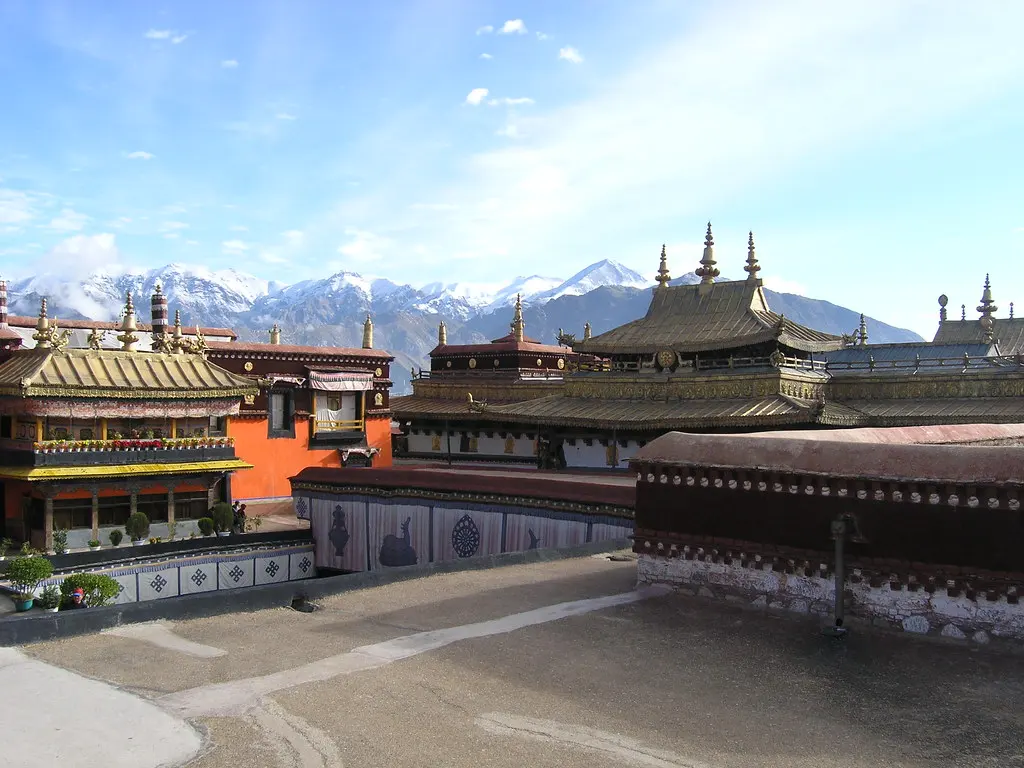


Photo gallery
3 curated photos
Pilgrim glossary
- Bodhisattva
- An enlightened being who postpones full nirvana to help others toward awakening.
- Stupa
- A dome-shaped Buddhist monument that holds relics or marks a sacred place.
- Mandala
- A symbolic diagram of the cosmos used in meditation and ritual.
- Dharma
- The teachings of the Buddha; also the universal law underlying them.
Share a photo
Help visitors recognize Ganden Monastery. Every submission is reviewed before publication.