Drukyal Dzong
A fortress of victory burned to ruin and rising again, at the gateway to sacred Chomolhari
Understand sacred places, explore living traditions, and learn how to engage respectfully with Pilgrim Map.
Access has not been verified. Check current local guidance before planning a visit.
Nyechhu_Shar-ri, Paro, Bhutan
Read the sources
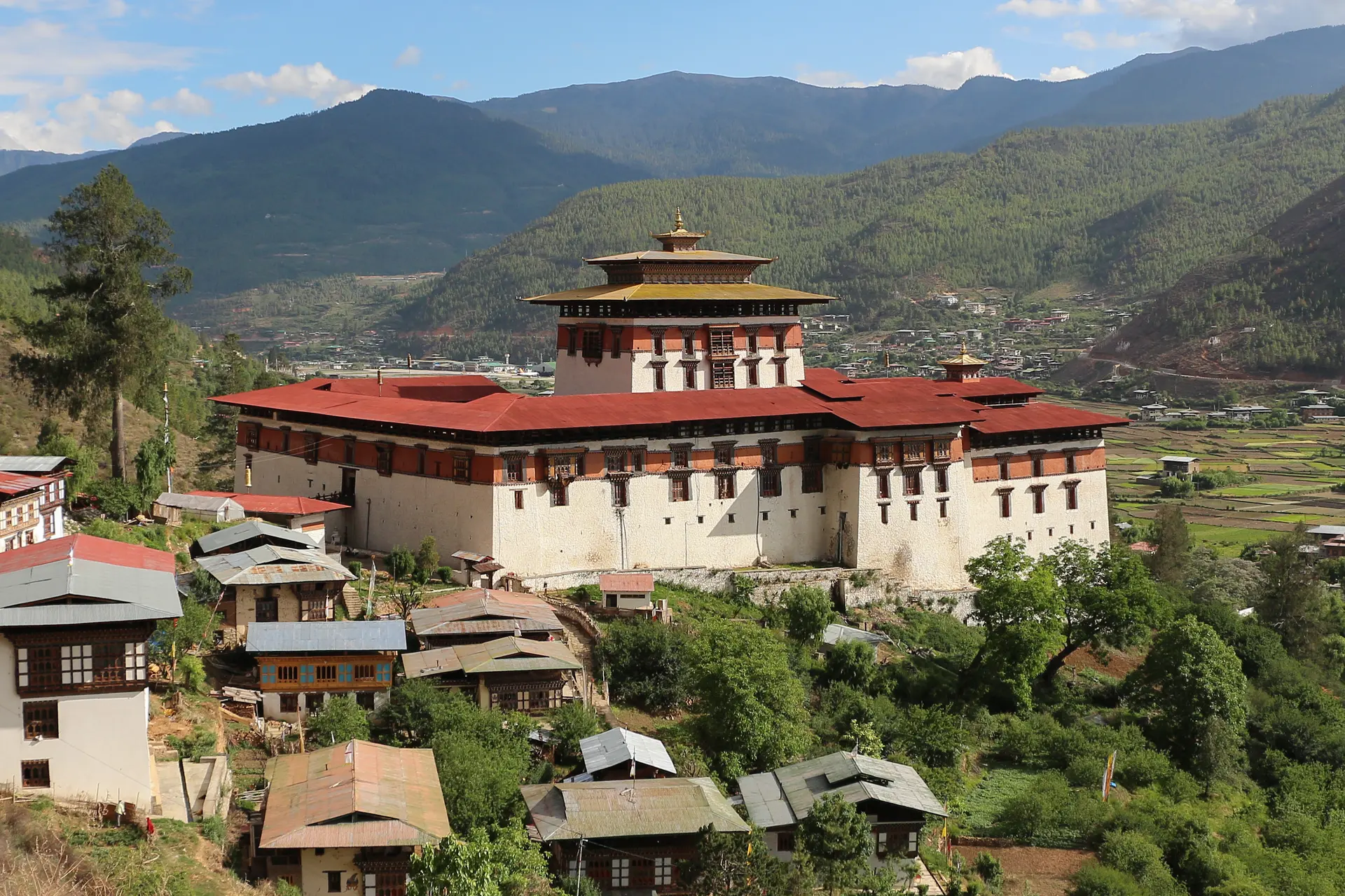
Image of Drukyal Dzong. Image source · CC-BY-SA-4.0
Visit essentials
A quick read before you go
- Duration
- 1-2 hours
- Access
- Located approximately 18km from Paro town at the head of the Paro Valley.
Overview
At the upper end of the Paro Valley, where the road narrows toward Tibet and Chomolhari rises in the distance, Zhabdrung Ngawang Namgyal ordered a fortress built to mark a victory. In 1649, the second Paro Penlop, Tenzin Drukdra, constructed Drukgyel Dzong—the Fortress of the Victorious Drukpas—near the Tibetan border. Unlike dzongs serving both administrative and religious functions, Drukgyel was built for defense alone; massive stone walls and a false entrance were designed to repel invasion.
After holding its position for three centuries, the fortress burned in 1951, whether from a butter lamp or a deliberate act remains unclear. Its blackened walls and empty windows became one of Bhutan's most photographed ruins, framing Chomolhari with an eloquence the intact fortress could never have achieved.
Since 2016, the Bhutanese government has restored approximately ninety percent of the dzong. Marking the four hundredth anniversary of the Zhabdrung's arrival and the Crown Prince's birth, the project reconnects the fortress to Bhutanese sovereignty: victory, destruction, and renewal form one ongoing story.
Why this place is sacred
Drukgyel Dzong is not a temple or a meditation site. Its thinness is of a different order — the kind that arises when a place embodies a paradox so completely that being there forces reflection. The fortress was built to endure, to defend, to stand as permanent testimony to Drukpa victory. Its walls were 2.5 metres thick. Its entrance was designed to deceive enemies. Its strategic position guarded the border with Tibet.
And yet fire took it in a single night.
The ruins, for the decades they stood open to the sky, taught a lesson that the intact fortress could not. Every Bhutanese schoolchild who visited learned not about military architecture but about impermanence — the central teaching of the Buddhist tradition that the fortress was built to protect. There is an irony here that is not bitter but clarifying.
Now the restoration adds another layer. The fortress rises again, rebuilt with the care and intention of the original construction, but with the knowledge of what happened before woven into every stone. This is not denial of impermanence but a creative response to it — the understanding that rebuilding is as much a part of the story as building and burning.
Military fortress built to defend the Paro Valley and commemorate victory over Tibetan-Mongol forces.
From active fortress (1649-1951) to fire-ruined monument to UNESCO Tentative List site (2012) to ongoing restoration (2016-present). The site's meaning has shifted from military defense to cultural heritage to meditation on impermanence.
Experience and orientation
The drive to Drukgyel Dzong follows the Paro Valley upstream, past rice paddies and farmhouses, to where the valley narrows and the mountains close in. The fortress occupies a hilltop at this strategic pinch point, its walls visible from a distance.
Approaching on foot, the scale of the construction becomes apparent. The stone masonry walls, massive and steeply sloped, enclosed the entire inner space of the dzong with only a single entrance — and that entrance was a trap, designed with a false passage to lure returning invaders into a courtyard where they could be attacked from above. This architecture of deception is part of the site's character, a reminder that the fortress was built not for beauty but for survival.
Inside, sections of the dzong show the progress of restoration alongside areas where the fire's damage remains visible. The transition between original stonework, fire-blackened walls, and fresh reconstruction creates a palimpsest of time that no single period could provide. On clear days, Mount Chomolhari appears at the valley's end — a sacred peak that the fortress was positioned to protect the approach to.
Walk the perimeter before entering to appreciate the defensive position and the scale of the walls. Inside, notice where original stone meets restoration work — the seam between them is the most interesting surface in the complex. If Chomolhari is visible, stand where the mountain and the fortress walls are in the same frame. This is the view that has meant something to Bhutanese for nearly four centuries.
Context and lineage
In the 1640s, a combined Tibetan and Mongol force invaded Bhutan but was repelled by forces loyal to the Zhabdrung Ngawang Namgyal. To commemorate this victory and guard against future incursions, the Zhabdrung ordered the construction of a fortress at the head of the Paro Valley, naming it Drukgyel Dzong — the Fortress of the Victorious Drukpas. It was built by Tenzin Drukdra, who served as the second Paro Penlop.
The fortress was purely military, without the administrative or religious functions that characterized other Bhutanese dzongs.
Drukgyel Dzong belongs to the network of fortresses built during the Zhabdrung's unification of Bhutan, representing the military dimension of the dual spiritual-temporal authority that defined the early Bhutanese state.
Zhabdrung Ngawang Namgyal
Ordered the fortress's construction after repelling the Tibetan-Mongol invasion
Tenzin Drukdra
Second Paro Penlop; built the fortress in 1649
Traditions and practice
The fortress historically housed a garrison and may have contained a chapel, as was common in Bhutanese dzong architecture.
Under active restoration. The site serves as a place of national heritage and cultural education.
Walk the ruins and restoration slowly. Consider the cycle of building, destruction, and rebuilding as a form of teaching. On a clear day, sit where Chomolhari is visible and let the mountain's permanence contrast with the fortress's story.
Bhutanese State Buddhism
HistoricalDrukgyel Dzong represents the military dimension of the Zhabdrung's dual system of spiritual and temporal authority — the principle that defending the dharma is itself a sacred act.
Historical garrison function. Currently under restoration as a national heritage site.
Perspectives and open questions
Drukgyel Dzong operates at the intersection of military history, sacred geography, and the Buddhist teaching of impermanence.
Scholarly perspective
Architectural historians note the fortress's unusual purely defensive design and its innovative false entrance, which distinguish it from other Bhutanese dzongs. Its placement on the UNESCO Tentative List recognizes its significance as an example of Himalayan military architecture and its role in the formation of the Bhutanese state.
Living and traditional perspectives
For the Bhutanese, Drukgyel Dzong represents the moment when the Drukpa people proved they could defend their sovereignty and their dharma against external aggression. The name itself — Fortress of the Victorious Drukpas — carries this meaning in every syllable.
Alternative interpretations
The fortress's destruction and rebuilding can be read as a large-scale enactment of the Buddhist sand mandala tradition — creation, dissolution, and recreation as a practice of non-attachment. The fire that destroyed the dzong did not end its story but opened a new chapter.
Open questions
Whether the 1951 fire was accidental (from an unattended butter lamp) or deliberate remains an unresolved question in Bhutanese history.
Plan your visit
Access and arrival
Located approximately 18km from Paro town at the head of the Paro Valley. Accessible by road. No entry fee.
Hotels in Paro town, approximately 18km south
Respectful visit
Comfortable walking shoes for uneven terrain. No specific dress requirements.
Generally permitted. Some restoration areas may be restricted.
Not applicable.
Stay within permitted areas | Do not climb on walls or ruins | Follow posted restoration zone restrictions | Do not remove any material from the site
Some areas may be closed due to ongoing restoration work. The terrain is uneven. Follow any posted restrictions.
Current practical details
Address
Bhutan
Hours, fees, and access can change — verify on the official source before you travel. Practical details last checked Jun 2026.
Location
Map loads as you approach this section.
Pilgrim reflections
A portrait of encounter, not a score
Pilgrims describe what they felt, how present they could become, and whether the place would shape a journey. There are no stars and no ranking of traditions.
No reviewed reflections yet
The first pilgrims can help describe the character of being here.
Share a reflection
Available after an account-backed “Been there.” Every reflection is reviewed before publication.
Nearby sacred places
Explore other sacred places in the region. Proximity does not establish access or travel time; check each place’s guidance.


References
Sources consulted for this page. Source categories describe the publication, not a guarantee that every claim is verified. Traditional accounts and outside interpretations may differ.
- 01Drukgyal Dzong - WikipediaencyclopediaComprehensive overview
- 02Ancient Ruin of Drukgyel Dzong - UNESCO — UNESCOSource contextOfficial UNESCO listing
- 03Drukgyel Dzong - Druk Asia — Druk AsiaguideHistorical and visiting details
- 04Drukgyel Dzong Guide — WanderonguidePractical information
- 05Drukgyel Dzong - Atlas Obscura — Atlas ObscuraguideCultural context
Pilgrim glossary
- Mandala
- A symbolic diagram of the cosmos used in meditation and ritual.
- Dharma
- The teachings of the Buddha; also the universal law underlying them.
Share a photo
Help visitors recognize Drukyal Dzong. Every submission is reviewed before publication.