Domus de Janas di Borucca
A Neolithic tomb carved from a tilted granite boulder in Sardinia's fairy house tradition
Understand sacred places, explore living traditions, and learn how to engage respectfully with Pilgrim Map.
Access has not been verified. Check current local guidance before planning a visit.
Budduso, Sassari, Italy
Read the sources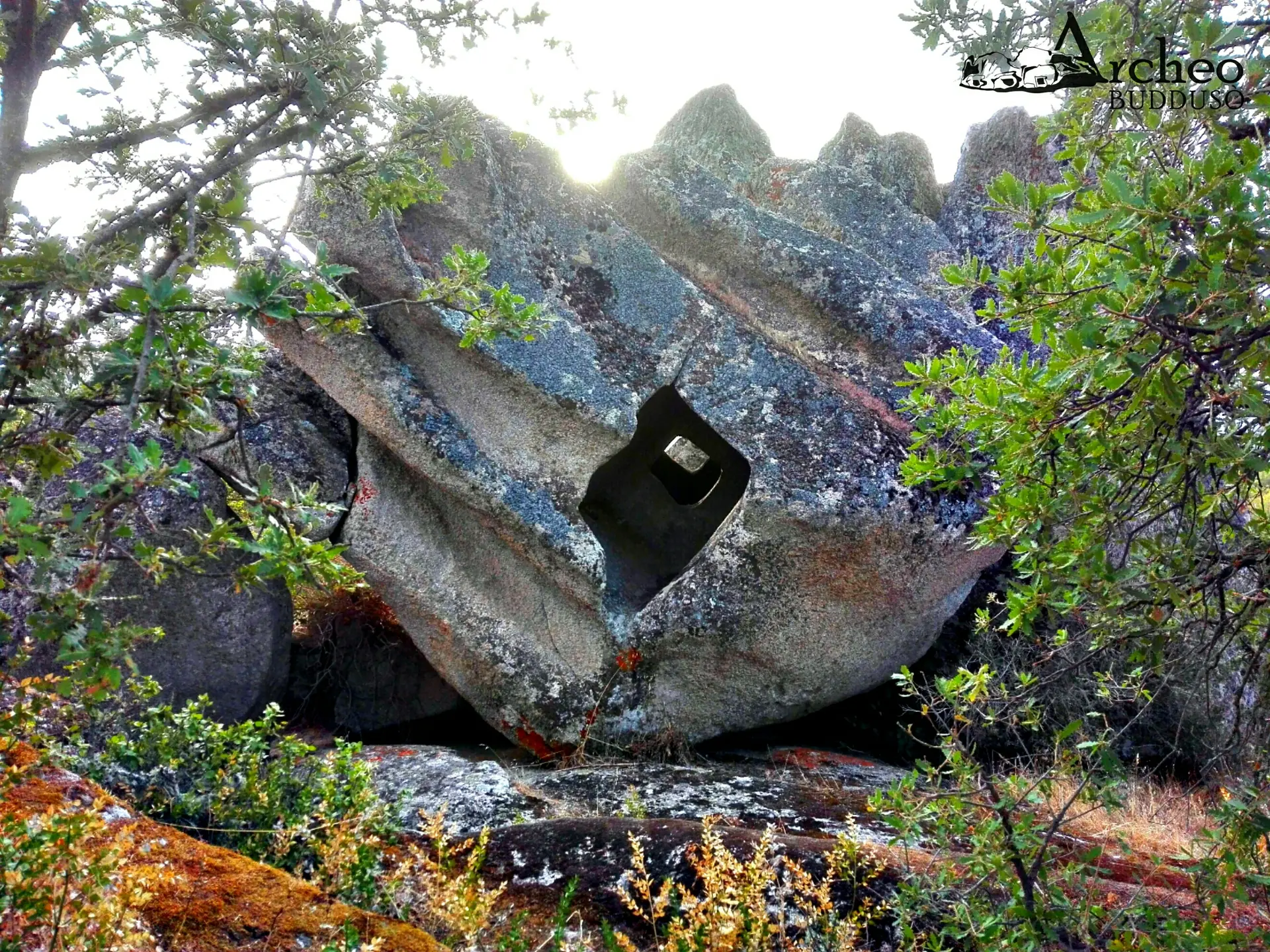
Image of Domus de Janas di Borucca. Image source · CC-BY-SA-4.0
Visit essentials
A quick read before you go
- Duration
- 20-30 minutes on site
- Access
- By car from Budduso.
Overview
About five hundred metres north of Budduso on the road to Ala dei Sardi, the Domus de Janas di Borucca is a single Neolithic tomb carved into granite. It belongs to Sardinia's pre-Nuragic domus de janas—“fairy houses”—cut between roughly 3400 and 2700 BC.
Three modest spaces form the tomb: an antechamber with a cup mark, a chamber, and a terminal niche, carved horizontally about half a metre above ground. Geological movement tilted the granite block, leaving the chamber oblique and opening a fissure through the structure: intact yet transformed.
Around sixty domus de janas are known near Budduso and more than three thousand five hundred across Sardinia, an immense landscape of prehistoric care for the dead. In July 2025, the tradition entered the UNESCO World Heritage List.
Why this place is sacred
The thinness here is elemental. Someone chose this granite block, chiseled an entrance, carved three rooms, and placed their dead inside. The labor of cutting granite with stone tools implies a devotion to the dead that exceeds what pragmatism alone can explain. The subsequent geological displacement — the tilting of the boulder, the opening of a fissure — adds a dimension of time that the original carvers could not have anticipated.
The tomb now sits at an angle to the world, as though deep time had offered its own commentary on human permanence.
Burial chamber for Neolithic communities of the Budduso area, carved c. 3400-2700 BC.
From active burial site to abandoned tomb to folklore ('fairy house') to UNESCO-recognized heritage.
Experience and orientation
The tomb is found by the roadside, set into one of the granite outcrops that punctuate the landscape around Budduso. The entrance is small. The chambers are intimate. The tilting of the boulder gives the space an otherworldly quality — the original geometry has been distorted by forces far larger than those that created it. The surrounding landscape of cork oak and pasture provides the context that no museum can replicate.
Approach on foot from the road to Ala dei Sardi. The tomb is unmarked or minimally marked. Bring a flashlight if you wish to see into the chambers. Allow the smallness of the space and the hardness of the granite to register.
Context and lineage
The domus de janas tradition arose among Sardinia's Neolithic communities, who carved burial chambers into rock to house their dead. The domestic layout of these chambers — rooms, vestibules, niches — suggests a belief that death was a continuation of domestic life in another register.
Part of a tradition spanning over three thousand five hundred tombs across Sardinia, inscribed as UNESCO World Heritage in 2025.
Traditions and practice
The original funerary rituals are lost. Bodies were likely deposited with grave goods; some domus de janas show traces of red ochre painting.
No formal interpretation or guided visits.
Visit in conjunction with the nearby Ludurru necropolis for a broader understanding of the tradition.
Pre-Nuragic funerary tradition
HistoricalPart of Sardinia's vast tradition of rock-cut burial chambers, now UNESCO World Heritage
Burial of the dead in rock-cut chambers modeled on domestic architecture
Perspectives and open questions
A modest tomb that participates in one of Europe's most significant prehistoric funerary traditions.
Scholarly perspective
The Borucca tomb is a representative example of the domus de janas tradition, notable for the geological displacement that has tilted the original chamber. The broader tradition is recognized as one of the most important funerary phenomena of European prehistory.
Living and traditional perspectives
In Sardinian folklore, domus de janas are fairy houses — dwellings of small supernatural beings. This folk memory preserves an awareness that the tombs were made by people now vanished.
Alternative interpretations
The enormous labor of carving granite with stone tools has led some to reflect on the intensity of Neolithic communities' relationship with their dead.
Open questions
The beliefs that motivated the carving of granite burial chambers remain unrecoverable. The domestic layout suggests ideas about death and continuity, but the specific content of those ideas is lost.
Plan your visit
Access and arrival
By car from Budduso. Minimal or no signage.
Limited in Budduso; more options in Olbia or Nuoro.
Respectful visit
Practical outdoor clothing.
Permitted.
Not applicable.
Do not touch, mark, or remove stone | Do not enter unstable chambers
No visitor infrastructure. The tomb may be difficult to locate without local guidance.
Current practical details
Address
Strada Statale 389 di Buddusò e del Correboi, 07020 Buddusò OT, Italy
Hours
Hours, fees, and access can change — verify on the official source before you travel. Practical details last checked Jun 2026.
Location
Map loads as you approach this section.
Pilgrim reflections
A portrait of encounter, not a score
Pilgrims describe what they felt, how present they could become, and whether the place would shape a journey. There are no stars and no ranking of traditions.
No reviewed reflections yet
The first pilgrims can help describe the character of being here.
Share a reflection
Available after an account-backed “Been there.” Every reflection is reviewed before publication.
Nearby sacred places
Explore other sacred places in the region. Proximity does not establish access or travel time; check each place’s guidance.


References
Sources consulted for this page. Source categories describe the publication, not a guarantee that every claim is verified. Traditional accounts and outside interpretations may differ.
- 01Funerary Tradition in the Prehistory of Sardinia - UNESCO — UNESCO World Heritage CentreofficialUNESCO listing for domus de janas as World Heritage (2025)
- 02Domus de Janas: things to see in Sardinia - Italia.it — Italia.itofficialOfficial Italian tourism portal on domus de janas generally
- 03Domus De Janas Di Borucca, Buddusò - Donna Nuragica — Donna Nuragica / Archeologia in SardegnaSource contextDedicated page for the Borucca site with structural description
- 04Domus de janas di Borucca, Buddusò - Nuragando — NuragandoblogDetailed description of the tomb layout and geological displacement
- 05Domus de Janas - Wikipedia — Wikipedia contributorsencyclopediaGeneral context on domus de janas across Sardinia
- 06Sardinia's prehistoric chamber tombs - DigVentures — DigVenturesacademicArchaeological context for domus de janas as a category
Share a photo
Help visitors recognize Domus de Janas di Borucca. Every submission is reviewed before publication.