Chimi Lhakhang
A hilltop temple where Bhutan's Divine Madman dissolved the boundary between sacred and profane
Understand sacred places, explore living traditions, and learn how to engage respectfully with Pilgrim Map.
Access has not been verified. Check current local guidance before planning a visit.
Oomtekha, Punakha, Bhutan
Read the sources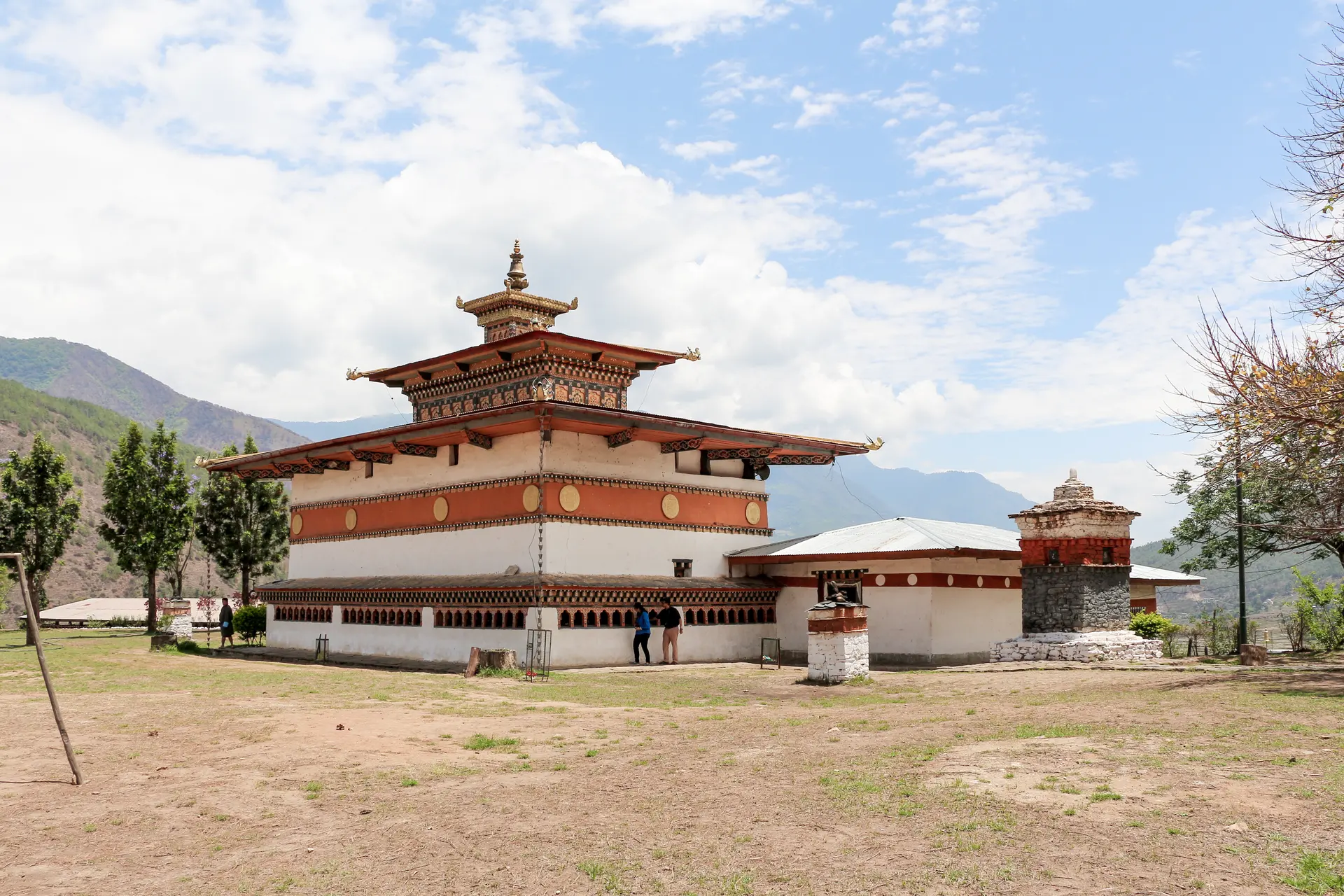
Image of Chimi Lhakhang. Image source · CC-BY-SA-4.0
Visit essentials
A quick read before you go
- Duration
- 1-2 hours including the walk from Sopsokha village
- Access
- 10km from Punakha town.
Overview
Chimi Lhakhang is dedicated to a saint who drank, sang, used sexual imagery as spiritual instruction, and fiercely mocked religious hypocrisy — conduct most traditions would expel rather than canonize. Drukpa Kunley, the Divine Madman, wandered fifteenth-century Bhutan shattering expectations of holiness. At this Punakha Valley hillock, tradition says he subdued a demoness with his 'Flaming Thunderbolt of Wisdom', with exactly the double meaning it suggests.
His cousin Ngawang Chogyal built the temple in 1499, and fertility blessings have continued ever since. Phallic images on the temple and surrounding houses are protective and sacred, expressing a tradition in which the body's generative power is continuous with spiritual awakening. Couples seeking children receive a monk's blessing by a tap on the head with a wooden phallus, and children born afterward are often named by temple monks.
The walk through rice paddies and mustard fields reveals ordinary cultivation itself as sacred ground.
Why this place is sacred
Most sacred sites achieve their quality through solemnity, through the gradual accumulation of reverence over centuries. Chimi Lhakhang achieves its quality through a different principle entirely: the refusal of separation. Drukpa Kunley's teaching was that the sacred does not exist in a realm apart from the human body, human desire, and human laughter. By locating the divine in what most traditions exclude or suppress, he created a form of thinness that operates through inclusion rather than elevation.
The fertility blessings embody this principle. A wooden phallus taps the crown of the head. The gesture is absurd and tender and sacred simultaneously. It does not resolve into one category. This irresolution is the teaching — that the categories themselves are the problem, and that what the Divine Madman called his 'thunderbolt of wisdom' was precisely the capacity to shatter them.
The walk through rice paddies to reach the temple reinforces this. There is no dramatic approach, no mountain ascent, no gatehouse. You walk through fields where people work, past houses painted with phalluses, and arrive at a small temple on a hillock. The sacred has been hiding in the ordinary all along. Drukpa Kunley's point exactly.
The site was blessed by Drukpa Kunley, who subdued a demoness here. The temple was built in 1499 by Ngawang Chogyal to honor the saint's activities and to serve as a place where the blessing of fertility — the continuation of life — could be sought.
The temple has maintained its character with remarkable consistency. The fertility blessing tradition has continued unbroken since the fifteenth century. The phallic symbolism, which predates Buddhism in Bhutan and was integrated by Drukpa Kunley into Buddhist practice, continues as living protective imagery throughout the surrounding village.
Why pilgrims come
Starting a family
The temple is associated with Drukpa Kunley, the Buddhist saint who is said to have blessed its site. A wooden ritual object attributed to him is used in fertility blessings, connecting hopes for parenthood with his remembered spiritual power.
How devotees visit
Couples visit for a fertility blessing. The local administration describes pilgrims receiving a blessing with a wooden phallic symbol associated with Drukpa Kunley. Follow the monastery’s own guidance about participation; this is a religious observance, not a medical treatment.
These are religious traditions and devotional practices, not promises of an outcome. Follow the community’s current guidance.
Experience and orientation
Park at Sopsokha village and begin walking. The path leads through rice paddies that glow green in summer and gold before harvest. Prayer flags appear, strung between trees. Houses along the way are painted with phalluses — not graffiti but traditional protective symbols, applied with the same care and intention as the dharma wheels and auspicious knots that appear on other Bhutanese buildings.
The temple sits on a round hillock, modest in scale. Inside, the atmosphere shifts from the bright openness of the fields to the dim, butter-scented interior of a working Buddhist temple. The main statue is of Drukpa Kunley. Monks perform the fertility blessing in the mornings, tapping visitors on the head with a wooden phallus decorated with a silver handle. The gesture is performed with quiet seriousness, though Drukpa Kunley himself would likely have laughed.
Around the temple, a chorten marks the spot where the saint is said to have trapped the subdued demoness. The views from the hillock take in the terraced fields and the valley beyond — a landscape of productivity and life, which is what the temple ultimately celebrates.
Take the longer path through the rice fields rather than the shorter steep route. The gradual approach through cultivated landscape is integral to understanding this site. Inside, receive the blessing if it is offered. Allow the phallus imagery to be what it is — neither shocking nor amusing but both and neither. Sit on the hillock after visiting the interior and look at the fields below.
Context and lineage
Drukpa Kunley, known as the Divine Madman, wandered fifteenth-century Bhutan and Tibet teaching through behavior that deliberately violated religious convention. At this hillock in the Punakha Valley, he subdued a demoness from the Dochu La pass using what he called his 'Flaming Thunderbolt of Wisdom,' trapping the demon in a rock. His cousin Ngawang Chogyal, the 14th abbot of Ralung Monastery, built the temple in 1499.
The fertility blessing tradition grew from Drukpa Kunley's broader teaching that the body and its powers are not obstacles to enlightenment but vehicles of it.
The temple belongs to the Drukpa Kagyu school. Drukpa Kunley's lineage represents the 'crazy wisdom' tradition within Vajrayana Buddhism, in which realized masters use shock, humor, and transgressive behavior to cut through spiritual pretension and transmit direct understanding.
Drukpa Kunley
The Divine Madman — wandering saint whose unconventional methods blessed the site and established its character
Ngawang Chogyal
14th abbot of Ralung Monastery; cousin of Drukpa Kunley; built the temple in 1499
Traditions and practice
The fertility blessing involves a monk tapping the visitor on the head with a ten-inch wooden phallus decorated with a silver handle. The blessing is understood to clear obstacles to conception and to invoke the protective and generative power associated with Drukpa Kunley. Children born after receiving the blessing are traditionally named by the temple's monks. The phallic imagery throughout the site functions as protection against malicious gossip and the evil eye, a tradition Drukpa Kunley himself advocated.
The blessing continues daily, typically in the mornings between nine and eleven. Monks maintain the temple and perform daily rituals. The site receives visitors from around the world, though it remains an active pilgrimage destination for Bhutanese seeking fertility blessings.
Arrive in the morning for the fertility blessing if you wish to receive it. Whether or not you seek this specific blessing, the walk through the rice fields and the encounter with the temple's distinctive spiritual character offer their own form of reception. Sit quietly on the hillock and consider what it means that the sacred can take this form.
Drukpa Kagyu (Crazy Wisdom tradition)
ActiveChimi Lhakhang is the primary site associated with Drukpa Kunley, the Divine Madman, representing the 'crazy wisdom' current within Vajrayana Buddhism. The temple preserves and continues his unconventional approach to spiritual transmission.
Fertility blessings, veneration of Drukpa Kunley, protective phallic symbolism, daily monastic rituals
Perspectives and open questions
Chimi Lhakhang resists single interpretation. It can be understood as a fertility shrine, a monument to spiritual iconoclasm, or a living argument that the body is sacred ground.
Scholarly perspective
Scholars of Tibetan Buddhism recognize Drukpa Kunley as a figure in the 'crazy wisdom' or 'holy madman' tradition, in which realized practitioners use transgressive behavior to bypass conventional religious filters. The phallic symbolism at Chimi Lhakhang integrates pre-Buddhist Bon protective practices with tantric Buddhist philosophy, suggesting a syncretic tradition that predates the temple itself.
Living and traditional perspectives
Within the Drukpa Kagyu tradition, Drukpa Kunley is revered as a fully realized master whose unconventional methods were not departures from the dharma but expressions of it at its most radical. His use of sexual imagery reflects the tantric understanding that wisdom and compassion unite in the body, and that the generative force of the body is itself an expression of Buddha nature.
Alternative interpretations
The temple offers a corrective to the tendency — in Buddhism and elsewhere — to locate the sacred exclusively in the austere, the elevated, and the disembodied. Chimi Lhakhang insists that the sacred is also in the earthy, the funny, and the fertile. This is not a compromise but a completion.
Open questions
The exact nature of the demoness Drukpa Kunley subdued, and the full scope of the pre-Buddhist protective tradition that his phallic imagery draws upon, remain areas where oral tradition exceeds documented history.
Plan your visit
Access and arrival
10km from Punakha town. Park at Sopsokha village. Two approach options: a 20-minute walk through rice fields (recommended) or a shorter, steeper 10-minute climb from the base.
Hotels in Punakha town. No accommodation at the temple.
Respectful visit
Shoulders and knees covered. Comfortable walking shoes for the approach through the fields.
Prohibited inside the temple. Exterior and landscape photography is welcome.
Butter lamp offerings and small monetary donations are customary.
No photography inside the temple | Walk clockwise around religious structures | Do not mock or trivialize the phallic imagery | Maintain quiet respect inside the temple
The phallic imagery is sacred, not novelty. Laughing at it is understandable but insufficient. Treating it as merely strange misses the point that Drukpa Kunley was making, which is that all our categories of the acceptable and unacceptable are constructions.
Current practical details
Address
GVGH+R7G, Teoprongchu, Bhutan
Phone
Hours
Hours, fees, and access can change — verify on the official source before you travel. Practical details last checked Jun 2026.
Location
Map loads as you approach this section.
Pilgrim reflections
A portrait of encounter, not a score
Pilgrims describe what they felt, how present they could become, and whether the place would shape a journey. There are no stars and no ranking of traditions.
No reviewed reflections yet
The first pilgrims can help describe the character of being here.
Share a reflection
Available after an account-backed “Been there.” Every reflection is reviewed before publication.
Nearby sacred places
Explore other sacred places in the region. Proximity does not establish access or travel time; check each place’s guidance.


References
Sources consulted for this page. Source categories describe the publication, not a guarantee that every claim is verified. Traditional accounts and outside interpretations may differ.
- 01Chimi Lhakhang - WikipediaencyclopediaComprehensive overview
- 02Chimi Lhakhang - Punakha Dzongkhag Administration — Government of BhutanSource contextOfficial government source
- 03Chimi Lhakhang - Bhutan Pilgrimage — Bhutan PilgrimageguideDetailed cultural context
- 046 Facts About Bhutan's Fertility Temple — Druk AsiaguidePractical visiting info
- 05Chimi Lhakhang Travel Guide — North Bengal TourismguideAccess and visiting details
Photo gallery
3 curated photos
Pilgrim glossary
- Dharma
- The teachings of the Buddha; also the universal law underlying them.
Share a photo
Help visitors recognize Chimi Lhakhang. Every submission is reviewed before publication.