Cheri Monastery/Chagri Monastery
The founding monastery of Bhutanese Buddhism, where the first monastic order took root in mountain forest
Understand sacred places, explore living traditions, and learn how to engage respectfully with Pilgrim Map.
Access has not been verified. Check current local guidance before planning a visit.
Boegarna_Dodennang, Thimphu, Bhutan
Read the sources
Visit essentials
A quick read before you go
- Duration
- 3-4 hours including the round-trip hike and time at the monastery
- Access
- Located 15km north of Thimphu.
Overview
Three years before establishing Bhutan's first monastic body, Zhabdrung Ngawang Namgyal arrived from Tibet carrying the Drukpa Kagyu lineage into the small Himalayan kingdom that would become its home. In 1620 he founded Cheri Monastery at the northern end of the Thimphu Valley, above the future capital at the end of a steep forest trail where river sound gives way to chanting.
Here in 1623, the first monks took vows under his guidance, creating the debshung, the formal monastic community that shaped Bhutanese religious and political life and continues unbroken. Monks still undertake three-year retreats in isolated cells, while forest caves preserve the traditional memory of earlier practitioners including Guru Rinpoche. The building is modest — whitewashed walls, intricate woodwork, vibrant murals — but its significance is foundational: Bhutan's monastic tradition and spiritual identity were seeded here.
Why this place is sacred
Some places become thin through spectacle or miracle. Cheri became thin through persistence. Since 1620, monks have climbed this same trail, entered these same buildings, and sat in the same posture of attention. The three-year retreat tradition means that at any given time, someone at Cheri is deep in sustained silence — not for days or weeks but for years.
This continuity of practice, unbroken across four centuries, creates a quality in the site that visitors often describe before they can name it.
The forest path upward participates in this quality. The thirty-minute to one-hour climb strips away the noise and pace of the valley below. By the time the monastery appears through the trees, the visitor has already been prepared — breathing harder, hearing differently, attending to the ground beneath each step. The transition is not symbolic but physical, and this matters. Cheri was placed here precisely so that reaching it would require effort, so that the body would arrive already quieted.
Founded as the first Drukpa Kagyu monastic establishment in Bhutan. The Zhabdrung chose this remote forest site specifically for monastic training and meditation retreat.
The monastery has remained remarkably consistent in its purpose from 1620 to the present. While Bhutan's political landscape transformed around it, Cheri continued as a center for deep practice and extended retreat, maintaining its founding character across four centuries.
Experience and orientation
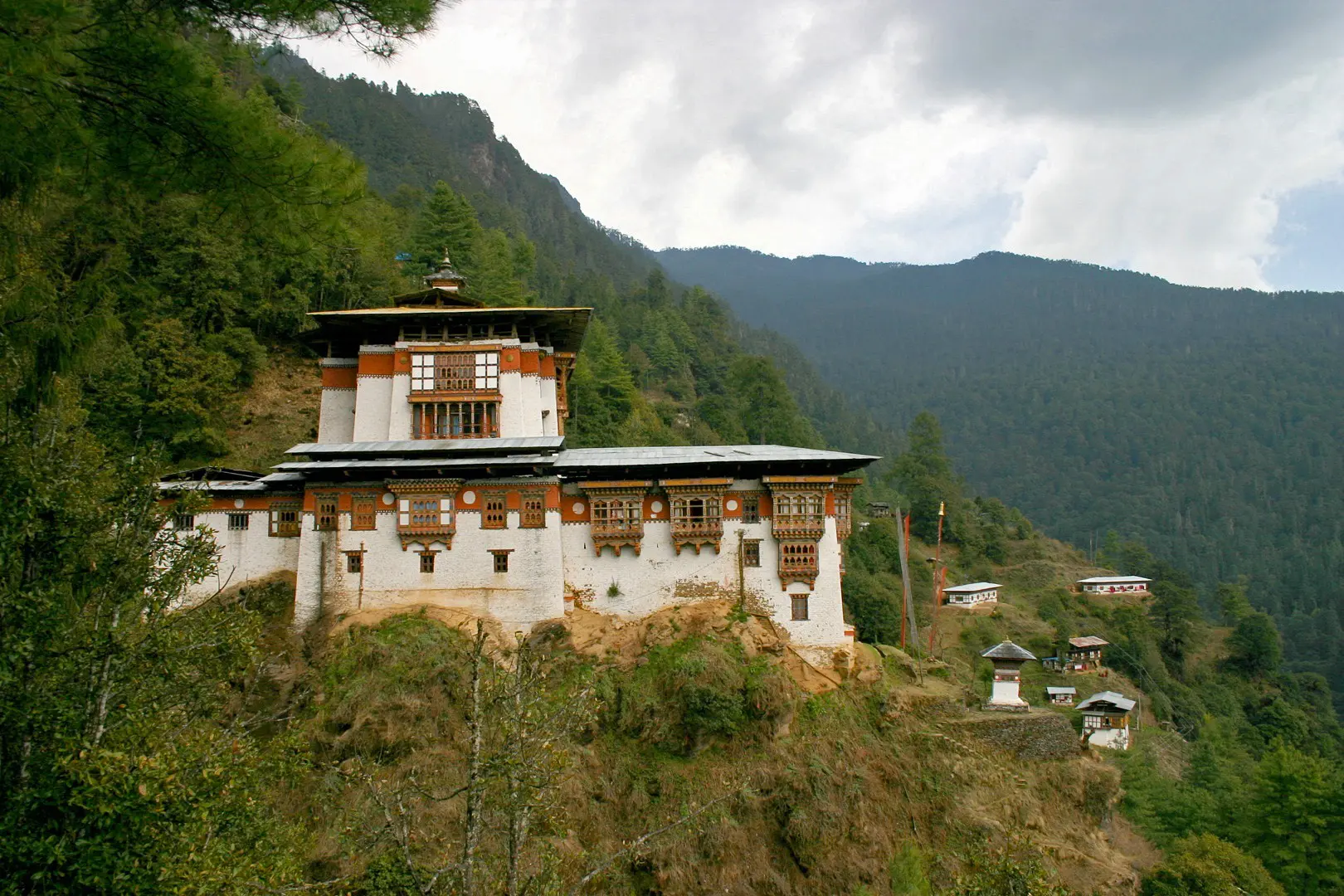
The approach to Cheri begins at the road's end in the northern Thimphu Valley. A suspension bridge crosses the Wang Chhu River, and then the trail enters forest and begins to climb. The walk takes between thirty minutes and an hour depending on pace and fitness. Rhododendrons and conifers line the path, and the sound of the river fades as altitude is gained.
The monastery appears through trees — whitewashed walls, traditional Bhutanese architecture, prayer flags stretching between structures. The scale is intimate rather than grand. Inside, murals depict scenes from the lives of Buddhist masters, and the scent of butter lamps and incense fills low-ceilinged rooms. Monks may be visible at their studies or prayers, but much of the community is engaged in practices that occur behind closed doors.
Scattered around the monastery grounds are meditation caves where practitioners, past and present, have undertaken solitary retreat. These are not tourist attractions but working spaces of contemplation. Their presence in the forest creates an extended field of practice that extends beyond the monastery walls into the surrounding landscape.
Begin at the bridge and walk slowly. The climb is the first teaching. When you reach the monastery, sit before entering. Let the transition complete itself. Inside, move quietly and observe what draws your attention without trying to see everything. The caves in the forest are best encountered by wandering rather than seeking.
Context and lineage
Zhabdrung Ngawang Namgyal arrived in Bhutan from Tibet in 1616, carrying the authority of the Drukpa Kagyu lineage. In 1620, he chose this forested hillside above the Thimphu Valley for his first monastery, dedicating it to Shakya Gyalpo. Three years later, he established the debshung — the first formal monastic order in Bhutan — within its walls. The site was not chosen at random.
Tradition holds that Guru Rinpoche and other saints had meditated in the area's caves centuries earlier, marking the ground as already receptive to sustained practice.
The monastery traces its lineage through the Drukpa Kagyu school of Tibetan Buddhism, brought to Bhutan by the Zhabdrung. The earlier association with Guru Rinpoche connects the site to the broader Vajrayana Buddhist tradition across the Himalayas.
Zhabdrung Ngawang Namgyal
Founder of Cheri Monastery and the Bhutanese state; established the first monastic order here in 1623
Guru Rinpoche (Padmasambhava)
Traditionally associated with the site through earlier meditation in the area's caves
Traditions and practice
The monastery's central practice since its founding has been extended meditation retreat. The three-year retreat (lo sum cho sum) follows a structured program of visualization, mantra recitation, and contemplation within the Drukpa Kagyu tradition. Monks undertake these retreats in complete isolation, emerging only after the full period. Daily monastic prayers follow the Drukpa Kagyu liturgical calendar, with chanting beginning before dawn.
The retreat tradition continues unbroken. Monks pursue studies in Buddhist philosophy alongside meditation training. The monastery functions as both a retreat center and a monastic education institution within the Southern Drukpa lineage.
Visitors cannot participate in the retreats, but may sit quietly on the monastery grounds and absorb the quality of sustained practice that pervades the site. Walking the forest trails that connect the meditation caves offers a way to share, however briefly, in the landscape of contemplation that the monks inhabit daily.
Drukpa Kagyu
ActiveCheri is the founding monastery of the Drukpa Kagyu school in Bhutan, established by the Zhabdrung Ngawang Namgyal in 1620. It remains the tradition's oldest continuously operating institution in the country.
Three-year meditation retreats, daily monastic liturgy, Buddhist philosophical study
Perspectives and open questions
Cheri Monastery can be understood through multiple lenses — as a historical foundation, a living center of practice, and a place where the physical landscape participates in the spiritual work being done within it.
Scholarly perspective
Historians recognize Cheri as the institutional birthplace of the Bhutanese monastic system. The establishment of the debshung here in 1623 was a political act as much as a religious one, laying the groundwork for the dual system of temporal and spiritual governance that defined the Bhutanese state. The monastery's continued function as a retreat center provides a living example of monastic practice that has changed remarkably little over four centuries.
Living and traditional perspectives
Within the Drukpa Kagyu tradition, Cheri holds the weight of origins. It is where the lineage first took root in Bhutanese soil, where the Zhabdrung's vision became institutional reality. The tradition also holds that the site's sacred quality predates the monastery — that Guru Rinpoche and other realized beings recognized and practiced in this place centuries before the first stones were laid.
Alternative interpretations
The monastery's placement — above the capital, requiring effort to reach, surrounded by forest and caves — reflects a deliberate relationship between practice and landscape. The mountain and the meditation are not separate. The altitude, the effort of the climb, and the silence of the forest are not obstacles to spiritual practice but components of it.
Open questions
The full history of contemplative practice at this site before the Zhabdrung's arrival remains largely unrecorded. What drew him to this particular hillside, beyond the traditions associating it with earlier masters, is not entirely clear.
Plan your visit
Access and arrival
Located 15km north of Thimphu. Drive to the road's end, cross the suspension bridge over the Wang Chhu, and hike 30-60 minutes uphill through forest. Good hiking shoes are essential. The trail is steep but well-established.
Hotels in Thimphu, approximately 15km to the south. No accommodation at the monastery.
Respectful visit
Shoulders and knees covered. Sturdy hiking shoes for the approach trail, with slip-on shoes or sandals for entering temple buildings.
Generally not permitted inside monastery buildings. Exterior and landscape photography should be done discreetly. Never photograph monks without asking.
Butter lamp offerings may be possible at designated areas within the monastery.
Retreat areas are closed to visitors | Women may have restricted access to certain areas | Maintain silence near monastery buildings and caves | Do not disturb monks in practice
The monastery is a place of active retreat. Sound carries in mountain forest. Maintain silence near buildings and caves. Some areas are closed to visitors, particularly during retreat periods. The hike requires reasonable fitness and sturdy shoes.
Current practical details
Address
21 Norzin Lam 2, Thimphu, Bhutan
Hours, fees, and access can change — verify on the official source before you travel. Practical details last checked Jun 2026.
Location
Map loads as you approach this section.
Pilgrim reflections
A portrait of encounter, not a score
Pilgrims describe what they felt, how present they could become, and whether the place would shape a journey. There are no stars and no ranking of traditions.
No reviewed reflections yet
The first pilgrims can help describe the character of being here.
Share a reflection
Available after an account-backed “Been there.” Every reflection is reviewed before publication.
Nearby sacred places
Explore other sacred places in the region. Proximity does not establish access or travel time; check each place’s guidance.

References
Sources consulted for this page. Source categories describe the publication, not a guarantee that every claim is verified. Traditional accounts and outside interpretations may differ.
- 01Chagri Monastery - WikipediaencyclopediaComprehensive historical overview
- 02Cheri Monastery - Treasury of Lives — Treasury of LivesSource contextScholarly Buddhist resource
- 03Cheri Monastery: A Glimpse into Bhutanese Monastic Life — Peregrine TreksguideVisitor experience details
- 04Cheri Monastery Thimphu — North Bengal TourismguidePractical visiting info
- 05HeavenlyBhutan - Cheri Monastery — HeavenlyBhutanguideGeneral overview
Pilgrim glossary
- Mantra
- A sound, word, or phrase repeated as part of meditation or ritual.
Share a photo
Help visitors recognize Cheri Monastery/Chagri Monastery. Every submission is reviewed before publication.