Carwynnen Quoit
A five-thousand-year-old portal dolmen, fallen and reborn on the summer solstice
Understand sacred places, explore living traditions, and learn how to engage respectfully with Pilgrim Map.
Access has not been verified. Check current local guidance before planning a visit.
Camborne, England, United Kingdom
Read the sources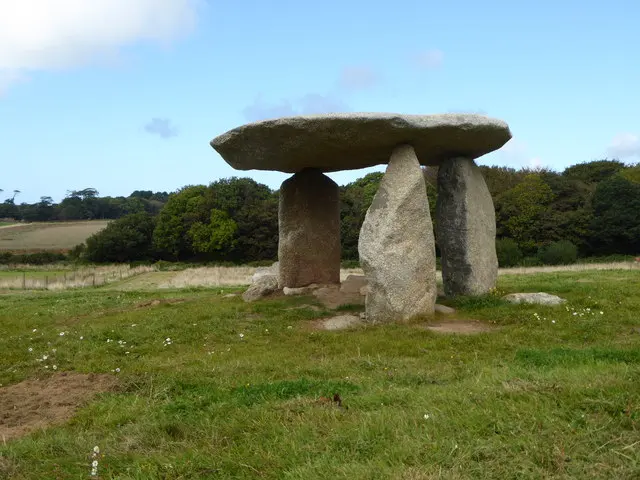
Image of Carwynnen Quoit. Image source · CC-BY-SA-2.0
Visit essentials
A quick read before you go
- Duration
- A focused visit takes thirty minutes to an hour.
- Access
- The quoit is located near Troon village, accessible from Camborne.
Overview
On the 2014 summer solstice, a rare event in British archaeology raised Carwynnen Quoit from its collapse in 1966: a ten-ton capstone settled onto restored pillars as the sun marked the year's turning.
Dating to around 3000 BC and contemporary with Stonehenge's earliest phases, this portal dolmen stood for five millennia in the Cornish landscape, built by people who left no written explanation. Folklore called it the Giant's Quoit and the Giant's Frying Pan. In 2012, excavators recovered over two thousand artifacts spanning the Neolithic, Bronze Age, Iron Age, Romano-British, and Medieval periods. No other Cornish monument has yielded comparable evidence of multi-period use, showing continued meaning to generations beyond its builders.
An earlier collapse around 1815 was followed by rebuilding under Lady Pendarves. The more rigorous 2014 restoration was archaeologically documented and deliberately timed for midsummer, acknowledging evidence of a place long associated with threshold and transition.
Why this place is sacred
What draws people to certain places across millennia? At Carwynnen, the archaeological evidence forces the question. The artifacts do not merely prove presence but prove intention. People came here, across every recorded period of British history, to do something, to mark something, to leave something behind.
The original structure, a portal dolmen with its massive capstone balanced on uprights, was likely a burial chamber. But burial alone does not explain centuries of return. The Neolithic peoples who built it would not recognize the Iron Age visitors who later stood here, yet both left traces. The Romans who arrived a millennium later still found reason to engage with this place.
Medieval Christians, who might have been expected to shun pagan remnants, added their own deposits to the record.
The discovery of an intact stone pavement beneath the capstone added another dimension. Arranged in a doughnut pattern, this floor suggests deliberate ritual space, not merely structural necessity. Someone designed this interior for use, not just viewing.
When the structure collapsed in 1966, it might have remained a ruin, one more fallen monument in a landscape that holds many. Instead, the Cornwall Heritage Trust and The Sustainable Trust undertook its restoration. The choice to raise the stones on the summer solstice was not archaeological necessity but spiritual recognition. This place had marked thresholds for five thousand years. The restoration itself became a threshold.
Carwynnen Quoit was almost certainly built as a burial chamber, a portal dolmen of the type found throughout Atlantic Europe in the Neolithic period. The massive capstone, balanced on smaller uprights, would have covered a burial or series of burials. Such structures are understood as houses for the dead, places where the living could encounter their ancestors.
The Cornish location, outside the main concentration of portal dolmens in the Penwith peninsula, suggests this site held particular significance for the community that built it. The effort required to raise a ten-ton stone would have drawn the entire population.
The evolution of Carwynnen is written in artifacts. After its construction around 3000 BC, the site continued to attract attention and activity. Bronze Age peoples left their traces. Iron Age visitors added theirs. Even after Christianity arrived, the deposits continued, suggesting that folk recognition of the site's importance outlasted changes in official religion.
The first recorded collapse around 1815 led to rebuilding by Lady Pendarves, the landowner whose name became attached to the quoit. When it fell again in 1966, decay seemed the likely fate. The 2014 restoration, however, reclaimed the site not as museum piece but as living monument. The Sustainable Trust maintains it for visitors today, continuing the multi-millennium pattern of stewardship.
Experience and orientation
Carwynnen Quoit is not a dramatic site in the way that Stonehenge or Avebury are dramatic. The capstone, impressive though it is at ten tons, sits low to the ground. The overall footprint is modest. Yet this intimacy creates its own effect. You do not observe Carwynnen from a distance; you stand with it, under the shadow of stone that hands placed here five thousand years ago.
The restoration adds a dimension unique among megalithic monuments. Most prehistoric sites have never been anything but ruins, their original form a matter of speculation. At Carwynnen, you see the intended structure, raised by modern engineering but faithful to the original pattern. The experience bridges archaeology and imagination, offering what other sites cannot: the form as it was meant to be.
Visitors often describe a settling quality, a sense of stillness that the surrounding landscape does not impose. The sky above, the grass below, the stone between, and the silence that seems to wait. Those aware of the site's history, the four thousand years of continuous recognition, report a particular weight to the silence, the accumulated attention of generations.
The solstice associations add meaning for those who visit near midsummer. The restoration was timed to coincide with the sun's peak, deliberately reconnecting modern observance with whatever solar alignments the original builders intended. To stand here at dawn on June 21st is to participate in something intentionally ancient.
Approach Carwynnen with attention to what has happened here. This is not merely old stones but a place that has been recognized, lost, and recognized again across five millennia.
Stand within the structure if the arrangement allows, placing yourself where the dead were once placed, where countless visitors over thousands of years have stood or knelt or prayed according to their own understanding. Notice how the capstone defines a space beneath itself, neither fully open nor enclosed.
If you are able to visit at dawn or dusk, the play of light across the stones reveals contours that midday flattens. The Neolithic builders may have aligned the structure for just such effects.
Context and lineage
No founding narrative survives from the Neolithic, but local folklore offers the names Giant's Quoit and Giant's Frying Pan. These reflect the common pattern of explaining mysterious monuments through stories of giants, beings large enough to handle what ordinary humans could not. The names preserve memory that this place was built by someone, for some purpose beyond everyday life, even as the specific memory faded.
The lineage at Carwynnen spans five millennia. Neolithic builders constructed the original tomb. Bronze Age, Iron Age, Romano-British, and Medieval visitors continued to engage with the site, leaving artifacts that prove recognition across every major cultural transition in British history. Lady Pendarves rebuilt the fallen stones in the 19th century. The 2014 restoration by The Sustainable Trust continues this pattern of stewardship, adding modern hands to the chain of those who have cared for this place.
Lady Pendarves
historical
The landowner who arranged for the quoit to be rebuilt after its first recorded collapse around 1815. Her intervention preserved the structure for another 150 years.
The Sustainable Trust
founders
The organization that undertook the 2014 restoration, working with archaeologists to ensure the stones were raised correctly and the excavation data preserved.
Traditions and practice
The original Neolithic practices at Carwynnen would have involved burial and ancestor veneration. The dead placed within the chamber may have been consulted or propitiated by the living. Such tombs often remained open for generations, allowing continued interaction between the living and the dead.
We cannot reconstruct the practices of later periods with confidence. The deposits suggest repeated visits with ritual intent, but the specific rituals remain unknown. The very diversity of the artifacts, spanning so many periods, indicates that no single tradition claimed exclusive rights to this place.
Today, Carwynnen serves as a heritage site managed by The Sustainable Trust. Visitors come for education, contemplation, photography, and in some cases, spiritual engagement. No formal ceremonies are scheduled, but the site's solstice associations make it a natural gathering point for those who observe solar festivals.
The restoration itself serves as a kind of ongoing practice, a commitment by modern people to maintain what ancient hands created and intervening centuries threatened.
Visit with awareness of what you are entering. This is a place that has drawn human attention for five thousand years. Approach slowly, allowing the transition from ordinary travel to deliberate presence.
If you are comfortable doing so, step beneath the capstone and stand where the Neolithic dead were laid. Consider what it might have meant to place the body of a loved one here, to know that the massive stone would mark their resting place for ages beyond imagination.
Before leaving, acknowledge the chain of stewardship that has preserved this place: the builders, the countless visitors across millennia, Lady Pendarves, The Sustainable Trust. You are now part of that chain.
Neolithic Burial Tradition
HistoricalCarwynnen Quoit was built as a burial chamber within the Neolithic tradition of megalithic tomb construction. The portal dolmen form, with its massive capstone, represents a widespread pattern across Atlantic Europe. Such tombs served as houses for the dead and points of contact between living and ancestors.
Neolithic burial practices likely involved the interment of selected individuals within the chamber, with the tomb remaining accessible for continued veneration. The construction itself would have been a community effort requiring significant organisation.
Multi-Period Sacred Use
HistoricalThe archaeological evidence shows that Carwynnen continued to attract ritual attention across Bronze Age, Iron Age, Romano-British, and Medieval periods. This continuity, spanning over four thousand years, is exceptional and suggests that the site retained a reputation for sacredness even as religions and cultures changed entirely.
We cannot reconstruct the specific practices of each period. The deposits suggest visits with ritual intent, leaving offerings or markers at a site recognized as significant. The diversity of periods indicates no single tradition claimed exclusive rights.
Contemporary Heritage Stewardship
ActiveThe 2014 restoration by The Sustainable Trust represents a modern form of engagement with the site, not religious in the traditional sense but committed to preserving what previous generations created. This stewardship continues the chain of care that has maintained Carwynnen through five millennia.
The Sustainable Trust maintains the site, provides visitor access, and ensures the restored monument remains protected. The deliberate timing of the restoration on summer solstice acknowledged the site's spiritual dimensions.
Perspectives and open questions
Carwynnen Quoit invites interpretation from archaeological, conservation, and spiritual perspectives. The extraordinary evidence of multi-period use raises questions that no single framework can fully answer.
Scholarly perspective
Archaeologically, Carwynnen is significant as a Neolithic portal dolmen with documented multi-period use. The 2012 excavations recovered over two thousand artifacts spanning every major period from Neolithic to Medieval, an unprecedented range for a Cornish monument. This evidence demonstrates that the site was recognized as significant across radical cultural transitions.
The structure itself, a portal dolmen with capstone and supporting pillars, fits within the broader Atlantic megalithic tradition. The location outside the main Penwith concentration of such monuments suggests particular local significance.
The restoration raises questions about authenticity and meaning. The 2014 raising followed the original pattern but used modern engineering. Archaeologists continue to debate how such reconstructions should be understood.
Living and traditional perspectives
For Cornish heritage communities, Carwynnen represents the deep roots of human presence in the landscape. The restoration is understood as an act of cultural recovery, reclaiming what time and neglect had threatened. The site now serves as a symbol of Cornish identity and the commitment to preserve ancient heritage.
The folklore names, Giant's Quoit and Giant's Frying Pan, preserve a form of traditional knowledge, the recognition that this place is ancient, significant, and built by someone no longer remembered.
Alternative interpretations
Contemporary spiritual interpretations see the summer solstice restoration as cosmologically significant, deliberately reconnecting the stones with solar alignment. The site is understood by some as an energy point, a location where earth forces concentrate. The multi-period deposits are interpreted as evidence that successive cultures recognized this power.
The portal dolmen form itself invites interpretation as a threshold or gateway, a structure that marks transition between states of being.
Open questions
Significant mysteries remain. Why did cultures as different as Iron Age Celts and Medieval Christians continue to visit this Neolithic tomb? What specific practices did they perform? What alignments, if any, were intended by the original builders? The multi-period use is proven; its meaning is not.
Plan your visit
Access and arrival
The quoit is located near Troon village, accessible from Camborne. The Sustainable Trust provides access information. A short walk leads to the site. The path is not fully accessible for wheelchairs.
Camborne offers accommodation options. Penzance and the Penwith area provide additional choices. No retreat facilities exist at the site.
Respectful visit
No specific dress code applies. Wear appropriate footwear for walking on uneven ground. Dress for weather, as the site is exposed.
Photography is permitted and welcomed. Be mindful of other visitors, particularly those who may be engaged in contemplation or practice.
If you wish to leave an offering, use only natural, fully biodegradable materials. Do not leave anything on or against the stones themselves. Place offerings discreetly.
Do not damage, touch, or climb on the stones. Do not dig or remove anything from the site. Camping is not permitted.
Do not touch or climb on the stones. The restoration was a significant undertaking, and the structure requires respect. Do not leave offerings of non-biodegradable materials. If you visit for solstice observance, be prepared for others to be present and be respectful of different approaches to the site.
Current practical details
Address
Portobello, Carwynnen Troon Camborne 9LR, Troon, Camborne TR14 9LR, UK
Hours
Hours, fees, and access can change — verify on the official source before you travel. Practical details last checked Jun 2026.
Location
Map loads as you approach this section.
Pilgrim reflections
A portrait of encounter, not a score
Pilgrims describe what they felt, how present they could become, and whether the place would shape a journey. There are no stars and no ranking of traditions.
No reviewed reflections yet
The first pilgrims can help describe the character of being here.
Share a reflection
Available after an account-backed “Been there.” Every reflection is reviewed before publication.
Nearby sacred places
Explore other sacred places in the region. Proximity does not establish access or travel time; check each place’s guidance.


References
Sources consulted for this page. Source categories describe the publication, not a guarantee that every claim is verified. Traditional accounts and outside interpretations may differ.
- 01Carwynnen Quoit — The Megalithic PortalofficialComprehensive megalithic database
- 02Carwynnen Quoit — Cornwall Heritage TrustofficialHeritage trust information
- 03Carwynnen Quoit — WikipediaencyclopediaEncyclopedia entry
- 04Carwynnen Quoit: 5,000-year-old Cornish monument restored — Ancient OriginsnewsNews about restoration
Photo gallery
2 curated photos
Share a photo
Help visitors recognize Carwynnen Quoit. Every submission is reviewed before publication.